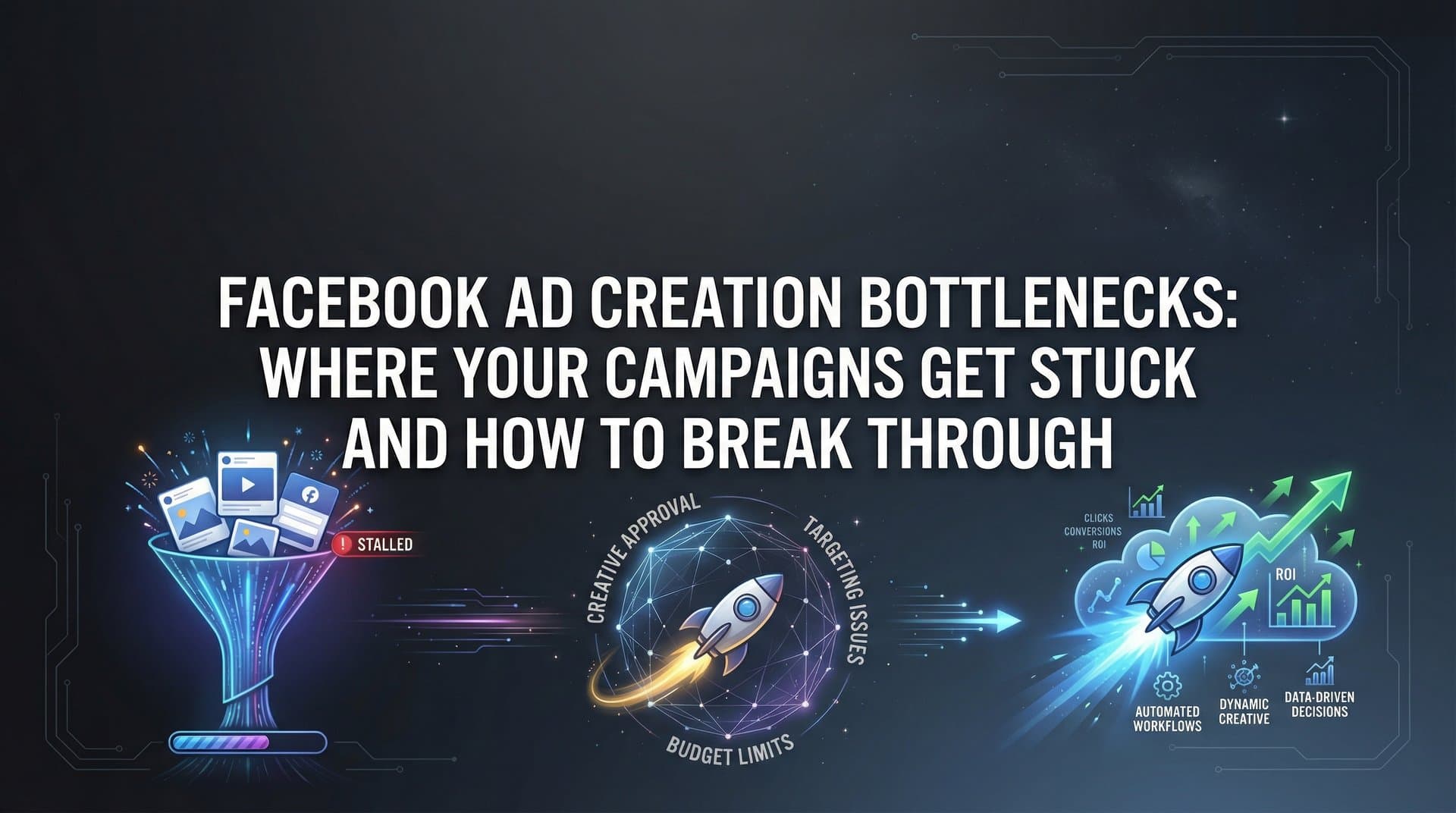
Every marketing team has experienced this: you have a killer product launch coming up, the budget is approved, and your strategy is crystal clear. But when it's time to actually get those Facebook ads live, everything grinds to a halt. The designer is booked for two weeks. The copywriter is juggling three other projects. The video editor needs another round of revisions. Meanwhile, your launch window is shrinking, your competitors are already running similar campaigns, and your team is stuck in an endless loop of Slack messages asking "when will this be ready?"
These aren't just minor inconveniences. Facebook ad creation bottlenecks represent a massive hidden cost that most marketing teams drastically underestimate. When it takes two weeks to get a campaign live instead of two days, you're not just losing time. You're missing seasonal trends, allowing competitors to claim market share, burning out your team with constant context-switching, and leaving money on the table every single day.
The frustrating part? Most of these bottlenecks aren't caused by lack of talent or effort. They're structural problems baked into traditional advertising workflows that were designed for a different era. This guide will help you diagnose exactly where your ad creation process is breaking down and implement targeted solutions that get campaigns live faster without sacrificing quality or strategic thinking.
The Creative Production Trap
Design dependencies create the single most common bottleneck in Facebook ad creation. The typical workflow looks something like this: the marketing manager briefs the designer, the designer adds it to their queue, a first draft appears three to five days later, feedback goes back and forth, revisions happen, and finally the asset is ready. For a single ad creative, this might be manageable. But modern Facebook advertising requires dozens or even hundreds of variations to find winners.
The math becomes brutal quickly. If you want to test five different product angles, each with three visual approaches, you're looking at fifteen unique creatives. Add in different formats for feed versus stories, and you're suddenly waiting weeks for what should be a straightforward testing campaign. Many teams respond by reducing their testing scope, which means they're making strategic compromises because of operational constraints.
Video content amplifies this problem exponentially. A single video ad requires coordination between scriptwriters, videographers, actors or talent, editors, and often motion graphics specialists. Each handoff introduces delay. Each stakeholder has their own workload and priorities. What seems like a simple thirty-second product demo can easily stretch into a month-long production cycle.
The iteration cycle compounds these delays. When you launch your carefully crafted ads and discover that the blue background performs better than the red one, or that lifestyle shots outperform product-only images, you're back in the creative queue. Every optimization insight requires another round of production. Teams often find themselves choosing between acting on performance data quickly and maintaining creative quality, a challenge that highlights why manual Facebook ad creation bottlenecks are so damaging to campaign performance.
This bottleneck doesn't just slow down individual campaigns. It fundamentally limits how fast your advertising can evolve. While your competitors might be testing new angles weekly, you're locked into monthly creative cycles. The market moves, trends shift, and customer preferences change while you're waiting for assets to clear the production pipeline.
The hidden cost here extends beyond timeline delays. Designer burnout is real when they're constantly producing minor variations of the same concept. Creative teams want to do innovative work, not generate the fifteenth version of a product shot with slightly different copy. This bottleneck doesn't just slow you down, it drains the creative energy from your entire team.
Copy and Messaging Gridlock
While creative production gets most of the attention, copywriting bottlenecks are equally destructive to campaign velocity. Modern Facebook advertising best practices call for testing multiple headlines, body copy variations, and calls-to-action for every campaign. Writing these variations manually is exhausting and time-consuming work that most teams drastically underestimate.
Consider what thorough ad copy testing actually requires. You need three to five headline variations that emphasize different value propositions. You need body copy that matches each headline's angle. You need to adapt messaging for different audience segments. You need variations that comply with Facebook's policies while still being persuasive. Writing all of this from scratch for every campaign is a full-time job.
The approval workflow adds another layer of delay that many organizations don't account for until they're stuck in it. Copy needs legal review for certain claims. Brand teams want to ensure consistency. Product managers want technical accuracy. Senior leadership wants final approval on messaging. Each approval layer adds days to your timeline, and every round of feedback means rewriting and resubmitting. Understanding these manual Facebook ad creation challenges is the first step toward solving them.
Maintaining brand consistency across hundreds of ad variations becomes nearly impossible without systematic processes. Your brand voice might be clear in your style guide, but translating that into dozens of ad variations while keeping messaging fresh and engaging is genuinely difficult. Teams often end up with either repetitive copy that performs poorly or inconsistent messaging that dilutes brand identity.
The real killer is that copy bottlenecks are invisible until they're already causing problems. Unlike waiting for a designer, where the delay is obvious, copywriting delays often hide inside other processes. The campaign is "almost ready" but the copy needs one more revision. The ads are "nearly done" but we're waiting on legal approval for one claim. These small delays accumulate into major timeline slippage.
Many teams respond by reusing the same copy templates across campaigns, which solves the bottleneck but creates a new problem: ad fatigue and declining performance. Facebook's algorithm and your audience both reward fresh, relevant messaging. When you're recycling the same copy frameworks because creating new variations is too slow, you're sacrificing performance for operational efficiency.
Campaign Setup and Launch Delays
Even after you have creatives and copy ready, the actual campaign building process in Facebook Ads Manager creates its own set of bottlenecks. Manual campaign setup is tedious and error-prone, especially when you're implementing sophisticated testing strategies that require multiple ad sets with different targeting combinations.
Building campaigns manually means clicking through the same interface repeatedly, copying and pasting audience definitions, duplicating ad sets, and hoping you don't make configuration mistakes that waste budget. For a simple campaign with one audience and a few ads, this is manageable. For a proper testing campaign with multiple audiences, placements, and creative combinations, it becomes mind-numbing work that takes hours. This is exactly why Facebook ad creation is time consuming for most marketing teams.
The bulk launching challenge forces teams into an impossible choice: thorough testing or reasonable timelines. You know you should test different audience segments, multiple placements, various bidding strategies, and dozens of creative combinations. But actually building all those ad sets and ads manually would take days. So you compromise, launching smaller tests that don't fully explore the opportunity space.
Technical configuration errors from rushed setups lead to wasted spend and campaign restarts. When you're manually building your twentieth ad set of the day, it's easy to forget to update the conversion event, select the wrong placement, or duplicate an audience definition incorrectly. These mistakes often aren't caught until the campaign has been running and spending budget, requiring a restart that delays your results and wastes money.
The complexity scales exponentially with testing ambition. If you want to test three audiences, five creatives, and two placement strategies, you're looking at thirty potential combinations. Building these manually means thirty separate ad sets to configure, each with multiple ads inside. The time investment becomes prohibitive, which is why most teams end up testing far less than they should.
Campaign setup bottlenecks also create knowledge silos. The person who built the campaign knows all the nuances of how it's configured, but that knowledge isn't easily transferable. When team members change or new people join, there's a steep learning curve to understand existing campaign structures and replicate successful setups. Addressing these Facebook ad setup bottlenecks requires a systematic approach to campaign building.
The Analysis Paralysis Problem
After investing all that time in creative production, copywriting, and campaign setup, you'd think the hard part is over. But many teams discover their biggest bottleneck is actually post-launch: figuring out what's working and what to do next. When you're running dozens of ad variations across multiple campaigns, identifying winners becomes genuinely overwhelming.
Facebook Ads Manager shows you data, but it doesn't automatically tell you which creative is your best performer across all the metrics that matter for your business. Is the ad with the highest click-through rate actually driving profitable conversions? Is the creative with the lowest cost per click generating quality leads? Without systematic analysis, teams resort to sorting by individual metrics and hoping patterns emerge.
Data fragmentation across platforms makes true attribution nearly impossible for many teams. Your Facebook data lives in Ads Manager, your conversion data might be in Google Analytics, your CRM has lead quality information, and your attribution platform has its own version of the truth. Connecting these dots to understand which ads actually drive business results requires manual data exports, spreadsheet gymnastics, and educated guessing. This Facebook ad creation inefficiency compounds the delays you've already experienced in production.
The result is that teams struggle to translate performance insights into actionable next steps. You can see that Campaign A outperformed Campaign B, but do you understand why? Was it the creative angle, the audience targeting, the copy approach, or the placement strategy? Without clear attribution of success factors, you're guessing at what to replicate in your next campaign.
This analysis bottleneck means optimization cycles stretch out over weeks instead of days. By the time you've manually analyzed performance, identified patterns, and decided what to test next, market conditions have changed and your insights might already be stale. Fast-moving competitors who can analyze and act on data quickly gain a massive advantage.
Many teams end up relying on gut instinct or surface-level metrics because thorough analysis is too time-consuming. You launch campaigns, check the basic numbers, and make decisions based on incomplete information. This works until it doesn't, and you're left wondering why your ad performance is plateauing despite increased investment.
Breaking Through with Systematic Solutions
The common thread across all these bottlenecks is dependency on manual processes and disconnected tools. Breaking through requires shifting to systematic, automated workflows that eliminate the handoffs and delays that slow traditional advertising down. The technology to do this exists today, and the fastest-moving advertisers have already made the switch.
AI-powered creative generation eliminates designer dependencies by producing image ads, video ads, and UGC-style content from product URLs. Instead of waiting days for a designer to create variations, you can generate dozens of scroll-stopping creatives in minutes. These aren't template-based generic ads, they're custom-created assets that understand your product, your brand, and your messaging needs.
The breakthrough here is that creative generation becomes parallel instead of sequential. You don't brief a designer, wait for drafts, provide feedback, and wait for revisions. You generate multiple variations simultaneously, select the strongest options, and refine them with chat-based editing. The entire process that used to take weeks now happens in a single session. Learning how to automate Facebook ad creation is essential for teams looking to scale their campaigns.
Automated campaign building with intelligent audience selection reduces setup time from hours to minutes. Instead of manually configuring dozens of ad sets, AI analyzes your historical performance data, identifies your best-performing audience segments, and builds complete campaign structures automatically. Every decision is explained with full transparency, so you understand the strategy behind the automation.
Performance leaderboards and goal-based scoring surface winners automatically, ending manual analysis bottlenecks. Instead of exporting data to spreadsheets and trying to identify patterns manually, you get instant rankings of your creatives, headlines, copy, audiences, and landing pages by the metrics that matter for your business. Set your target ROAS or CPA, and every element gets scored against your benchmarks.
The shift to integrated platforms means creative generation, campaign building, and performance analysis happen in one place. You're not jumping between design tools, Ads Manager, and analytics platforms. You're working in a single environment where insights from performance automatically inform creative decisions, and winning elements are instantly available for your next campaign. Exploring the best Facebook ad creation tools can help you find the right solution for your workflow.
This isn't about removing human creativity or strategic thinking from advertising. It's about removing the operational bottlenecks that prevent your strategy from being executed quickly. The creative decisions, strategic positioning, and brand messaging still come from your team. The tedious manual work that creates delays gets automated.
Building a Bottleneck-Free Ad Workflow
Understanding bottlenecks is valuable, but the real transformation comes from redesigning your entire ad workflow to prevent them from occurring in the first place. This requires thinking about advertising as a continuous system rather than a series of discrete campaigns, each starting from scratch.
Create a continuous creative pipeline where new variations are always ready to test. Instead of treating creative production as a pre-launch phase that happens once, build a system where creative generation is ongoing. As performance data comes in and you identify winning angles, immediately generate new variations that build on those insights. Your creative pipeline should never be empty.
This continuous approach means you're never waiting for assets when opportunity strikes. Seasonal trends emerge, competitor strategies shift, or market conditions change, and you have fresh creatives ready to deploy immediately. The speed advantage this creates compounds over time as you're constantly testing while competitors are still in production. Implementing effective Facebook ad creation time reduction strategies makes this continuous approach possible.
Implement bulk launching to test hundreds of combinations without proportional time investment. The traditional model where testing scope is limited by setup time becomes obsolete when you can create and launch comprehensive testing matrices in minutes. Test every audience segment, every creative variation, every placement strategy, and every copy angle simultaneously. Using bulk Facebook ad creation tools transforms what's possible with limited resources.
The insight velocity this enables is transformative. Instead of running small tests sequentially and waiting weeks to understand what works, you get comprehensive performance data within days. You're not guessing which combination might work best, you're seeing actual results across the full opportunity space and making decisions based on real data.
Establish feedback loops where winning elements automatically inform future campaign builds. When AI identifies that certain creative angles, audience segments, or copy frameworks consistently outperform, that intelligence should flow directly into your next campaign. Your advertising system should get smarter with every campaign, not require you to manually transfer learnings.
This creates a compounding advantage over time. While competitors are reinventing their approach with each campaign, your system is building on proven winners and exploring new variations from a foundation of data-backed success. The gap between your performance and theirs widens with each testing cycle.
Document your bottleneck-free workflow so it's repeatable and scalable. When your process depends on individual knowledge and manual execution, it breaks down as your team grows or changes. When it's systematized and automated, new team members can execute sophisticated campaigns from day one, and your advertising capability scales with your business.
Moving Forward
Facebook ad creation bottlenecks are not inevitable consequences of running sophisticated advertising campaigns. They're symptoms of outdated workflows that rely too heavily on manual processes, disconnected tools, and sequential dependencies that create delay at every step. The marketers who are winning in today's competitive landscape have recognized this and fundamentally redesigned how they approach advertising.
The shift happening right now is from fragmented, manual workflows to integrated, AI-powered systems that handle creative generation, campaign building, and performance optimization in one unified platform. This isn't a future trend, it's happening today, and the gap between teams using modern tools and those stuck in traditional processes is widening rapidly.
Every day spent waiting for creatives, manually building campaigns, or struggling to analyze performance is a day your competitors are testing, learning, and optimizing. The opportunity cost of bottlenecks isn't just the time lost, it's the insights you're not discovering, the winning campaigns you're not scaling, and the market share you're ceding to faster-moving advertisers.
The good news is that eliminating these bottlenecks doesn't require rebuilding your entire marketing operation or hiring specialized teams. It requires choosing tools designed for speed, automation, and integration. Platforms that generate creatives with AI, build campaigns based on performance data, and surface winners automatically transform what's possible with the same team and budget you have today.
Ready to transform your advertising strategy? Start Free Trial With AdStellar and be among the first to launch and scale your ad campaigns 10× faster with our intelligent platform that automatically builds and tests winning ads based on real performance data.