Scaling Facebook ad creatives is one of those problems that sneaks up on you. Everything looks fine until it doesn't. Your winning ad is humming along, your cost per acquisition is where you want it, and you decide to push more budget into the campaign. Then, slowly, the numbers start to drift. CPMs climb. Click-through rates dip. Conversions thin out. You refresh your creative, run a new batch, and the cycle starts again, but this time the recovery is shorter and the drop is steeper.
This is the creative scaling wall, and it stops more growth-stage advertisers in their tracks than almost any other paid social challenge. The frustrating part is that it rarely announces itself clearly. Performance doesn't fall off a cliff overnight. It erodes gradually, and by the time you've diagnosed the problem, you've already burned through budget and lost momentum.
What makes this particularly tricky is that the issue isn't usually the creative itself. The ad that worked brilliantly at $500 per day often isn't broken at $5,000 per day. The problem is structural: the way most advertisers produce, test, and refresh creatives simply cannot keep pace with what scaling actually demands. The volume requirements go up, the feedback loops stay slow, and the gap between what the algorithm needs and what teams can deliver keeps widening.
This guide breaks down exactly why Facebook ad creative scaling challenges happen, what they look like at each stage of growth, and how a more systematic approach changes the outcome. Whether you're managing campaigns for a single brand or running accounts for multiple clients, understanding the mechanics behind creative scaling is the first step toward solving it for good.
The Creative Scaling Wall: What It Is and Why It Happens
Creative scaling in Meta advertising means increasing your spend and reach without sacrificing the performance metrics that made your campaign worth scaling in the first place. Simple in theory. Genuinely difficult in practice.
The core challenge is that scaling isn't just a budget decision. It's a creative infrastructure decision. When you increase spend, Meta's algorithm needs to reach a larger audience to spend that budget efficiently. Reaching a larger audience means exposing more people to your ads, which means burning through your creative inventory faster. The more you spend, the more quickly your existing creatives get exhausted, and the more new material you need to keep performance stable.
This creates a fundamental tension between volume and quality. At lower spend levels, a handful of solid creatives can carry a campaign for weeks. At higher spend levels, that same handful might last a few days before frequency builds and performance starts to slide. The production demand scales with the budget, but most creative workflows don't scale with the production demand.
The root cause of this problem is audience saturation, which typically shows up as creative fatigue. Meta's algorithm works by finding users within your target audience who are most likely to take the action you're optimizing for. As your campaign runs, the algorithm cycles through these high-probability users. When the same people see the same creative repeatedly, engagement signals weaken. Clicks drop. Video views shorten. Reactions disappear.
Meta reads these declining signals as evidence that the creative is less relevant to the audience, and responds by deprioritizing it in the auction. The result is that you start paying more to reach fewer people who are less likely to convert. CPMs rise, CTR falls, and your cost per acquisition begins to climb, even though nothing about your offer or landing page has changed.
The algorithm isn't punishing you. It's responding rationally to the data it sees. When a creative stops generating strong engagement signals, it becomes less competitive in the auction environment. The solution isn't to force more spend behind a fatigued creative. It's to give the algorithm something fresh to work with, consistently and at the volume that scaling actually requires.
Five Creative Challenges That Block Facebook Ad Scaling
Understanding the general problem is useful. Understanding the specific friction points that cause it is where you can actually make changes. Here are the five most common creative challenges that prevent advertisers from scaling successfully on Meta.
Creative fatigue and frequency buildup: When your ad frequency climbs, it's a direct signal that the same users are seeing your ad multiple times without taking action. Many advertisers respond by duplicating ad sets or increasing budget on existing campaigns, which doesn't solve anything. The underlying creative is still the same. Duplicating delivery doesn't introduce new creative signals; it just accelerates the pace at which the existing creative burns out. The only real fix is introducing genuinely fresh creative variations.
The production bottleneck: Traditional creative production involves briefing a designer, waiting for concepts, going through revision rounds, getting copy approved, and then uploading everything manually. That process might take a week for a single batch of ads. When scaling requires fresh creative on a weekly or bi-weekly cadence across multiple ad sets, that timeline becomes a serious constraint. The feedback loop between performance data and new creative is simply too slow to keep up with what the algorithm needs.
Inconsistent testing methodology: Many advertisers test full ads rather than individual creative elements, which makes it nearly impossible to understand what's actually driving performance. If you change the hook, the visual format, the headline, and the call to action all at once, and the new ad performs better, you still don't know why. You can't replicate the success systematically because you don't know which element made the difference. Proper creative testing isolates variables, one hook against another, one visual style against another, so that winners can be built on with confidence.
Insufficient variation volume: Scaling requires more creative variations than most teams intuitively expect. Running three to five ads and calling it a test is common, but it rarely generates the data needed to find clear winners across different audience segments. The more budget you're working with, the more variations you need in rotation to prevent any single creative from dominating frequency and burning out your audience.
No systematic winner identification: Even when teams do produce enough variations, many don't have a clear process for identifying which ads are actually winning and why. Performance data sits in Ads Manager, creatives live in a shared drive, and the connection between what works and what gets built next relies on someone manually making that link. Without a structured way to surface and reuse winning creative elements, every new batch starts from scratch rather than building on proven performance.
How Creative Fatigue Quietly Destroys Your ROAS
Creative fatigue doesn't announce itself with a sudden crash. It's a slow bleed, and that's what makes it so damaging. By the time most advertisers recognize the pattern, they've already spent significant budget on a campaign that's quietly losing efficiency.
The typical performance decay timeline looks something like this. A new creative launches and performs strongly. The algorithm finds the right audience, engagement is high, and your ROAS looks healthy. Over the following days or weeks, depending on your spend level, frequency begins to build. The same users start seeing the ad more often. Engagement signals soften. CTR starts to drift downward, and CPA begins to creep up, but not dramatically enough to trigger immediate action.
This middle phase is where the most budget gets wasted. The creative still appears to be working because it's still generating conversions. But the efficiency is declining, and the trend is clearly in the wrong direction. Many advertisers interpret this as a normal performance fluctuation rather than the early stage of creative fatigue, so they hold the course and keep spending.
The compounding cost problem makes this worse. As engagement signals decline, Meta's algorithm has to work harder to find users who might still respond to the creative. That means competing more aggressively in the auction for a shrinking pool of responsive users, which drives CPMs higher. You're now paying more per impression to reach people who are less likely to convert. The math on your ROAS gets worse with every passing day.
The distinction between reactive and proactive creative management is where scaling success is often determined. A reactive approach waits for performance to drop significantly before creating new ads. By that point, you've already lost efficiency, and there's a lag between when you recognize the problem and when new creative is ready to deploy. A proactive approach treats creative refresh as a continuous process rather than an emergency response. New variations are always in production, always being tested, and always ready to rotate in before the current creative reaches saturation.
Building that proactive pipeline is the operational challenge. It requires a creative production process that is fast enough to stay ahead of fatigue rather than chasing it.
Why Traditional Creative Workflows Break at Scale
Most creative workflows were designed for a world where you needed a few good ads per quarter. They weren't built for the continuous, high-volume production that scaling Meta campaigns actually requires. When you try to force a traditional workflow into a scaling environment, the cracks show up quickly.
The manual workflow has a lot of hidden steps. Someone needs to write a brief. A designer needs to interpret it and produce concepts. There are revision rounds. A copywriter handles the ad text. Someone approves the final assets. Then everything gets uploaded and organized in Ads Manager. Each of those steps adds time, and the steps compound. What looks like a simple creative refresh can easily take a week or two from brief to live ad, and that's assuming nothing gets stuck in an approval cycle.
At scale, that timeline is unsustainable. If your campaigns need fresh creative every one to two weeks across multiple ad sets, you'd need a production machine running constantly just to stay current. Most teams don't have that capacity, so they fall behind. The creative pipeline dries up, existing ads run too long, fatigue sets in, and performance suffers.
The agency dependency trap compounds this for brands that outsource creative production. Working with an external agency adds communication overhead, longer revision cycles, and higher cost per asset. It also creates a responsiveness problem: when performance data tells you that a specific hook or visual format is outperforming everything else, you can't immediately build on that insight. You have to brief the agency, wait for production, and by the time new assets arrive, the performance window may have shifted.
Perhaps the most damaging issue is the data disconnect. Creative teams and performance teams often operate in separate workflows. Designers and copywriters build ads based on brand guidelines, creative instincts, and whatever feedback they receive from account managers. They rarely have direct access to granular performance data: which headlines are generating the highest CTR, which visual formats are driving the lowest CPA, which hooks are holding attention longest. Without that data informing creative decisions, new ads are built on intuition rather than evidence. This is one of the core reasons Facebook ad scaling problems persist even for experienced teams.
The result is a creative production process that is slow, expensive, and disconnected from the performance signals that should be driving it. That combination is precisely why traditional workflows break at scale.
A Smarter Framework for Scaling Facebook Ad Creatives
Solving the creative scaling problem requires a different operating model, not just better ads. The foundation of sustainable creative scaling is a test-learn-scale loop: generate a high volume of creative variations, identify winners quickly using real performance data, and then systematically build on those winning elements rather than starting from scratch with every new batch.
The test phase is where most teams underinvest. Running three to five variations isn't a real test at scale. You need enough creative diversity to surface meaningful signal across different hooks, visual formats, headlines, and calls to action. The goal is to give the algorithm enough material to find what resonates with different audience segments, and to give yourself enough data to make confident decisions about what to build next.
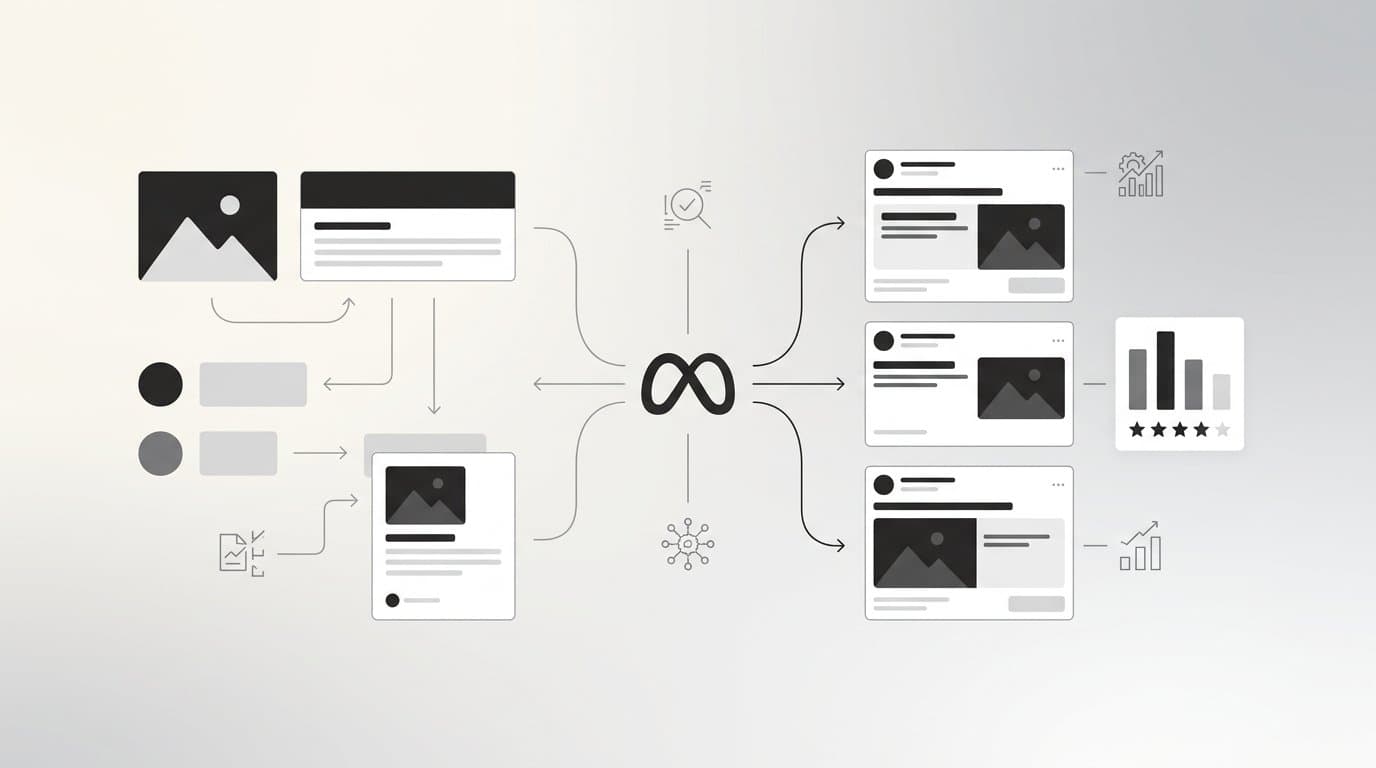
This is where AI-powered creative generation fundamentally changes the economics. Platforms that can produce image ads, video ads, and UGC-style creatives from a product URL, or by cloning proven formats from the Meta Ad Library, compress the time between idea and live test from days to minutes. Instead of briefing a designer and waiting for production, you can generate dozens of creative variations, refine them with chat-based editing, and have a full test batch ready to launch in a fraction of the time.
AdStellar's AI Creative Hub does exactly this. You can generate scroll-stopping creatives across multiple formats without designers, video editors, or actors. You can also clone competitor ads directly from the Meta Ad Library, which means you're not just generating creative from scratch but learning from what's already proven to work in your market. That's a meaningful competitive advantage when speed and volume are both critical.
The learn phase requires structured performance tracking that connects creative elements to real outcomes. Leaderboard-style insights that rank creatives, headlines, audiences, and copy by ROAS, CPA, and CTR make it straightforward to identify which elements are actually driving performance. AdStellar's AI Insights feature does this automatically, scoring every element against your target goals so you can instantly spot winners rather than manually sifting through Ads Manager data.
The scale phase is where bulk launching changes the game. Instead of manually building each ad set, you can mix multiple creatives, headlines, audiences, and copy variations simultaneously and let AdStellar generate every combination. Hundreds of ad variations can be launched to Meta in minutes rather than hours. The Winners Hub then keeps your best-performing creatives, headlines, and audiences organized with real performance data attached, so selecting proven elements for your next campaign takes seconds rather than a manual search through historical data.
This loop, generate at volume, identify winners fast, build on what works, is what makes creative scaling sustainable rather than a temporary spike followed by inevitable decline.
Putting It All Together: From Creative Bottleneck to Scaling Engine
The mindset shift that unlocks creative scaling is deceptively simple: stop thinking about finding one great ad and start thinking about building a system that continuously produces, tests, and promotes winning creatives. One great ad is a moment. A repeatable system is a competitive advantage.
Every challenge covered in this guide, creative fatigue, production bottlenecks, inconsistent testing, data disconnects, comes back to the same underlying gap. The creative production process isn't connected to the performance data that should be driving it, and it can't move fast enough to stay ahead of audience saturation at meaningful scale. Close that gap, and the scaling problem becomes much more manageable.
AI-powered creative generation addresses the volume problem. Structured testing addresses the methodology problem. Performance-based insights address the data disconnect. And a centralized system that connects all three closes the loop between creative production and campaign results. That combination is what transforms creative production from a bottleneck into a genuine scaling engine.
The practical implication is that scaling Facebook ad creatives in 2026 is less about creative talent and more about creative infrastructure. The teams and brands that scale successfully aren't necessarily producing better individual ads. They're producing more variations, testing more systematically, identifying winners faster, and building on proven elements more efficiently than their competitors.
If you're ready to stop chasing creative fatigue and start building the kind of proactive creative pipeline that scaling actually requires, AdStellar gives you every tool in one place. From AI-generated image ads, video ads, and UGC-style creatives to bulk launching, AI-driven campaign building, and real-time performance leaderboards, it's the full creative-to-campaign workflow without the traditional bottlenecks.
Start Free Trial With AdStellar and be among the first to launch and scale your ad campaigns faster with an intelligent platform that automatically builds and tests winning ads based on real performance data. The 7-day free trial gives you full access to see exactly how much faster your creative pipeline can move.
The Bottom Line on Creative Scaling
Facebook ad creative scaling challenges are structural. They're not a sign that your ads aren't good enough or that your targeting is off. They're the predictable result of running a high-volume, fast-moving advertising channel through a production process that was never designed to keep up with it.
Understanding the mechanics, audience saturation, creative fatigue, production bottlenecks, data disconnects, is what allows you to address the root causes rather than just treating the symptoms. When you know why performance decays, you can build the systems to stay ahead of it instead of constantly reacting to it.
AdStellar is built specifically for this problem. It handles creative generation across image, video, and UGC formats. It launches bulk ad variations to Meta in minutes. It surfaces winning creatives, headlines, and audiences with real performance data attached. And it connects the entire workflow from first creative concept to campaign results, so nothing falls through the gap between production and performance.
The advertisers who scale successfully on Meta aren't the ones with the biggest budgets or the most creative talent. They're the ones with the most efficient systems. Building that system starts at adstellar.ai.