Your Facebook Ads Manager dashboard shows 23 active campaigns. Inside those campaigns? Sixty-three ad sets. Inside those ad sets? Two hundred and seventeen individual ads. You started with a simple hypothesis about testing new creative angles. Now you have a sprawling ecosystem of variations that would require a full-time analyst just to understand what's actually being tested.
This is Facebook ad creative testing overwhelm, and it's not happening because you're bad at your job.
It's happening because the math of modern advertising is fundamentally broken for human management. When you test 5 different images against 4 headlines against 3 audience segments, you're not managing 12 variables. You're managing 60 unique combinations. Add in copy variations and placement differences, and you're suddenly responsible for tracking hundreds of data points across dozens of campaigns.
Most marketers hit their breaking point somewhere around variation 30. That's when the spreadsheets stop getting updated. When you start making decisions based on "this one feels better" rather than statistical significance. When you realize you've been running a test for six weeks and forgot to check if it ever reached meaningful traffic.
The solution isn't to test less. In 2026's competitive advertising landscape, creative testing is the competitive advantage. Brands that can systematically identify winning creative angles and scale them faster than competitors win the attention game.
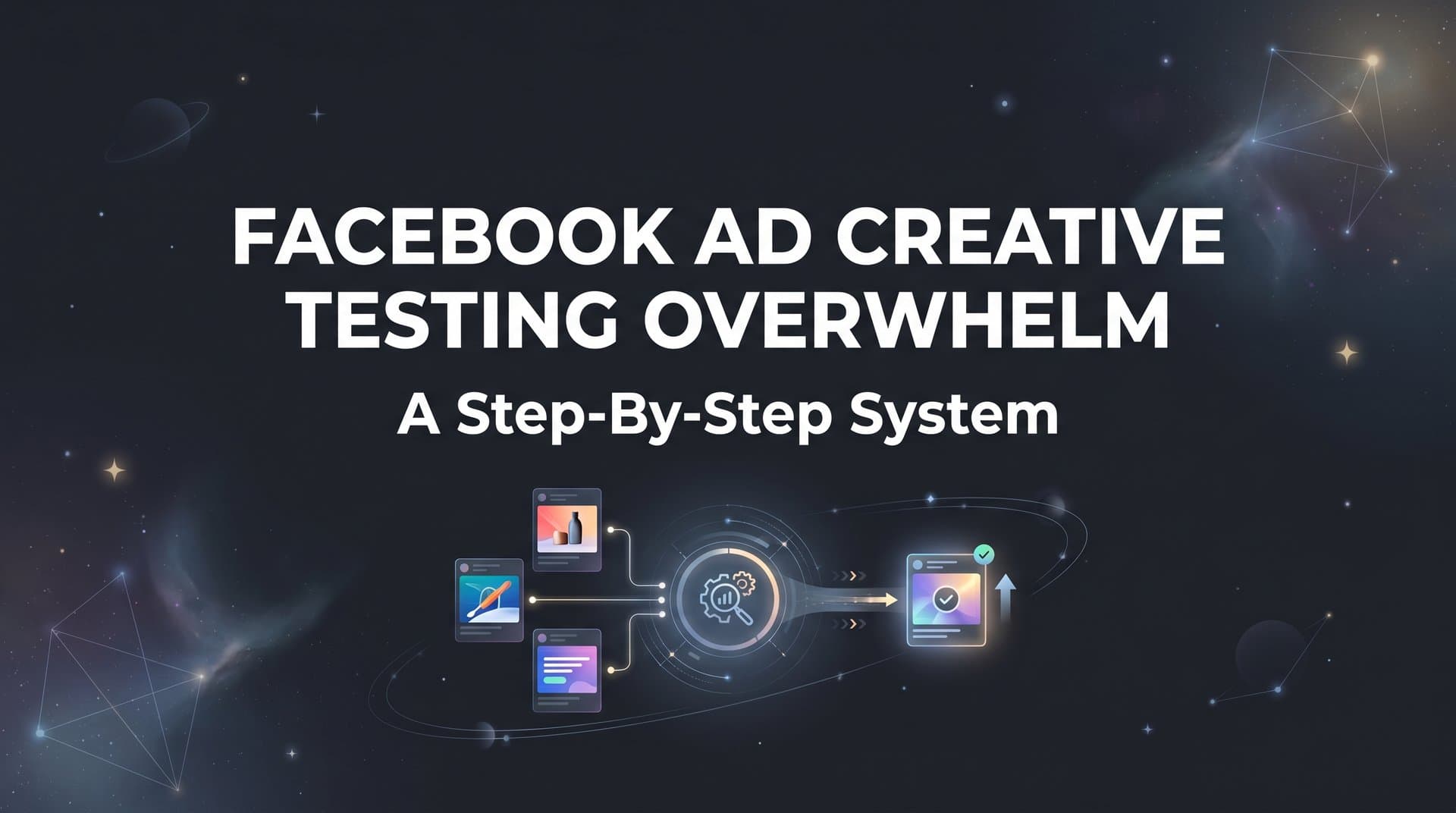
The solution is to build a system that matches the complexity of modern advertising without requiring superhuman organizational skills. This guide walks you through seven concrete steps to transform creative testing from a source of stress into a repeatable competitive advantage. You'll learn how to audit your current chaos, prioritize what actually moves the needle, build sustainable testing frameworks, and leverage automation to handle the complexity that was never meant for spreadsheets.
By the end, you'll have a clear system that turns exponential variables into manageable processes.
Step 1: Audit Your Current Testing Chaos
Before you can fix the overwhelm, you need to see it clearly. Most marketers underestimate how many active tests they're actually running because the tests are scattered across campaigns, ad accounts, and time periods.
Start by creating a master testing inventory. Open a fresh spreadsheet and document every campaign that's currently running any form of creative test. For each campaign, record the specific variables being tested: are you testing images, headlines, audiences, copy, placements, or some combination?
Now comes the uncomfortable part. Calculate your actual variable count by multiplying your variations. If you're testing 4 images times 3 headlines times 2 audiences, you're managing 24 unique combinations, not 9 separate elements. Write down the real number.
Next, identify your zombie tests. These are campaigns that are technically active and spending budget, but nobody is monitoring them or planning to act on the results. They're running on autopilot, consuming resources without generating insights. Highlight every test that doesn't have a clear owner, a defined success metric, or a scheduled review date.
Flag tests with unclear hypotheses. If you can't articulate what you're trying to learn from a specific test, it's contributing to overwhelm without contributing to strategy. "Testing new creative" isn't a hypothesis. "Testing whether lifestyle imagery outperforms product shots for our cold audience" is a hypothesis. Understanding common Facebook ad creative testing problems helps you identify these issues faster.
Calculate your total monthly testing budget and divide it by your number of active tests. If you're spreading $10,000 across 30 different tests, each test is only getting $333. That's rarely enough to reach statistical significance, which means you're running inconclusive experiments that generate noise instead of insights.
This audit reveals the true source of your overwhelm. For most marketers, it's not that they're testing too aggressively. It's that they're running too many underfunded, unmonitored tests simultaneously. The audit creates your baseline and shows you exactly where to start simplifying.
Step 2: Define Your Testing Hierarchy
Not all variables are created equal. Testing your CTA button color might generate a measurable difference, but it won't transform your campaign performance. Testing whether video outperforms static images for your audience? That can double your conversion rate.
The testing hierarchy principle says to focus on high-impact variables first, then move to refinements only after you've optimized the elements that actually move the needle.
For most Facebook advertisers, creative visuals sit at the top of the hierarchy. Your image or video is what stops the scroll. It's what captures attention in a feed full of competing content. A strong visual can overcome mediocre copy. Mediocre visuals rarely get saved by brilliant headlines.
Audience targeting typically ranks second. Showing the right message to the wrong people wastes budget. Showing a decent message to the right people can still generate positive returns. Audience testing answers fundamental questions about who your product resonates with.
Copy elements like headlines, primary text, and CTAs rank third. They matter significantly, but they operate within the constraints set by your creative and audience choices. Testing five different headlines on a creative that doesn't stop the scroll won't fix your underlying problem.
Create your own priority matrix based on your business. If you're in a highly visual category like fashion or home decor, creative testing deserves even more focus. If you're selling complex B2B solutions, audience precision might rank higher than creative variations. A clear Facebook ad testing methodology helps you make these prioritization decisions systematically.
The key is to establish clear rules for when you test one variable versus multiple variables simultaneously. Single-variable testing gives you clean data about what specifically drove performance changes. Multi-variable testing lets you find winning combinations faster but makes it harder to understand why something worked.
A clear hierarchy prevents the trap of testing everything at once and getting conclusive results on nothing. It gives you permission to ignore low-impact variables until you've exhausted the high-impact opportunities. This focus is what transforms scattered testing into strategic advantage.
Step 3: Build a Structured Testing Calendar
Testing without a calendar is how you end up with 40 simultaneous experiments that all blur together. A structured testing calendar transforms reactive chaos into proactive experimentation with clear milestones and decision points.
Start by mapping out testing phases. Each phase should focus on one primary variable from your hierarchy. Phase one might be creative format testing: static images versus video versus carousel. Phase two might be audience segment testing. Phase three might be messaging angle testing.
Give each phase specific start and end dates. A typical testing phase runs two to three weeks, long enough to gather meaningful data but short enough to maintain momentum. Mark your calendar with the exact date when each test launches and the exact date when you'll make your go or kill decision.
Allocate budget per phase rather than spreading thin across dozens of simultaneous experiments. If you have $5,000 monthly for testing, put the full amount behind your phase one tests. This concentration gives each test enough fuel to reach statistical significance quickly.
Schedule weekly review sessions where you actually look at the data and make decisions. Put these sessions on your calendar as non-negotiable appointments. During these sessions, you'll check if tests have reached significance, identify early winners or losers, and decide whether to kill underperformers or let them run another week.
Build in buffer time between phases. When a testing phase ends, you need time to implement learnings before launching the next round of tests. If phase one reveals that video outperforms static images, you need time to produce more video creative before phase two begins. A one-week buffer between phases prevents the rushed feeling that leads to sloppy execution.
Your calendar should also include monthly retrospectives where you step back and evaluate your entire testing framework. What did you learn this month? Which tests generated actionable insights versus which ones were inconclusive? How can you refine your approach for next month? Building a solid Facebook ad testing framework makes these retrospectives more productive.
A calendar creates accountability and prevents the endless expansion of active tests. When someone suggests testing a new variable, you don't say yes or no based on gut feel. You say "let's add that to phase four in six weeks" based on your structured plan.
Step 4: Create Your Minimum Viable Test Framework
One of the biggest drivers of testing overwhelm is the belief that more variations always equals better data. In reality, testing 15 different headlines against each other often produces less clarity than testing your top 3 strongest hypotheses.
Your minimum viable test framework defines the smallest test that can give you actionable data. For most variables, that's three to five variations. Testing three different creative approaches gives you enough data to identify patterns. Testing twelve different creative approaches usually just dilutes your budget and extends your timeline without proportionally improving your insights.
Set your statistical significance thresholds before you launch any test. Decide in advance what confidence level you need to declare a winner. Many marketers use 95% confidence as their threshold, meaning they need to be 95% certain that the performance difference isn't due to random chance.
Establish minimum spend and impression thresholds for declaring winners. A creative that got 50 impressions and generated 3 clicks might show a 6% CTR, but that's not a reliable winner. You need volume. A common baseline is 1,000 impressions minimum and $100 spend minimum before you trust the data enough to make scaling decisions. When you're struggling with difficulty testing Facebook ad variations, these clear thresholds provide much-needed structure.
Document your framework so every team member follows the same standards. Create a simple one-page testing guide that answers: How many variations do we test per variable? What metrics determine a winner? How much spend is required before we make decisions? When do we kill underperformers?
This documentation prevents the drift that happens when different team members apply different standards. One person kills tests after two days, another lets them run for six weeks. One person declares winners at 90% confidence, another waits for 99%. Inconsistent standards create inconsistent results and make it impossible to learn from your testing history.
The minimum viable framework gives you permission to test less and learn more. It's the antidote to the "just test one more variation" mentality that leads to analysis paralysis and decision fatigue.
Step 5: Automate Creative Generation and Variation Building
Here's the bottleneck that creates most testing overwhelm: manual creative production. You know you should test more creative variations. You understand that creative refresh is essential in 2026's fast-moving ad environment. But producing new images, videos, and UGC content requires designers, video editors, actors, and time you don't have.
So you make an impossible choice. Either test too little and miss winning angles, or attempt to manage the complexity manually and drown in spreadsheets tracking hundreds of variations.
AI-powered creative automation solves this bottleneck by shifting your role from production to strategy. Instead of spending hours in design tools or coordinating with freelancers, you focus on deciding what to test while AI handles the actual creation. Implementing Facebook ads creative testing automation fundamentally changes what's possible for your team.
Modern creative platforms can generate scroll-stopping image ads, video ads, and UGC-style avatar content from just a product URL. You provide the link, define your creative direction, and the system produces multiple variations ready to test. Want to see how your product looks in lifestyle settings versus product shots? The AI generates both approaches in minutes.
Competitor creative cloning takes this further. When you spot a competitor's ad that's been running for months in the Meta Ad Library, you can clone the approach and adapt it for your brand. This lets you test proven creative angles without starting from scratch or hoping your designer can reverse-engineer what's working.
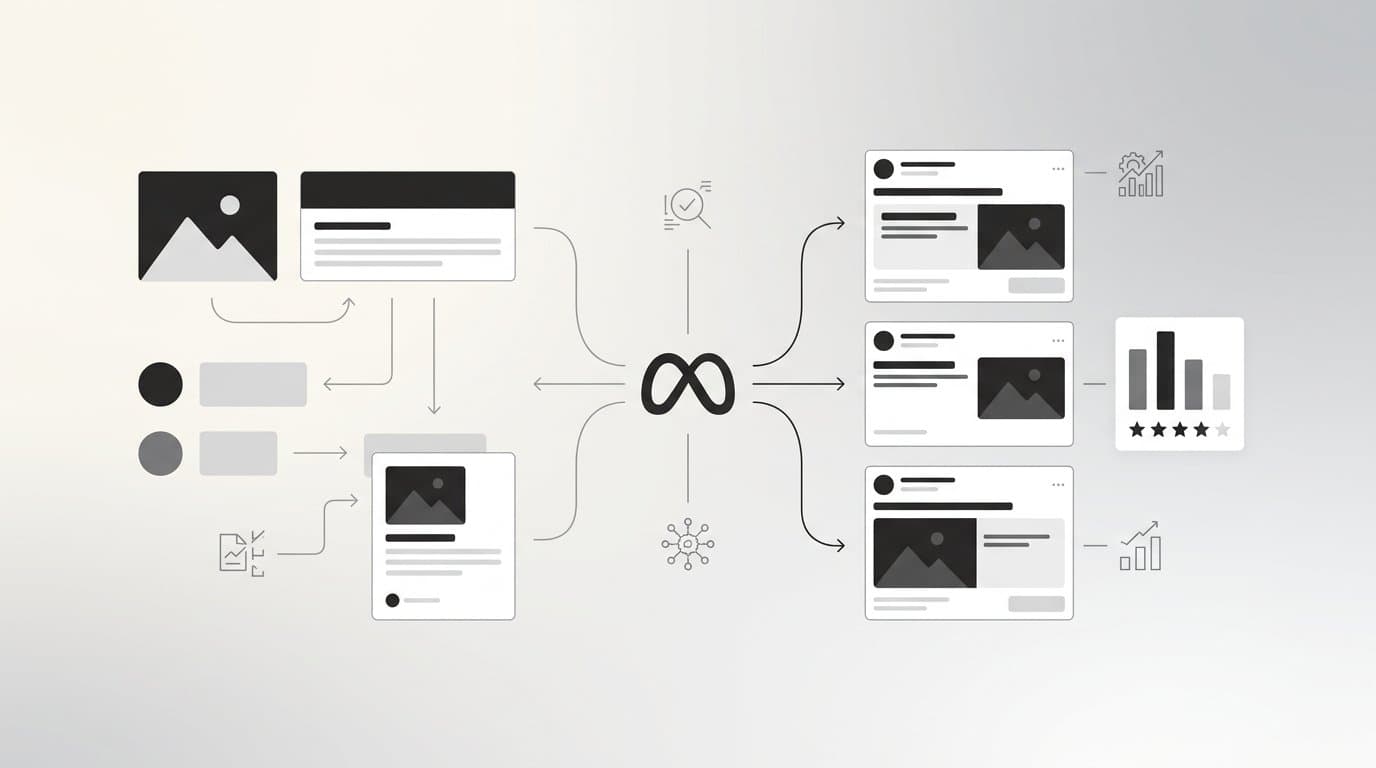
Bulk launch capabilities multiply your testing capacity without multiplying your workload. Instead of manually building campaigns for every combination of creative, headline, audience, and copy, you select your variables and the system generates every combination automatically. Want to test 5 creatives against 4 headlines against 3 audiences? That's 60 unique ads built and launched in minutes instead of hours of manual campaign setup. The right Facebook ad testing automation tools make this level of scale achievable.
This automation fundamentally changes what's possible with creative testing. When production takes minutes instead of days, you can run sophisticated multi-variable tests that would have been logistically impossible with manual workflows. You can refresh creative weekly instead of monthly. You can test emerging trends while they're still relevant instead of three weeks after the moment has passed.
AdStellar's AI Creative Hub handles the entire creative generation workflow, from initial concept to final ad variations. The Bulk Ad Launch feature then takes those creatives and systematically builds every testing combination you need. The result is testing volume that matches the complexity of modern advertising without creating manual overwhelm.
Step 6: Implement a Winner Identification System
You've launched your tests. Budget is flowing. Data is accumulating. Now comes the moment where most testing frameworks break down: actually identifying which variations are winning and deserve more budget.
Scattered spreadsheets can't handle this at scale. When you're tracking 50 active ad variations across multiple campaigns, manually calculating which creative has the best ROAS or which headline drives the lowest CPA becomes a part-time job. By the time you've updated your spreadsheet, the data has changed and you need to start over.
Replace manual tracking with a centralized performance dashboard that automatically ranks your ads by the metrics that actually matter for your business. If your goal is ROAS, every creative should be ranked by ROAS in real-time. If you're optimizing for CPA, that becomes your primary sorting metric. A dedicated Facebook ad creative management system makes this centralization possible.
Leaderboards transform overwhelming data into clear hierarchies. Instead of staring at rows of numbers trying to spot patterns, you see your top 10 performing creatives instantly. You see which headlines consistently appear in winning ads. You see which audience segments generate the best returns.
The Winners Hub concept takes this further by creating a centralized repository where proven performers live with their performance data attached. When you identify a winning creative, it doesn't just get noted in a spreadsheet and forgotten. It gets added to your Winners Hub with its actual ROAS, CTR, and conversion data visible.
This creates a feedback loop where winners automatically inform your next round of testing. Planning your next campaign? Start by browsing your Winners Hub to see what's already proven to work. Want to test a new audience segment? Pull your top three winning creatives from the Hub to give that audience the best chance of success.
AI-powered insights can score every ad element against your specific benchmarks. Instead of you manually calculating whether a 2.8% CTR is good or bad for your account, the system compares it against your historical performance and assigns a score. A creative that's performing in the top 10% of your historical data gets flagged as a winner. One performing in the bottom 25% gets flagged for review or kill.
This automated scoring eliminates the guesswork and emotional attachment that clouds manual analysis. You're not deciding based on which creative you personally like or which one took the most effort to produce. You're deciding based on objective performance against your actual business goals.
AdStellar's AI Insights feature provides exactly this kind of automated winner identification. Leaderboards rank your creatives, headlines, copy, audiences, and landing pages by real metrics. Goal-based scoring compares everything against your targets. The system surfaces winners automatically so you can focus on strategic decisions instead of data analysis.
Step 7: Establish Your Ongoing Testing Rhythm
The final step in conquering testing overwhelm is moving from reactive firefighting to a sustainable ongoing rhythm. Creative testing isn't a project with a finish line. It's a continuous process that needs to become a manageable habit rather than a recurring crisis.
Define your testing cadence based on your budget and team capacity. For many advertisers, a bi-weekly rhythm works well. Every two weeks, you launch a new testing phase, review results from the previous phase, and make scaling decisions. This creates regular checkpoints without the constant churn of weekly changes.
Establish your test-to-scale ratio. This is the balance between budget allocated to testing new variations versus budget allocated to scaling proven winners. A common ratio is 70/30: seventy percent of your budget goes to scaling what's already working, thirty percent goes to testing new approaches. This prevents the trap of endlessly testing without ever scaling winners, or the opposite trap of scaling yesterday's winners without discovering tomorrow's opportunities.
Create a kill criteria checklist so underperformers get cut quickly without emotional attachment. Your checklist might include: Has this ad spent at least $100? Has it received at least 1,000 impressions? Is it performing in the bottom 40% of active ads by ROAS? If the answer to all three is yes, kill it. No exceptions, no "let's give it one more week" based on gut feel. When Facebook ad testing takes too long, it's often because teams lack these clear kill criteria.
Fast kills are essential for maintaining testing velocity. Every dollar spent on a proven loser is a dollar not available for testing the next potential winner. Ruthless pruning of underperformers keeps your testing budget focused on actual opportunities.
Schedule monthly testing retrospectives where you step back from individual campaign performance and evaluate your entire framework. What did you learn this month? Which types of tests generated the most valuable insights? Which tests were inconclusive and why? How can you refine your minimum viable test framework based on what you now know?
These retrospectives turn testing into a learning system that gets smarter over time. You're not just running tests, you're building institutional knowledge about what works for your specific business, audience, and category.
Document your learnings in a central knowledge base. When you discover that UGC-style creatives outperform polished product shots for your cold audiences, that insight should be recorded and accessible to your entire team. Future testing builds on proven principles instead of rediscovering the same lessons repeatedly.
A sustainable rhythm transforms creative testing from an overwhelming project into a competitive advantage. Your competitors are still drowning in spreadsheets and making gut-feel decisions. You're running a systematic process that consistently identifies winners and scales them before the market shifts.
Moving Forward With Confidence
Facebook ad creative testing overwhelm is a systems problem, not a willpower problem. You're not failing because you lack discipline or organizational skills. You're struggling because the exponential math of modern advertising was never designed for manual management.
The solution isn't to test less or work harder. It's to build a framework that matches the complexity of modern advertising without requiring superhuman effort.
Start with your audit to understand the true scope of your current chaos. How many tests are actually running? How many are zombie tests consuming budget without generating insights? What's your real variable count when you multiply combinations instead of just counting elements?
Establish your testing hierarchy so you focus on high-impact variables first. Creative visuals, audience targeting, then copy refinements for most advertisers. Test what moves the needle before you optimize the details.
Build a calendar that creates structure and decision points. Testing phases with clear start and end dates. Weekly review sessions where you make go or kill decisions. Monthly retrospectives where you refine your approach based on learnings.
Define your minimum viable test framework to prevent endless expansion. Three to five variations per variable. Clear statistical significance thresholds. Minimum spend requirements before declaring winners. Documentation so everyone follows the same standards.
Automate the production bottleneck that forces impossible tradeoffs between testing volume and manual workload. AI-powered creative generation handles image ads, video ads, and UGC content. Bulk launching builds hundreds of variations in minutes. This shifts your role from production to strategy.
Implement winner identification systems that surface insights automatically. Leaderboards that rank performance by your actual goals. Winners Hubs where proven performers live with their data attached. AI scoring that compares everything against your benchmarks without manual analysis.
Establish a sustainable rhythm that makes testing a habit rather than a crisis. Bi-weekly testing cadence. Clear test-to-scale ratios. Kill criteria checklists that cut underperformers fast. Monthly retrospectives that build institutional knowledge.
Your quick-start checklist for this week: Complete your testing audit today to see the full scope of active tests. Define your top three testing priorities based on your hierarchy. Schedule your first structured testing phase with specific start and end dates. Explore automation platforms that can handle creative generation and bulk launching at the scale modern advertising requires.
The goal isn't to eliminate testing. Testing is how you stay competitive in a market where attention is scarce and creative fatigue happens faster than ever. The goal is to make testing feel like a competitive advantage rather than a source of stress.
Ready to transform your advertising strategy? Start Free Trial With AdStellar and be among the first to launch and scale your ad campaigns 10× faster with our intelligent platform that automatically builds and tests winning ads based on real performance data.