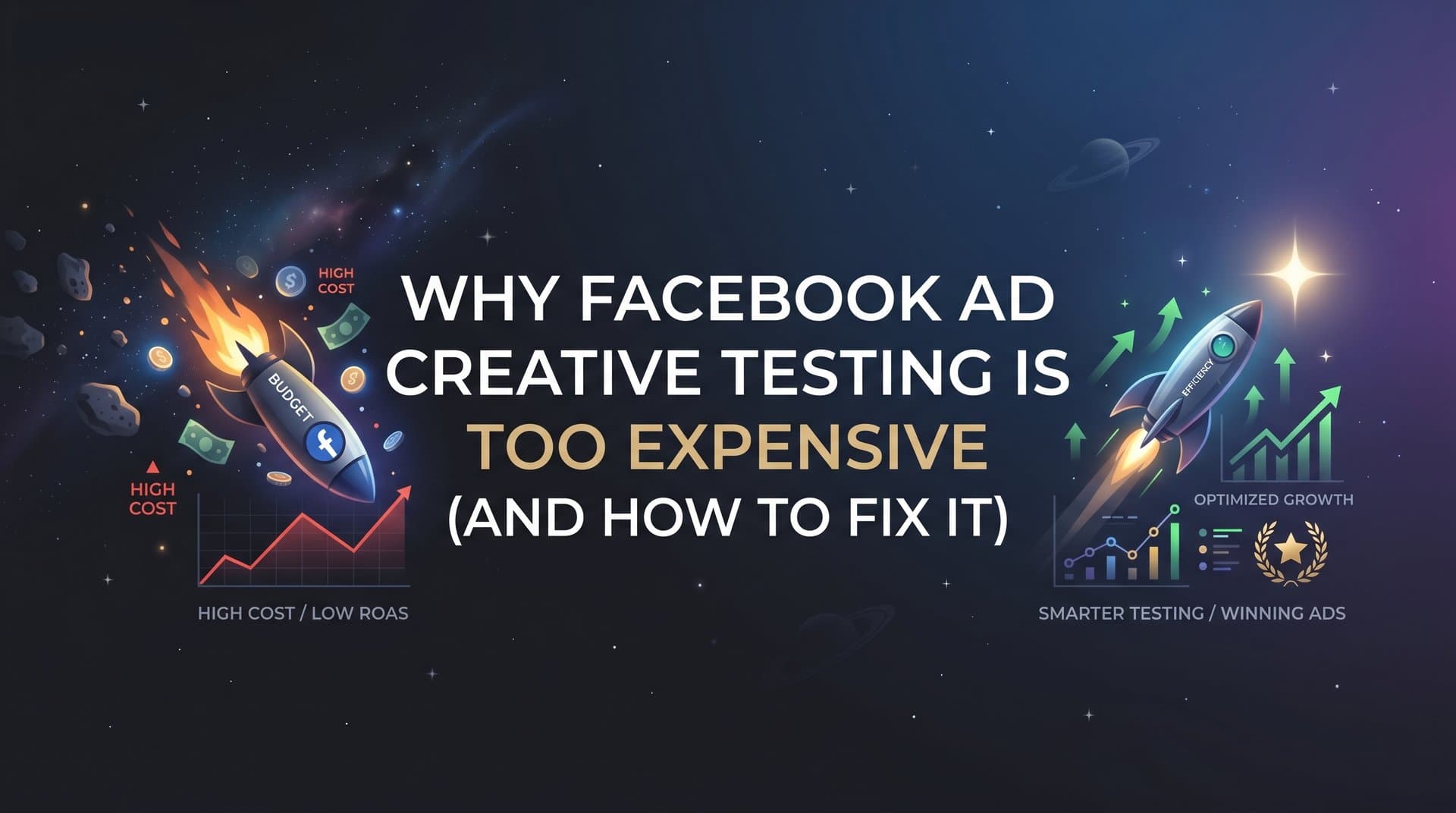
Let's be honest about something most Meta advertisers already know: creative testing is not optional. The data is clear, the platform demands it, and your competitors are doing it. But somewhere between knowing you need to test and actually running a systematic program, the budget math stops working. You burn through spend, collect inconclusive data, and end up right back where you started, just with a lighter wallet.
This is the central frustration of Facebook ad creative testing: it is non-negotiable for performance, yet the traditional approach makes it feel financially punishing. Produce multiple assets, split your budget across ad sets, wait for statistically meaningful results, and repeat when the data is murky. For most advertisers, that cycle drains spend long before a winner ever emerges.
The problem is not that creative testing is inherently expensive. The problem is that most advertisers are running a production-heavy, trial-and-error process that was designed for agencies with large budgets and dedicated creative teams. If you are working with a modest budget or a lean team, that approach will eat you alive. This article breaks down exactly why testing costs spiral, where the real cost drivers hide, and how a structural shift in your approach can make systematic creative testing affordable at almost any scale.
The Real Reason Your Creative Tests Keep Burning Budget
Most advertisers think of creative testing as a media spend problem. The real issue is that it is a two-cost problem, and the first cost never shows up in your Ads Manager dashboard.
Production overhead is the hidden first cost. Every variation you want to test needs to exist before you can spend a single dollar on media. That means briefing a designer, waiting on revisions, coordinating with a video editor, or sourcing a UGC creator. Each asset carries a real cost in time, money, or both. When you factor in the full production pipeline, the cost-per-test is significantly higher than the media spend alone. Most teams underestimate this overhead badly, which is why creative testing always feels more expensive than budgeted.
Ad spend fragmentation is the second cost. When you split a limited budget across multiple ad sets to test creative variations, you are essentially guaranteeing that no single creative gets enough impressions to produce reliable data quickly. Meta's algorithm needs volume to optimize. When each ad set is starved of impressions, CPMs inflate, delivery becomes erratic, and the data you collect is too noisy to act on confidently. So you spend more trying to reach significance, which compounds the cost problem rather than solving it.
The iteration trap compounds both. When a test produces inconclusive results, the natural instinct is to run another round with fresh variations. Without a clear framework for what you are testing and why, this becomes a cycle: produce more assets, split more budget, collect more ambiguous data, repeat. Each round layers new production costs on top of new media costs, and the cycle continues until someone pulls the plug or the budget runs out.
The uncomfortable truth is that most creative testing programs fail not because the creatives were bad but because the process itself was structurally set up to waste money. Fixing Facebook ad creative testing that feels too expensive starts with recognizing that the production and fragmentation problems are just as important to solve as the media efficiency problem.
How Meta's Algorithm Works Against Small-Budget Testers
Understanding the platform mechanics helps explain why testing costs feel disproportionately high for advertisers who are not working with large daily budgets.
The learning phase creates a minimum viable spend threshold. According to Meta's own platform documentation, an ad set typically needs around 50 optimization events within a seven-day window before it exits the learning phase and begins delivering results efficiently. During the learning phase, CPMs are higher, delivery is less stable, and the data is less reliable. For advertisers targeting a conversion event with a high CPA, reaching 50 conversions per ad set per week requires significant spend. Multiply that across several test ad sets and the minimum budget required to run a legitimate test becomes substantial, often more than a small or mid-sized advertiser can comfortably allocate to testing alone.
Audience overlap makes the problem worse. Running multiple test ad sets targeting similar or overlapping audiences causes Meta's system to compete against itself in the auction. The result is inflated CPMs across all variations and distorted performance data. When two of your ad sets are bidding for the same users, the creative that wins may be the one that got lucky in the auction rather than the one that genuinely resonated. Meta's Ads Manager even includes an Audience Overlap tool specifically because this is a recognized and common problem. If you are running a creative test and your audiences overlap significantly, you are not getting clean data. You are getting expensive noise.
Broad targeting raises the creative stakes. Meta has consistently pushed advertisers toward broader audiences, Advantage+ placements, and automated targeting over the past few years. The practical consequence is that targeting has become less of a differentiator. Creative quality is now the primary lever advertisers can actually control. When creative is the main variable, getting it wrong is more costly than it used to be, and the pressure to test systematically increases. This is not a reason to avoid testing. It is a reason to test smarter.
What Systematic Creative Testing Actually Requires
Effective creative testing is not about running as many variations as possible. It is about running the right variations in the right sequence with a clear framework for interpreting results.
Volume is the foundation, but structure is what makes volume useful. You need enough variations to isolate variables, which means testing different hooks, formats, visual styles, and calls to action rather than making cosmetic tweaks to a single concept. A test matrix that only varies button color is not a creative test. But a test matrix that throws every possible variable into a single round produces noise rather than signal. The goal is meaningful volume within a structured framework.
A clear variable hierarchy makes results actionable. The most efficient approach tests one layer of variables at a time. Start with creative format: does a static image outperform a short video for this offer? Once you have that answer, test hooks within the winning format. Then test copy angles within the winning hook. This sequential approach means each round of testing builds on the last, and you are never left wondering whether the creative failed because of the format, the hook, the copy, or all three at once. Following a structured ad testing framework means the cost of each test round is lower because you are not starting from zero, and the results are cleaner because you controlled for the variables you are not testing.
A consistent scoring system prevents subjective debates. Without defined success metrics tied to actual business goals, teams end up arguing about which ad looked better or which one got more clicks rather than scaling the one that drove the most profitable conversions. Before any test launches, define what winning looks like: a specific CPA target, a minimum ROAS threshold, or a CTR benchmark that correlates with downstream performance. Score every creative against those benchmarks in real time. This removes the guesswork and the internal debates, and it tells you when to cut a loser early rather than waiting for the full test cycle to drain your budget.
Cutting the Cost of Creative Production Without Sacrificing Quality
If production overhead is one of the two major cost drivers, then collapsing the cost of producing variations is one of the highest-leverage moves available to any advertiser running a creative testing program.
AI-generated creatives eliminate the production bottleneck entirely. Tools like AdStellar's AI Creative Hub can generate image ads, video ads, and UGC-style avatar content directly from a product URL, without designers, video editors, or actors. The practical implication is significant: what used to take days of briefing, production, and revision cycles can now happen in minutes. The marginal cost of producing an additional variation drops to near zero, which fundamentally changes the economics of creative testing. When each new variation costs almost nothing to produce, you can afford to test more hypotheses, iterate faster, and run a genuinely systematic program rather than rationing your test rounds because production is creating a bottleneck.
Cloning competitor ads gives you a validated starting point. One of the most underused approaches in creative testing is starting from proven frameworks rather than building every concept from scratch. AdStellar's AI Creative Hub lets you pull ads directly from the Meta Ad Library and adapt them with AI, giving you a structural foundation that has already demonstrated enough market appeal to keep running. This does not mean copying competitors. It means learning from what is working in your category and building your own version with your own messaging. Starting from a validated framework reduces the risk that a test fails simply because the creative concept was untested in the market, which means fewer wasted test rounds.
Bulk variation generation changes the cost-per-insight math. AdStellar's Bulk Ad Launch feature lets you mix multiple creatives, headlines, and copy variations to generate hundreds of ad combinations in minutes. The ability to create a large test matrix without proportionally increasing production time or cost means the cost-per-insight drops dramatically. Instead of producing five assets and hoping one works, you can use a bulk Facebook ad creation tool to generate fifty combinations, launch them systematically, and let performance data tell you which elements are driving results. That is a fundamentally different relationship between production cost and learning output.
Smarter Budget Allocation: Spending Less While Learning More
Even with production costs under control, media spend efficiency determines whether your testing program is sustainable. The goal is to structure your campaigns so Meta's algorithm can gather data faster with less total spend.
Consolidate testing into fewer, better-structured campaigns. Rather than spreading budget across many small ad sets, consolidating variations within campaigns using dynamic creative or structured ad set architecture helps the algorithm accumulate optimization events faster. When budget is concentrated rather than fragmented, individual ad sets exit the learning phase more quickly, CPMs stabilize, and the data you collect becomes more reliable with less total spend. Meta's Advantage+ Creative and dynamic creative features exist precisely to support this kind of consolidation, and they are worth using as part of a structured testing approach.
Use historical data to pre-qualify creatives before you spend. One of the most expensive habits in creative testing is starting every round from zero. If you have been running Meta ads for any length of time, your historical campaigns contain signal about which creative elements, hooks, formats, and audiences have driven results. AdStellar's AI Campaign Builder analyzes that historical data, ranks creative elements by performance, and builds campaigns around the highest-probability candidates. Starting each test with pre-qualified elements means fewer losing rounds to fund and a faster path to finding variations that work. Automating the testing process this way removes the guesswork that typically inflates media spend.
Set goal-based scoring before you spend a dollar. AdStellar's AI Insights feature lets you define your CPA or ROAS target before a campaign launches and scores every creative against that benchmark in real time. The leaderboard view ranks creatives, headlines, copy, audiences, and landing pages by actual metrics like ROAS, CPA, and CTR. When you can see clearly and early which variations are trending toward your goals and which are not, you can cut losers before they drain significant budget and reallocate spend to emerging winners. This real-time scoring approach replaces the traditional model of waiting for a full test cycle to complete before making any decisions.
Building a Testing System That Compounds Over Time
The most important shift in thinking about creative testing is moving from a per-campaign cost frame to a system cost frame. Individual tests have costs. A well-built testing system generates returns that make those costs look small.
Proven creatives compound in value. Every winning creative you surface through systematic testing becomes an asset for future campaigns. AdStellar's Winners Hub stores your best-performing creatives, headlines, audiences, and more in one place, with real performance data attached. When you launch a new campaign, you are not starting from zero. You are starting from a library of proven performers that have already demonstrated they can drive results. Over time, this means fewer test rounds needed to reach a winner, lower average cost per insight, and a higher baseline performance for every new campaign you launch.
Automation closes the feedback loop. The most efficient testing systems are ones where insights from each campaign automatically feed into the next round of creative generation. When a platform can identify top performers, explain why they won based on the specific elements that drove results, and use those insights to inform the next batch of creative, you get a continuous improvement cycle. Each campaign makes the next one faster and cheaper to run. AdStellar's AI Campaign Builder does exactly this: it learns from your historical data, gets smarter with each campaign, and provides full transparency into the rationale behind every recommendation so you understand the strategy rather than just following outputs blindly. Relying on AI marketing tools for Facebook campaigns this way turns each test into a compounding investment rather than a sunk cost.
The right frame is the cost of not testing. When you find a creative that delivers a strong ROAS and scale it across a meaningful budget, the returns on that winning creative pay back the entire testing investment many times over. The question is never whether testing is expensive in isolation. The question is whether the cost of running a systematic testing program is higher or lower than the cost of running campaigns with unvalidated creatives at scale. Consistently, the math favors the testing investment, provided the testing system is built to find winners efficiently rather than burning budget on inconclusive rounds.
Putting It All Together
Facebook ad creative testing feels too expensive because most advertisers are using a process that was never designed for lean teams or modest budgets. The traditional approach, heavy production costs, fragmented media spend, and trial-and-error iteration, is structurally set up to drain budget before it delivers results.
The fix is structural, not incremental. Lower the cost of producing variations with AI-generated creatives. Use historical data and competitor insights to pre-qualify creative decisions before you spend. Consolidate budget to satisfy Meta's algorithm faster and collect cleaner data. Build a system where winners are stored, reused, and compounded over time rather than forgotten after each campaign.
AdStellar is built to handle the full loop: from generating image ads, video ads, and UGC-style creatives in minutes, to launching campaigns with AI-optimized audiences and copy, to surfacing your winners with real-time leaderboard scoring and a Winners Hub that keeps your best performers ready to deploy. The result is a testing program that gets smarter and more cost-efficient with every campaign you run.
If your current approach to creative testing is burning budget without producing clear winners, the answer is not to test less. It is to test better. Start Free Trial With AdStellar and be among the first to launch and scale your ad campaigns with an intelligent platform that automatically builds and tests winning ads based on real performance data.