Creative fatigue is not a possibility in Facebook advertising. It is a certainty. Every ad you run has a shelf life, and once your audience has seen it enough times, performance starts to slide. CPMs creep up. Click-through rates drop. Your cost per acquisition climbs to a point where the campaign no longer makes sense. Then you pause, scramble to produce something new, and the cycle starts over.
The advertisers who break out of that cycle are not the ones with the biggest budgets or the largest creative teams. They are the ones with a deliberate creative variations strategy. Instead of reacting to fatigue after it happens, they build systems that continuously generate, test, and replace creative assets before performance has a chance to collapse.
This article lays out that system in full. You will learn which creative variables actually move the needle, how to structure tests so your data is actionable rather than noisy, how to read results without jumping to premature conclusions, and how to turn your winners into a repeatable engine that gets smarter with every campaign cycle. By the end, you will have a framework you can implement immediately, whether you are managing a single account or scaling across dozens of campaigns.
Creative Variation Is the Engine of Facebook Ad Performance
To understand why a creative variations strategy matters, it helps to understand what is actually happening when an ad fatigues. Meta's delivery system is constantly measuring how your audience responds to your ads. When engagement signals are strong, the algorithm rewards you with cheaper, more targeted delivery. When those signals weaken because people have already seen the ad and are scrolling past it, the algorithm interprets that as a relevance problem and your costs go up.
This is not a flaw in the system. It is the system working as designed. Meta wants to show people content they find relevant and engaging. When your ad stops being that, you pay more to force it in front of them. The only sustainable answer is fresh creative.
Here is where the volume question becomes strategic. More creative variations do not just delay fatigue. They give Meta's algorithm more signals to work with from the start. When you launch five distinct variations instead of one, the delivery system can identify which version resonates with which segment of your audience and allocate spend accordingly. You are effectively giving the algorithm more raw material to optimize against, which accelerates the path to efficient delivery.
The critical distinction is that creative variation is not about producing volume for its own sake. Randomly generating different visuals and copy combinations without a clear hypothesis is expensive noise. A real Facebook ad variations strategy treats each variation as a test of a specific idea. You are not throwing things at the wall. You are running structured experiments that build compounding knowledge about what your audience responds to and why.
That compounding knowledge is the real asset. Each campaign cycle, you learn something new about your audience's preferences, and that learning informs the next round of creative decisions. Over time, you are not starting from zero with each new campaign. You are starting from a progressively stronger baseline, which is what separates advertisers who scale profitably from those who constantly feel like they are rebuilding from scratch.
The Six Creative Variables Worth Testing (And How to Isolate Them)
Not everything in an ad is worth testing with equal urgency. There are six core creative variables that consistently drive meaningful performance differences, and understanding each one is the foundation of any serious variation strategy.
Format: Whether you run a static image, a video, or a UGC-style creative is often the single biggest performance lever. Different formats stop the scroll in different ways and carry different levels of perceived authenticity. Format should typically be tested early because it affects everything downstream.
Visual hook: This is the first frame of a video or the primary image in a static ad. It is what determines whether someone keeps scrolling or pauses. Even within the same format, a different opening visual can produce dramatically different engagement rates. Think of the hook as your ad's handshake with the audience.
Headline: The headline carries a specific job: it frames the value proposition in a few words. Testing different headline angles, such as benefit-led versus curiosity-driven versus problem-aware, can reveal how your audience prefers to be approached.
Primary text angle: This is the body copy that expands on the headline. Different angles include social proof, feature-focused, story-based, and urgency-driven copy. The angle you choose signals what kind of conversation you are trying to have with the reader.
Call to action: The CTA button and the closing line of your copy both influence what action someone takes next. Small changes here can meaningfully shift click-through behavior, particularly for audiences already familiar with your brand.
Landing page pairing: The ad does not exist in isolation. The page someone lands on after clicking is part of the creative experience. Testing which landing page variant pairs best with a given ad is often overlooked but can have a significant impact on conversion rates.
The isolation principle is what makes these tests meaningful. When you change one variable at a time, you know exactly what caused any shift in performance. When you change multiple variables simultaneously, you have results but no understanding of why those results happened. That distinction matters enormously because your goal is not just to find a winning ad. It is to understand what made it win so you can replicate that insight in future creative. Understanding the challenge of managing too many Facebook ad variables at once is what keeps most advertisers from building real testing discipline.
Funnel stage also shapes which variable to prioritize first. Top-of-funnel audiences who have never encountered your brand are most sensitive to format and visual hook because those elements determine whether they engage at all. Retargeting audiences already know who you are, so they are more responsive to copy angle and offer framing. Matching your test priority to the funnel stage makes your budget work harder from the start.
Building a Creative Variation Framework That Scales
Knowing what to test is one thing. Building a structure that makes testing manageable at scale is another. The tiered variation model is the most practical framework for doing this without losing control of your creative library or your budget.
The model works in two layers. The first layer is creative concepts. A concept is a distinct messaging angle or visual approach. It answers the question: what core idea is this ad trying to communicate, and how is it framing that idea? Examples might include a problem-solution concept, a social proof concept, a lifestyle aspiration concept, or a product demonstration concept. Start with three to five distinct concepts per campaign. Any fewer and you are not learning enough. Any more and you dilute your budget before any single concept gets enough data to be meaningful.
The second layer is executions. An execution is a specific combination of headline, visual, and copy that expresses one of your concepts. Each concept should have two to three executions. This gives you a test set of roughly six to fifteen ads, which is large enough to generate real learning but small enough to manage without a dedicated creative operations team.
The distinction between concept and execution matters because it tells you what level of your framework a winning ad is validating. If multiple executions of the same concept outperform executions of other concepts, you have learned something about your audience's receptivity to that messaging angle. If only one execution of a concept performs well while others underperform, you have learned something more granular about specific elements like a particular visual or headline phrasing.
Naming and tagging conventions are the unglamorous but essential part of this framework. When you are managing dozens or hundreds of ad variations, the ability to quickly identify what each ad was testing is critical. A consistent naming structure that captures concept name, execution number, format type, and test date makes it possible to pull meaningful analysis without digging through individual ad settings. Something as simple as "ConceptA_Exec2_Video_June26" tells you everything you need to know at a glance.
This kind of organizational discipline also makes it possible to analyze performance patterns across campaigns over time. You are not just looking at which ad won last month. You are building a searchable record of what has worked and why, which is the foundation of a Facebook ad creative management system that compounds in value rather than resetting with each new campaign.
Reading Creative Test Results Without Jumping to Conclusions
One of the most common mistakes in creative testing is pulling conclusions too early. An ad that looks like a clear winner after two days of data can turn out to be a statistical fluke once it has had enough time and budget to stabilize. Premature decisions waste money by scaling ads that will not hold up and by killing ads that needed more runway to prove themselves.
The right evaluation window depends on your daily budget and your conversion volume. As a general principle, you want enough data for the algorithm to move through its learning phase before you make any significant decisions. Meta's own guidance suggests that ad sets typically need around 50 optimization events to exit the learning phase. If your budget and conversion rate do not support reaching that threshold within a reasonable time, you may need to use a higher-funnel metric as your primary evaluation signal while you wait for downstream data to accumulate.
This is where the metrics hierarchy becomes essential. Leading indicators like CTR and hook rate tell you about creative resonance early in the funnel. A high hook rate means people are stopping and engaging with your ad. A high CTR means the combination of creative and copy is compelling enough to drive a click. These signals appear quickly and can tell you whether a creative concept has potential before you have enough conversion data to be conclusive.
Lagging indicators like ROAS and CPA confirm whether that resonance translates into real business impact. These take longer to accumulate but are the metrics that ultimately determine whether an ad is worth scaling. The mistake is using lagging indicators to make early decisions, or using leading indicators as a substitute for conversion data when budget allows you to collect it.
When results are genuinely inconclusive, you have three options. You can extend the test window and give the ads more time and budget. You can consolidate budget from underperforming variations into the ones showing the strongest leading indicators to accelerate data collection. Or you can reframe the hypothesis entirely, recognizing that inconclusive results sometimes mean the variable you were testing is not the right lever for this audience at this funnel stage. Understanding the common Facebook ad creative testing challenges that cause these inconclusive results helps you design better experiments from the start. None of these options mean the variation strategy failed. They mean the strategy is working as intended by surfacing information that guides the next decision.
Turning Winners Into a Repeatable Creative System
Finding a winning ad is satisfying. Building a system that consistently produces winning ads is the actual goal. The difference between those two outcomes is what happens after you identify a winner.
Most advertisers stop at "this ad worked." They scale it, run it until it fatigues, and then scramble to find the next winner from scratch. A more productive approach is winner extraction: the process of documenting not just which ad won but why it won by identifying the specific element that drove the lift.
Was it the format that made the difference? The opening hook? A specific headline angle? The copy's emotional framing? If you have followed the isolation principle in your testing, you should be able to answer this question with reasonable confidence. That answer is the real asset, not the ad itself.
Once you know what element drove the win, you use it as a building block for the next generation of variations. If a UGC-style format consistently outperforms static images for your top-of-funnel audience, your next round of testing should explore different executions within that format rather than retesting the format question you have already answered. You are building on proven ground rather than re-exploring territory you have already mapped.
This is how a creative library accumulates institutional knowledge over time. Each campaign cycle, you add new validated insights to your understanding of what works for your audience. You know which hooks stop the scroll. You know which copy angles drive action. You know which offers convert for which audience segments. Reusing winning Facebook ad elements systematically is what separates advertisers who scale efficiently from those who treat every campaign as a fresh start. That knowledge does not disappear when a specific ad fatigues. It lives in your creative library and informs every subsequent campaign.
The practical output of this process is that each campaign cycle starts from a stronger baseline than the last. You are not rebuilding from zero. You are iterating on a foundation of proven elements, which compresses the time it takes to find your next winner and reduces the budget wasted on ideas you have already ruled out.
Using AI to Generate and Launch Creative Variations at Scale
The framework described in this article is sound, but there is a practical constraint that limits how many advertisers actually implement it: production capacity. Generating three to five distinct creative concepts with two to three executions each, across multiple formats, requires significant creative resources if you are doing it manually. Designers, video editors, copywriters, and the coordination overhead between them create a bottleneck that limits how fast you can test and iterate.
This is where AI-powered platforms fundamentally change the economics of creative variation. Instead of waiting days for a design team to produce a new batch of ad creatives, you can generate image ads, video ads, and UGC-style avatar content from a product URL in minutes. No designers, no video editors, no actors needed. The creative production bottleneck effectively disappears, which means the limiting factor becomes your testing strategy rather than your production capacity. Exploring the best Facebook ad creative tools available today makes it clear just how much the production barrier has dropped for advertisers of every size.
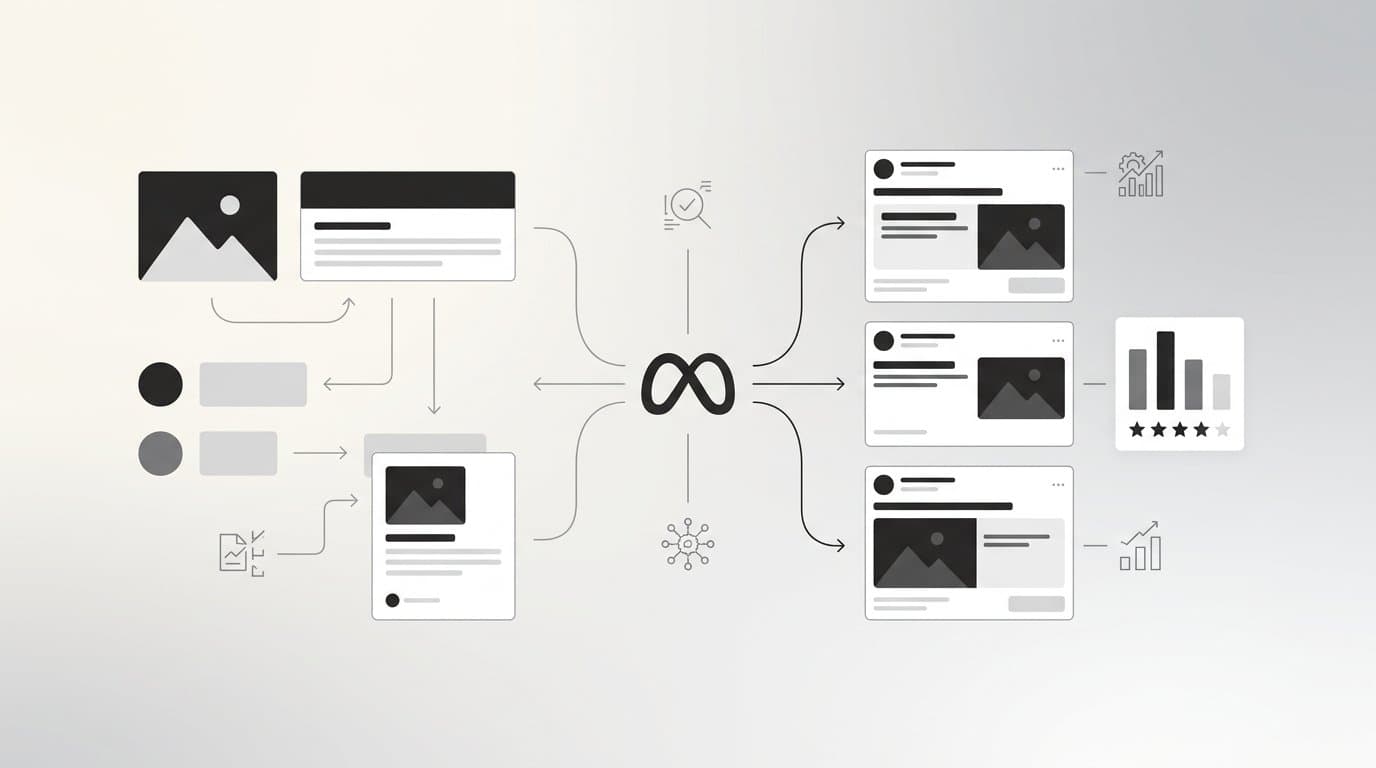
Bulk launching takes this a step further. Rather than manually building each ad variation in Ads Manager, you can mix multiple creatives, headlines, audiences, and copy combinations to generate hundreds of ad variations and deploy them to Meta in a matter of clicks. What used to take a team several hours can happen in minutes. This matters not just for efficiency but for the quality of your creative testing. When production is fast and cheap, you can afford to test more hypotheses, which means you learn faster and find winners sooner.
The analysis side of creative testing has traditionally been another bottleneck. Tracking performance across dozens of variations in spreadsheets, manually calculating which elements are winning, and trying to identify patterns across campaigns is time-consuming and error-prone. AI insights and leaderboard rankings replace that manual process by automatically scoring every creative element against your actual goals. You set your target metrics, and the system surfaces which creatives, headlines, copy angles, and audiences are performing above benchmark and which are not.
Platforms like AdStellar are built around exactly this workflow. The AI Campaign Builder analyzes your historical performance data, ranks every creative and audience element by what has actually worked, and builds complete Meta campaigns with full transparency into the reasoning behind each decision. The Winners Hub keeps your best-performing creatives, headlines, and audiences organized and ready to deploy, so the compounding creative library described earlier is not just a concept but a functional part of your workflow. The AI gets smarter with each campaign cycle, which means the system improves over time in the same way a skilled human analyst would, but without the hours of manual work. For advertisers looking to scale Facebook ads efficiently, this kind of AI-driven workflow is what makes the difference between incremental growth and genuine scale.
The combination of fast creative generation, bulk launching, and AI-powered performance analysis is what makes a facebook ad creative variations strategy viable at real scale. Each piece of the system reinforces the others: faster production enables more testing, more testing generates better data, and better data feeds smarter creative decisions in the next cycle.
Putting It All Together
A creative variations strategy is not a campaign tactic. It is an operating system for your Meta advertising. The advertisers who treat it that way, running structured tests, documenting what they learn, building on winners, and using modern tooling to do it at speed, are the ones who scale profitably over time rather than constantly fighting fires.
The framework is straightforward in principle. Isolate the variables worth testing. Build variation sets organized by concept and execution. Use the right metrics at the right time to evaluate results. Extract the specific elements that drove wins and use them as building blocks for the next generation. And leverage AI tools to remove the production and analysis bottlenecks that make this process impractical at scale.
The compounding effect of this approach is real. Each campaign cycle, you know more about your audience than you did before. Each round of testing starts from a stronger baseline. Each winner you identify shortens the path to the next one.
If you are ready to implement this system without the manual overhead, Start Free Trial With AdStellar and be among the first to launch and scale your ad campaigns faster with an intelligent platform that automatically builds and tests winning ads based on real performance data. The framework is here. The tooling exists. The only variable left is whether you start building the system today.