There is a particular kind of frustration that performance marketers know well. You have the product, the budget, the Meta Ads account, and a clear sense of what you want to achieve. And then the workflow gets in the way.
Not the strategy. Not the targeting. The workflow. The back-and-forth with designers. The approval chains. The manual ad set construction. The guesswork about which creative might actually land. By the time a campaign finally launches, the window you were trying to hit has narrowed, the audience has shifted, and you are already behind on the next round of testing.
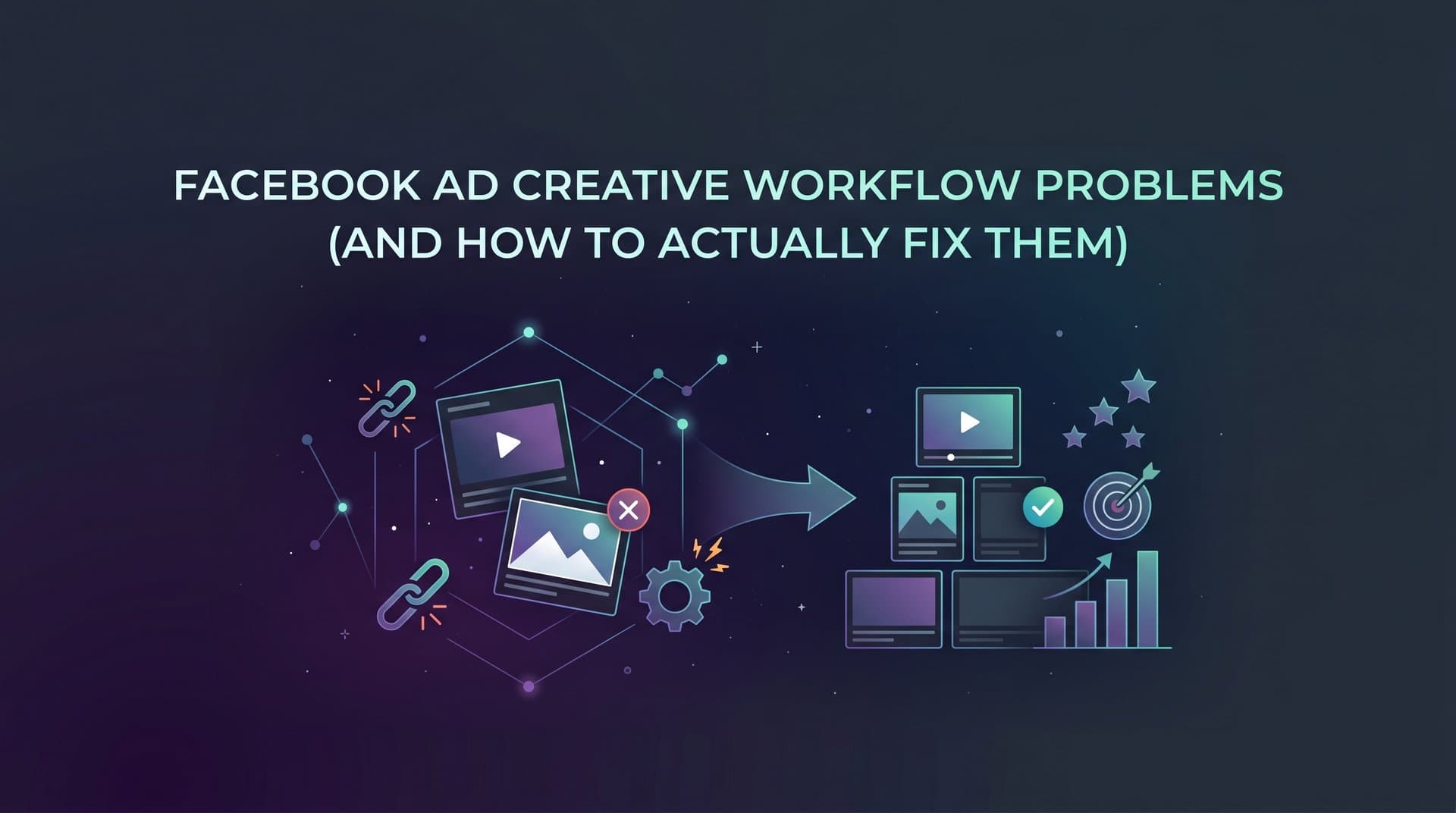
This is not a story about one bad campaign. It is a structural problem that compounds over time, quietly eroding performance, slowing iteration, and making it harder to compete in an ad environment that rewards speed and creative volume. This article is a diagnostic guide. We are going to name the specific Facebook ad creative workflow problems that slow teams down, explain why they happen, and walk through what a modern, systematic workflow actually looks like when those problems are solved.
Why Your Ad Creative Process Is Slower Than It Should Be
The traditional creative production chain has a lot of steps, and each one introduces a potential delay. A strategist writes a brief. A designer picks it up when they have bandwidth. A first draft comes back. Stakeholders review it, leave comments, and the designer revises. Someone needs final approval. Then the asset gets uploaded to Ads Manager and formatted for placements. Then the copy gets written, the targeting gets configured, and the campaign finally goes live.
On paper, that process sounds manageable. In practice, each handoff point is a place where momentum dies. A single revision request can push a launch back by two or three days. A designer who is juggling multiple projects might not get to your brief until next week. An approver who is traveling might not sign off until the following Monday. These delays do not stay isolated. They compound.
For teams running always-on campaigns, this creates a perpetual backlog. You are always waiting on something. The creative for next week's test is stuck in review. The new angle you wanted to try has been sitting in a brief document for ten days. Meanwhile, your current ads are fatiguing, CPMs are creeping up, and you are watching performance decline without the fresh creative needed to reverse it.
The hidden cost here is not just time. It is testing velocity. Every week you spend waiting on creative is a week you are not learning what resonates with your audience. In Meta's ad environment, where the algorithm rewards early performance signals and creative fatigue sets in faster than ever, the ability to iterate quickly is a genuine competitive advantage. Teams that can test a new batch of creatives every week learn faster than teams that test once a month. Over a quarter, that difference in learning velocity translates directly into performance gaps.
There is also the problem of dependency bottlenecks. When the entire creative pipeline runs through one designer, one tool, or one approval process, a single point of failure can halt everything. This is not a people problem. It is a systems problem. The workflow was not designed for the speed that modern Meta advertising demands.
The fix is not to pressure designers to work faster or to streamline the approval email chain. The fix is to remove the dependency entirely where possible, and to build a workflow that does not require a full production cycle every time you want to test a new creative angle.
The Testing Gap: Why a Handful of Creatives Is Never Enough
Ask most marketing teams how many creatives they test in a given campaign, and the answer is usually somewhere between three and six. A few image variations, maybe one video, a couple of headline options. That feels like testing. It is not, at least not in any statistically meaningful sense.
Effective creative testing on Meta requires variation at multiple levels simultaneously: the visual format, the hook, the headline, the body copy, and the audience. A single image ad with one headline is not a test. It is a guess. To actually understand what is driving performance, you need to isolate variables and run enough combinations that patterns can emerge from the data rather than from your intuition.
The reason most teams default to a handful of creatives is not a lack of understanding. It is a practical constraint. Manual ad set construction is slow and error-prone. Building out every combination of creative, headline, copy, and audience in Ads Manager takes hours. For a team already stretched thin, the idea of launching fifty ad variations sounds appealing in theory and exhausting in practice. So teams compress. They pick their best guesses and launch with those.
The problem is that gut-feel decisions about creative performance are frequently wrong. The image you thought would crush it underperforms. The headline that seemed too simple turns out to be the winner. The audience segment you were skeptical about delivers the best CPA. You only know these things if you test them, and you can only test them efficiently if the process of building and launching variations does not require hours of manual work.
Without systematic variation testing across all four dimensions at once, it is also nearly impossible to isolate causality. If you change the creative and the headline at the same time and performance improves, you do not know which change drove the result. You are accumulating spend without accumulating knowledge. That is one of the more expensive mistakes in performance marketing, and it happens constantly because the workflow does not support disciplined testing that would prevent it.
The teams that consistently find winners are not necessarily more creative or more strategic. They are running more tests, more efficiently, and reading the results with more rigor. Workflow is what enables that, or prevents it.
Creative Chaos: When Winning Ads Disappear Into the Noise
Here is a scenario that plays out regularly across marketing teams of all sizes. A campaign runs, a few creatives outperform the others, and the team notes the winners somewhere. Maybe in a spreadsheet. Maybe in a Slack message. Maybe just in someone's memory. A month later, when it is time to build the next campaign, nobody can find that information quickly. The winning creative gets buried in an Ads Manager export. The headline that drove a strong CTR is in a tab that nobody can locate. So the team starts from scratch.
This is not laziness. It is a systems failure. When performance data lives in multiple disconnected places, and when there is no centralized repository for organizing and reusing top performers, institutional knowledge evaporates. Every new campaign effectively starts from zero, even when months of real performance data exist that could inform it.
The problem is compounded by the difficulty of distinguishing genuine winners from temporary spikes. A creative that performed well during a promotional period might not be a structural winner. An ad that spiked in the first 48 hours might have been riding novelty rather than genuine resonance. Without a clear view of performance tied to real metrics over meaningful time windows, teams make decisions based on incomplete pictures.
Subjective opinion tends to fill the gap when objective data is hard to access. The creative that the founder likes. The ad that the account manager remembers as "the one that did well last summer." These impressions are not worthless, but they are not a substitute for a leaderboard tied to actual ROAS and CPA data. When the data is hard to surface, opinions win by default, and that is when creative decisions start drifting away from performance and toward preference.
A centralized system for organizing winners changes the dynamic entirely. When your best-performing creatives, headlines, audiences, and copy are all in one place with real performance data attached, you are not starting from scratch each campaign. You are building on a foundation of proven elements, which is both faster and more likely to produce results.
The Feedback Loop Problem: Slow Data, Slower Decisions
Meta's ad delivery system is responsive. It picks up on early performance signals quickly and adjusts delivery accordingly. That responsiveness is a feature, but it only benefits teams that can read and act on those signals at the same speed. Many teams cannot, and the reason is usually a data visibility problem rather than a strategy problem.
When you do not have real-time access to creative-level performance data, you are making decisions on a delay. You pull a report at the end of the week. You notice a creative is underperforming. You make a change. By the time that change goes live, you have already spent several more days on a losing ad. Multiply that delay across a full campaign and the wasted spend adds up quickly.
The issue is not just speed. It is context. A metric only means something when you know what it means relative to your goals. A 2% CTR might be excellent for one campaign objective and mediocre for another. A CPA of $40 might be a win for one product and a loss for another. When insights are not tied directly to your specific benchmarks, you end up interpreting numbers in a vacuum. That leads to decisions that look data-driven but are actually just as subjective as gut-feel choices.
Goal-based scoring addresses this by anchoring every metric to what you actually care about. Instead of looking at raw numbers and trying to decide if they are good, you see a score that tells you how each creative is performing against your defined targets. That shift from raw data to contextualized insight makes decisions faster and more confident.
Attribution gaps make the problem worse. When there is a disconnect between what you see in Ads Manager and what is actually happening downstream in conversions and revenue, scaling decisions become guesswork. You might be scaling an ad that looks strong on click metrics but is driving poor-quality traffic that does not convert. Without clean attribution tied to real conversion data, you are optimizing for the wrong signals. Integrating your ad platform with a reliable attribution tool closes that gap and gives you a complete picture from ad impression to actual outcome.
What a Modern Ad Creative Workflow Actually Looks Like
Once you map out the specific problems, the shape of the solution becomes clear. A modern ad creative workflow is not just a faster version of the traditional one. It is structurally different, designed to eliminate the bottlenecks that make the traditional approach slow, inconsistent, and difficult to scale.
It starts with creative generation that does not depend on a designer. AI-powered creative tools can produce image ads, video ads, and UGC-style content directly from a product URL, removing the brief-to-asset production cycle entirely. You can generate multiple creative angles in the time it used to take to write a brief. You can clone competitor ads from the Meta Ad Library to understand what is working in your category and build from there. You can refine any ad through chat-based editing rather than waiting for a revision cycle. The result is a creative pipeline that moves at the speed of ideas rather than the speed of production schedules.
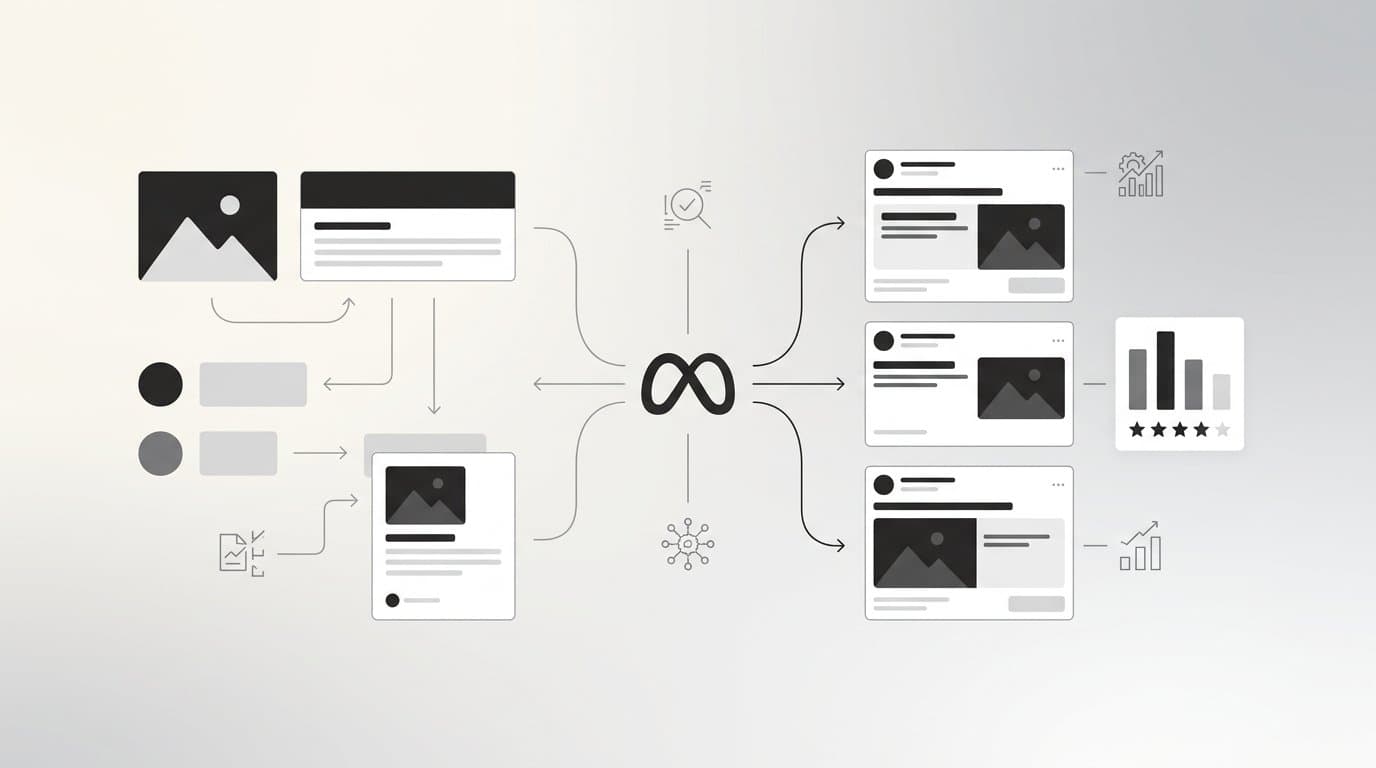
The next layer is bulk ad launching. Instead of manually constructing each ad set in Ads Manager, a modern workflow lets you mix multiple creatives, headlines, audiences, and copy variations and generate every combination automatically. Hundreds of ad variations can go live in minutes. This is what makes meaningful creative testing practical rather than theoretical. You are no longer choosing between testing rigorously and launching on time. You can do both.
Centralized performance insights replace scattered spreadsheets and Ads Manager exports. Leaderboards rank your creatives, headlines, copy, and audiences by the metrics that matter: ROAS, CPA, CTR, benchmarked against your actual goals. Every ad element gets scored against your targets so you can see at a glance what is winning, what is underperforming, and what deserves to be scaled. The guesswork about whether a metric is good gets replaced by a clear, goal-referenced score.
A Winners Hub ties it together by giving you a permanent, organized repository of your best-performing elements. When you are ready to build the next campaign, you are not starting from scratch. You are selecting from a curated library of proven creatives, headlines, and audiences, each with real performance data attached. That continuity is what transforms individual campaign wins into a compounding performance advantage over time.
Platforms like AdStellar are built around exactly this architecture. The AI Creative Hub handles generation and cloning. The AI Campaign Builder analyzes historical data and builds complete campaigns with full transparency into the reasoning behind every decision. Bulk ad launching handles the variation scale. AI Insights with leaderboards handles the performance visibility. The Winners Hub handles the institutional knowledge problem. And Cometly integration closes the attribution gap. It is a connected system rather than a collection of disconnected tools.
Putting It All Together: From Workflow Problems to a Repeatable System
The reason Facebook ad creative workflow problems persist is that teams tend to treat them as separate issues. The creative production delay is a resourcing problem. The limited testing is a bandwidth problem. The lost winners are an organization problem. The slow feedback loop is a reporting problem. Each one gets addressed in isolation, which means none of them actually get solved.
The more useful frame is to see them as a connected system. Slow creative production limits testing scale. Limited testing scale makes winner identification harder. Poor winner identification means campaigns start from scratch instead of building on proven elements. Starting from scratch means the feedback loop never compounds into institutional knowledge. Each problem feeds the next, and fixing one without fixing the others produces limited improvement.
The shift to a modern workflow requires treating production speed, testing scale, winner identification, and feedback loops as one system. When creative generation is fast, testing becomes practical. When testing is systematic, winners emerge from data rather than opinion. When winners are centralized and organized, new campaigns inherit the learning from previous ones. When insights are tied to goals and attribution is clean, scaling decisions are made with confidence rather than guesswork.
Teams that consolidate creative generation, campaign building, and performance analysis into one platform eliminate the handoff friction that causes most workflow delays. There is no gap between the creative tool and the campaign builder. No export and re-import cycle between the ad platform and the reporting dashboard. No separate system for tracking what worked. Everything is connected, which means the learning loop tightens with every campaign rather than resetting.
Over time, this compounding effect is what separates teams that consistently improve from teams that plateau. The first campaign informs the second. The second informs the third. Each iteration starts from a stronger foundation because the system captures and applies what was learned rather than discarding it.