Dropshipping lives and dies by the quality of its Facebook ads. Unlike brands with established audiences or loyal repeat buyers, dropshipping businesses depend almost entirely on paid traffic to drive sales. That means your ads need to stop the scroll, communicate value instantly, and convert cold audiences into buyers, often for products those people have never heard of before.
The challenge most dropshippers face is not knowing what to advertise, but how to create ads fast enough to test, iterate, and scale before a winning product window closes. Hiring designers or video editors is slow and expensive. Building creatives manually inside Meta's Ads Manager is tedious. And guessing which creative angle will resonate with a cold audience wastes budget you cannot afford to burn.
This guide walks you through a practical, step-by-step process for using a Facebook ad creator built for the pace and demands of dropshipping. You will learn how to generate multiple creative formats quickly, set up campaigns that test variations systematically, read performance data to identify winners, and scale what works without starting from scratch each time.
Whether you are launching your first dropshipping product or managing multiple stores, this process will help you move from product idea to live, optimized Facebook ads in a fraction of the time it used to take. By the end, you will have a repeatable system for creating, launching, and scaling Facebook ads that fits the fast-moving nature of dropshipping.
Step 1: Gather Your Product Assets and Define Your Creative Angle
Before you open any ad creation tool, spend time gathering what you actually need. This step sounds obvious, but skipping it is one of the most common reasons dropshipping campaigns underperform right out of the gate.
Start by collecting your core assets: your product URL, high-quality product images, and any existing customer language. Customer reviews are especially valuable here. The words real buyers use to describe a product, the problems they mention, the benefits they highlight, are often more persuasive than anything a copywriter would invent. Mine those reviews for hooks and headline ideas before you write a single word of ad copy.
Next, define two to three distinct creative angles. For cold dropshipping audiences, these three tend to perform best consistently:
Problem-Solution: Lead with the frustration or pain point your product addresses, then position the product as the fix. This angle works well for functional or novelty products where the "why" is not immediately obvious.
Lifestyle Benefit: Show the positive outcome of owning the product rather than the product itself. This angle resonates when the emotional or aspirational appeal is stronger than the functional one.
Social Proof: Lead with credibility signals, such as customer results, review counts, or popularity indicators. This angle reduces the perceived risk of buying from an unfamiliar brand, which is a real barrier for cold dropshipping audiences.
At this same stage, identify your target audience demographics and interests. Many dropshippers make the mistake of defining their audience after they have already built creatives, which leads to a mismatch between the message and the person receiving it. Know who you are talking to before you decide how to talk to them.
Finally, check the Meta Ad Library to see what your competitors are running. Look at the formats they are using, the hooks they are leading with, and how long their ads have been running. Ads that have been running for weeks or months are typically profitable ones. That is useful signal for both your angle and your format choices. Understanding dropshipping with Facebook ads at a strategic level will sharpen every creative decision you make from this point forward.
Success indicator: You have a clear product URL, a defined audience profile, and at least two distinct creative angles documented before you move to the next step.
Step 2: Generate Multiple Creative Formats with AI
Here is where the pace of modern dropshipping advertising changes dramatically. Instead of briefing a designer, waiting for drafts, and going through rounds of revisions, you can generate a full suite of ad creatives from your product URL in minutes.
The key principle is format diversity. Different placements and audiences respond differently to different creative formats, and you cannot know in advance which will win. That means you need at least one static image ad, one short-form video ad, and one UGC-style creative in your initial batch.
Static image ads are fast to produce and work well for straightforward product presentations. Short-form video ads are particularly effective for demonstrating product functionality, which matters a lot for the novelty and problem-solving products that dominate dropshipping catalogs. UGC-style creatives, designed to look like organic user content rather than polished brand advertising, tend to perform well with cold audiences because they blend into the feed and reduce the psychological friction of buying from an unfamiliar brand. When producing video creatives, make sure you understand the correct video size for Facebook ads to avoid cropping or quality issues across placements.
AdStellar's AI Creative Hub lets you generate all three formats directly from a product URL. Paste in the URL and the AI pulls product information, generates visual concepts, and produces creatives across formats without requiring a designer, video editor, or actor. You can also clone competitor ads directly from the Meta Ad Library, which is a significant shortcut when you already know a specific angle or format is working in your niche.
Once your initial creatives are generated, use the chat-based editing feature to refine them. Want to test a different headline? Swap it without rebuilding the creative. Need to adjust the visual emphasis or change the call-to-action? Do it through the chat interface rather than starting over. This is where you apply your defined creative angles, making sure each creative clearly reflects either the problem-solution, lifestyle benefit, or social proof angle you identified in Step 1. Using AI copywriting for Facebook ads at this stage can significantly sharpen your hooks and headlines across every format.
Aim to have six to ten distinct creatives by the end of this step. That might sound like a lot, but with AI generation it is achievable in under an hour. The variety is what makes systematic testing possible.
Common pitfall: Generating only one creative type and assuming it will perform across all placements and audiences. It will not. Format diversity is not optional if you want reliable testing data.
Success indicator: You have six to ten distinct creatives across static, video, and UGC formats, each clearly tied to one of your defined creative angles.
Step 3: Build Your Campaign Structure for Systematic Testing
Having great creatives is only half the equation. If your campaign structure is sloppy, you will not be able to tell what is actually driving results, and you will end up making decisions based on noise rather than signal.
The goal of your campaign structure at this stage is isolation. You want to be able to look at performance data and clearly attribute differences to specific variables, whether that is a creative, a headline, an audience, or a combination of the three.
A clean testing structure for dropshipping looks like this: one campaign with a single objective, multiple ad sets each targeting a distinct audience segment, and multiple ads within each ad set representing different creatives. This setup lets you compare audiences against each other at the ad set level, and compare creatives against each other within each audience at the ad level.
For new dropshipping stores with no historical data, start with interest-based audiences and broad targeting as your baselines. Interest-based audiences give Meta's algorithm enough signal to find relevant users, while a broad targeting ad set lets the algorithm work without constraints. Running both gives you useful comparison data from day one. Developing a strong AI targeting strategy for Facebook ads at this stage will help you build audience segments that are genuinely distinct rather than overlapping.
For stores with existing campaign history, the process gets smarter. AdStellar's AI Campaign Builder analyzes your historical performance data and ranks every creative, headline, and audience segment by past performance. It then builds a complete campaign structure with explained rationale for every decision it makes. You are not just getting a campaign, you are getting a strategy with the reasoning behind it. That transparency matters because it helps you understand the logic, not just follow instructions blindly.
The AI gets smarter with every campaign you run. As you feed it more performance data, its recommendations become more refined and more tailored to what actually works for your specific products and audiences.
Tip: Keep your daily budget modest per ad set during the testing phase. The goal right now is data collection, not volume. Spreading a small budget across too many ad sets dilutes the learning signal for each one.
Success indicator: Your campaign is structured so you can clearly attribute performance differences to specific creatives or audiences without ambiguity.
Step 4: Launch Ad Variations in Bulk Without Manual Setup
If you have ever built a campaign manually inside Meta Ads Manager while testing multiple creatives across multiple audiences, you know how painful it is. Duplicating ad sets, swapping creatives, updating naming conventions, checking that every variation is set up correctly. For a dropshipper testing several products simultaneously, this process alone can consume hours every week.
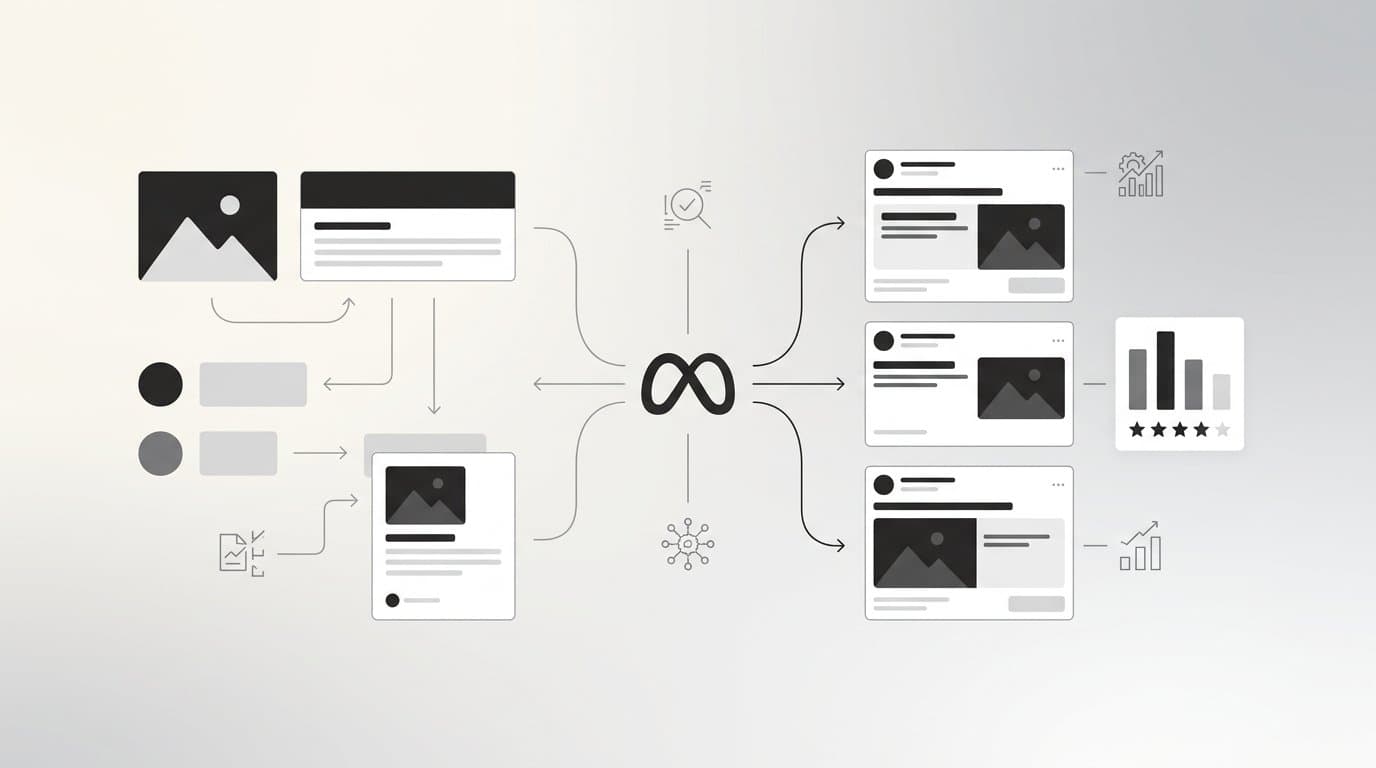
Bulk ad launching eliminates that bottleneck entirely. The concept is straightforward: instead of manually creating each ad variation one by one, you define your inputs (creatives, headlines, copy, audiences) and let the system generate every possible combination automatically, then push them all live to Meta at once. This is exactly the kind of workflow that bulk Facebook ad creation tools are designed to enable at scale.
AdStellar's Bulk Ad Launch feature does exactly this. You can mix multiple creatives, headlines, audiences, and copy variations at both the ad set level and the ad level. The platform generates every combination and launches them to Meta in minutes rather than hours. For a dropshipper testing six creatives across three audience segments with two headline variations, that is 36 distinct ad variations created and launched without manual setup for each one.
It helps to understand the difference between the two levels of variation:
Ad-level variation: Different creatives running to the same audience within a single ad set. This tells you which creative resonates best with that specific audience.
Ad set-level variation: The same creative running to different audiences across multiple ad sets. This tells you which audience responds best to a given creative.
Running both simultaneously gives you a matrix of data that would take significantly longer to build manually. And because everything is launched with consistent naming conventions, tracking performance by creative angle and audience segment becomes straightforward rather than chaotic.
Common pitfall: Launching too many variations with too little budget. If each variation only receives a few dollars of spend before you evaluate it, the data is not statistically meaningful. Decide on a minimum spend threshold per variation before you consider the results reliable enough to act on. What that threshold is depends on your product price point and target CPA, but the principle is the same: give each variation enough runway to show you something real.
Success indicator: All variations are live in Meta with consistent naming conventions, and you can track performance by both creative angle and audience segment without confusion.
Step 5: Read Performance Data and Identify Winning Combinations
Data without interpretation is just noise. This step is about turning the numbers your campaigns generate into clear decisions about what to keep, what to cut, and what to scale.
For dropshipping Facebook ads, the metrics that matter most are ROAS (Return on Ad Spend), CPA (Cost Per Acquisition), CTR (Click-Through Rate), and add-to-cart rate. ROAS and CPA are your ultimate performance indicators, but they require enough conversion volume to be reliable. In the early days of a campaign, add-to-cart rate serves as a leading indicator of purchase intent before you have enough purchase data to draw conclusions. A high add-to-cart rate with low purchases often points to a checkout or pricing issue rather than an ad problem. Knowing the average click-through rate for Facebook ads in your niche gives you a meaningful benchmark for evaluating whether your creatives are performing above or below expectations.
The challenge with manual analysis is that it scales poorly. When you have dozens of ad variations running across multiple ad sets, pulling data into spreadsheets and sorting through it to find patterns takes time you could spend on the next product test.
AdStellar's AI Insights feature solves this with leaderboard rankings that surface top performers across creatives, headlines, copy, and audiences in real time. You set your target goals, and the AI scores every element against those benchmarks. Instead of building pivot tables, you see immediately which combinations are winning and which are dragging down your results. A dedicated Facebook ad performance tracking dashboard makes this kind of real-time analysis far more actionable than manual spreadsheet reviews.
When reviewing your data, look for two distinct types of winners:
Creative winners show high CTR and strong engagement. They are good at stopping the scroll and generating interest. But a high CTR does not automatically mean a strong ROAS.
Campaign winners show strong ROAS and acceptable CPA. These are the combinations that are actually profitable, which is ultimately what you are optimizing for in dropshipping.
Look for patterns across your winners. Is a specific creative format consistently outperforming others? Is a particular headline style driving more conversions? Is one audience segment delivering better ROAS across multiple creatives? These patterns are more valuable than any single winning ad because they inform every campaign you run going forward.
Common pitfall: Pausing ads too early before they have enough data, or keeping underperformers running too long out of hope. Set clear rules for both decisions before you launch, and stick to them.
Success indicator: You can clearly identify your top two to three performing combinations and articulate specifically why they are winning, not just that they are.
Step 6: Scale Winners and Build a Reusable Creative Library
Scaling in dropshipping is not simply increasing the budget on your best-performing ads. Done that way, it often leads to audience fatigue, rising CPAs, and diminishing returns. Sustainable scaling is about systematically replicating what works across new audiences and new products, not just pouring more money into the same well.
Horizontal scaling is the more durable approach for most dropshipping advertisers. Instead of only increasing budget on winning ad sets, you take your proven creatives and expand them to new audience segments. This maintains performance consistency while broadening your reach, and it reduces the risk of burning out a single audience with too much frequency. Dropshippers running Facebook ads for ecommerce businesses at scale consistently rely on this horizontal approach to sustain ROAS as they grow.
To do this efficiently, you need your winning assets organized and accessible. AdStellar's Winners Hub stores your top-performing creatives, headlines, audiences, and copy with real performance data attached to each one. When you are ready to launch a new product or expand to a new audience, you are not starting from memory or digging through old campaign exports. You are pulling from a library of validated assets with documented results.
Cloning a winning creative for a new product or seasonal angle is straightforward from the Winners Hub. Take the structure that worked, the format, the hook style, the visual approach, and adapt it for the new context. You are not starting from scratch; you are building on a proven foundation. Using an AI-powered Facebook ads platform to manage this scaling process ensures your winning patterns are applied consistently rather than lost between product launches.
This approach compounds over time. Every campaign you run adds to your library of proven elements. Every winning creative becomes a template. Every successful audience segment gets documented for future use. The result is that each new product launch gets faster and more targeted because you are leveraging what you already know works.
Tip: Treat every winning creative as a template and document what made it work. Was it the angle? The format? The specific hook in the first three seconds? The more precisely you can articulate why something worked, the faster your next round of creative generation will be.
Success indicator: You have a library of proven assets with performance data attached and a clear, repeatable process for pulling them into new product launches without starting from zero each time.
Your Dropshipping Ad System at a Glance
Here is the complete six-step workflow condensed into a quick reference:
1. Gather assets and define angles: Collect your product URL, images, and customer language. Define two to three creative angles and identify your target audience before touching any tool.
2. Generate multiple creative formats: Use AI to produce static image ads, video ads, and UGC-style creatives from your product URL. Aim for six to ten distinct creatives across formats.
3. Build a structured campaign: Set up one objective, multiple ad sets with distinct audiences, and multiple ads per ad set. Use AI campaign building for stores with historical data.
4. Launch variations in bulk: Mix creatives, headlines, audiences, and copy to generate every combination automatically and push them live to Meta without manual setup for each one.
5. Read the data and find winners: Track ROAS, CPA, CTR, and add-to-cart rate. Use AI leaderboards to surface top performers without manual spreadsheet analysis.
6. Scale winners and build your library: Expand proven creatives to new audiences horizontally. Store winning assets with performance data so every future launch starts from a stronger foundation.
The goal is a repeatable system, not a one-time campaign. The dropshippers who win consistently on Facebook are not the ones with the biggest budgets. They are the ones who test the most variations the fastest and scale what the data tells them to scale.
AI-powered tools compress every stage of this process significantly. What used to take days of design work, manual campaign setup, and spreadsheet analysis can now happen in hours. That speed advantage compounds over time, especially when you are managing multiple products or stores.
AdStellar offers a 7-day free trial, which is a low-risk way to run this entire workflow on your next product launch and see the difference firsthand. Start Free Trial With AdStellar and run your first AI-generated dropshipping campaign today.