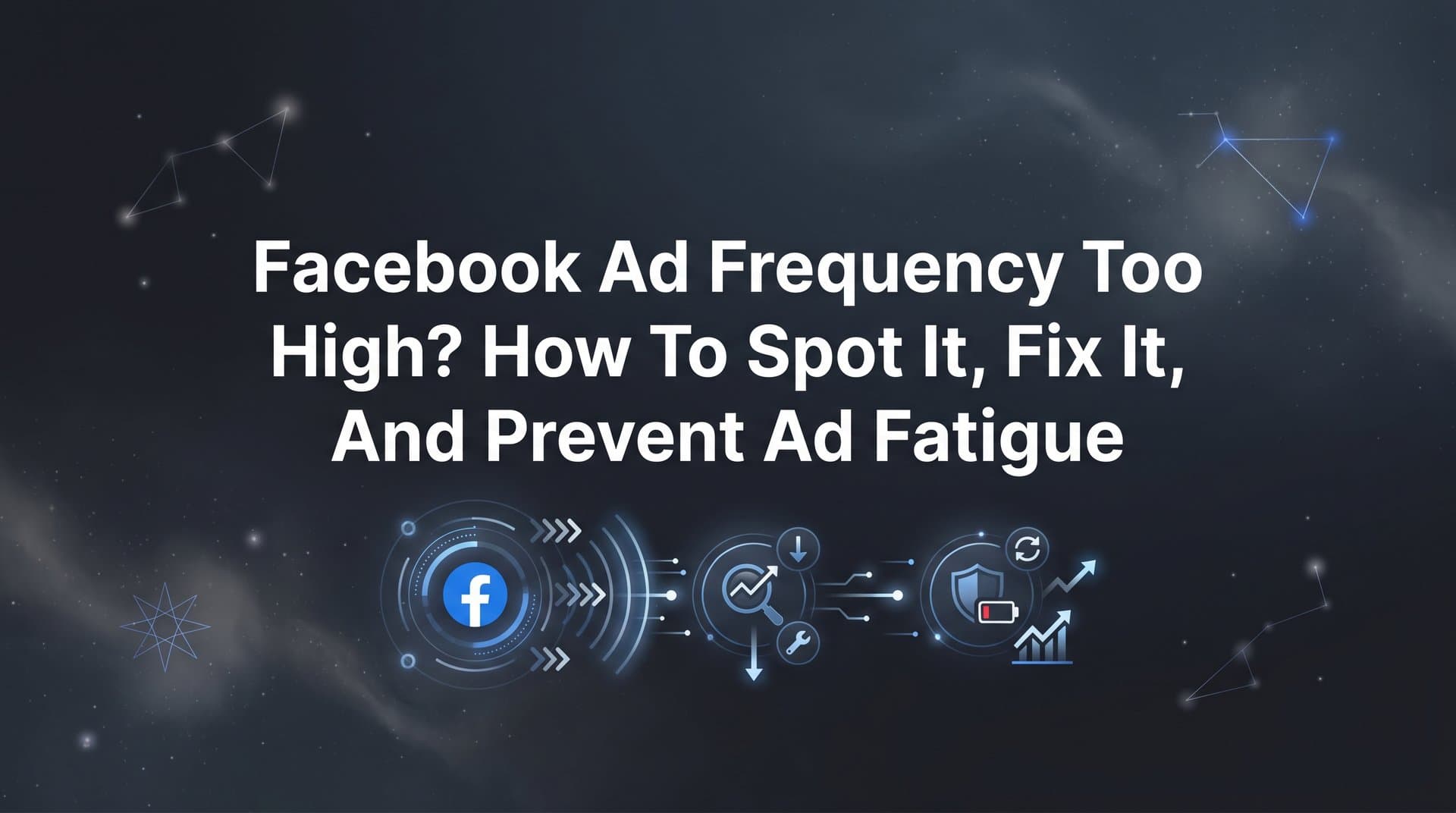
Let's talk about a silent budget killer that shows up in almost every Facebook ad account sooner or later. Your campaign looks fine on the surface: spend is stable, ads are running, and Meta isn't throwing any errors. But then you dig into the numbers and notice something uncomfortable. Your cost per acquisition has been quietly climbing for two weeks. Your click-through rate has drifted downward. And your frequency? It's sitting at 7.4.
That number tells a story. It means the average person in your audience has seen your ad more than seven times. Some have seen it twice. Others have seen it a dozen times and are actively tuning it out, hiding it, or clicking the "I don't want to see this" button. Every one of those actions sends a negative signal to Meta's algorithm, which responds by charging you more to reach the same people.
High Facebook ad frequency is one of the most common and costly problems in performance advertising. It doesn't announce itself loudly. It creeps up gradually while you're focused on other things, and by the time the damage shows up in your ROAS, you've already burned through budget on an audience that stopped listening weeks ago.
This guide covers everything you need to know: what frequency actually measures, how to recognize when it's too high, why it keeps happening, and the concrete strategies that keep your campaigns fresh and profitable. Whether you're managing a single account or running ads for a portfolio of clients, getting a handle on frequency is one of the highest-leverage moves you can make.
What Ad Frequency Actually Measures (And Why the Number Lies a Little)
Facebook ad frequency is calculated by dividing total impressions by total reach. If your ad generated 50,000 impressions and reached 10,000 unique people, your frequency is 5. Simple enough. But here's the part that trips people up: it's an average.
That frequency of 5 doesn't mean every person in your audience saw your ad exactly five times. It means the average is 5. In practice, the distribution is uneven. Some users might have seen the ad once or twice. Others, particularly those who fit Meta's delivery algorithm preferences, may have seen it ten, fifteen, or even twenty times. When you see a frequency of 5 in your dashboard, the real exposure for your most-served users is likely much higher.
This matters because ad fatigue doesn't hit everyone at the same moment. It hits the people who've been overserved first, and those tend to be the users Meta considers most likely to convert, which means you're burning out your best prospects fastest.
The relationship between frequency and fatigue is fairly predictable. As people see the same creative repeatedly, their engagement drops. They scroll past it. They stop reading the headline. Eventually, some will actively dismiss it by hiding the ad or reporting it as irrelevant. Each of those negative interactions feeds back into Meta's auction system, signaling that your ad is a poor experience. Meta responds by reducing your ad quality rankings and increasing what you pay per impression. The result is a compounding problem: higher frequency leads to lower engagement, which raises costs, which means you're spending more to reach the same fatigued audience even less effectively.
One thing worth clarifying early: there is no single frequency number that's universally "too high." Context matters significantly. For cold prospecting audiences, people who have never heard of your brand, performance often starts to decline around a frequency of 2 to 3. These users have no prior relationship with you, so repeated exposure to the same message quickly feels intrusive rather than persuasive.
Warm retargeting audiences are different. Because these users already know your brand and have shown some level of interest, they can tolerate higher frequencies, often in the 5 to 7 range, before fatigue sets in meaningfully. They're further along in the decision process, so multiple touchpoints can actually reinforce the message rather than annoy. Understanding these nuances is essential when building high-converting Facebook campaigns that sustain performance over time.
The right frequency threshold for your campaigns depends on creative quality, audience warmth, and campaign objective. The key is establishing your own benchmarks and monitoring them consistently rather than waiting for performance to collapse before paying attention.
Red Flags That Your Facebook Ad Frequency Is Too High
Frequency-driven fatigue rarely announces itself with a single dramatic drop. It typically shows up as a slow deterioration across several metrics at once. Knowing what to look for, and where to look, is what separates advertisers who catch it early from those who discover it after significant budget has been wasted.
Declining click-through rate over time: CTR naturally fluctuates, but a consistent downward trend over one to two weeks on a campaign with stable targeting is a strong signal. The audience has seen the ad enough times that the creative no longer earns a click. They know what it says before they finish reading it.
Rising CPC and CPA: When clicks become harder to earn, you pay more for each one. When conversions dry up because the engaged portion of your audience has already converted or tuned out, your cost per acquisition climbs. If your CPA is rising while your budget stays flat, frequency is often the first place to investigate. This pattern is one of the most common reasons Facebook ad costs get too high across accounts of all sizes.
Increasing negative feedback: Meta Ads Manager allows you to add a column for negative feedback, which captures ad hides and reports. A spike in this metric is a clear sign that people are actively rejecting your ad rather than simply ignoring it. This is particularly damaging because negative feedback directly influences your ad quality rankings.
Flat or declining conversions despite stable spend: If you're spending the same amount but generating fewer conversions, and your landing page and offer haven't changed, you've likely saturated the audience. The people most likely to convert have already done so or have been overexposed to the point of disengagement.
To monitor these signals effectively, set up a custom column view in Meta Ads Manager that shows frequency, CTR, CPC, CPA, and negative feedback side by side. Using dedicated Facebook ad optimization tools can make this monitoring process significantly more efficient and actionable.
The hidden cost that many advertisers overlook is what high frequency does to Meta's perception of your ad quality. Meta replaced its original single relevance score with three separate rankings: Quality Ranking, Engagement Rate Ranking, and Conversion Rate Ranking. High frequency, combined with the negative feedback it generates, can push all three rankings downward. Lower rankings mean you're less competitive in the ad auction, which means Meta charges you more per impression even when you're bidding the same amount. You end up paying a frequency tax on top of the direct waste from serving a burned-out audience.
Why Your Frequency Keeps Climbing in the First Place
Understanding the root causes of high frequency is important because the fix depends on the cause. There are three main culprits, and most accounts are dealing with at least one of them at any given time.
Audience size is too small for the budget: This is the most straightforward cause. If you're spending a meaningful daily budget against a narrow audience, Meta will exhaust the reach quickly and start recycling impressions. Think about the math: a $100 daily budget targeting an audience of 10,000 people will generate frequency problems within days. The budget-to-audience ratio is out of balance, and Meta has no choice but to serve the same people repeatedly. A Facebook ad budget allocation tool can help you balance spend across audiences to prevent this kind of saturation.
Creative stagnation: Running the same two or three ad creatives for weeks is one of the most common drivers of frequency problems. When Meta's algorithm has a limited creative pool to work with, it keeps cycling through the same options. Even if the algorithm tries to vary delivery, your audience is still seeing the same visuals and messaging over and over. Fresh creatives give the algorithm new options to serve, which naturally distributes impressions more broadly and reduces the per-person exposure on any single ad.
Audience overlap across ad sets: This is the most overlooked cause, and it's particularly tricky because it's invisible at the individual ad set level. If you're running multiple ad sets that target overlapping audiences, the same person may be seeing ads from several of your ad sets simultaneously. Each ad set reports its own frequency, but the user's actual exposure to your brand is the sum of all of them. A person seeing ads from three overlapping ad sets, each with a reported frequency of 3, is actually experiencing a combined frequency of 9. When Facebook ad targeting gets too complicated, overlap issues tend to multiply quickly.
Meta provides an Audience Overlap tool inside Ads Manager that lets you compare audiences across ad sets. If you find significant overlap, consolidating those ad sets is often the fastest way to reduce effective frequency without changing anything else about your campaigns.
Proven Strategies to Lower Frequency and Beat Ad Fatigue
Once you've identified that frequency is a problem, the response needs to be deliberate. Pausing an ad and hoping things reset isn't a strategy. Here are the approaches that actually work.
Creative rotation at scale: This is the single most effective lever for managing frequency. Introducing fresh creatives regularly means your audience encounters new visuals, new hooks, and new messaging angles even if the underlying offer hasn't changed. The key is variety across formats, not just content. Rotating between static image ads, video ads, and UGC-style content creates meaningfully different feed experiences that can re-engage users who had tuned out a previous format. Investing in the right Facebook ad creative tools makes this rotation sustainable at scale.
The practical challenge is volume. You need enough creative variations to rotate through meaningfully, which means having multiple options across different hooks, visual styles, and calls to action. The more variations you have in testing simultaneously, the faster winners emerge, and the less dependent you are on any single creative staying fresh.
Audience expansion and restructuring: If your audience is too narrow, broaden it. This might mean expanding interest targeting, testing lookalike audiences at varying percentages (1%, 3%, 5%), or using Meta's Advantage+ audience settings to let the algorithm find new pockets of your target market that you haven't explicitly defined. Consolidating overlapping ad sets reduces hidden frequency inflation and often improves overall delivery efficiency at the same time.
For brand awareness and reach campaigns, Meta offers frequency capping directly within the Reach and Frequency buying type. This lets you set a hard limit on how many times a person sees your ad within a given time window. For auction-based performance campaigns, direct frequency caps aren't available, so audience management and creative rotation are your primary tools.
Budget and delivery adjustments: If a specific ad set has high frequency and declining performance, reducing its daily budget slows the pace of impression delivery and gives the audience more breathing room between exposures. Shifting that budget toward fresher ad sets or newer audiences puts your spend where it can work harder. Using Advantage Campaign Budget (Meta's campaign-level budget optimization) can help automate this: it allocates spend dynamically across ad sets based on delivery efficiency, which naturally tends to reduce concentration on saturated, high-frequency ad sets.
Scheduled creative refreshes: Rather than waiting for performance to drop before swapping creatives, build a proactive refresh schedule. Set a frequency threshold for each audience type, such as 3 for cold audiences and 6 for warm retargeting, and have new creatives ready to deploy when those thresholds are hit. This turns frequency management from a reactive scramble into a predictable workflow.
Building a Creative Pipeline That Prevents Frequency Problems
Here's the honest truth about frequency management: the reactive approach rarely works well. By the time you notice frequency is too high and performance has degraded, you've already paid the price. The real solution is upstream, in how you produce and deploy creatives before fatigue has a chance to set in.
The long-term fix is maintaining a steady pipeline of fresh creative assets so you always have new options ready to launch before any single creative wears out its welcome. This shifts the dynamic entirely. Instead of scrambling to find something new after performance collapses, you're proactively rotating in fresh material on a schedule.
The practical challenge is production speed. Designing image ads, filming video content, and editing UGC-style creatives takes time and resources. Most teams, especially smaller ones, end up running the same creatives far longer than they should simply because producing new ones is slow and expensive. This is exactly why so many accounts end up with frequency problems: it's not that advertisers don't know they should refresh their creatives. It's that the production bottleneck makes it hard to keep up. If Facebook ad creation takes too long, frequency problems become almost inevitable.
AI-powered creative tools change this equation significantly. Platforms like AdStellar can generate image ads, video ads, and UGC-style avatar content from a product URL, clone high-performing competitor ads from the Meta Ad Library, or build creatives from scratch using AI. What used to take a designer and a video editor days can happen in minutes, which means you can maintain the creative volume needed to stay ahead of frequency problems without scaling your production team.
A sustainable workflow looks something like this. Monitor frequency weekly across all active campaigns, segmented by audience type. Set clear thresholds that trigger a creative refresh, for example, frequency hitting 3 for cold prospecting audiences or 6 for retargeting. When a threshold is crossed, pull new creatives from your pipeline and use bulk ad creation tools to test multiple variations simultaneously. AdStellar's bulk launch capability lets you mix different creatives, headlines, audiences, and copy to generate hundreds of ad combinations and push them live in minutes rather than hours.
The winners that emerge from that testing cycle go into your Winners Hub, where you can track their performance over time and pull them back into rotation for future campaigns. The creatives that fatigue get retired. The pipeline keeps moving.
This approach also feeds AdStellar's AI Campaign Builder, which analyzes historical performance data to understand which creative elements, audiences, and messaging angles have worked before. Over time, the system gets better at predicting what will work, which means your creative pipeline becomes not just faster but smarter.
Your Frequency Management Checklist
Managing Facebook ad frequency is an ongoing discipline, not a one-time fix. The best-performing advertisers treat it as a regular part of their workflow rather than an emergency response. Here's a practical checklist to keep things on track.
Set up frequency monitoring: Add frequency as a custom column in Meta Ads Manager alongside CTR, CPC, CPA, and negative feedback. Review these metrics together at least weekly, not in isolation.
Establish frequency thresholds by audience type: Define what "too high" means for each segment you run. Cold prospecting audiences typically need a refresh around frequency 2 to 3. Warm retargeting audiences can often sustain up to 5 to 7 before performance meaningfully degrades. Document these thresholds and use them consistently.
Audit audience overlap regularly: Use Meta's Audience Overlap tool to check for significant overlap between ad sets. Consolidate where necessary to prevent hidden frequency inflation that won't show up in any single ad set's reporting.
Maintain a creative refresh cadence: Don't wait for performance to drop. Have new creatives ready to deploy before your thresholds are hit. Vary formats across image, video, and UGC-style content to keep the feed experience genuinely different rather than just swapping one static image for another.
Use bulk launching to test at scale: The more creative variations you test simultaneously, the faster you identify winners and the less reliant you are on any single creative staying fresh. Bulk launching is the fastest way to build a rotation library.
Review ad quality rankings: Keep an eye on your Quality Ranking, Engagement Rate Ranking, and Conversion Rate Ranking in Ads Manager. Declining rankings alongside rising frequency is a clear signal that fatigue is affecting your auction performance.
If you're ready to take the manual work out of this process, Start Free Trial With AdStellar and see how AI-powered creative generation, bulk ad launching, and real-time performance insights work together to keep your frequency in check and your campaigns scaling efficiently. One platform from creative to conversion, with no designers, no video editors, and no guesswork required.