Managing Facebook ad campaigns shouldn't feel like herding cats. Yet here you are—toggling between seventeen browser tabs, hunting for that one creative file buried in Slack, double-checking whether you used the correct naming convention, and wondering if you remembered to turn off that test campaign from last week.
The problem isn't your competence. It's that modern Facebook advertising demands juggling dozens of moving parts simultaneously: creative assets, audience segments, budget allocations, performance data, team communications, and campaign structures. Without a systematic approach, each new campaign becomes an exercise in reinventing the wheel while praying you didn't forget something critical.
This is where facebook ad workflow management transforms everything. Rather than treating each campaign as a standalone project, workflow management creates repeatable systems that handle the operational heavy lifting automatically. The result? You spend less time on mechanical tasks and more time on what actually moves the needle—strategic decisions that improve performance.
Understanding the Five Pillars of Ad Workflow Excellence
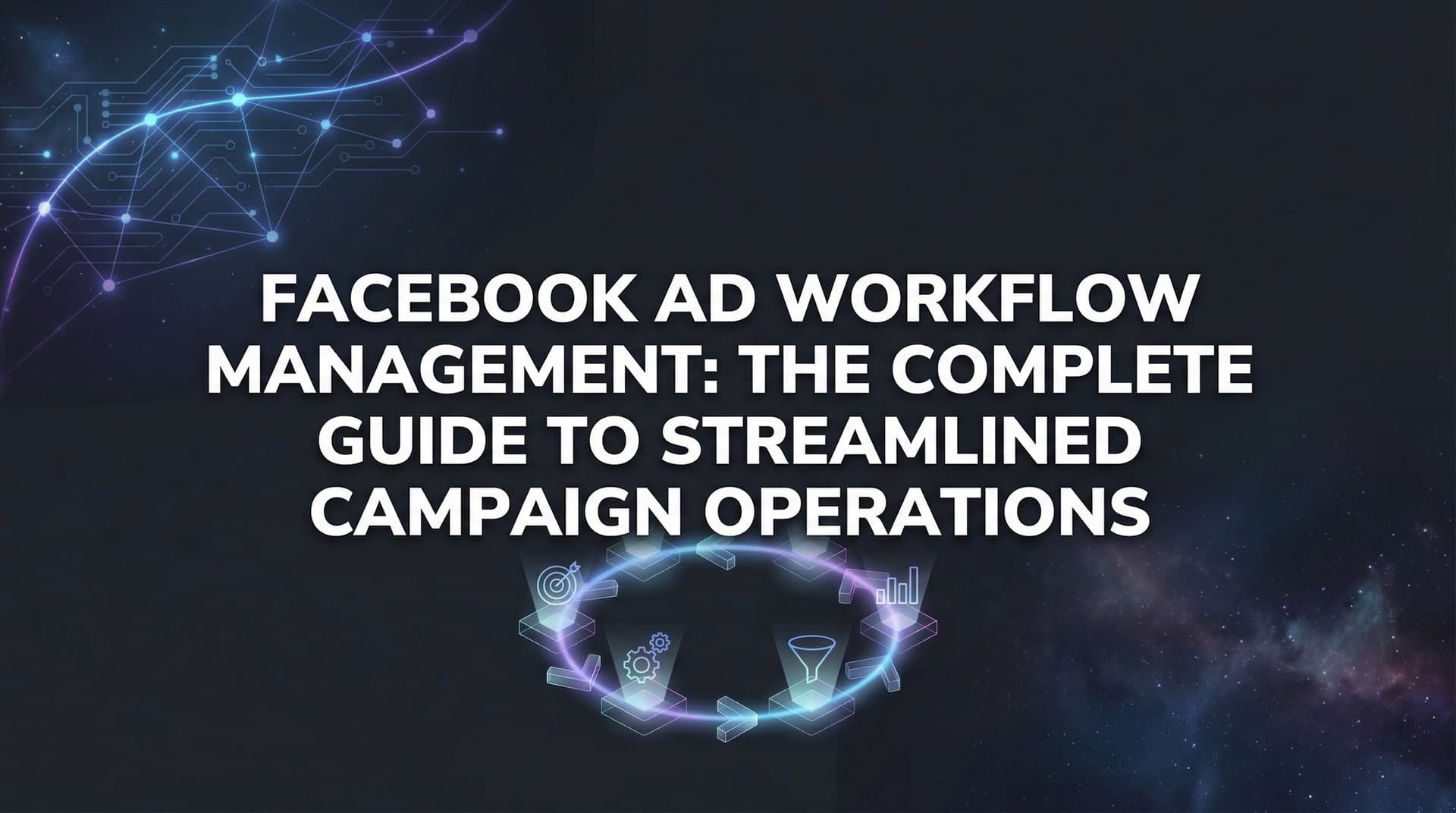
Think of facebook ad workflow management as the operating system for your advertising operations. Just as your computer's OS manages resources and coordinates applications, your workflow system orchestrates the five essential stages that every campaign passes through.
Planning: This is where campaigns are born. You define objectives, identify target audiences, set budgets, and establish success metrics. Without structured planning, campaigns launch with misaligned expectations and unclear success criteria. The planning stage answers the fundamental question: what are we trying to accomplish and how will we know if we succeeded?
Asset Preparation: Creative assets don't materialize magically. This stage involves briefing designers, collecting product information, writing ad copy, and organizing everything for easy retrieval. When asset preparation breaks down, you get bottlenecks—media buyers waiting on creatives, designers unclear on requirements, and launch dates slipping.
Campaign Building: Here's where strategy becomes reality. You structure campaigns in Ads Manager, configure targeting parameters, upload creatives, and set bidding strategies. This stage is deceptively time-consuming because it's highly manual and error-prone. One misplaced decimal point or incorrect audience selection can waste significant budget. Understanding why campaign building takes hours instead of minutes is the first step toward fixing it.
Launch and Quality Assurance: Before spending a dollar, campaigns need verification. Are tracking pixels firing correctly? Do all links work? Are budgets set appropriately? This quality gate prevents expensive mistakes from reaching live traffic.
Performance Monitoring: Once campaigns are live, the optimization cycle begins. You track metrics, identify winning variations, pause underperformers, and feed insights back into planning for future campaigns. This stage never really ends—it loops continuously, each iteration informing the next.
The magic happens when these stages connect seamlessly. Information flows from planning into asset preparation. Creative briefs inform campaign structures. Performance data shapes future planning decisions. When workflows break down, it's usually at these connection points—handoffs where information gets lost or delayed.
Compare this systematic approach to ad-hoc campaign management, where each advertiser operates independently with their own methods. Ad-hoc approaches work fine at small scale, but they don't scale. As campaign volume increases, inconsistency compounds. You can't effectively analyze cross-campaign performance when every campaign uses different naming conventions. You can't quickly launch new tests when creative assets are scattered across email threads and desktop folders.
Creating a Campaign Planning System That Actually Works
Great campaigns begin with clear planning, but most planning happens in scattered conversations and mental notes that evaporate by launch day. A structured planning framework captures essential information upfront and makes it accessible throughout the campaign lifecycle.
Start with campaign briefs—documents that answer the fundamental questions before anyone touches Ads Manager. What business objective does this campaign serve? Who exactly are we targeting and why? What's our budget and how should it be allocated? What creative approach will we test? What does success look like quantitatively?
These aren't academic exercises. Campaign briefs prevent the "I thought you meant..." conversations that waste time and budget. When your creative team understands the target audience and campaign objective, they produce more relevant assets. When media buyers know the success metrics upfront, they optimize toward the right outcomes.
Naming conventions sound bureaucratic until you're trying to analyze performance across fifty campaigns and can't tell which is which. Establish a consistent structure that encodes key information into campaign names. Many teams use formats like: [Date]_[Product]_[Audience]_[Objective]_[Version]. This makes campaigns instantly identifiable and enables filtering and analysis at scale.
The same principle applies to organizational structures within Ads Manager. Decide upfront how you'll group campaigns—by product line, by funnel stage, by audience type. If you're struggling with Facebook ad structure, consistency here pays dividends when you need to quickly assess performance across similar campaigns or allocate budget strategically.
Approval processes often become bottlenecks, but they don't have to. The key is clarity about who needs to approve what and by when. Creative reviews shouldn't wait until the day before launch. Budget approvals shouldn't require hunting down stakeholders. Build these checkpoints into your timeline and establish clear communication channels—whether that's dedicated Slack channels, project management tools, or regular check-in meetings.
The goal isn't to create bureaucracy. It's to eliminate the friction that comes from unclear expectations and last-minute scrambling. When everyone knows their role, deadlines, and deliverables, campaigns launch smoothly and on schedule.
Organizing Creative Assets for Speed and Scale
Your creative library is either your secret weapon or your biggest headache. The difference comes down to organization. When assets are tagged, categorized, and instantly retrievable, you can launch tests quickly and iterate based on performance. When they're scattered across folders, devices, and team members, every new campaign starts with a treasure hunt.
Build a tagging system that captures the dimensions you care about. Tag creatives by product, by format (image, video, carousel), by theme or message, by performance tier (winner, test, archive), and by any other attributes relevant to your testing strategy. This enables powerful filtering: "Show me all video ads for Product X that performed in the top quartile."
Cloud-based asset management systems make this practical. A dedicated Facebook ads creative management platform can organize strategically, letting you find what you need in seconds, not minutes.
Modular creative templates accelerate variation testing. Instead of creating each ad from scratch, build templates with swappable elements. A video ad template might have interchangeable hooks, product demonstrations, and calls-to-action. This lets you rapidly test combinations without requiring entirely new creative production for each variation.
The handoff between creative teams and media buyers deserves special attention because it's where workflows often break down. Designers need clear specifications: exact dimensions, file formats, character limits for text overlays. Media buyers need context: what was the creative strategy, what audience is this designed for, are there any testing priorities?
Establish a standard handoff format. This might be a shared folder with organized subfolders and a brief document explaining the creative approach. Or it could be a project management task with all assets attached and key information in the description. The specific tool matters less than consistency and completeness.
Eliminating Manual Work Through Smart Automation
If you're manually creating each ad set, duplicating campaigns by hand, and copying-pasting targeting parameters, you're working ten times harder than necessary. Facebook ad workflow management reaches its full potential when you identify repetitive tasks and automate them.
Consider the typical campaign build process. You're testing three audience segments against four creative variations with two different landing pages. That's twenty-four unique ad combinations. Building these manually means creating each ad set individually, uploading each creative, configuring each audience, setting budgets, and verifying everything works. This process can easily consume hours.
Bulk operations transform this equation. Instead of building ads one at a time, you prepare your variations in a structured format—often a spreadsheet—and launch everything simultaneously. What took hours now takes minutes. More importantly, bulk launching reduces errors because you're working from a single source of truth rather than repeatedly entering information manually.
The time savings compound when you're running multiple campaigns. Testing new creative against your standard audience segments? Bulk launch. Expanding a winning campaign to new geographic markets? Bulk launch. Seasonal promotions across your product catalog? Bulk launch. Learning how to automate Facebook ad creation is essential for teams serious about scaling.
But automation isn't just about speed—it's about consistency and quality. Pre-launch checklists ensure nothing falls through the cracks. Before any campaign goes live, verify: tracking pixels are installed and firing correctly, all links lead to the intended destinations, budgets are set appropriately, targeting parameters match the campaign brief, ad copy passes compliance requirements, and naming conventions are followed.
Smart automation tools can handle much of this verification automatically. They check for common errors, flag potential issues, and ensure campaigns meet your standards before spending begins. This quality gate catches mistakes when they're free to fix rather than after they've consumed budget. The best Facebook ad automation tools combine speed with built-in quality controls.
The key is identifying which tasks to automate. Start with the most time-consuming, repetitive activities that follow predictable patterns. Campaign builds, budget adjustments across similar campaigns, and routine performance checks are prime candidates. Strategic decisions about creative direction, audience expansion, and budget allocation still benefit from human judgment.
Building Performance Monitoring Systems That Drive Action
Checking campaign performance shouldn't require logging into Ads Manager, exporting data to Excel, creating pivot tables, and squinting at numbers for thirty minutes. Yet that's exactly how many advertisers spend their mornings. Effective performance monitoring delivers insights automatically and highlights what requires attention.
Start by defining what matters. Not every metric deserves equal attention. Identify your North Star metrics—the outcomes that truly indicate success—and build monitoring systems around them. For e-commerce, that might be return on ad spend and cost per purchase. For lead generation, cost per qualified lead and lead-to-customer conversion rate. For awareness campaigns, cost per thousand impressions and engagement rates.
Dashboard systems pull these key metrics into a single view, updated in real-time. Instead of hunting through multiple reports, you see campaign health at a glance. Color coding helps: green for campaigns exceeding targets, yellow for those requiring attention, red for underperformers needing immediate action.
Automated alerts take this further by proactively notifying you when something needs attention. Set thresholds for your key metrics and receive notifications when campaigns cross them. Spending accelerates beyond daily budget? Get alerted. Cost per result exceeds your target by 20%? Get alerted. A new ad variation is significantly outperforming others? Get alerted.
This shifts your role from data gatherer to decision maker. Instead of spending time identifying issues, you spend time solving them. The system surfaces what matters, and you apply strategic judgment about what to do next. Understanding what Facebook campaign optimization really means helps you focus on the metrics that drive results.
Decision frameworks bring consistency to optimization. Rather than making reactive decisions based on gut feel, establish clear criteria for common scenarios. When do you pause an underperforming ad? Perhaps when it's spent at least three times your target cost per result without generating conversions. When do you scale a winner? Maybe when it maintains target performance for three consecutive days at current spend levels.
These frameworks don't eliminate judgment—they provide starting points that you refine based on experience. Over time, you develop institutional knowledge about what works in your specific context.
The real power comes from closing the feedback loop. Performance insights should flow back into planning for future campaigns. Which audiences consistently outperform? Prioritize them in upcoming tests. What creative themes resonate most? Develop more variations in that direction. Which landing pages convert best? Apply those learnings across campaigns. Mastering how to improve Facebook ad ROI requires this systematic approach to learning.
Document these insights systematically. A simple shared document where you capture key learnings after each campaign creates organizational memory. Six months later, when you're planning a similar campaign, you have a knowledge base to draw from rather than starting from scratch.
Your Roadmap to Workflow Transformation
Transforming your facebook ad workflow management doesn't happen overnight, and it doesn't require rebuilding everything simultaneously. Start with the areas causing the most pain and delivering the biggest time savings.
For most teams, campaign building and launching represents the highest-impact opportunity. If you're manually creating campaigns, moving to bulk operations immediately frees up hours per week. Discovering how to build Facebook ad campaigns faster creates breathing room to tackle other workflow improvements.
Next, address your asset organization. If you're wasting time hunting for creatives or recreating assets you know exist somewhere, implementing a structured library pays immediate dividends. This doesn't require fancy tools—start with organized folders and consistent naming.
Then layer in planning frameworks and performance monitoring systems. These take longer to show returns but compound over time as your campaigns become more strategic and data-driven.
Common pitfalls derail workflow implementations. The biggest? Overengineering. You don't need perfect systems—you need systems that work better than what you have now. Start simple and evolve based on what you learn. Another trap: implementing workflows without team buy-in. If people don't understand why changes matter or how they benefit, adoption suffers. Involve your team in designing workflows and address their concerns upfront.
AI-powered tools are accelerating workflow adoption by handling complexity automatically. Rather than manually building campaign structures, configuring targeting, and organizing creative testing, intelligent systems can analyze your objectives and performance data to build optimized campaigns in minutes. The latest AI-powered Facebook ads software applies consistent naming conventions, implements best practices, and handles the operational details that consume time.
This doesn't replace strategic thinking—it amplifies it. When AI handles campaign construction and routine optimization, you focus on higher-level decisions: which markets to enter, what products to promote, how to position against competitors. The workflow becomes less about mechanics and more about strategy.
Making Excellence Repeatable
Effective facebook ad workflow management isn't about adding complexity to your operations—it's about creating systems that make excellence the default rather than the exception. When workflows handle the operational details consistently, you eliminate the errors and inefficiencies that drain budgets and time.
The five workflow stages—planning, asset preparation, campaign building, launch verification, and performance monitoring—work together as an integrated system. Strengthen the connections between stages, and your entire operation becomes more efficient. Information flows smoothly, handoffs happen cleanly, and insights from performance feed back into planning.
Remember that workflows should evolve with your needs. What works when you're running five campaigns monthly won't scale to fifty. What works for a single product line might need adjustment when you expand to multiple products. Build flexibility into your systems and revisit them regularly as your operation grows. Understanding scaling Facebook ad campaigns efficiently means your workflows must grow with you.
The best time to improve your workflows was six months ago. The second-best time is now. Start by documenting your current process—even if it's messy. Identify the biggest bottlenecks and time sinks. Pick one area to improve first, implement changes, measure the impact, and iterate. Small improvements compound into significant operational advantages.
Ready to transform your advertising strategy? Start Free Trial With AdStellar AI and be among the first to launch and scale your ad campaigns 10× faster with our intelligent platform that automatically builds and tests winning ads based on real performance data. Our AI agents handle the workflow heavy lifting—from campaign structure to creative optimization—so you can focus on strategy while the system executes flawlessly.