There's a specific kind of frustration that every performance marketer eventually encounters. A campaign is humming along beautifully at $50 a day. Your CPA is solid, ROAS is healthy, and everything looks like a green light to scale. So you push the budget to $200 a day, sit back, and wait for the results to multiply.
Instead, your CPA spikes. ROAS craters. The campaign that looked like a winner now looks like a money pit, and you're left wondering whether you broke something or whether the whole thing was a fluke to begin with.
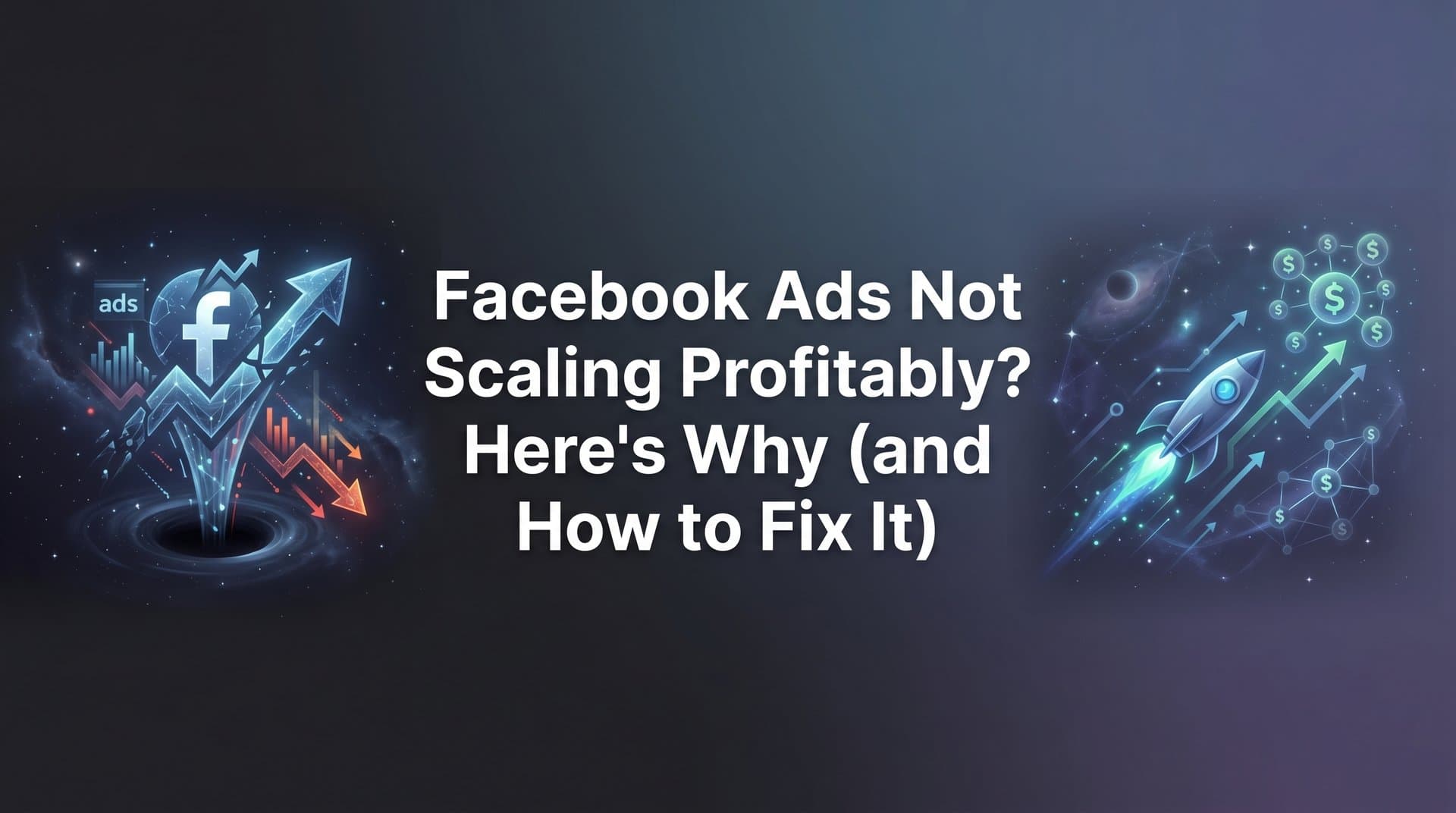
This is one of the most common and most demoralizing experiences in Meta advertising. And the frustrating part is that it's rarely random. Facebook ads not scaling profitably almost always traces back to a handful of identifiable, fixable root causes. The campaign didn't break because Meta is unpredictable or because your product stopped working. It broke because scaling introduces specific pressures that small-budget campaigns never have to face.
This article breaks down exactly what those pressures are and how to address each one systematically. From algorithm behavior and creative fatigue to audience structure and attribution gaps, you'll walk away with a clear picture of why profitable scaling is hard and a concrete framework for making it work.
Why Profitable Campaigns Break When You Increase Budget
The first thing to understand is that Meta's ad delivery system is not a simple tap you can turn up. It's a learning machine, and learning machines behave differently under different conditions.
When you make a significant budget change, typically anything above roughly 20% of your current daily spend, Meta's algorithm treats it as a meaningful shift in campaign parameters. This can trigger what's commonly called a learning phase reset. During this period, the algorithm is essentially re-exploring delivery: testing different users, times, and placements to figure out how to spend your new budget efficiently. Delivery becomes volatile, costs inflate, and performance often looks worse before it stabilizes. If you panic and cut the budget back, you restart the cycle.
The practical implication is that rapid budget jumps are often self-defeating. Many experienced media buyers recommend a gradual approach, increasing budgets incrementally and allowing the algorithm time to restabilize between changes. This is slower, but it preserves the delivery efficiency your campaign has already built.
Then there's the audience saturation problem. At lower budgets, Meta serves your ads to the highest-intent, most relevant users in your target audience first. These are the people most likely to convert, and your early results reflect that. As you increase spend, Meta works through those high-value users more quickly and begins reaching progressively less qualified segments. Your conversion rate dips, your CPA rises, and the audience that made your campaign look great is now largely exhausted.
This is frequency creep in action. When the same users see your ad repeatedly without converting, your relevance signals weaken, and the algorithm starts working harder to find new delivery opportunities. That extra effort costs more.
Finally, there's the auction dynamics layer. More spend means competing in more auctions, often at higher budget levels where stronger advertisers with bigger creative libraries and more historical data are also bidding. CPMs rise as you move into more competitive auction territory, compressing your margins even if conversion rates hold steady. A campaign that was profitable at a $12 CPM may not be profitable at a $22 CPM, even with identical creative and targeting. Understanding these scaling challenges is the starting point for building effective countermeasures.
Creative Fatigue: The Silent Scaling Killer
Ask any experienced Meta advertiser what kills scaling campaigns, and creative fatigue will come up almost every time. At low budgets, your ads reach a small slice of your audience slowly. At high budgets, the same ads are served to a much larger portion of your audience much faster. The result is that creative assets burn out in days rather than weeks.
When users see the same ad repeatedly, engagement drops. Click-through rates decline, relevance signals weaken, and Meta's algorithm responds by either reducing delivery or increasing the cost to maintain it. By the time most advertisers notice the problem, performance has already degraded significantly.
The way to diagnose creative fatigue before it tanks your campaign is to watch three metrics closely. First, frequency: if your ad frequency is climbing above two or three impressions per user per week and performance is declining, fatigue is likely a factor. Second, CTR trends: a consistent week-over-week decline in click-through rate on a specific creative is a reliable early signal. Third, relevance and quality rankings inside Ads Manager: dropping quality scores often correlate with an audience that has seen your ad too many times.
Catching these signals early gives you time to rotate in fresh creative before performance fully collapses. But this leads to the deeper problem: the creative volume challenge.
Scaling profitably requires a continuous pipeline of fresh ad variations. Images, videos, UGC-style content, different hooks, different formats. Most marketing teams simply cannot produce creative at the speed that high-budget campaigns consume it. A traditional workflow involving designers, video editors, copywriters, and approval rounds might produce a handful of new ads per week. A scaling campaign might exhaust those assets in a few days.
This is where the gap between teams that scale successfully and those that don't often lives. It's not strategy or budget. It's creative output velocity. The teams winning at scale have figured out how to produce more variations faster, whether through streamlined internal processes, freelance networks, or AI-powered creative generation tools that can produce image ads, video ads, and UGC-style content from a product URL without designers or video editors in the loop.
The underlying principle is simple: if you want to scale spend, you need to scale creative. There's no sustainable path around it.
Audience Structure Mistakes That Cap Your Growth
Audience strategy that works at $50 a day often actively works against you at $500 a day. The instinct to control targeting precisely is understandable, but over-segmentation is one of the most common structural mistakes that prevents profitable scaling.
Here's what happens: you create multiple narrow ad sets targeting slightly different audience segments, each with its own budget. These ad sets frequently overlap, meaning Meta is essentially running your ads against the same users from multiple directions simultaneously. The ad sets compete against each other in the auction, driving up your own costs. Meanwhile, each individual ad set has a smaller budget and a smaller audience, which means the algorithm has less data to optimize against and reaches the learning phase threshold more slowly. Avoiding these campaign structure mistakes is critical for anyone trying to scale.
Meta's own guidance consistently points in the opposite direction: consolidate ad sets, give the algorithm larger audiences, and let it find converters within broader pools rather than trying to manually engineer who sees your ads. This isn't just platform preference. It reflects how the delivery system actually works. More data per ad set means faster learning, more stable delivery, and better optimization over time.
Advantage+ audiences represent Meta's most direct expression of this philosophy. Rather than defining tight demographic or interest parameters, Advantage+ gives Meta's algorithm significant latitude to find users likely to convert based on your campaign objective and historical data. Many advertisers who have resisted broad targeting find that Advantage+ outperforms their carefully constructed manual audiences at scale, precisely because the algorithm has more room to optimize.
Lookalike audiences introduce a different challenge as you scale. A 1% lookalike built from your best customers is highly targeted and often performs well at modest budgets. But when you need to reach more people, you expand to 2%, 5%, or 10% lookalikes. Quality degrades as you move further from your seed audience. The solution is not to keep expanding the same lookalike, but to refresh your seed audiences regularly. Build new lookalikes from recent purchasers, high-value customers, or users who completed specific high-intent actions. Fresh seed data produces stronger lookalikes, even at broader percentages.
The structural principle for scaling is to design your audience strategy for expansion from the beginning, not as an afterthought when performance starts declining.
Testing at Scale: Where Most Advertisers Go Wrong
One of the most costly mistakes in scaling Meta campaigns is conflating testing with scaling. They are fundamentally different activities, and running them inside the same campaign creates problems that undermine both.
When you test unproven creative, audience, and copy combinations inside your scaling campaign, you're spending scaling budget on variables that haven't earned their place yet. You're also muddying the data. If a new creative underperforms, is it because the creative is weak, or because the audience it's running against isn't the right fit? Without isolation, you can't know. And without knowing, you can't improve.
A structured testing framework separates these two activities clearly. Testing campaigns run with controlled, smaller budgets and are designed to isolate one variable at a time: a new creative concept, a different headline approach, an alternative copy angle, or a new audience segment. The goal is to gather clean data on each variable independently before combining elements. A well-designed campaign structure makes this separation much easier to maintain.
Once a variable proves itself in testing, it gets promoted to the scaling campaign, where it joins other proven elements. The scaling campaign is reserved for combinations that have already demonstrated they can convert. This keeps your scaling budget focused on what works and prevents unproven variables from dragging down overall performance.
The challenge is volume. Proper testing requires testing many variations to find the ones worth scaling. If you're manually creating ads one at a time, building a meaningful test library takes weeks. By the time you have results, the market may have shifted or your competitors have already found the winning angles.
This is where bulk launching changes the economics of testing. When you can generate hundreds of ad variations by mixing creatives, headlines, audiences, and copy combinations in minutes rather than hours, you can run meaningful tests quickly, gather data faster, and promote winners to your scaling campaigns with confidence. The speed advantage compounds: faster testing means faster learning, which means faster scaling.
The advertisers who scale most effectively treat their testing pipeline as a production system, not a one-off exercise. They're always generating new variations, always feeding data back into the process, and always promoting the next round of winners.
Attribution Gaps That Distort Your Scaling Decisions
Here's a scenario that plays out constantly in performance marketing: a campaign looks unprofitable in Ads Manager, so the advertiser cuts it. But backend revenue data tells a different story. The campaign was actually driving conversions that never got attributed back to the ad.
Since Apple's iOS 14.5 App Tracking Transparency update, attribution on Meta has become meaningfully less reliable. Users who opt out of tracking cannot be tracked across apps and websites, which means conversions they complete after seeing or clicking an ad often go unrecorded in Meta's reporting. The result is systematic underreporting of actual campaign performance, and many advertisers are still making scaling decisions based on incomplete data. This is one of the hidden reasons why so many Facebook ads appear unprofitable when they actually aren't.
The practical consequence is that campaigns get killed prematurely. A campaign showing a $45 CPA in Ads Manager might have an actual CPA of $32 when you account for conversions that weren't attributed. If your target CPA is $40, that's the difference between cutting a winner and scaling it.
Addressing this requires looking at multiple data sources in parallel. Ads Manager data gives you one view. Your CRM, Shopify dashboard, or order management system gives you another. Comparing Meta-reported conversions against actual backend revenue over the same time period reveals the attribution gap and helps you calibrate how much to trust platform data.
Server-side tracking integrations, such as the Meta Conversions API, help close this gap by sending conversion signals directly from your server rather than relying solely on browser-based pixel tracking. This captures conversions that the pixel misses due to ad blockers, browser restrictions, or iOS opt-outs, giving Meta's algorithm better data to optimize against and giving you a more accurate picture of true performance.
Platforms that integrate with attribution tools, like AdStellar's integration with Cometly, give advertisers a consolidated view of performance data that accounts for these gaps. When your scaling decisions are based on accurate attribution rather than underreported platform data, you make fewer premature cuts and more confident investments in campaigns that are actually working.
Building a Scaling System That Actually Works
Everything covered so far points toward the same conclusion: scaling profitably on Meta is a systems problem, not a settings problem. You can't solve it by finding the right interest to target or the right bid strategy. You solve it by building a repeatable workflow that addresses creative volume, audience structure, testing discipline, and attribution accuracy simultaneously.
A practical scaling workflow looks like this. It starts with creative generation at volume: producing a steady stream of image ads, video ads, and UGC-style content in multiple formats and angles. Not one or two new creatives per week, but dozens of variations that can be tested quickly and rotated in as fatigue sets in on current assets.
Those creatives then enter a structured testing phase, where they're launched in controlled campaigns that isolate variables and generate clean performance data. The ability to mix multiple creatives, headlines, audiences, and copy combinations and launch them all at once compresses what would otherwise be weeks of manual work into a matter of minutes. Leveraging scaling automation is what makes this level of throughput possible.
Performance data from testing feeds into a clear winner identification process. Which creatives are driving the best CTR? Which headlines are producing the lowest CPA? Which audiences are converting at the highest ROAS? The answers to these questions determine what gets promoted to the scaling campaign and what gets retired.
Winners then anchor the scaling campaign, supported by continuous creative rotation to prevent fatigue and regular audience refreshes to prevent saturation. Attribution data from both the platform and backend systems informs budget decisions, ensuring you're scaling campaigns that are actually profitable rather than ones that only look profitable in a single reporting view. For a deeper dive into this entire process, our guide on how to scale Facebook ads profitably covers each step in detail.
This is the workflow that AdStellar is built to power. The AI Creative Hub generates image ads, video ads, and UGC-style content directly from a product URL, or clones competitor ads from the Meta Ad Library for inspiration. The AI Campaign Builder uses specialized agents to analyze your historical campaign data, rank every creative, headline, and audience by performance, and build complete Meta campaigns with full transparency into every decision. Bulk launching creates hundreds of ad variations in minutes. The AI Insights leaderboard ranks everything by real metrics like ROAS, CPA, and CTR, scored against your specific goals. And the Winners Hub keeps your best-performing assets organized and ready to deploy into the next campaign.
The result is a continuous learning loop where every campaign makes the next one smarter. Instead of starting from scratch each time, you're building on a growing library of proven elements, and the system gets better at predicting winners as it accumulates more data.
Moving Forward: From Stalled Campaigns to Scalable Growth
Facebook ads not scaling profitably is rarely a platform problem. Meta's advertising system is sophisticated and powerful. The bottlenecks are almost always on the advertiser's side: not enough creative volume, an audience structure built for control rather than expansion, a testing process that can't keep pace with spend, or attribution data that's too incomplete to support confident decisions.
The fixes are clear. Maintain a steady pipeline of fresh creatives so fatigue never gets ahead of you. Structure your audiences for algorithmic expansion rather than manual micromanagement. Keep testing and scaling in separate campaigns so your data stays clean and your scaling budget stays focused. And close your attribution gaps so you're making decisions based on what's actually happening, not what the platform can see.
Each of these fixes is achievable independently. But the advertisers who scale most effectively aren't solving them one at a time. They're running a system where all of these elements work together, informed by real performance data and continuously refined with each campaign cycle.
If you're ready to stop troubleshooting scaling problems one by one and start running a system designed to handle them all, Start Free Trial With AdStellar and experience a platform built specifically to solve these scaling bottlenecks, from AI creative generation to campaign building to performance insights. The 7-day free trial gives you the full picture.