Most Facebook advertisers test. The problem is how they test. A new creative goes up, results disappoint, so the audience gets swapped. That does not work either, so the copy gets rewritten. Three weeks and several hundred dollars later, you have no idea what the actual problem was, and you are back to square one with a new set of hunches.
This is not testing. It is expensive guessing with extra steps.
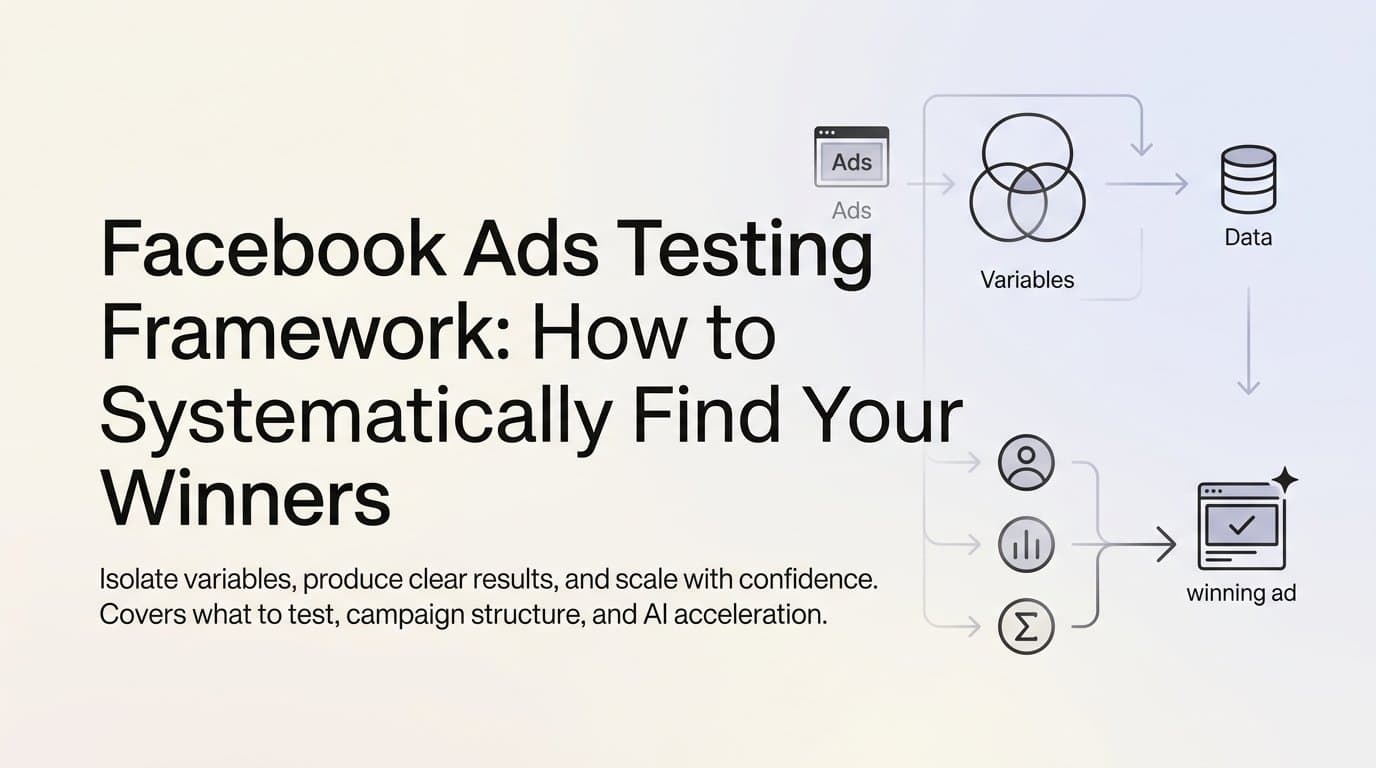
The difference between advertisers who consistently find winning ads and those who burn through budget without answers comes down to one thing: a structured Facebook ads testing framework. Not a random series of experiments, but a deliberate system that isolates variables, gathers meaningful data, and produces decisions you can actually defend.
This article breaks down exactly how to build that system. You will learn which variables to test and in what order, how to structure your campaigns so results stay clean and interpretable, how to scale winners without destroying them, and how AI is changing what is possible for teams that want to test faster and smarter. Whether you are managing a modest budget or running accounts at scale, the principles here apply the same way.
Why Random Testing Destroys Your Ad Budget
Here is the core problem with how most advertisers approach testing: they change too many things at once. A new creative goes live with a different audience, updated copy, and a tweaked headline all at the same time. If performance improves, which variable gets the credit? If it tanks, which one caused the damage? You genuinely cannot know, and that means you cannot replicate the win or avoid the loss.
This is not a minor inefficiency. It compounds. When you cannot isolate what worked, you carry bad assumptions forward into your next campaign. A weak creative paired with the wrong audience can make a strong offer look like a failure. You end up pausing a product that could have converted well, simply because the test was designed in a way that made it impossible to read the results correctly.
The other common failure mode is pulling tests too early. Meta's delivery system needs time and data to optimize. When advertisers see two days of poor performance and shut down an ad set, they often kill something that was still in the learning phase, before the algorithm had enough signal to find the right people. The conclusion becomes "that creative didn't work" when the real issue was impatience.
A real Facebook ads testing framework is built on three principles that fix both of these problems.
Isolate one variable at a time. Every test should have a single independent variable. Everything else stays constant. This is the only way to produce data that tells you something actionable.
Define success before you launch. Decide in advance what metric you are optimizing for and what threshold constitutes a meaningful result. Do not interpret results after the fact based on whichever number looks best.
Wait for statistically meaningful data. Determine minimum thresholds for impressions and conversions before you make any decisions. Gut feel is not a data point.
None of this is complicated in theory. The challenge is maintaining this discipline when you are under pressure to find a winner quickly and the temptation to "just try a few things" is constant. A structured framework is what keeps you honest.
The Four Variables Every Testing Framework Must Cover
A complete Facebook ads testing framework addresses four distinct variables. Each one affects performance in a different way, and each one needs to be tested separately before you start combining learnings.
Creative (image, video, UGC-style formats): This is the highest-leverage variable on Meta, and it is not particularly close. The algorithm rewards ads that generate strong early engagement signals, which means creative quality directly affects how efficiently your budget gets spent. A compelling creative gets cheaper delivery because Meta shows it to more people organically within your target. A weak one gets penalized. Creative fatigue is also the most common reason winning campaigns eventually decay: the same audience sees the same ad too many times, engagement drops, and costs climb. For all of these reasons, creative testing should be your first priority and your most frequent testing activity.
Audience (cold, warm, lookalike, custom audiences): The same creative can perform dramatically differently depending on who sees it. Cold traffic audiences, lookalike audiences built from your customer list, and warm retargeting audiences based on website visitors all respond differently to the same message. Audience testing is important, but it should follow creative testing in your sequence. There is no point in finding your best audience if you are serving them a mediocre creative.
Copy and headlines: The hook in your first line of copy and the headline beneath your creative play a larger role than many advertisers give them credit for. These elements determine whether someone who pauses on your ad actually clicks through. Testing different value propositions, different emotional angles, and different calls to action can meaningfully shift your CTR and conversion rate. Headline testing in particular tends to be underinvested. Small wording changes can produce notable differences in how people respond.
Offer and landing page: This variable sits outside Ads Manager, but it is part of your framework whether you account for it or not. The best creative and the most dialed-in audience will not save a weak offer or a landing page that fails to convert. The key is to isolate offer and landing page testing from your other variables. Do not change your creative and your landing page in the same test cycle. If you do, you will not know which change drove the result.
Think of these four variables as a hierarchy. Creative first, then audience, then copy, then offer. Each layer builds on the one before it, and working through them in sequence gives you a foundation of learnings that compounds over time.
Building Your Testing Sequence Step by Step
Knowing what to test is one thing. Knowing how to structure the actual test is where most frameworks break down in practice.
Start with creative, and start with enough variations to generate real signal. A test with two creatives is better than nothing, but it gives you limited information. Ideally, you want to test at least three to five creative variations in a single round, covering different formats or angles. This gives the algorithm enough to work with and gives you a clearer read on which direction to pursue. Keep everything else constant: same audience, same copy, same budget per variation.
Define your primary KPI before you launch, not after. This is one of the most important disciplines in structured testing, and one of the most commonly skipped. Different funnel stages call for different metrics. If you are testing top-of-funnel creative, CTR and cost per link click may be your primary signal. If you are running a conversion campaign, CPA or ROAS is what matters. Pick one metric per test. If you wait until after the test to decide which number to optimize for, you will unconsciously choose the metric that flatters the result you were hoping for, which defeats the purpose entirely.
Set minimum data thresholds before you make any decisions. This is where patience becomes a competitive advantage. The exact thresholds depend on your budget and your conversion volume, but a general principle applies: you need enough conversions to distinguish a real pattern from noise. For conversion-focused campaigns, many practitioners use a minimum of 30 to 50 conversions per variation before drawing conclusions. For awareness or traffic campaigns, impression volume and frequency matter more. Whatever your thresholds are, set them before launch and commit to them.
Pulling the plug too early is as damaging as letting a loser run too long. Both produce bad data. An ad set that looks weak on day two may be in the middle of Meta's learning phase, where delivery is still unstable and costs are naturally higher. Cutting it then means you never find out what it could have done. On the other side, running a clear loser for weeks out of hope is just burning budget. The threshold framework keeps you from making either mistake.
Once you have a creative winner, move to the next variable. Run your winning creative against different audience segments. Then test copy variations. Then test landing page or offer elements. Each round of testing builds on the last, and your decisions get progressively more grounded in evidence.
Campaign Structure That Supports Clean Testing
Even a well-designed test can produce messy data if your campaign structure is not set up to support it. The way you organize your ad sets, set your budgets, and name your campaigns has a direct impact on how clean and usable your results are.
Ad Set Budget Optimization (ABO) is generally better for testing phases than Campaign Budget Optimization (CBO). With CBO, Meta distributes budget across ad sets based on its own optimization signals. During a test, this means the algorithm may funnel most of your spend toward one variation before you have collected enough data to make a fair comparison. ABO lets you set a fixed budget at the ad set level, giving each variation equal exposure. This is exactly what you want during testing. Save CBO for scaling phases, when you want the algorithm to optimize spend across proven winners.
Audience overlap between ad sets contaminates your results. If two ad sets are targeting audiences that significantly overlap, the same person may see both ads, which skews your data and creates internal competition that drives up costs. Use Meta's Audience Overlap tool to check before launch, and structure your ad sets so each one targets a distinct segment. This is especially important when testing audience variables.
Naming conventions are not optional if you want to learn from your history. When you are running dozens of ad sets and hundreds of creatives across multiple campaigns, the only way to make sense of your data later is if everything is labeled consistently. Build a naming system that captures the key variables in each ad set name: the creative type, the audience segment, the test round, and the date. This sounds tedious, but it pays off every time you want to pull learnings from a previous campaign without rebuilding context from scratch.
Meta's native A/B test tool is worth understanding, but it has real limitations. The built-in tool does a good job of splitting audiences cleanly and preventing overlap, which is its main advantage. But it limits how many variables you can test simultaneously and can be slower to produce results than manual split testing at higher budgets. For teams running lean or testing many combinations at once, manual structure with careful audience isolation often gives more flexibility.
Scaling Winners Without Breaking What Works
Finding a winning ad is only half the job. Scaling it without destroying its performance is where a lot of advertisers stumble.
The most common scaling mistake is increasing budget too aggressively, too fast. Meta's delivery system has a learning phase during which it calibrates who to show your ad to and when. When you make a significant budget change, the learning phase can reset, and performance often dips before it stabilizes again. The general guidance from practitioners is to increase budgets incrementally, typically in smaller percentage steps every few days, rather than doubling or tripling spend overnight. This preserves the optimization work the algorithm has already done.
Build a winners library as you scale. Every top-performing creative, headline, audience segment, and copy combination should be documented in a centralized reference. This is not just record-keeping. It is a strategic asset. When you launch a new campaign, you start with your best historical performers rather than a blank slate. Your testing cycles get faster because you are not reinventing the wheel, you are building on proven foundations. Over time, this library becomes one of the most valuable things your marketing operation produces.
Recognize creative fatigue before it tanks your campaign. Even the best creative has a shelf life. As frequency climbs and the same users see the same ad repeatedly, engagement drops and costs rise. The signals to watch are frequency climbing above three or four for a given audience, CTR declining over time, and CPA creeping upward without a corresponding change in budget or bidding strategy. When you see these patterns together, it is time to rotate in fresh creative rather than waiting for performance to collapse. Catching fatigue early means you can refresh the campaign proactively instead of scrambling to recover from a nosedive.
The winners library and the fatigue monitoring system work together. When a creative shows fatigue signals, you pull from your library of proven performers to rotate in, or you use those winners as a brief for creating the next generation of ads. This keeps your campaigns fresh without starting from zero every time.
How AI Changes the Speed and Scale of Ad Testing
The framework described above is sound in theory. In practice, the bottleneck for most teams is production capacity. Running a proper creative test with five variations, multiple copy angles, and clean ad set isolation requires a significant amount of work before a single dollar of budget is spent. Briefing a designer, waiting for assets, writing copy variations, building out ad sets, and setting up naming conventions can take days. For teams without dedicated creative resources, that timeline stretches even further.
This production bottleneck is why most advertisers end up cutting corners on their testing framework. They test two creatives instead of five because that is all they can produce. They skip copy variations because the copy is already done. They consolidate ad sets that should be separate because building them out individually takes too long. Every shortcut makes the data noisier and the learnings less reliable.
AI tools are changing this dynamic significantly. Platforms like AdStellar remove the production bottleneck by generating image ads, video ads, and UGC-style creatives at scale, directly from a product URL or from scratch. Instead of briefing a designer and waiting, you generate five creative variations in minutes. Instead of writing copy angles one by one, you produce multiple versions simultaneously. The Bulk Ad Launch feature lets you mix those creatives with different headlines, copy, and audience combinations, then launch every variation to Meta in clicks rather than hours.
The analysis side of the framework gets automated as well. AdStellar's AI Insights feature uses performance leaderboards to rank creatives, headlines, audiences, and landing pages by real metrics including ROAS, CPA, and CTR. You set your target benchmarks and the system scores everything against them, so you can see your winners at a glance rather than pulling reports manually. The Winners Hub collects your top performers in one place so you can feed them directly into your next campaign.
The compounding advantage here is significant. As AdStellar learns from your campaign history, the AI Campaign Builder gets better at predicting which creative formats, audience segments, and copy angles are likely to perform for your specific account. Each testing cycle produces not just winners to use now, but data that makes the next cycle faster and more accurate. The framework improves with every test rather than starting from scratch each time.
For teams that want to run a real Facebook ads testing framework without a 30-person production operation behind them, this is the practical path forward. The strategy stays human. The production and analysis become systematic.
Putting It All Together
A Facebook ads testing framework is not a campaign tactic. It is a system you build once and run continuously, and it gets more valuable the longer you use it.
The sequence is straightforward: start with creative, move to audience, then refine copy, then test offer and landing page. Isolate one variable at a time, define your success metric before you launch, and wait for meaningful data before drawing conclusions. Structure your campaigns with ABO during testing phases, keep your audiences clean, and use naming conventions that let you learn from your history. Scale winners incrementally, monitor for creative fatigue, and document everything in a winners library that gives every future campaign a head start.
The goal is not just to find one winning ad. It is to build a repeatable process that produces winners consistently, compounds your learnings over time, and reduces the amount of budget you spend on inconclusive experiments.
The hardest part of this framework is not the strategy. It is having the production capacity to run enough variations and the analytical infrastructure to surface the right insights quickly. That is exactly where AI changes the equation.
Start Free Trial With AdStellar and be among the first to launch and scale your ad campaigns faster with an intelligent platform that automatically builds and tests winning ads based on real performance data. Stop guessing. Start testing with a system that actually tells you what works.