Let's be direct about something most Facebook advertising guides skip over: creative testing is not a creative problem. It is a systems problem.
Most advertisers launch a batch of ads, wait a few days, and then find themselves staring at a dashboard full of data they are not sure how to interpret. Which creative is actually driving purchases? Is the headline doing the work, or is it the image? Should you pause that ad set or give it more time? Without a clear framework, these questions lead to guesswork, and guesswork leads to wasted budget.
The difference between a profitable ad account and one that quietly drains your budget often comes down to one skill: finding winning Facebook ad creatives quickly and scaling them before fatigue sets in. The marketers who do this well are not necessarily more creative or more analytical than everyone else. They just have a repeatable system.
Creative testing at scale is genuinely messy. Between managing multiple ad sets, comparing metrics across different audiences, and trying to isolate what is actually working (the image? the hook? the copy?), many marketers either abandon structured testing entirely or spend hours in spreadsheets making sense of fragmented data.
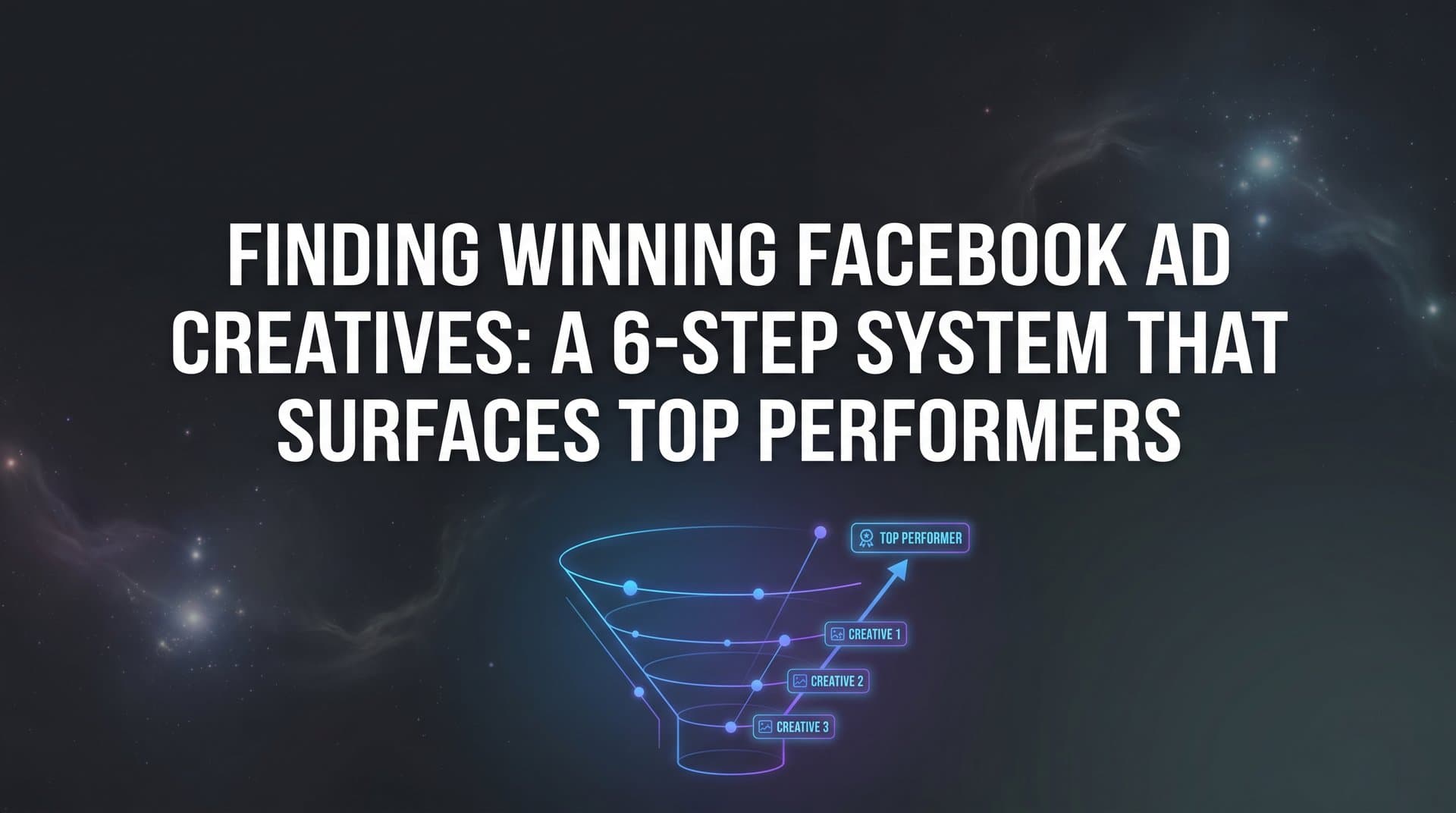
This guide walks you through a six-step system for generating, testing, analyzing, and scaling winning Facebook ad creatives. You will learn how to build a creative testing framework, launch variations efficiently, read performance data with clarity, and build a library of proven winners you can pull from for every future campaign. Whether you do this manually or use AI-powered tools to accelerate the process, these steps give you a clear path from creative idea to validated winner.
Step 1: Define What "Winning" Means for Your Campaign Goals
Before you launch a single test, you need to answer one question: what does a winning creative actually look like for this campaign? This sounds obvious, but most advertisers skip it. They launch ads, collect data, and then try to reverse-engineer what success means after the fact. That approach leads to inconsistent decisions and wasted spend.
The first thing to do is choose your primary KPI based on your campaign objective. For purchase campaigns, ROAS (return on ad spend) is typically your north star. For lead generation, CPA (cost per acquisition or cost per lead) is the metric that matters most. For traffic or awareness campaigns, CTR (click-through rate) and CPM (cost per thousand impressions) become more relevant. Pick one primary metric and let it guide your decisions.
Next, set benchmark thresholds before you start. If your historical average CPA is $30, then a creative achieving $20 CPA is a clear winner and one hitting $55 CPA is a clear loser. Without these benchmarks, you end up making relative comparisons between ads without knowing whether any of them are actually performing well in absolute terms.
If you are new to a market or lack historical data, look at your unit economics. What is the maximum CPA you can afford while remaining profitable? Work backwards from there to set your thresholds.
This is where goal-based scoring becomes powerful. Instead of eyeballing which ads look better, you assign each creative a score based on how it performs against your specific benchmarks. This turns a subjective judgment call into an objective ranking. Many advertisers struggle with this because it remains unclear why Facebook ads succeed, but structured scoring eliminates that ambiguity.
Why this matters: Without predefined benchmarks, you risk scaling ads that feel like winners because they are performing better than your other ads, even when none of them are actually profitable.
Tools like AdStellar automate this process by letting you set your target goals upfront. The platform then scores every ad element against your benchmarks automatically, so you are not manually calculating performance ratios across dozens of creatives. You see ranked results against the goals you defined, not just raw numbers.
Set your benchmarks before you launch. Everything else in this system depends on having a clear definition of success to measure against.
Step 2: Generate a High Volume of Creative Variations
Here is a hard truth about Facebook advertising: most of your ads will not be winners. The goal is not to create one perfect ad. The goal is to test enough variations that you find the small percentage that genuinely outperforms the rest.
Volume matters more than most advertisers realize. The marketers consistently finding winners are not necessarily better at predicting what will work. They are testing more angles and letting data make the decision. If you launch three ad variations, you have a limited pool to work with. If you launch thirty, your chances of finding a standout creative increase significantly. Understanding how to approach Facebook ad creatives at scale is the first step toward building that volume.
The three core creative formats to include in your testing mix are static image ads, video ads, and UGC-style creatives. Each format behaves differently in the feed and resonates with different segments of your audience. Static images load fast and communicate a clear message instantly. Video ads allow for storytelling and demonstration. UGC-style content (content that looks like it was created by a real customer rather than a brand) tends to blend into the organic feed and often generates higher engagement because it does not feel like an advertisement.
Beyond format, think about creative angle diversity. Here are the main angles worth testing:
Product-focused: Lead with the product itself, showing it clearly and prominently.
Benefit-driven: Lead with the outcome the customer gets, not the product features.
Social proof: Use reviews, testimonials, or usage numbers to build credibility.
Problem/solution: Open with the pain point your audience experiences, then position your product as the answer.
Lifestyle imagery: Show the product in context, as part of a desirable lifestyle or situation your audience aspires to.
The traditional bottleneck here is production. Creating image ads, video ads, and UGC-style content across multiple angles requires designers, video editors, and often actors or content creators. Learning how to improve Facebook ad creation speed is essential for teams that want to test at meaningful volume.
AI creative generation tools eliminate that bottleneck. AdStellar generates image ads, video ads, and UGC avatar ads directly from a product URL. You can also clone competitor ads from the Meta Ad Library to create variations inspired by what is already working in your market. The entire production process that used to take days compresses into minutes.
Once you have AI-generated creatives, use chat-based editing to refine them rather than starting from scratch each time. Adjust the hook, swap the background, change the call-to-action text. This iterative approach lets you rapidly build out a diverse creative library without the overhead of a full production cycle for each variation.
Step 3: Structure Your Testing Campaign for Clean Data
You can have great creatives and still get bad data if your campaign structure is messy. Clean data is the foundation of good creative decisions, and clean data requires deliberate setup before you launch.
The core principle is isolation. When you are testing creatives, the creative should be the only variable changing between ad sets. If you are also testing different audiences, different placements, and different budgets simultaneously, you cannot determine whether performance differences are caused by the creative or by something else entirely.
A straightforward testing structure looks like this: one campaign, multiple ad sets with identical targeting, and one creative per ad set. This gives you true isolation. Every ad set sees the same audience, runs on the same placement, and operates with the same budget. The only difference is the creative. When one ad set outperforms the others, you know why. Effective Facebook campaign management depends on getting this structure right from the start.
Dynamic creative testing is an alternative approach that lets Meta's algorithm mix and match creative elements automatically within a single ad set. This can be useful for faster iteration, but it makes it harder to identify exactly which element (image, headline, copy) is driving performance. Use it when you want directional data quickly, and use isolated ad sets when you need definitive answers.
Budget allocation is a common sticking point. How much should you spend per variation, and how long should you let tests run? The general principle is that you need enough data to make a statistically meaningful decision. For conversion-focused campaigns, many experienced media buyers recommend waiting until each variation has generated a meaningful volume of conversion events before drawing conclusions. Pulling the plug after 24 hours based on minimal spend leads to premature decisions that kill potentially strong creatives before they have had a fair chance.
A common pitfall to avoid is overlapping audiences across your test ad sets. If your audiences overlap significantly, the same people are seeing multiple versions of your ads, which skews your frequency data and can distort your performance comparisons. Use audience exclusions or distinct targeting parameters to keep your test populations as separate as possible.
The structure you set up before launch determines the quality of the insights you get out. Take the time to build it correctly.
Step 4: Launch Variations at Scale Without the Manual Grind
You have defined your success metrics, generated a strong pool of creative variations, and structured your testing campaign correctly. Now comes the step where most teams hit a wall: actually getting all of those variations live without spending an entire day in Ads Manager.
The manual approach is genuinely painful. Creating dozens of ad variations by hand means uploading each creative individually, writing or pasting copy for each ad, setting up each ad set one at a time, and then double-checking everything before launch. For a test involving 30 or 40 variations, this can take hours. And because it is repetitive manual work, errors creep in. Wrong headline attached to the wrong creative. An audience setting that did not carry over correctly. A budget that was set differently on one ad set.
Bulk Facebook ad creation solves this by automating the combination and creation process. Instead of building each variation manually, you provide the inputs: a set of creatives, a set of headlines, a set of copy variations, and a set of audiences. The system generates every possible combination and pushes them all to Meta simultaneously.
Think about what that means in practice. If you have five creatives, three headlines, and three copy variations, that is 45 unique ad combinations. Building those manually could take most of a workday. With bulk launching, it takes minutes.
AdStellar's Bulk Ad Launch feature works at both the ad set and ad level, mixing your creative, headline, audience, and copy inputs to generate every combination automatically and launch them to Meta in clicks rather than hours. The speed advantage is significant: faster launches mean you start collecting data sooner, which means you identify winners sooner, which means you can start scaling sooner.
Pairing bulk launching with the AI Campaign Builder adds another layer of efficiency. Rather than selecting your creative elements manually, the AI Facebook ad strategist analyzes your historical campaign data, ranks every creative, headline, and audience by past performance, and uses that intelligence to assemble new campaigns. It explains every decision it makes, so you understand the reasoning behind the selections, not just the output.
Speed in this context is a competitive advantage. The faster you can move from creative concept to live test, the faster you find your winners and the more testing cycles you can run in a given period.
Step 5: Read the Data and Surface Your Winners
This is the step where patience and discipline matter most. Data analysis in creative testing is less about sophisticated analytics and more about avoiding the most common mistake: making decisions too early.
Checking results after 12 hours and pausing ads based on early numbers is one of the most expensive habits in Facebook advertising. Early data is noisy. An ad that looks like a loser on day one might be your top performer by day five once the algorithm has had time to find its audience. The general principle is to wait until each variation has accumulated enough conversion events to be meaningful before drawing conclusions. The exact threshold depends on your budget and campaign volume, but the key is building this patience into your process as a rule rather than an exception.
When you do analyze results, focus on these three metrics in combination:
CTR (click-through rate): This tells you whether the creative is grabbing attention in the feed. A low CTR suggests the ad is not stopping the scroll, regardless of what happens after the click.
CPA or ROAS: This tells you whether the creative is actually converting. A high CTR combined with a poor CPA often indicates a disconnect between the ad and the landing page, or a creative that attracts clicks from the wrong audience. If you are seeing this pattern, explore why your Facebook ads are not converting despite strong engagement.
Frequency: This tells you whether the creative is fatiguing. When frequency rises and performance drops simultaneously, the creative has run its course with that audience and needs to be refreshed or replaced.
The challenge with analyzing multiple creatives across multiple ad sets is that the data becomes hard to scan quickly. Comparing 40 ads in a spreadsheet, cross-referencing CTR against CPA against ROAS against spend, is time-consuming and easy to get wrong. A lack of Facebook ad insights at this stage is what causes many advertisers to make costly scaling decisions based on incomplete information.
Leaderboard-style ranking simplifies this dramatically. Instead of a flat table of numbers, you see your creatives ranked from best to worst against the metrics that matter for your goals. The winners rise to the top. The underperformers are clearly visible at the bottom.
AdStellar's AI Insights feature provides exactly this. Leaderboards rank every element of your campaigns, creatives, headlines, copy, audiences, and landing pages, by real metrics like ROAS, CPA, and CTR. Because your target goals are already set in the system, the AI scores each element against your benchmarks so you can instantly see what is working and what is not, without building a custom spreadsheet for every analysis.
When you identify losers, pause them quickly and reallocate that budget to your winners. Every day an underperforming ad runs is budget that could be fueling a proven creative.
Step 6: Build a Winners Library and Feed Your Next Campaign
Finding a winning creative is valuable. Having a library of winning creatives, headlines, hooks, audiences, and visual styles that you can draw from for every future campaign is a genuine competitive advantage.
Top advertisers do not start from scratch with each new campaign. They maintain a living library of proven elements and use that library as the foundation for every new test. This approach compounds over time. Each campaign adds new winners to the library, and the library makes each subsequent campaign smarter and faster to build. Learning how to effectively reuse winning Facebook ad elements is what separates one-hit-wonder campaigns from consistently profitable ad accounts.
The key is cataloging winners with their actual performance data attached. A winning creative stored without context (what campaign it ran in, what audience it served, what CPA or ROAS it achieved) is much less useful than one stored with full performance history. When you are building a new campaign six months from now, you want to be able to look at a creative and know exactly how it performed, for which audience, at what budget level, and in what time period.
AdStellar's Winners Hub is built for exactly this purpose. Your best-performing creatives, headlines, audiences, and other elements are stored in one place with their real performance data attached. When you are ready to build your next campaign, you can browse your winners, select the elements you want to use, and add them directly to your new campaign without having to dig through old ad accounts or spreadsheets to find what worked.
The continuous improvement loop this creates is one of the most powerful aspects of a structured creative testing system. Each campaign generates data. That data informs which elements go into the Winners Hub. Those winning elements feed the next campaign. The AI Campaign Builder in AdStellar learns from this historical performance data, which means the recommendations it makes for new campaigns get progressively more accurate over time.
One practical tip for maintaining your winners library: periodically refresh winning creatives with new angles to combat ad fatigue. If a particular visual style or hook has proven effective, create new variations that retain those proven elements while introducing fresh details. This extends the life of your winners rather than letting them burn out and forcing you to start the discovery process over from scratch.
The goal is a flywheel: every test makes the next test smarter, and every campaign builds on the foundation of what has already been proven to work.
Your Winning Creative System: A Quick-Reference Checklist
Finding winning Facebook ad creatives is not about instinct or luck. It is about running a repeatable system consistently. Here is the six-step framework condensed into a checklist you can reference before every campaign:
1. Define your success metrics first. Choose your primary KPI (ROAS, CPA, or CTR) and set benchmark thresholds before launching any test. Use goal-based scoring to rank creatives objectively against your targets.
2. Generate high-volume creative variations. Test static images, video ads, and UGC-style creatives across multiple angles: product-focused, benefit-driven, social proof, problem/solution, and lifestyle. Use AI creative tools to eliminate the production bottleneck.
3. Structure your campaign for clean data. Keep audiences, placements, and budgets identical across test ad sets. Change only the creative. Avoid overlapping audiences that distort your results.
4. Launch at scale efficiently. Use bulk launching to generate and push hundreds of variations to Meta in minutes. Pair with AI-driven campaign building to leverage historical performance data in your setup.
5. Read the data with patience and clarity. Wait for statistically meaningful data before making decisions. Use leaderboard-style rankings to surface winners quickly. Pause losers fast and reallocate budget to what is working.
6. Build and maintain a winners library. Catalog winning creatives, headlines, hooks, and audiences with their performance data. Use your library as the starting point for every future campaign and refresh proven elements regularly to extend their lifespan.
This system works whether you are running it manually or using AI-powered tools to accelerate each step. The difference is speed. Manual execution of this framework can take days per cycle. With the right platform, the same cycle compresses into hours.
AdStellar handles this entire workflow in one place: AI creative generation, bulk campaign launching, performance ranking with leaderboards, and a Winners Hub that stores your proven elements for future use. Every step in this guide has a corresponding feature in the platform, and the AI gets smarter with every campaign you run.
If you are ready to move from guesswork to a system that consistently surfaces your best-performing creatives, Start Free Trial With AdStellar and run your first structured creative test with a 7-day free trial. Your next winning creative is already in the data. You just need the right system to find it.