The best Facebook ad creatives don't just appear out of thin air. They're not the result of a lucky brainstorming session. They are meticulously engineered from a solid strategic game plan. This is all about turning your business goals into a clear creative direction and, just as importantly, understanding what truly grabs attention on the feed right now.
The top performers I’ve worked with don’t rely on guesswork. They build a repeatable system for coming up with and producing winning creative.
Building Your Foundation for Winning Creatives
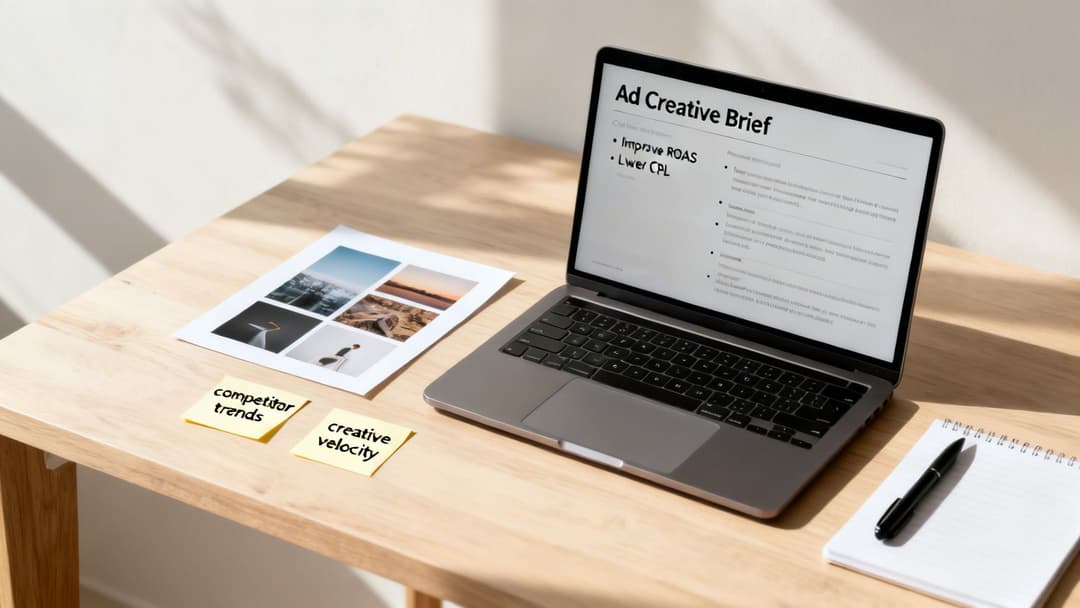
Before a single pixel gets designed or a word of copy is drafted, the best performance marketers are busy laying the groundwork. This foundational stage is what separates campaigns that scale profitably from those that just burn cash with nothing to show for it. It's about creating a blueprint that makes every creative decision intentional and backed by data.
And this whole process kicks off with a powerful creative brief.
A well-crafted brief is your campaign’s North Star. It gets everyone—from designers to copywriters—rowing in the same direction. It’s the single best way to avoid the classic mistake of creating ads that look incredible but do absolutely nothing for your bottom line.
The Power of a Great Creative Brief
Think of a creative brief as a strategic tool, not just another document to fill out. It forces you to get crystal clear on exactly what you want to achieve. Forget vague goals like "increase sales." You need to define specific, measurable outcomes.
- Objective: Are you aiming to slash your Cost Per Lead (CPL) by 15%? Or maybe you need to push your Return on Ad Spend (ROAS) from 3x to 4x? Get specific.
- Target Audience: Who, exactly, are you talking to? Ditch the basic demographics and dig into their real-world pain points, deepest desires, and online habits.
- Core Message: If they only remember one thing from your ad, what should it be? Nail this down.
- Tone of Voice: Does the ad need to feel urgent and direct? Or should it be more inspirational and aspirational? The vibe matters.
A detailed brief is basically a contract between the business and the creative team. It cuts down on endless, subjective feedback loops and makes sure the final Facebook ad creatives are judged against strategic goals, not someone’s personal taste.
To make sure your brief covers all the bases, we've put together a quick checklist of the non-negotiables. Think of this table as your pre-flight check before any creative production begins.
Creative Brief Essentials Checklist
| Element | Purpose | Example |
|---|---|---|
| Campaign Objective | Defines the specific, measurable goal. | "Decrease CPL by 20% for our lead gen campaign." |
| Target Audience | Describes the ideal customer in detail. | "Early-stage startup founders struggling with project management." |
| Key Pain Point | Identifies the primary problem the ad will solve. | "They're wasting hours on manual tasks and can't focus on growth." |
| Unique Value Prop | Explains what makes your solution different/better. | "Our tool automates workflows in minutes, not hours." |
| Core Message | The single most important takeaway. | "Stop managing tasks. Start building your business." |
| Call to Action (CTA) | Tells the user exactly what to do next. | "Sign Up for a Free Trial" |
| Mandatory Inclusions | Lists any required logos, taglines, or legal text. | "Must include our official logo and the tagline 'Work Smarter'." |
| Tone of Voice | Sets the personality of the ad. | "Empathetic, confident, and direct." |
Using this checklist ensures that nothing critical gets lost in translation. It aligns everyone from the start, which is the secret to producing effective creative, faster.
Moving at the Speed of the Feed
In the fast-and-furious world of Meta advertising, perfectionism is the enemy of progress. The best advertisers I know prioritize creative velocity—the ability to consistently ship and test new ideas. Your goal should be to build a system that lets you launch fresh concepts quickly, learn from the data, and iterate without missing a beat.
Spending weeks trying to polish a single "masterpiece" ad is a surefire way to lose. The algorithm loves novelty and is ruthlessly efficient at finding top performers. In fact, data consistently shows that the top three creatives in an account capture 55-80% of the total spend as Meta's algorithm aggressively backs the winners.
This means your job is to feed the algorithm a diverse menu of creative options and let it tell you what works.
A huge part of maintaining this speed is doing quick, regular competitor analysis. Use tools like the Meta Ad Library to see what visuals, hooks, and offers are working for other brands in your space. Look for emerging trends, but more importantly, look for the messaging gaps that your brand can uniquely fill. This isn't about copying—it's about understanding the conversation your audience is already in and finding a fresh way to join it.
Properly managing all these assets and workflows is crucial, and understanding the nuances of your Facebook ad account structure can streamline this entire process. When you build this strong foundation, you create a repeatable engine for generating high-performing Facebook ad creatives. You stop chasing fleeting viral moments and start building sustainable, predictable growth.
Designing Creatives That Actually Stop the Scroll
Let's be real. Your Facebook ad is fighting for attention in the most crowded place on earth: the social media feed. People scroll through an average of 300 feet of content every single day—that’s like scrolling past the Statue of Liberty. You're not just competing with other brands; you're up against puppy videos, your cousin's wedding photos, and viral memes.
Being loud doesn’t work here. You have to be arresting. The key to creating Facebook ad creatives that actually make someone slam the brakes on their thumb lies in a deep understanding of what works on the platform and a little bit of human psychology. It all starts with your visual.

Mastering the Visual Hook
Your visual is everything. Whether it's a static image or the first three seconds of a video, its only job is to shatter someone's mindless scrolling pattern. This isn't the time for subtle branding or overly polished scenes. You need an immediate, crystal-clear hook.
Think about a skincare brand. They could run a generic, glossy product shot, and it would disappear into the feed. I've seen it happen a thousand times. Or, they could show a raw, up-close video of the product's unique, gooey texture being scooped out of the jar. That tangible, sensory experience is infinitely more compelling because it makes you wonder, "What does that feel like?"
The best visual hooks create an "information gap." They flash a question or a scene that sparks so much curiosity that the user has to stop and read your copy to get the answer. That’s the entire game right there.
Dominant Creative Formats and How We Use Them
After years of running campaigns, I've seen that a few creative formats consistently crush it on Meta's platforms. Why? Because they perfectly match how people are already consuming content. If you focus your energy here, you’re already halfway to a winning ad.
- Raw, User-Generated Content (UGC): These ads are gold. They look like a post from a friend, not a faceless corporation. We're talking unboxing videos shot on a phone, real customer testimonials, or simple "how-to" clips. Their lo-fi, authentic vibe builds instant trust and slips right past a person's built-in "ad blocker."
- Dynamic Product Ads (DPA): For any e-commerce brand, DPAs are a non-negotiable. They automatically retarget users with products they’ve already looked at on your site. The pro move here is to use custom image templates that overlay social proof—like a "Top Seller" badge or "5-Star Rated" graphic—directly onto the product image. This makes them far more powerful than a standard, boring product feed.
- Interactive Polls and Quizzes: These formats pull the user in by asking for their opinion. A simple poll sticker in an Instagram Story ad can send engagement and watch time through the roof, warming the user up for your actual pitch and call to action.
To really make your creative pop, you need to lean into effective banner ad design principles that optimize your layout and copy for action. Even though Facebook offers tons of ad types, the core rules of clear visuals and compelling copy never change.
Weaving Psychology into Your Copy and Visuals
Once your visual has bought you a couple of seconds, your copy has to land the punch. This is where we layer in psychological triggers that turn a flicker of interest into a genuine desire to click.
Your headline is your second hook. It needs to be bold, benefit-focused, and short. A headline like "High-Quality Protein Powder" is a snoozefest. Try something like, "The 1-Minute Smoothie That Kept Me Full 'Til Lunch." The first describes a feature; the second sells a solution to a problem your audience actually has.
Here’s how we ethically bake these principles into our ads:
- Social Proof: Don't just tell people you're great—show them. Weave snippets like "Join 50,000+ happy customers," star ratings, or short testimonial quotes right into the creative itself.
- Urgency & Scarcity: This is basic but effective. Phrases like "Offer ends tonight" or "Only 17 left!" tap into our innate fear of missing out (FOMO). This pushes people to act now instead of thinking, "I'll check it out later."
- Reciprocity: Give something of value first. An ad for a genuinely helpful free guide, a checklist, or an exclusive webinar builds goodwill. It makes the user feel a subconscious need to "repay" you with their attention and, hopefully, their business down the line.
The goal is to find that perfect balance. Your ads should feel native to the platform—not like a slick, overproduced TV commercial that sticks out like a sore thumb. A great way to get a feel for what works is to study a variety of top-performing Facebook ad creative examples. This blend of platform-native aesthetics and smart psychological triggers is what turns a simple ad into a true conversion engine.
Engineering a Powerful Creative Testing System
The top-tier advertisers aren’t just getting lucky; they’ve engineered a system to figure out what works. A solid, scalable creative testing framework is the engine that drives profitable campaigns, and it's the real difference between accounts that scale and those that just burn cash.
The goal is to build a flywheel. You want a system where the insights from one test directly feed the creative ideas for the next, creating a cycle of constant improvement for your Facebook ad creatives.
A/B Testing vs. Multivariate Testing
Before you can build your testing machine, you have to know your tools. There are two main ways to test, and knowing when to use each one is the key to moving fast and getting clean results.
A/B testing, or split testing, is your workhorse. It’s simple: you isolate one single thing and test it against another. Think one headline versus a different headline, while the image and body copy stay exactly the same. It's clean, straightforward, and perfect for finding quick wins.
Multivariate testing is the more advanced play. It lets you test multiple variables all at once to find the single best combination. You could test two images, two headlines, and two CTAs in the same experiment. This is really only for accounts with big budgets and tons of conversion data, since it needs a lot more volume to tell you anything meaningful.
For most advertisers, a structured A/B testing approach is the most practical place to start.
The Tiered Testing Model
One of the most common mistakes I see is when someone pits a brand-new creative against a battle-tested winner that's been running for months. It’s an unfair fight. Your old ad has a ton of social proof, historical data, and pixel optimization on its side. The new ad is starting from scratch.
A tiered testing model fixes this, giving you clean data without torching your budget.
- Tier 1: Broad Concept Testing: Here, you're testing fundamentally different ideas against each other. The goal is to find a winning angle or format. Don't get lost in the weeds with tiny details.
- Tier 2: Iterative Testing: Once a clear winner emerges from Tier 1, you start iterating. This is where you test smaller variations to refine and improve the winning concept.
For example, a Tier 1 test might pit a raw, UGC-style testimonial video against a polished, animated explainer video. The big question you're asking is, "Does our audience respond better to authentic social proof or a clear product demo?"
Let's say the UGC video wins by a landslide. Now you move to Tier 2. You’d test different 3-second hooks for that video, try alternate customer soundbites, or swap in a new call to action at the end. You're not searching for a new continent anymore; you're just optimizing the gold mine you found.
Structuring Your Testing Campaigns
The way you set up your campaigns inside Meta Ads Manager will make or break your test. The name of the game is isolating variables so the algorithm can give you a clean read on performance.
A structured approach is everything. The most successful advertisers create a continuous testing flywheel: consistent production of new ideas, structured testing to find winners, and rapid implementation of those winners into their campaigns.
Here’s a practical look at how you can use Ad Sets to isolate your tests effectively:
| Campaign Type | Structure | Best For |
|---|---|---|
| ABO Campaign | Each ad set contains only one creative concept. | Medium-sized accounts needing a balance of accuracy and speed. ABO gives you more control over spend per creative. |
| CBO Campaign | Each ad set contains only one creative concept. | Smaller accounts focused on budget efficiency. CBO will automatically shift spend to the best-performing ad set. |
| Advantage+ (ASC+) | All creative variations are placed within a single campaign. | Accounts that need maximum efficiency and are willing to trade some testing control for simplicity. |
For most advertisers who need reliable, clean data, the ABO (Ad Set Budget Optimization) approach is the gold standard for a Tier 1 concept test. By creating a separate ad set for each distinct creative and giving them equal daily budgets, you force Facebook to give each idea a fair shot.
Once you have a system like this in place, you move from random acts of creative testing to a predictable process for finding winners. To go even deeper on this, you should check out our complete guide on Facebook ad creative testing at scale, where we break down even more advanced setups. Building this system is how you turn your ad account from a money pit into a data-driven growth machine.
How to Measure Performance and Pinpoint Winning Creatives
Getting a new batch of Facebook ad creatives live is just the starting line. The real work—the skill that separates the pros from the amateurs—is digging into the data to figure out what's actually working and what’s not. Without this, you’re just throwing money at the wall and hoping for the best.
It's tempting to get sidetracked by vanity metrics like likes, shares, and comments. Sure, high engagement feels good, but it's completely meaningless if it doesn't lead to actual business results. You have to be ruthless and focus only on the key performance indicators (KPIs) that directly impact your bottom line.
Moving Beyond Vanity Metrics
To get a true read on creative performance, you need to zero in on the metrics that measure efficiency and return. These are the numbers that tell you if you're actually making money.
Your entire analysis should revolve around these three core KPIs:
- Return on Ad Spend (ROAS): This is the ultimate measure of profitability. For every dollar you put in, how many dollars are you getting back out in revenue?
- Cost Per Acquisition (CPA) / Cost Per Result: This shows you exactly what it costs to get a purchase, a lead, or whatever your goal is. Keeping this number as low as possible is the name of the game.
- Click-Through Rate (CTR): This is your best indicator of how well your ad grabs attention. A high CTR means your visual and copy are doing their job and stopping the scroll.
The goal isn't just to find an ad people like; it's to find an ad that makes them act. The first step is to customize your Meta Ads Manager columns to put these core metrics front and center.
This simple flow chart really breaks down the journey from broad testing all the way to scaling your best-performing ads.
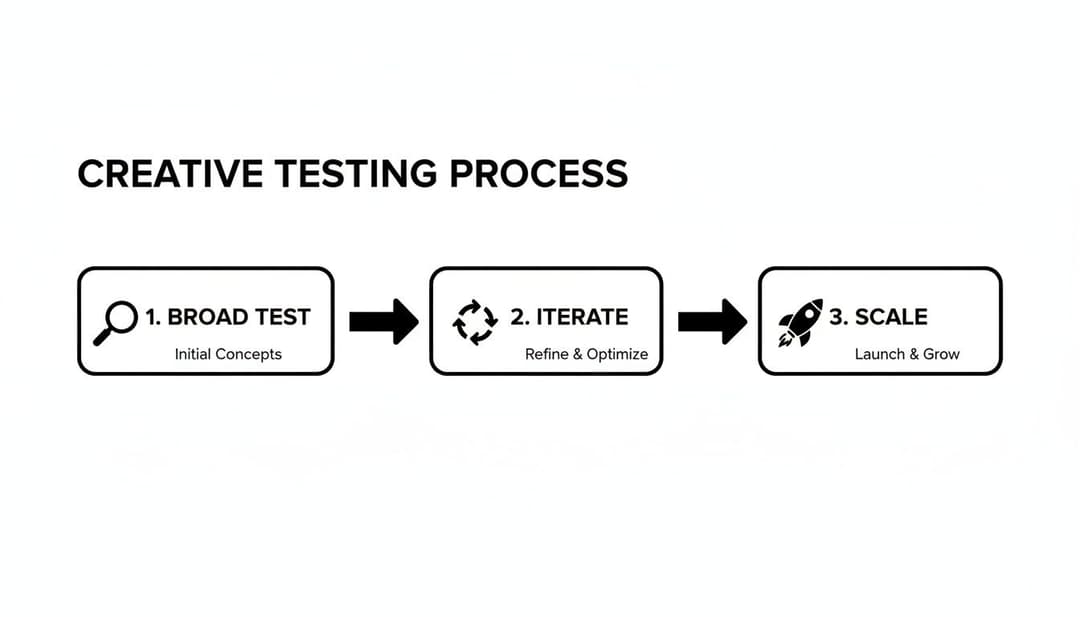
Think of it this way: you start wide to discover what concepts have potential, then you double down on those winners with small tweaks, and finally, you pour the budget into the proven performers to maximize your return.
Interpreting the Data to Declare a Winner
Once your tests are running, the trick is knowing when you have enough data to make a call. This is all about statistical significance. Declaring a winner after a dozen clicks and a couple of conversions is just gambling.
As a solid rule of thumb, I wait until a creative gets at least 50-100 conversions before I pass judgment. This helps make sure the results aren't just a fluke. If your target CPA is $20, that means you need to be prepared to spend $1,000-$2,000 per creative to get a reliable read.
When you're testing a new creative against an old champion, the new one doesn't always have to be a knockout success to be useful. If a new ad hits a similar CPA but with a way higher CTR, that tells you you've found a more engaging angle. That creative could be a huge asset for fighting ad fatigue in other ad sets. For a deeper look at setting up these kinds of reports, check out our guide on advanced Facebook advertising reporting.
Spotting and Combating Ad Fatigue
Even your best ad creative will eventually burn out. It's called ad fatigue, and it's inevitable. It happens when your audience has seen an ad so many times they just start scrolling right past it, causing your performance to tank.
The metric you need to watch like a hawk here is Frequency—the average number of times a person has seen your ad. Once you see frequency climbing (getting near 4-5 for a top-of-funnel audience) and your core KPIs start heading south, it's time to act.
Look for these warning signs:
- Rising CPA: You're paying more and more for the same result.
- Falling CTR: Your ad isn't grabbing attention like it used to.
- Declining ROAS: Your profitability is starting to erode.
You have to be proactive. Don't wait for your campaign's performance to completely fall off a cliff. The best media buyers always have their next batch of creatives tested and ready to go. That way, you can seamlessly rotate in fresh ads the moment you spot those early warning signs, keeping your performance stable and your campaigns profitable for the long haul.
Using AI to Scale and Automate Your Creative Strategy

So you’ve found a winning creative. The metrics look great, conversions are rolling in, and the team is celebrating. But if you’ve been in this game for a while, you know the clock is already ticking. Even the best-performing Facebook ad creatives eventually succumb to ad fatigue, and their effectiveness tanks.
The old-school approach was to just work harder—more brainstorming, more design mockups, more late nights. The modern playbook isn't about working harder; it’s about working smarter by bringing AI into your creative workflow.
This isn’t about firing your marketing team and letting the robots take over. It’s about giving your best people superpowers. Imagine freeing your top strategist from the mind-numbing task of duplicating ad sets so they can focus on finding the next big market opportunity. That's what this is about.
From Manual Repetition to AI-Powered Velocity
Let’s be honest, the traditional creative process is painfully slow. A designer creates a few visual options. A copywriter bangs out a handful of headlines. Then, a media buyer painstakingly stitches them all together in Ads Manager, one by one. It’s a linear, time-draining process that severely caps how many new ideas you can actually test.
AI-powered platforms completely flip this model on its head.
You can take that single high-performing ad—the image, the copy, that core hook that’s resonating—and instantly multiply it. In just a few minutes, you can generate a whole universe of variations that mix and match your winning elements in new ways:
- Visual Remixing: Instantly swap out backgrounds, change the models in the photo, or overlay different text styles on your core image.
- Copy Generation: Create dozens of fresh headlines and primary text variations based on the angle that’s already proven to work.
- Audience Matching: Get suggestions for new audience segments that are statistically likely to respond to your specific creative style.
This is the real game-changer. You’re no longer just creating a few ads; you’re producing creative at a scale that was impossible before, giving Meta’s algorithm a steady diet of fresh, relevant content to work with.
The real magic of AI isn't just about speed. It’s about systematically exploring every possible combination of your winning assets. This turns creative scaling from a guessing game into a data-backed process.
What used to take a team days of back-and-forth coordination can now get done in the time it takes to grab a coffee.
Manual vs AI-Powered Creative Workflow
Just how big is the difference? The table below lays out the stark contrast in efficiency. It highlights how AI takes over the most repetitive, time-sucking parts of scaling your Facebook ad creatives, letting your team get back to thinking strategically.
| Task | Manual Approach (Time/Effort) | AI-Powered Approach (Time/Effort) |
|---|---|---|
| Creating 50 Ad Variations | 8-12 hours of design and copy work. | 15 minutes of setup and generation. |
| Building the Campaign | 1-2 hours of manual ad creation in Ads Manager. | 5 minutes with a one-click launch feature. |
| Analyzing Performance | Hours of exporting data and building reports. | Real-time dashboards with automated insights. |
| Scaling Winners | Manual budget adjustments and ad set duplication. | Automated rules and budget shifting to top performers. |
This shift transforms campaign management from a reactive, often chaotic scramble into a streamlined, predictable system. If you want to dive deeper, you can explore these concepts in our detailed guide on AI for Facebook Ads.
Centralizing Assets for Smarter Automation
One of the biggest, unspoken roadblocks to scaling is pure chaos. Creatives are buried on a designer's hard drive, the final copy lives in a separate Google Doc, and the performance data is trapped inside Ads Manager. This disorganization makes any real automation nearly impossible.
AI platforms tackle this head-on by creating a single, centralized hub for all your campaign assets.
- Creative Library: All your images, videos, and past ad creatives are stored, tagged, and easily searchable in one place.
- Copy Repository: Your winning headlines, body copy, and CTAs are saved, letting you easily reuse and remix them for new campaigns.
- Performance Data: By plugging directly into your ad account, the platform sucks in all your historical data—ROAS, CPA, CTR—and ties it directly to each creative asset.
Once you have this unified system in place, the AI can actually start learning what works for your brand. It might spot that a certain type of image paired with a benefit-driven headline consistently drives a lower CPA. Armed with that insight, the platform can then intelligently build new campaigns using your proven winners.
Ultimately, bringing AI into your creative strategy is about building a perpetual growth engine. You stop chasing one-off wins and start building a system that predictably generates high-performing Facebook ad creatives at a velocity your competitors just can't match manually.
If you've spent any time in the world of Facebook ad creatives, you know the same questions pop up again and again. Getting straight answers to these sticking points can save you a ton of time, budget, and headaches. Let's tackle the questions we hear most from performance marketers in the trenches.
How Much Budget Should I Actually Set Aside for Testing?
This is the big one, isn't it? A solid benchmark we use is to dedicate 10-20% of your total ad budget strictly to creative testing. This gives you enough runway to gather real, meaningful data before you declare a creative a winner or a dud.
The biggest mistake we see is spreading a small budget across a dozen tiny variations. It’s a recipe for inconclusive results.
It's far more powerful to test a few wildly different concepts. For instance, instead of tweaking ten headlines, pit a raw, user-generated testimonial video against a polished animated explainer and a bold static image. You're looking for big swings. To be confident in your results, aim for 50-100 conversions per ad variant. Anything less, and you risk making a decision based on a lucky streak, not statistical significance.
How Often Do I Need to Refresh My Creatives?
The metric you need to obsess over here is Frequency. Once you see an ad's frequency for a given audience creeping up to 4-5, and you notice your click-through rate dipping or cost-per-acquisition rising, alarm bells should be ringing.
This is ad fatigue in action. Your audience is simply tired of seeing the same thing.
For high-spend, top-of-funnel campaigns, this could mean you're swapping in fresh creative every single week. For smaller budgets or bottom-of-funnel retargeting, that might stretch to every 2-4 weeks.
The key is to be proactive, not reactive. You should always have your next batch of creatives tested and ready to deploy before your current winners start to tank. This is how you maintain stable performance without the costly downtime of scrambling for something new.
What's More Important: The Visual or The Copy?
They're a package deal, but the visual is the one that has to make the first impression. In a feed where people are scrolling a mile a minute, the visual has one job: stop the thumb. It has less than three seconds to earn that attention.
Once the visual has done its job, the copy tags in to do the real work. It's the copy that provides the context, builds the desire, and gives someone a compelling reason to actually click.
Think of it this way: a stunning visual with lazy copy might get eyeballs, but it won't get clicks or conversions. On the flip side, the most persuasive copy in the world will be completely ignored if it's paired with a boring, uninspired visual. Focus on a thumb-stopping visual first, then back it up with clear, benefit-driven copy that pushes for the click.
Ready to stop guessing and start scaling? With AdStellar AI, you can automate the entire creative testing and scaling process. Generate hundreds of ad variations, launch campaigns in a single click, and let our AI pinpoint your winning creatives based on real-time performance data. Discover how AdStellar AI can transform your creative workflow today.