You’re staring at Ads Manager, a spreadsheet, a creative folder, and three Slack messages asking the same thing in different ways: what’s working, what should we pause, and how fast can we launch the next batch.
That’s the primary starting point for understanding the digital media buyer role.
Outside performance marketing, media buying is still often pictured as budget allocation and button clicking. That image is outdated. In a market projected to reach about $700 billion in digital ad spending by 2025, with digital accounting for 67% of total global ad spend according to Creed Infotech’s 2025 digital marketing analysis, the job is less about placing ads and more about steering a fast-moving system.
The old stereotype was the ad person with taste and instinct. The current reality is a hybrid operator who works across Meta, Google Ads, analytics tools, pixels, naming conventions, creative testing, budget pacing, and post-click conversion data. That person still uses judgment, but now judgment sits on top of data and automation.
A junior marketer often sees the visible surface of the role: launch campaigns, change bids, duplicate ad sets, pull reports. A good media buyer knows those tasks are just mechanics. The actual job is deciding what deserves budget, what deserves another test, what should be killed quickly, and what the business should learn from the results.
That’s also why AI matters so much now. Not because it replaces the buyer, but because it removes the repetitive setup work that used to consume the day. The buyer’s value shifts upward. Less manual assembly. More strategic control.
Introduction Beyond Bids and Budgets
A new marketer usually meets media buying at the most frustrating point in the workflow. They’ve got a campaign brief, a deadline, and too many combinations to build by hand. One audience becomes four. One offer becomes three angles. One image set becomes multiple crops, headlines, descriptions, and CTA variants. By the time everything is loaded, the first round of learning is already delayed.
That’s why the role gets misunderstood. On the surface, a digital media buyer looks like an execution specialist. In practice, the buyer is often the person connecting business goals, creative direction, audience logic, platform behavior, and measurement.
What the role really controls
A digital media buyer doesn’t just “run ads.” The buyer controls the quality of the feedback loop.
That means:
- Translating business goals into campaign structure so the account isn’t optimized for the wrong outcome
- Matching audiences to offers instead of treating all traffic as equal
- Guiding creative tests based on actual objections, hooks, and purchase intent
- Protecting budget efficiency by reallocating spend quickly when data shifts
- Turning platform data into decisions the rest of the team can act on
A weak buyer spends budget. A strong buyer creates clarity.
The distinction matters because platform automation has become powerful, but not self-directing. The platform can optimize inside the system you build. It can’t decide whether your offer is weak, whether your creative angle is stale, or whether your landing page is breaking message match.
Why this role matters more now
As spend shifts further into digital channels, the buyer sits closer to revenue than ever. Teams running acquisition for e-commerce, SaaS, and lead generation businesses don’t need a glorified dashboard watcher. They need someone who can reduce wasted motion and make smart calls under uncertainty.
That’s the modern version of the role. Less “ad operator.” More strategic pilot of paid growth systems.
A Day in the Life Core Responsibilities and KPIs
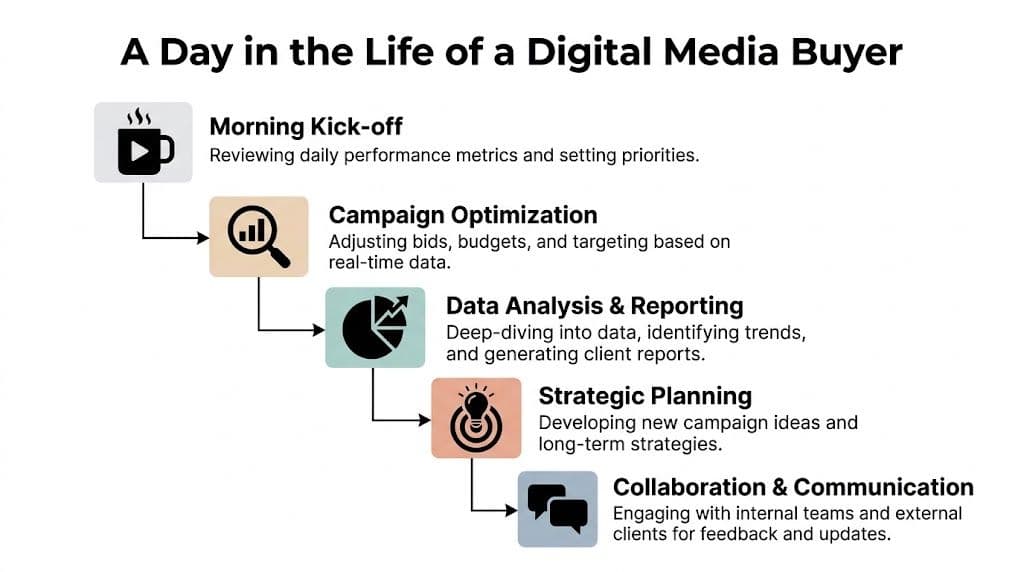
The easiest way to understand a digital media buyer is to follow the workday. Not the polished version. The actual one.
A typical day starts with triage. Before touching anything, the buyer checks pacing, spend distribution, delivery issues, conversion tracking, and the gap between targets and actual results. If campaigns are spending cleanly and performance is stable, the day opens up for deeper testing. If not, everything else waits.
Morning is for signal checking
The first pass isn’t about overreacting. It’s about spotting what changed.
A buyer usually reviews:
- Spend pacing against budget and delivery expectations
- Topline KPI movement such as ROI, CPC, CPA, impressions, and conversions
- Tracking integrity through pixels, tags, and platform reporting
- Campaign health including rejected ads, broken UTMs, audience overlap concerns, or learning disruptions
According to Celarity’s media buyer job description breakdown, expert buyers use real-time pacing reports against KPIs to dynamically reallocate budgets, and continuous A/B testing historically consumed 40% to 60% of manual media buyer workflows. That lines up with what the job feels like in practice. A huge share of effort goes into producing the next clean comparison quickly enough to matter.
Midday is for optimization, not random tweaking
Most inexperienced buyers change too much, too often. They confuse activity with optimization.
A disciplined buyer asks narrower questions:
- Is this a creative problem?
- Is this an audience problem?
- Is this an offer or landing page problem?
- Is the platform still exploring, or is there enough data to act?
That framework keeps the account from turning into chaos.
Practical rule: If you can’t explain why you made a change, you’re probably adding noise instead of improving performance.
This is also where the role overlaps with performance marketing more broadly. If you want the broader business context behind how these campaigns connect to acquisition goals, this performance marketing overview is a useful companion.
Afternoon is for communication and next steps
The back half of the day often matters more than the launch itself. A buyer has to explain results in a way that helps creative teams, founders, clients, or growth leads make better decisions.
Good reporting doesn’t dump metrics. It answers questions like:
- What changed since the last review
- Which variable likely caused the change
- What should be scaled, paused, or rebuilt
- What the next test is designed to learn
That communication skill is also what helps buyers get hired. If you’re trying to present your own experience clearly, this guide on how to prove your value with resume metrics is helpful because media buying resumes often fail for one reason: they list tasks instead of outcomes.
The KPIs that actually matter
The buyer’s dashboard can get crowded fast, but a few measures anchor the role:
| KPI | Why buyers track it | What it usually helps answer |
|---|---|---|
| ROI / ROAS | Shows return relative to spend | Is the campaign economically viable |
| CPA | Ties cost to the desired action | Are we acquiring customers or leads efficiently |
| CPC | Helps diagnose click cost and traffic quality | Are we paying too much to generate visits |
| Impressions | Indicates delivery and scale | Is the campaign reaching enough people |
| Conversions | Confirms actual business outcomes | Is traffic turning into results |
A planner might focus more on channel allocation before launch. A digital media buyer lives in the feedback loop after launch. That’s the difference. The buyer isn’t judged by how neat the plan looked. The buyer is judged by whether the spend moved the KPI that mattered.
The Anatomy of a Great Media Buyer Skills and Mindset
The strongest buyers are bilingual. They speak data and creative fluently enough to catch problems before they become expensive.
That’s why the role is harder to hire for than many teams expect.

A recent industry analysis highlighted that the most successful media buyers need a 50/50 blend of technical execution and creative strategy, while many organizations still struggle to find candidates who bridge that divide, as discussed in this industry conversation on the media buyer skills gap. That feels accurate because weak buyers usually lean too far in one direction. They’re either spreadsheet-heavy and creatively blunt, or creatively sharp but technically loose.
The technical half
A digital media buyer needs enough technical depth to trust, question, and organize the data.
That usually includes:
- Platform fluency in tools like Meta Ads Manager, Google Ads, and analytics dashboards
- Tracking awareness around pixels, events, tag managers, attribution logic, and naming conventions
- Spreadsheet competence because bulk edits, performance slicing, and QA still happen there
- Testing discipline so one variable changes at a time when possible
- Workflow control across campaign structure, audience exclusions, budget allocation, and reporting cadence
This is one reason performance marketing is a serious career path rather than an entry-level side skill. The strategic ceiling is high if you can operate inside the complexity. For people thinking long term, this performance marketing career guide gives a good picture of how these skills can expand into broader growth roles.
The creative half
Platform mechanics don’t save weak messaging.
A buyer doesn’t need to be the best copywriter or designer on the team, but they do need strong instincts around creative performance. They should be able to judge whether an ad has a real hook, whether the angle matches the audience, and whether a winning ad worked because of message, format, offer, or novelty.
Three creative habits separate good buyers from average ones:
- They study customer language. Reviews, sales calls, founder notes, and comments often produce better hooks than brainstorming sessions.
- They brief clearly. “Make it pop” is useless. “Lead with the pain point, show the product in use early, and close on proof” is usable.
- They respect fatigue. Some buyers keep squeezing the same winning creative too long. Performance drops, and they blame targeting.
The buyer who can explain why a creative won is more valuable than the buyer who merely spotted that it won.
The mindset that holds it together
Media buying attracts people who like control, but platforms don’t reward ego. They reward adaptation.
Strong buyers usually share a few traits:
- Calm under ambiguity
- Skeptical without being cynical
- Comfortable with imperfect data
- Able to communicate trade-offs clearly
- Curious about customer behavior, not just ad account behavior
That last part matters. Great buyers don’t stare only at dashboards. They study the market, the offer, the objections, the landing page, the checkout flow, and the sales process. They know ad performance often breaks outside the ad account.
The Modern Media Buyer's Toolkit and Workflow
The toolkit starts with familiar software. The workflow is where things split between old and new media buying.
Many teams still operate with some mix of ad platforms, analytics, spreadsheets, tag management, reporting dashboards, creative folders, and project management tools. That stack is normal. The problem is how often the workflow between those tools remains painfully manual.
The base stack that actually matters
A working digital media buyer usually depends on a stack like this:
- Ad platforms such as Meta Ads Manager, Google Ads, TikTok Ads Manager, or LinkedIn Campaign Manager
- Analytics tools including Google Analytics and platform-native reporting
- Tag management through systems like Google Tag Manager
- Creative organization in shared drives, asset libraries, or design tools
- Reporting and analysis in Looker Studio, spreadsheets, or internal dashboards
- Task and communication tools like Slack, Notion, ClickUp, or Asana
The challenge isn’t access. It’s coordination.
According to Avahr’s digital media buyer role breakdown, buyers operate across complex ecosystems with multiple bidding systems and targeting methods, and centralized workflow platforms that combine campaign setup, creative libraries, and performance dashboards are critical for reducing cognitive load and error rates, especially for agencies handling 10 to 50+ client accounts.
That’s the operational reality. A good buyer can manage complexity. A scalable team reduces unnecessary complexity.
Where the old workflow breaks
Traditional media buying breaks down in repetitive assembly work.
A buyer gets a brief. Then they manually duplicate campaigns, update UTM parameters, rename ad sets, swap in creatives, paste copy variants, adjust audience rules, launch tests, and check whether every detail went live correctly. By the time the campaigns are clean, the buyer has spent energy on execution that should have gone toward decision-making.
Common failure points in the manual workflow include:
- Naming inconsistencies that wreck reporting hygiene
- Version control issues across creative and copy files
- Missed exclusions or wrong audiences
- Slow testing velocity
- Human error during bulk setup
- Delayed learning because launch takes too long
If you want a broader stack view around Meta specifically, this Meta advertising technology stack guide is a useful reference.
Manual versus AI-augmented work
The biggest shift in the role is simple: the buyer is moving from builder to supervisor.
Instead of spending most of the day constructing campaign variations, the buyer increasingly defines the testing logic, reviews outputs, approves what goes live, and interprets the results. That doesn’t remove accountability. It raises the bar for judgment.
| Task | Traditional Workflow (Manual) | AI-Augmented Workflow (e.g., AdStellar) |
|---|---|---|
| Campaign setup | Buyer builds campaigns and ad variants one by one | System assists bulk creation across many combinations |
| Creative testing | Variants are assembled manually and launched slowly | Variations are generated faster for structured testing |
| Audience management | Buyer copies, edits, and checks segments across campaigns | Centralized workflows reduce repeated setup work |
| Performance review | Buyer exports data and manually compares patterns | Ranked insights help surface likely winners faster |
| Scaling decisions | Buyer reacts after manual review cycles | Buyer uses system outputs to guide faster strategic moves |
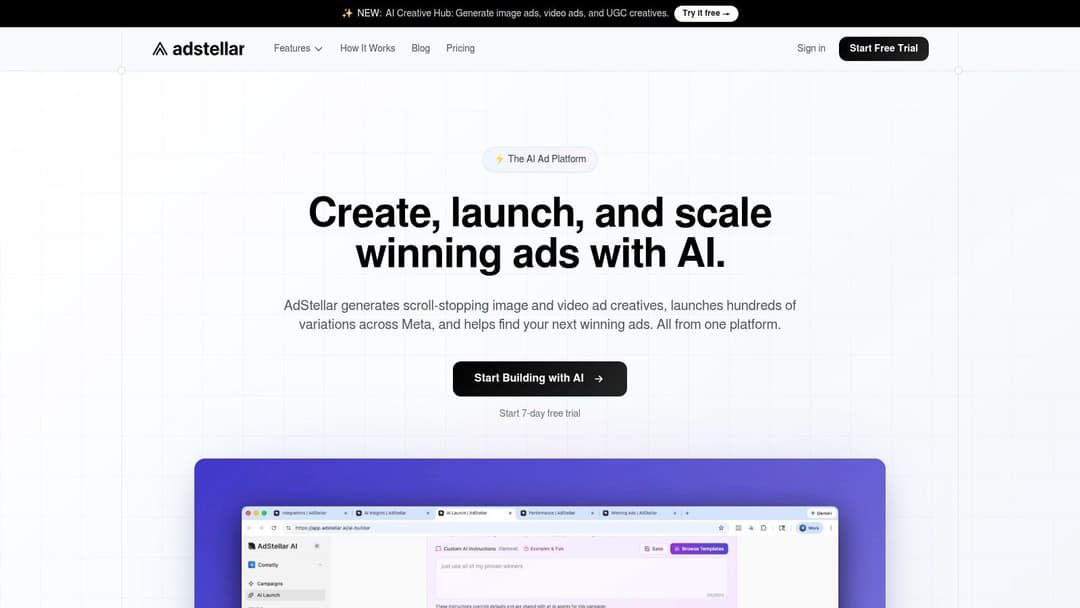
One practical example is AdStellar AI, which is built to automate bulk Meta ad creation, centralize campaign and audience workflows, connect through secure OAuth, and rank creatives, audiences, and messages against goals like ROAS, CPL, or CPA. Used well, a tool like that doesn’t replace the media buyer. It strips out production drag so the buyer can focus on test design, quality control, and scaling logic.
Tools don’t eliminate the need for skill. They expose whether the buyer has real strategic skill in the first place.
There’s still a place for smaller utilities too. For marketers who like lightweight workflow helpers, it’s worth browsing discover SuperX's marketing extensions for browser-based tools that support research, outreach, and productivity around campaign work.
Building Your Career as a Digital Media Buyer
The career path is rarely linear, but the progression is predictable. You start by learning execution. Then you learn judgment. Then you learn how to tie paid media decisions to business outcomes.
A lot of people want to skip step one. They want strategy titles before they’ve built enough campaigns to recognize patterns. That usually backfires. Good strategic thinking in media buying comes from seeing enough launches, mistakes, recoveries, and postmortems to know what breaks in live environments.
How the career usually develops
An aspiring digital media buyer often enters through one of four doors: agency coordinator work, in-house paid social support, freelance campaign execution, or broader performance marketing roles with a paid acquisition component.
The rough progression looks like this:
Junior execution role
You learn platform mechanics, QA, tracking basics, reporting hygiene, and campaign setup discipline.Buyer or specialist role
You own budgets, testing plans, and daily optimization decisions across one or more channels.Senior buyer or strategist role
You guide creative direction, shape acquisition strategy, and influence budget allocation across initiatives.Growth lead, performance lead, or head of acquisition
You stop thinking only in campaign metrics and start thinking in contribution margin, pipeline quality, customer economics, and organizational alignment.
How to build proof when you don’t have much experience
Early on, hiring managers don’t expect perfection. They do expect evidence that you can think clearly.
A useful starter portfolio can include:
- A teardown of an existing ad account or brand’s paid funnel
- Sample testing frameworks for creative angles, audiences, and offers
- Mock dashboards or reporting templates
- Short campaign analyses explaining what you’d change and why
- Certifications from major platforms, if you’re still building practical history
If you’re hiring, this is also where remote talent can broaden the candidate pool. Teams that want more flexibility in sourcing paid media support often look to Hire LATAM talent when building marketing operations across time zones.
A modern job description for the role
Old job descriptions ask for a “hands-on media buyer” who can manage budgets and optimize campaigns. That’s incomplete now.
A better version sounds more like this:
Digital media buyer
Own campaign launch, testing, optimization, and reporting across paid digital channels. Work closely with creative, analytics, and growth stakeholders to translate business goals into campaign structure. Maintain tracking accuracy, protect budget efficiency, and generate clear recommendations on what to scale, pause, or revise. Use automation responsibly and bring strategic judgment to AI-assisted workflows.
For agencies, this matters even more because the job isn’t only buying media. It’s client communication, prioritization, and account hygiene under pressure. If your team structure includes outsourced or specialist support, studying how a modern Facebook ads agency frames capability can help clarify what should stay in-house versus what should be delegated.
Interview questions that actually reveal skill
Bad interviews focus on platform trivia. Good interviews focus on reasoning.
For employers, better questions include:
- Walk me through a campaign that underperformed. What did you investigate first?
- How do you decide whether a problem is creative, audience, offer, or landing page related?
- When do you avoid making changes, even when performance looks shaky?
- How do you structure tests so the learnings are usable?
- What does good reporting look like to a stakeholder who doesn’t live in the ad account?
For candidates, ask questions that reveal the company’s maturity:
- How does the team define success beyond platform-reported results?
- Who owns creative strategy, and how are performance learnings fed back into production?
- How does the company handle tracking disputes or attribution ambiguity?
- What work is still manual that the team wants to automate?
- How much room does the buyer have to challenge offer, landing page, or funnel assumptions?
Those questions reveal whether the company wants a thinker or just someone to keep the dashboard moving.
The Next Frontier AI and the Future of Media Buying
The future of the digital media buyer is easier to understand if you stop asking whether AI will replace the role and start asking which parts of the role should never have been manual in the first place.
That’s where the shift is happening.

Industry executives increasingly believe media buying will become so machine and data driven that traditional roles may become “as dated as Mad Men,” as discussed in this report on the future of media buying. That doesn’t mean buyers disappear. It means low-level repetition loses value fast.
What buyers are becoming
Platforms already automate large parts of bidding, placement, and delivery. AI tools increasingly automate creative generation, campaign assembly, and performance pattern detection. So the buyer’s influence moves up a layer.
The future buyer does four things especially well:
- Sets strong inputs through clear goals, clean structure, and usable creative angles
- Interprets black-box outputs instead of trusting them blindly
- Protects strategic coherence across audience, offer, message, and landing page
- Builds repeatable learning systems so each campaign improves the next one
That’s why AI literacy now matters as much as platform literacy. Not engineering depth. Operational fluency.
If you want to get more concrete about how that applies inside ad workflows, this guide to AI for ads is worth reading.
The buyer of the next few years won’t win by doing more clicks inside ad managers. The buyer will win by making better decisions about what the machines should test, optimize, and ignore.
What doesn’t change
Some parts of media buying stay stubbornly human.
AI can generate options. It still needs a person to judge whether the angle is on-brand, whether the audience logic makes sense, whether the offer is compelling, and whether performance reflects real business value or just platform noise.
It also can’t own accountability. When spend goes sideways, a founder or client won’t ask the model what happened. They’ll ask the buyer.
A good buyer therefore needs a new mix of skills:
- Systems thinking
- Creative judgment
- Measurement skepticism
- Prompting and workflow design
- Clear communication with non-technical stakeholders
For a broader look at where this shift is heading, this video gives useful context.
The practical takeaway
If you’re entering the field, learn the manual fundamentals so you understand what the automation is doing.
If you’re already in the field, stop treating AI as a novelty feature. Start treating it as an operational force multiplier.
The digital media buyer role is not shrinking. It’s being upgraded. The work that survives is the work closest to judgment, prioritization, creative interpretation, and commercial thinking.
AdStellar AI helps digital media buyers move in that direction by automating bulk Meta ad creation, organizing campaigns and audiences in one workflow, and surfacing performance insights that support faster testing and smarter scaling. If your team is spending too much time on setup and not enough on decisions, take a look at AdStellar AI.