If you're the kind of person who gets a thrill from seeing your work translate directly into dollars and cents, a career in performance marketing might be your perfect fit. It’s a space where success isn't just a vague feeling—it's measured in hard numbers like clicks, leads, and sales, making it a highly sought-after and often lucrative path.
Is a Performance Marketing Career a Good Choice for You?
 Picture yourself as the strategic mind behind a company's growth, where every dollar you spend is tracked and every win is crystal clear. That's the heart of a performance marketing career. While traditional marketing often plays the long game with brand awareness, performance marketing is all about driving actions that deliver immediate, measurable business results.
This world is where creativity and accountability collide. A brilliant ad campaign is only half the battle; the real win is proving it drove a specific number of sales or leads at a cost that makes sense for the business. You aren't just spending a budget—you're investing it with the clear expectation of a profitable return.
The Mindset of a Performance Marketer
So, what kind of person truly excels here? It's less about having a classic "marketing personality" and more about a specific intellectual and competitive drive. Certain traits pop up again and again in the industry’s top performers.
Successful performance marketers almost always have:
- An Analytical Mind: You have to genuinely enjoy diving into data to figure out why something is working or, just as importantly, why it isn't. Spreadsheets and analytics dashboards should feel like a playground, not a punishment.
- A Competitive Spirit: This field is built on winning. You’re constantly trying to beat last month's numbers, outperform a competitor's campaign, or uncover a new angle that unlocks explosive growth. That hunger to improve is non-negotiable.
- Endless Curiosity: The digital ad platforms, their algorithms, and the way people behave online are in a constant state of flux. You need a real desire to ask questions, test your assumptions, and never stop learning.
A performance marketer's job is to connect an advertising dollar to a business outcome. If you can't measure it, you can't optimize it—and if you can't optimize it, you're not doing performance marketing.
Why This Career Path Is in High Demand
The appeal is obvious: you are directly tied to the company's bottom line. When your campaigns hit their mark, everyone knows it. Your work can be directly credited for a 20% jump in sales or a 30% drop in customer acquisition costs (CAC). That direct link to revenue makes skilled performance marketers incredibly valuable.
Businesses are constantly searching for predictable, scalable ways to grow, and performance marketing is the engine that makes it happen. This demand is clear from the sheer number of open roles and the competitive salaries offered to professionals who can deliver results. If the core concepts have you hooked, you can learn more about what is performance marketing in our detailed guide. This high-stakes, data-fueled field offers massive opportunities for anyone ready to prove their impact.
What Performance Marketing Roles and Career Paths Look Like
Think of a career in performance marketing less like a straight-line ladder and more like a vast, branching tree. Unlike some fields with a single, predictable track, this industry is packed with diverse roles that play to different strengths—whether you're a data geek, a creative mastermind, or a natural relationship builder.
The job titles can sound a bit jargony at first, but they typically boil down to a handful of core specializations. Each role is laser-focused on hitting measurable targets through specific channels, all working together to fuel the company's growth.
Common Performance Marketing Job Titles
Where you start and where you go will often depend on the channels you decide to master. Here are some of the most common roles you'll see posted and a glimpse into what they do every day:
PPC Specialist (or SEM Manager): This person lives and breathes platforms like Google Ads and Microsoft Ads. Their entire focus is capturing user intent through search. They obsess over metrics like Cost Per Click (CPC), Click-Through Rate (CTR), and the ultimate goal: a profitable Return on Ad Spend (ROAS). They're masters of keyword research, bidding strategies, and crafting high-converting landing pages.
Paid Social Manager: This role is all about driving results on social platforms like Meta (Facebook/Instagram), TikTok, and LinkedIn. They blend constant creative testing with sophisticated audience targeting, always aiming to lower the Cost Per Acquisition (CPA) or boost lead quality. Their world revolves around A/B testing ad creatives and outsmarting platform algorithms.
Affiliate Marketing Manager: This is a performance role built on relationships. These managers are responsible for building and managing networks of partners (the "affiliates") who promote the company’s products for a commission. Success here is all about tracking affiliate-driven sales and leads to ensure a profitable Cost Per Sale (CPS).
These specialists can thrive in a few different settings. Working at an agency means you'll juggle campaigns for multiple clients, giving you a ton of exposure to different industries. On the other hand, an in-house role at a brand lets you go incredibly deep on one business model. And with technology constantly shifting the ground beneath our feet, you'll want to see our guide on the rise of the automated marketing agency to understand how these roles are evolving.
A Sample 10-Year Career Progression
To make this feel more real, let's walk through a potential 10-year journey. Of course, everyone's timeline is different, but this gives you a solid idea of how your skills and responsibilities can grow from hands-on execution to high-level strategy.
Performance Marketing Salary Benchmarks for 2026 (US Market)
As you map out your career, it's helpful to have a sense of your earning potential. Here's a look at what you can expect at different stages in the US market.
| Job Title | Experience Level | Average Annual Salary Range |
|---|---|---|
| Performance Marketing Coordinator | Entry-Level (0-2 years) | $55,000 – $75,000 |
| PPC / Paid Social Specialist | Mid-Level (2-4 years) | $70,000 – $95,000 |
| Senior Performance Marketer | Senior (5-7 years) | $95,000 – $130,000 |
| Performance Marketing Manager | Manager (5-8 years) | $110,000 – $150,000 |
| Director of Growth / Head of Performance | Director+ (8+ years) | $150,000 – $220,000+ |
These figures are just a benchmark, of course. Salaries can vary quite a bit based on your location, the size of the company, and the specific industry you're in.
Years 1-2: Media Buyer or Performance Marketing Coordinator You're starting out by getting your hands dirty and learning the ropes. Your days are spent inside the ad platforms, launching campaigns, keeping an eye on daily budgets, and pulling basic reports. The name of the game is execution—learning the mechanics of one or two channels inside and out.
Years 3-5: Performance Marketing Specialist You've got the fundamentals down, and now you own a channel. You're on the hook for hitting specific monthly targets, whether it's a certain number of leads or a specific ROAS. You’ve moved beyond just launching campaigns to actively testing new strategies, digging into the data to find optimization opportunities, and sharing your insights with your manager.
The world of performance marketing has seen explosive career growth, and it's no accident. It’s directly tied to the massive surge in digital ad spending. With digital ad revenue in the US projected to race past $383 billion by 2027, the demand for skilled professionals who can turn clicks into customers is only getting more intense. This is a field that handsomely rewards those who can translate campaign metrics into tangible business wins.
Years 6-10: Senior Manager or Head of Growth At this point, you're zooming out. Instead of managing a single channel, you're now orchestrating the entire customer acquisition strategy. You’re managing a team of specialists, setting multi-million dollar budgets, and you're accountable for big-picture business metrics like Customer Lifetime Value (LTV). Your focus shifts from "How do I lower this CPA?" to "What new channels should we invest in to scale the business next year?"
As you start looking at various performance marketing job opportunities, you'll notice this strategic oversight is exactly what separates senior-level roles from the rest.
The Essential Skills and Tools for Modern Performance Marketers
To really make it in performance marketing, you need a specific mix of left-brain analytics and right-brain creativity. It’s not just about knowing how to launch an ad. You have to master the whole system—from digging into the data and finding the story, to explaining that story to your team and using the right tech to get ahead.
Think of your abilities in two buckets: hard skills and soft skills.
Hard skills are the technical must-haves. These are the concrete, measurable things you do to run campaigns, analyze what’s working, and drive real growth. Without them, you’re just guessing.
Soft skills, on the other hand, are all about how you work. This is your communication, your problem-solving, and your strategic mind. These skills are what turn a decent media buyer into a great one and are your ticket to senior roles where you’re managing people and strategy, not just campaigns.
Mastering the Hard Skills
Think of hard skills as the engine of your performance marketing career. They’re the practical abilities you'll rely on every single day to turn ad spend into actual revenue. Getting these down should be your first priority.
Here are the non-negotiables:
- Deep Data Analysis: This is the big one. It’s the ability to stare at a dashboard full of acronyms—CPA, ROAS, LTV—and not just read the numbers, but truly understand the story they’re telling about the business.
- Rigorous A/B Testing: The best in the game are obsessed with testing. They have a structured system for trying out new ad creatives, copy, landing pages, and audiences to find what actually makes a difference.
- Channel-Specific Expertise: You need to become a true expert on the main ad platforms. That means going deep on the mechanics of Google Ads for search and Meta Ads for social, and really understanding their algorithms, bidding systems, and ad formats.
- Financial Acumen: At its core, performance marketing is managing an investment. You have to be comfortable with pacing budgets, forecasting results, and calculating profitability to make sure your campaigns are actually helping the bottom line.
Cultivating Essential Soft Skills
If hard skills are the engine, soft skills are the steering wheel. They give you direction, help you navigate tough spots, and allow you to work well with everyone else. These abilities are what make your technical knowledge so much more powerful.
The most effective performance marketers are translators. They can take complex campaign data and explain its strategic implications to a creative team, a product manager, or a CEO in a way that everyone understands and can act upon.
This communication skill is absolutely vital. You’ll need to explain why one ad is crushing another, or justify a bigger budget with a clear, data-backed argument. Other key soft skills include relentless problem-solving and an insatiable curiosity to figure out the "why" behind your results.
This career path shows how your skills and responsibilities will evolve as you grow.
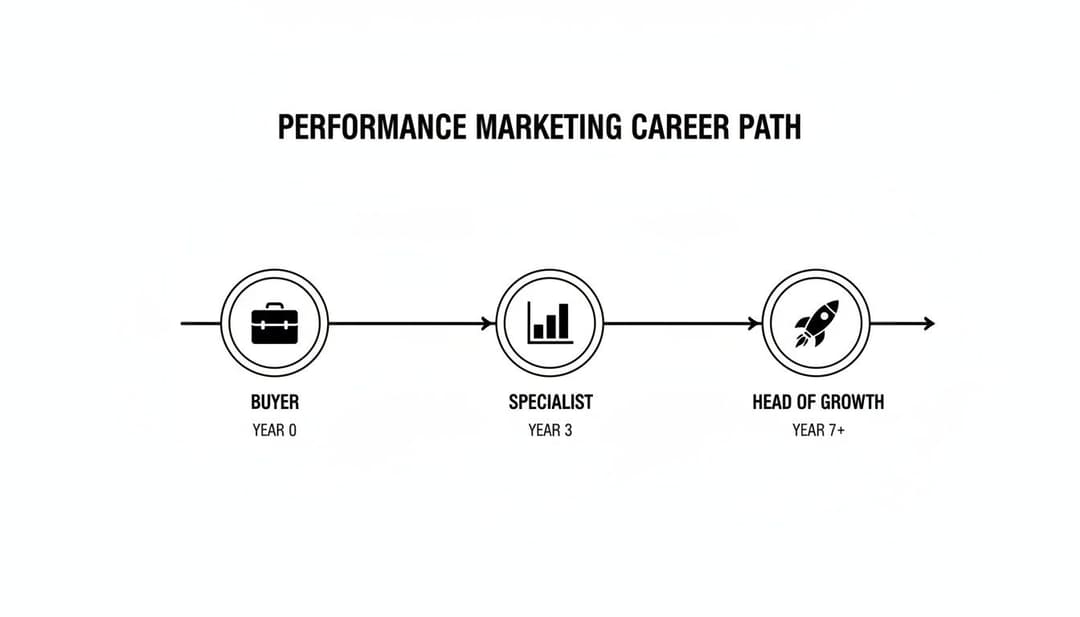
As you can see, the path often moves from pure execution (Buyer) to owning a channel (Specialist) and eventually to shaping high-level strategy (Head of Growth).
The Modern Performance Marketer's Tech Stack
Your skills are only as good as the tools you use to apply them. The modern marketer's toolkit is built around data analysis and, more and more, automation. A foundational platform for anyone in this field is Google Analytics 4 (GA4), which gives you the raw data needed to understand user behavior and campaign results.
The biggest shift in recent years, though, has been the explosion of AI. AI-driven automation is completely reshaping performance marketing, and it’s quickly becoming a mandatory skill. Platforms from Meta and Google now lean heavily on machine learning for their bidding and optimization.
Tools built on this tech are changing the job description from manual button-pusher to strategic architect. Instead of spending hours creating hundreds of ad variations by hand, marketers can now use AI to automate the process, freeing them up to focus on the bigger picture. You might be interested in our guide on the best AI tools for marketing to see what's out there.
This shift lets you graduate from tedious tasks to becoming the architect of a sophisticated, automated growth engine for the business.
How to Build a Portfolio That Gets You Hired
 In performance marketing, experience is only as good as the results you can prove. A résumé that lists duties like "managed social media ads" is just noise. But a portfolio that shows how you grew revenue by 25% while cutting ad spend by 10%? That’s what gets you hired.
Hiring managers aren’t looking for a job description. They’re looking for a story of your impact. Your portfolio is your chance to tell that story, turning vague responsibilities into undeniable, quantifiable results.
Frame Your Accomplishments with Numbers
The single biggest mistake I see candidates make is describing their job instead of their achievements. To really stand out, you have to get comfortable translating your daily tasks into measurable business outcomes. This is the shift in thinking that separates the top-tier candidates from everyone else.
Put yourself in the hiring manager's shoes. They have a growth problem to solve, and your portfolio's only job is to prove you've already solved similar ones before.
Instead of writing:
- "Ran Google Ads campaigns."
Reframe it as a powerful result:
- "Managed a $50,000/month Google Ads budget, hitting a 3.5x ROAS by completely restructuring our ad groups and refining keyword targeting."
And instead of saying:
- "Was responsible for lead generation."
Showcase the direct impact you had:
- "Grew marketing qualified leads by 40% quarter-over-quarter and simultaneously dropped our cost per lead (CPL) by 15% through rigorous A/B testing on our key landing pages."
This simple change elevates you from a passive team member to an active driver of business growth. It proves you understand the metrics that actually matter and that you hold yourself accountable for delivering them.
Structure Your Portfolio as a Case Study
Think of your portfolio as a collection of compelling case studies, not just a pretty gallery of ads you’ve made. Each project needs to tell a complete story, walking the hiring manager through your strategic process from start to finish.
A great performance marketing portfolio doesn’t just show the ‘what’ (the ad creative). It explains the ‘why’ (the strategy), the ‘how’ (the execution), and most importantly, the ‘so what’ (the measurable results).
For every campaign you highlight, structure it using this simple, four-part framework. It works every time.
The Four-Part Case Study Framework:
- The Problem: First, set the scene. What was the core business challenge you were facing? Maybe it was a dangerously high customer acquisition cost, terrible conversion rates on a new landing page, or the pressure to scale into a new channel.
- Your Strategy: Next, explain your hypothesis. Based on the problem, what was your strategic plan? Did you propose targeting a completely new audience, testing a different bidding model, or overhauling the creative? If you need inspiration, check out our guide on creative ad campaigns.
- The Execution: This is where you detail the specific actions you took. Show examples of the ad copy, the creative tests you ran, and the audience segments you built. Let your hands-on skills shine here.
- The Results and Learnings: End with the numbers. Display the key metrics that improved, like a 20% boost in CTR or a 30% drop in CPA. Just as importantly, include what you learned—even from tests that failed. Showing you can analyze and learn from your losses is a huge sign of a mature, strategic marketer.
Navigating the Interview Process and Landing Your Dream Job
You’ve built a killer portfolio that shows what you can do. Now it’s time to talk the talk. This is the final step—the interview—and it’s your chance to prove you're the real deal.
This isn’t about just rattling off your resume. It’s about showing them how you think. You need to demonstrate your strategic mind, your comfort with data, and your knack for connecting marketing actions to real business growth.
Most performance marketing interviews follow a predictable path: a quick chat with a recruiter, a deeper dive with the hiring manager, and then the main event—the technical case study.
The Standard Interview Questions
The first few conversations are all about getting to know you. They’re looking for a good fit, both in terms of your skills and your personality. You'll get questions that dig into what you’ve done, but more importantly, why you did it and what you learned from the experience.
It’s one thing to say you ran a campaign; it’s another to explain the strategic thinking behind it. Since so much hiring is done remotely now, it’s worth brushing up on how to prepare for a video interview to make sure you come across clearly and confidently.
I’ve seen hundreds of interviews, and the same types of questions come up again and again. Here is a quick guide to what hiring managers are really asking and how you can frame your answers to stand out.
Common Interview Questions and Strategic Answers
| Question Type | Example Question | Strategic Approach to Answering |
|---|---|---|
| Strategic Thinking | "Walk me through how you'd launch a campaign with a very limited budget." | Don't just list channels. Explain your framework. Start with the objective, define the audience, and choose the channel with the highest leverage. Show you prioritize ROI over just being busy. |
| Problem-Solving | "Tell me about a campaign that failed. What went wrong, and what did you do?" | Everyone has failures. Own it. Explain your hypothesis, what the data showed, and what you learned. The key is to show you're resilient and can turn a loss into a lesson. |
| Budget Management | "If I gave you $100,000 for a new user acquisition campaign, how would you spend it?" | Break it down logically. Allocate a percentage for proven channels, a smaller portion for testing new ones, and explain your rationale. Show them you think like an investor managing a portfolio of bets. |
When you answer, use a simple story-telling framework like STAR (Situation, Task, Action, Result). It keeps your answers focused and makes it easy for the interviewer to see your direct impact.
Cracking the Technical Case Study
This is where the rubber meets the road. The case study is the single most important part of the interview process. It’s your chance to stop talking about past results and actually show them how you operate.
Don't panic. This isn't about finding a single "right" answer.
The case study isn't a test. It’s a simulation. The hiring manager wants to see your thought process in action—how you break down a problem, use data to build a hypothesis, and present a logical plan.
You’ll usually get a spreadsheet full of campaign data and a business problem. For example: "Our CPA for new customers has jumped by 30% this quarter. Dig into this data and tell us what you'd do to fix it."
Here’s how to nail it, step by step:
A Step-by-Step Approach to Your Case Study
Analyze the Data: Resist the urge to jump to a conclusion. Start by methodically slicing the data. Look at it by channel, campaign, ad group, audience, device, and creative. Is one channel the culprit? Is a specific audience suddenly costing more? Find the source of the fire.
Formulate a Hypothesis: Once you've found a pattern, form a clear theory. For example, "My hypothesis is that our primary 'Lookalike 1%' audience is suffering from ad fatigue. I see this in the declining CTR and rising CPM over the last six weeks."
Develop Your Media Plan: This is your solution. Propose specific, concrete actions. You might recommend pausing the fatigued audience, testing new creative against a fresh audience segment, and reallocating 20% of the budget to test an emerging channel like TikTok.
Present with Confidence: Structure your presentation like a story: Here’s the problem, here’s my analysis, here’s my recommendation, and here’s what I expect to happen. Explain your reasoning clearly and be ready to defend your choices with the data. This proves you can not only find insights but also convince others to act on them.
Future-Proofing Your Performance Marketing Career in an AI-Driven World
If there’s one thing you can count on in performance marketing, it's that the ground is always shifting beneath your feet. To stay valuable and in-demand, you have to look ahead. Right now, the biggest change is the move away from manual campaign management and toward strategic oversight of powerful, AI-driven advertising systems.
Don't see this as a threat—it's a promotion. Instead of spending your days tweaking bids or building hundreds of ad variations, your job is evolving into something much more strategic. You’re becoming the pilot of a sophisticated system, responsible for feeding it the right inputs and making smart business decisions based on its outputs. This is the key to career longevity.
Embracing AI and Strategic Oversight
AI isn't some far-off concept anymore; it's a daily part of the job. Ad platforms like Meta and Google already lean heavily on machine learning for real-time bidding, targeting, and optimization. It's no surprise that a staggering 92% of businesses plan to ramp up their investment in generative AI tools.
For you, this means your value is shifting away from tactical, hands-on-keyboard work and toward high-level direction. Your future success will hinge on your ability to:
- Set the Strategy: You define the goals, audiences, and core messaging that guide the AI.
- Feed the System: You provide the AI with high-quality first-party data and a diverse library of creative assets to test.
- Analyze the Output: You interpret the performance data to figure out why the AI is making certain moves and what larger trends you can act on.
This jump from a "doer" to a "director" is the single biggest change hitting the modern performance marketing career path. Marketers who get this right will be the ones managing bigger budgets and driving better results. If you want to get ahead of the curve, digging into the fundamentals of AI marketing automation is the perfect place to start.
The New Non-Negotiable Skills
As AI handles more of the grunt work, other skills become far more important. The post-cookie world, for example, makes first-party data proficiency an absolute must-have. Your ability to collect, segment, and strategically use your own company’s customer data is what will set you apart.
In the near future, the most sought-after performance marketers won't be the ones who can click buttons the fastest. They will be the ones who can translate complex, AI-generated data into actionable business intelligence that drives growth.
This skill—deep data interpretation—is where human insight is still irreplaceable. It’s about spotting the patterns the machine might overlook and asking the strategic "what if" questions that lead to breakthrough campaigns. Combine that with a relentless commitment to learning, and you’ve got the ultimate toolkit for a long and successful career in performance marketing.
Frequently Asked Questions About a Performance Marketing Career
As you start to picture yourself in this field, you're bound to have some questions. Let's tackle a few of the big ones head-on so you can get a clearer picture of what it takes to build a career in performance marketing.
Can I Get Into Performance Marketing With No Experience?
Yes, you can absolutely break into this field without a traditional marketing background, but you’ll need to be scrappy and proactive. Your first move is to build a foundational understanding.
Start with free, high-quality resources like Google Skillshop and Meta Blueprint. Earning these certifications shows you’re serious and proves you’ve grasped the core concepts before ever asking for a job.
From there, it’s all about getting your hands dirty. Offer to run a tiny campaign for a personal project, a friend’s shop, or even a local nonprofit. Even a micro-budget can generate real data and tangible results—the perfect ingredients for your first portfolio case study.
What Is the Most Important Skill for a Performance Marketer?
While you'll need a mix of skills, the single most critical one is a strong analytical ability. At its core, a performance marketer's job is to look at the data, spot the patterns, and make smart decisions to improve a campaign. It’s the bedrock of everything else you do.
You have to be comfortable digging into spreadsheets and dashboards to figure out what metrics like CPA (Cost Per Acquisition) and ROAS (Return on Ad Spend) are really telling you. This analytical mindset is what turns advertising from a simple cost into a predictable, revenue-driving machine.
AI is fundamentally shifting the performance marketing career from a manual "doer" to a strategic "director." Your value now lies in setting the strategy, analyzing the system's output, and making high-level decisions to guide the automation.
How Is AI Changing the Job of a Performance Marketer?
AI is taking over the tedious, repetitive work that used to eat up most of a marketer's day. Instead of spending hours manually tweaking bids or building hundreds of ad variations, you’re now overseeing AI-driven systems that handle that execution for you.
This means your role is becoming far more strategic. Your job is to feed the AI the right ingredients—compelling creative, clear business goals, and clean first-party data. Then, you step back and analyze the results to make bigger-picture calls.
Marketers who embrace this new reality will end up managing larger budgets and driving significantly better results, making themselves indispensable strategic partners to the business.
Ready to stop wasting time on manual ad setup and start focusing on strategy? AdStellar AI is an AI-powered platform that launches, tests, and scales your Meta campaigns 10x faster. Learn more and book a demo at https://www.adstellar.ai.