The designer bottleneck is one of the most common growth blockers for marketing teams running Facebook ads. You have a product worth advertising, a budget ready to deploy, and a clear sense of who you want to reach. What you do not have is a designer available to turn that vision into polished ad creatives on demand.
Hiring a freelancer introduces a two-to-five day turnaround. Agencies cost thousands per month. And while template tools like Canva are useful for basic tasks, they tend to produce creatives that look like everyone else's because everyone is pulling from the same template library.
The reality is that the designer requirement has become optional. AI-powered creative tools now give marketers, media buyers, and business owners the ability to generate scroll-stopping image ads, video ads, and UGC-style content without touching a design file or briefing a single creative professional.
This guide walks you through the complete process, from gathering your inputs and generating your first creatives to launching polished campaigns directly to Meta and identifying which ads are actually driving results. Every step is designed to be repeatable, so you can run this workflow independently for every campaign you build.
No design background required. No hiring needed. Just a clear process that puts creative production back in your hands.
Step 1: Gather Your Inputs Before You Build Anything
The quality of your output depends heavily on the clarity of your inputs. Before you open any creative tool, spend fifteen to twenty minutes gathering the raw materials that will shape every decision you make downstream.
Start with the basics. Pull together your product URL, any existing brand assets like logos or approved color palettes, and any previous ad copy that has performed well. These give the AI context it needs to generate creatives that feel on-brand rather than generic.
Next, define your campaign goal with specificity. Are you driving cold traffic to a landing page? Retargeting warm audiences who have already visited your site? Running an awareness campaign for a new product launch? Each objective calls for a different creative approach. Awareness ads typically prioritize stopping power and brand recognition. Conversion ads need a clear hook, a specific benefit, and a direct call to action. Retargeting ads can reference what the audience has already seen or done. Getting this clear before you generate anything prevents you from building creatives that do not match the job they are supposed to do.
Then identify your target audience and the core message you want to land. Who is this ad for, and what is the single most important thing you want them to take away? The more specific your answer, the more targeted your creative will feel.
Finally, spend time in the Meta Ad Library before you build a single thing. This is a publicly available tool that lets you see exactly what competitors are running across Facebook and Instagram. Search for brands in your niche, filter by active ads, and look for patterns. What formats are they using? What hooks appear most often? Are they leading with price, with a problem, or with social proof?
Practical tip: Save three to five competitor ads that immediately catch your attention. These become your reference points for tone, format, and hook style. You are not copying them. You are calibrating your creative direction against what is already working in your market.
Common pitfall: Skipping this step and jumping straight into creative generation almost always produces generic output. The AI is powerful, but it performs best when you give it a clear brief to work from. Five minutes of research here saves you multiple rounds of revisions later.
Step 2: Generate Your First Ad Creatives with AI
With your inputs ready, you can move into creative generation. This is where AI tools fundamentally change the workflow. Instead of briefing a designer and waiting days for a first draft, you can have multiple creative variations ready to evaluate in minutes.
Tools like AdStellar are built specifically for this use case. You can generate image ads, video ads, and UGC-style avatar content without designers, video editors, or actors. The platform gives you three distinct paths into creative generation, and each one serves a different starting point.
From a product URL: Paste in your product page and the AI pulls relevant visuals, product details, and positioning cues to build ad-ready creatives. This is the fastest path if you have a clean product page with strong imagery and clear copy.
By cloning competitor ads from the Meta Ad Library: If you identified strong competitor ads during your research phase, you can use those as a creative starting point. AdStellar can analyze the structure, format, and angle of a reference ad and generate original variations built around similar patterns. You get the benefit of proven creative frameworks without replicating anyone's specific content.
From scratch using AI: If you are entering a new market or want to explore angles you have not seen competitors use, you can let the AI generate creatives from a blank brief. Provide your audience, goal, and core message, and the AI draws on proven creative patterns to build options for you.
Regardless of which path you take, generate multiple formats in a single session. Do not commit to one creative early. Produce image ads, video ads, and at least one UGC-style variation so you have genuinely different formats to evaluate.
Tip: UGC-style avatar ads tend to perform particularly well for direct-to-consumer products because they feel native to the feed. A polished branded image ad and a conversational UGC-style video can speak to completely different audience segments, even if the underlying message is identical. Running both gives you more data and more chances to find a winner.
Success indicator: By the end of this step, you should have at least three to five distinct creative variations ready to evaluate. If everything looks similar, go back and try a different generation method or adjust your brief. Variety at this stage is the entire point.
Step 3: Refine Your Ads Using Chat-Based Editing
Generating a strong first draft is only part of the process. The refinement stage is where you sharpen the creative into something worth testing. Chat-based editing makes this fast and intuitive. You describe what you want to change in plain language, and the AI adjusts the creative without requiring any design software or technical skill.
Common refinement prompts include things like: "change the background to a darker color," "make the headline more urgent," "swap the CTA button text to say 'Shop Now' instead of 'Learn More'," or "move the product image to the left side of the frame." Each instruction produces an updated version instantly.
When you are deciding what to refine, start with the hook. The hook is the first frame of a video or the headline of a static image. It determines whether someone stops scrolling or keeps moving. If the hook is weak, nothing else in the ad matters. Evaluate your generated creatives with this question: would someone pause on this in a busy feed? If the answer is uncertain, refine the hook before touching anything else.
Once the hook is strong, test different emotional angles on the same visual. Take one of your creatives and produce three versions: one that leads with the problem the product solves, one that leads with the primary benefit, and one that incorporates a social proof element like a customer result or a usage scenario. These three angles often resonate with different audience mindsets, and you cannot know which will perform best until you test them.
Tip: Resist the urge to over-edit a single creative. If a variation needs more than two rounds of changes and still does not feel right, generate a fresh one instead. The goal of this step is to produce a set of polished, testable variations, not to perfect a single ad. Time spent chasing perfection on one creative is time not spent building the range of options that actually drives learning.
Common pitfall: Many marketers get stuck in this phase, iterating endlessly on one creative instead of moving forward. Set a time limit. If you cannot get a creative to a point where you would feel confident testing it within two rounds of edits, move on and generate something new.
Step 4: Build Out Ad Variations at Scale
Individual creatives are a starting point. What actually accelerates performance is running a structured set of variations that gives Meta's algorithm enough data to identify what is working and optimize delivery accordingly.
Meta's algorithm needs signal. When you run a single creative with a single headline against a single audience, you are giving the platform almost nothing to work with. The algorithm cannot optimize what it cannot compare. Running multiple variations simultaneously creates the data environment the algorithm needs to find your best-performing combinations faster.
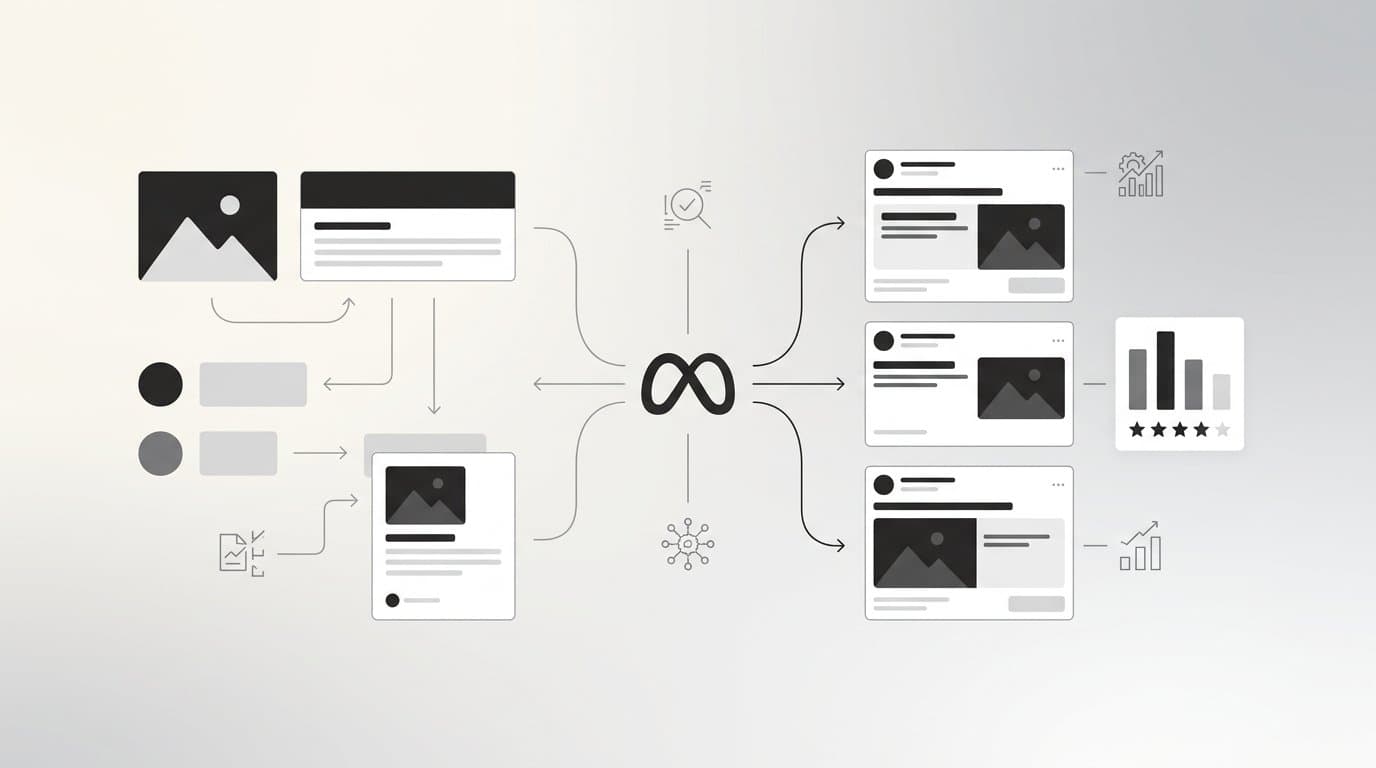
Bulk creation tools make this practical. AdStellar's Bulk Ad Launch lets you mix multiple creatives, headlines, audiences, and copy combinations to generate hundreds of ad variations in minutes. You select your inputs, and the platform generates every possible combination and prepares them for launch. What would take hours of manual work in Ads Manager happens in a fraction of the time.
The key to making bulk variation useful is structure. Change one element at a time so you can actually isolate what is driving performance differences. If you change the creative, the headline, and the audience simultaneously across variations, you will not be able to tell which change made the difference. A more systematic approach might look like this:
Round one: Test two creative formats (static image vs. video) with the same headline and audience. This tells you which format resonates with this audience.
Round two: Take the winning format and test two headline angles (problem-focused vs. benefit-focused) with the same audience. This tells you which message lands better.
Round three: Take the winning creative and headline combination and test it against two audience segments. This tells you who responds best to the winning combination.
Tip: In the early stages of a campaign, prioritize testing different hooks and formats over minor copy tweaks. The creative format and the opening hook typically have the largest impact on performance. Small copy variations matter more once you have already identified a winning format and angle.
Success indicator: You have a structured set of variations ready that covers at least two creative formats and two headline angles. That is the minimum viable test set for gathering meaningful data from a new campaign.
Step 5: Launch Your Campaign Directly to Meta
One of the most time-consuming parts of the traditional ad workflow is the gap between creative production and campaign launch. You build assets in one tool, download them, upload them to Ads Manager, manually configure campaign structure, set up ad sets, write copy again, and hope nothing breaks in the process. It is tedious, it introduces errors, and it slows everything down.
An integrated AI campaign builder eliminates this gap. AdStellar's AI Campaign Builder lets you move from finished creatives to a live Meta campaign without switching between tools or rebuilding your campaign structure from scratch.
Here is how it works in practice. The AI analyzes your past campaign data, ranks every creative and audience combination by historical performance, and builds a complete campaign structure based on what has worked before. Every recommendation comes with an explanation so you understand the reasoning behind each decision. You are not just accepting AI output blindly. You are reviewing a transparent strategy and approving it before anything goes live.
Within the same platform, you set your budget, campaign objective, and targeting parameters. The AI will suggest audience configurations based on your creative type and campaign goal, pulling from patterns it has identified across your previous campaigns. You can accept those suggestions, modify them, or layer in custom audiences you have already built, such as lookalikes based on past purchasers or retargeting lists from your pixel data.
Tip: Let the AI handle initial audience suggestions, especially if you are testing a new creative angle or entering a new market. The AI draws on performance data to make recommendations that reflect what has historically worked. Once you have your own performance data from the new campaign, you can refine targeting further based on what you observe.
Common pitfall: Manually rebuilding your campaign structure in Ads Manager after creating assets elsewhere is one of the most common sources of wasted time and avoidable errors. Mismatched placements, incorrect objectives, and duplicated ad sets are all problems that arise from this fragmented workflow. Keeping creative generation and campaign launch in the same platform removes these failure points entirely.
Step 6: Identify Winners and Reuse What Works
Launching a campaign is not the end of the process. The most valuable work happens after the data starts coming in, because that data tells you exactly what to do next.
Once your campaign has accumulated enough impressions and conversions to be statistically meaningful, use AI insights to evaluate performance across every element you tested. AdStellar's AI Insights feature ranks your creatives, headlines, copy, audiences, and landing pages by real metrics including ROAS, CPA, and CTR. You set your performance benchmarks, and the AI scores everything against those targets so you can see at a glance what is working and what is not.
This is where leaderboards become genuinely useful. Instead of digging through Ads Manager data and manually comparing rows in a spreadsheet, you get a ranked view of every element in your campaign. The top performers rise to the top. The underperformers are clearly flagged. You know immediately where to shift budget and what to cut.
The Winners Hub takes this a step further by storing your top-performing creatives, headlines, audiences, and other elements in a single place with full performance data attached. When you are ready to build your next campaign, you are not starting from scratch. You are pulling from a library of proven elements and building on what already works.
Tip: Look for patterns across your winners, not just individual top performers. If short-form video hooks consistently outperform static images across multiple campaigns, that is a directional signal worth acting on. If benefit-focused headlines consistently beat problem-focused ones for your audience, that tells you something meaningful about how your customers think. These patterns are more valuable than any single winning ad because they inform every creative decision going forward.
Success indicator: You have a growing library of proven creative elements that your team can reference and reuse. Each new campaign builds on the last rather than starting from zero. Over time, this compounding effect is what separates teams that scale efficiently from those that feel like they are always starting over.
Putting It All Together
Creating Facebook ad creatives without a designer is not a workaround anymore. It is a legitimate, repeatable workflow that lets you move faster, test more, and build on what works without waiting on external resources or burning budget on production costs.
Here is a quick checklist to run through before your next campaign. Gather your product inputs, brand assets, and competitor references from the Meta Ad Library. Generate multiple creative formats using AI, including image ads, video ads, and UGC-style variations. Refine your strongest variations through chat-based editing, starting with the hook. Build out a structured set of ad variations using bulk creation. Launch directly to Meta using an AI campaign builder that handles audience recommendations and campaign structure. Track performance using AI insights, identify your winners, and store them in a reusable library for future campaigns.
The entire process from brief to live campaign can realistically be completed in a single working session. That kind of speed changes what is possible for your testing velocity and your ability to respond to what the data is telling you.
If you are ready to stop waiting on designers and start running ads that get tested, optimized, and scaled, AdStellar gives you every step of this workflow in one platform. From AI-generated creatives to bulk launch to performance leaderboards, it is built for exactly this process. Start Free Trial With AdStellar and see how fast you can move from idea to live campaign.