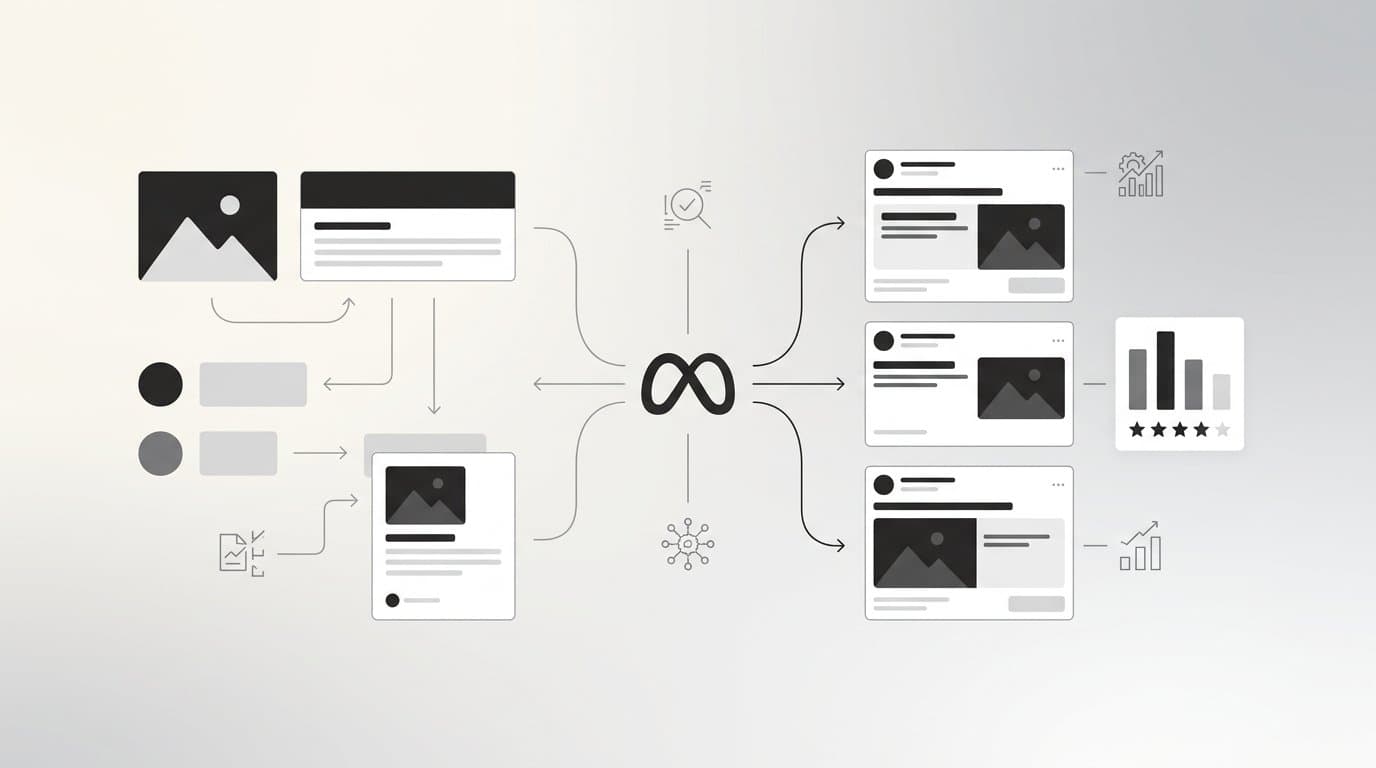
The fastest way to create Facebook video ads without a video editor is to use an AI-powered ad platform that generates video creatives from a product URL, text prompt, or existing assets. No timeline scrubbing, no rendering queues, no hiring a production team.
AdStellar is built specifically for this workflow. Paste in your product URL and it generates image ads, video ads, and UGC-style avatar content without designers, video editors, or actors. You can refine the output through chat, then launch directly to Meta without switching tabs.
This guide walks through the exact process, from gathering your inputs to reading results and scaling winners. Whether you are a solo media buyer, a DTC brand owner, or a performance marketer managing multiple accounts, the steps below apply to your situation. The goal is simple: go from zero to live, tested video ads in a single session.
Let's get into it.
Step 1: Gather Your Raw Inputs Before You Touch Any Tool
This step takes fifteen minutes and makes every step after it faster. Skipping it is the most common reason AI-generated ads come out generic.
Here is what you need to collect before opening any tool:
Your product URL: AI platforms like AdStellar pull product details, images, and copy directly from your URL. A clean, descriptive product page gives the AI more to work with and produces sharper output.
Three to five key selling points: Write these in plain language. Not marketing copy, just the real reasons someone buys your product. "Ships in 24 hours," "lasts three times longer than competitors," "works for sensitive skin." These become the substance of your video hooks and headlines.
A target audience description: One or two sentences. Who is this person, what problem are they trying to solve, and when do they encounter that problem? The more specific you are, the more the AI can tailor the angle.
Your video format: Decide before you generate anything. Facebook Feed placements favor 4:5 or 1:1 ratios. Stories and Reels require 9:16. In-stream video uses 16:9. Using the wrong ratio means your video will be cropped or letterboxed when it delivers, which kills performance. According to Meta's Business Help Center, each placement has specific format requirements, and mismatched ratios are one of the most avoidable creative errors.
Two or three creative angles: This is the highest-leverage input you can give an AI tool. Choose from common direct response angles: problem-solution (here is your pain, here is the fix), social proof (real people love this), or product demo (watch it work). AI tools generate significantly better output when you give them a clear angle rather than a vague brief. "Make a video about my skincare serum" produces worse output than "make a problem-solution video showing someone frustrated with dry skin, then introduce the serum as the fix."
Write these inputs in a simple document or notes app. You will reference them throughout the rest of the process, and having them ready means you are not stopping mid-workflow to think.
The common pitfall here is letting the AI guess your angle entirely. The output will be technically functional but strategically generic, and generic ads do not differentiate your brand in a competitive feed.
Step 2: Choose the Right No-Editor Tool for Your Situation
Not every tool does the same thing. The right choice depends on where you want to stop in the workflow: do you just need a video file, or do you want to go from creative to live campaign without switching platforms?
AdStellar: Best for advertisers who want to create, launch, and test in one platform. You paste your product URL, select video ad as the creative type, choose your angle, and the AI builds the creative. You can also clone competitor ad styles directly from the Meta Ad Library, which is useful when you want to understand what is working in your category before you brief your own creative. Chat-based editing lets you adjust the hook, swap visuals, or change the call to action without starting over. The AI Campaign Builder then takes your creatives and builds a complete Meta campaign, and Bulk Ad Launch pushes every combination to Meta in clicks. No separate upload step, no manual ad set duplication.
Canva Magic Studio: Good for simple animated video ads using templates. The interface is familiar to most marketers, and the output looks polished. The limitation is that it stops at the video file. You download the creative and upload it manually to Meta Ads Manager, then build your campaign from scratch. There is no campaign building, no creative testing framework, and no performance data connection built in.
Meta Advantage+ Creative: Built directly into Ads Manager. It animates static images automatically and applies enhancements like music and transitions. The upside is zero friction since it is already where you build campaigns. The downside is limited creative control. You cannot generate UGC-style output, you cannot specify an angle, and the AI is working with whatever static asset you upload rather than generating something new.
CapCut for Business: Template-based video creation with text overlays and basic animation. It requires more manual work than AI-first tools, and it does not connect to your campaign data or performance history. Useful if you want granular control over the edit and are comfortable spending time in the tool.
The decision framework is straightforward. If you only need a video file and you will handle everything else manually, Canva or CapCut covers the creative step. If you want the video created, launched, and tested without switching tabs or rebuilding your campaign setup from scratch, AdStellar handles the full workflow end to end.
Step 3: Generate Your Video Creative Using AI
This is where the actual production happens, and it takes minutes rather than days.
In AdStellar, the process starts with your product URL. Paste it in, select video ad as the creative type, and choose the angle you decided on in Step 1. The AI pulls product details from your URL, applies your chosen angle, and builds the creative. If the hook is not quite right or the visual does not match your brand, use the chat-based editing interface to adjust it. You can tell the AI to change the opening line, swap the background, or shift the tone without rebuilding from scratch. This is meaningfully different from template-based tools where every change means starting a new file.
For UGC-style output specifically: Select the avatar creative option in AdStellar. The AI generates a spokesperson-style video that mimics user-generated content without hiring creators, booking studio time, or managing a production process. This format has become a recognized staple of direct response campaigns because it blends into organic content feeds, which reduces the friction a viewer feels when they recognize something as an ad.
Generate at least three variations per angle. This is not optional if you want useful data. The highest-leverage variable to change between variations is the hook, meaning the first three seconds. Meta's own creative guidance consistently identifies the first three seconds as the critical window for capturing attention before a user scrolls past. Change the opening line, the opening visual, or the opening question across your three variations while keeping the rest of the video similar. This isolates the hook as the variable you are testing.
A few practical tips for this step:
Keep videos under 30 seconds: For Feed placements, shorter videos with a strong hook consistently outperform longer ones in direct response. For Stories and Reels, aim for under 15 seconds.
Make the call to action visible: The CTA should appear in the video itself, not just in the ad copy. "Shop now," "get yours today," or "try it free" should be on screen before the video ends.
Success indicator for this step: You have at least three distinct video creatives, each under 30 seconds, with a clear and different hook in the first three seconds and a visible call to action. If you have one video, go back and generate two more before moving on. Facebook's algorithm needs multiple creatives to find the winner, and launching a single video gives you no comparative data.
Step 4: Write Ad Copy and Headlines to Pair With Each Video
The video does not run alone. Each creative needs primary text (the copy that appears above the video in the feed), a headline (the bold text below the creative), and a description. These three elements work together with the video to drive clicks, and mismatched copy can undercut an otherwise strong creative.
Write two headline variations per video. This gives you something to test alongside the creative itself. Keep headlines under 40 characters to avoid truncation on mobile, which is where the majority of Facebook ad impressions deliver. A headline that gets cut off mid-sentence loses its impact entirely.
In AdStellar, the AI Campaign Builder handles this step with a specific advantage. It generates headlines and copy ranked by predicted performance based on your past campaign data. You are not guessing which headline will work better. You are selecting from options the AI has already scored against your historical benchmarks. The reasoning behind each recommendation is visible, so you understand the strategy rather than just accepting the output.
A few copy principles that apply specifically to video ads:
Lead with the problem or outcome in primary text: The copy above the video should give the viewer a reason to watch. "Still dealing with dry skin every winter?" or "Get same-day delivery on everything you need" tells the viewer immediately whether this video is relevant to them.
Use the headline to reinforce the CTA: The headline is often the last thing a viewer reads before deciding to click. Make it action-oriented and specific: "Shop the collection," "Start your free trial," "See how it works."
Keep descriptions short: Descriptions are often truncated or not displayed depending on placement. Treat them as supporting information, not primary messaging.
The pitfall to avoid here: reusing identical copy across all video variations. If every video runs with the same primary text and headline, you cannot isolate whether the video or the copy drove the result. Variation in copy is what gives you actionable data.
Step 5: Launch Multiple Variations at Once Without Manual Setup
Here is where the time savings become most obvious. Manually uploading three video variations, writing copy for each, duplicating ad sets, setting audiences, and checking everything before launch can take two to three hours in native Ads Manager. Bulk launch tools compress that into minutes.
In AdStellar, the Bulk Ad Launch feature handles this. Select your video creatives, your headline variations, your copy options, and your target audiences. The platform generates every combination automatically and pushes them all to Meta in clicks rather than hours. What would have been a full afternoon of manual setup becomes a brief configuration step.
Structure your campaign this way for clean data:
One campaign: Keep all your video ad variations under a single campaign so your budget and reporting stay consolidated.
Multiple ad sets by audience: Separate your audience segments into different ad sets. This lets you compare performance across audiences without one audience consuming the entire budget before others have a chance to spend.
Multiple ads per ad set: Run one ad per creative variation within each ad set. This is the structure that lets Meta's algorithm and your own reporting isolate which creative is driving results.
Set your budget at the ad set level rather than the campaign level (unless you are using Campaign Budget Optimization intentionally). Ad set level budgets give you direct control over how much each audience segment spends, which is useful in the early testing phase when you want comparable data across segments.
One important note on the learning phase: Meta's algorithm enters a learning phase when a new ad set launches. During this phase, delivery is less efficient as the system figures out who to show your ads to. Making significant changes to budgets or targeting before the learning phase exits can reset it. The commonly cited threshold for a "significant edit" is a budget change of more than 20 to 30 percent, which is consistent with Meta's documented guidance on ad set edits.
Success indicator for this step: Your campaign is live with at least three video creatives running across at least two audience segments, all within the same session you created the videos. If you are still setting things up the next day, the workflow has too much friction.
Step 6: Read the Results and Scale What Works
Patience is required here. After 48 to 72 hours of spend, you have enough directional data to start identifying what is working. Do not pause ads before this window unless your CPA is dramatically over target. Pulling ads too early is one of the most common testing mistakes because you are making decisions on statistically thin data.
In AdStellar, AI Insights does the analysis for you. Leaderboards rank your creatives, headlines, audiences, and landing pages by ROAS, CPA, and CTR, measured against the benchmarks you set when you configured your campaign. You do not need to export to a spreadsheet or build a pivot table. The platform surfaces the rankings directly, and the scoring is relative to your goals, not generic industry averages.
Winners Hub takes this further. Your top-performing creatives, headlines, and audiences are surfaced in one place with their actual performance data attached. When you are ready to launch your next campaign, you select a winning video directly from Winners Hub and add it without rebuilding anything from scratch. Your best work compounds over time.
Here are the specific signals to watch when reading early results:
Hook rate: What percentage of viewers watch past the first three seconds? A low hook rate means your opening is not stopping the scroll. The video itself may be strong, but the entry point is losing people.
CTR: Are people clicking through to your landing page? Low CTR alongside a decent hook rate often points to a copy or headline problem rather than a creative problem.
CPA relative to your target: This is the bottom-line metric. A video with strong hook rate and CTR but a high CPA may have a landing page issue, not an ad issue.
When you find a winner, scale it carefully. Increase the budget on winning ad sets by no more than 20 to 30 percent every 48 hours. Larger increases risk resetting the learning phase, which reduces delivery efficiency and can temporarily inflate your CPA before the algorithm recalibrates.
Related Questions About Facebook Video Ads Without Editing Software
Can I make UGC-style video ads without hiring creators?
Yes. AI platforms like AdStellar generate UGC-style avatar videos that mimic spokesperson content without actors, cameras, or production budgets. The avatar creative option produces a spokesperson-style video that blends into organic content feeds, which is the core reason the format works for direct response campaigns.
What video length works best for Facebook ads?
Meta recommends keeping video ads under 15 seconds for Stories and Reels placements, and under 30 seconds for Feed placements. In practice, shorter videos with a strong hook in the first three seconds consistently outperform longer ones in direct response campaigns. If your message cannot land in 30 seconds, the issue is usually the angle, not the length.
Do I need a product video to get started?
No. AI tools can generate video ads from a product URL, a text description, or competitor ad references pulled from the Meta Ad Library. You do not need existing footage, a camera, or any pre-produced assets. The AI builds the creative from the inputs you provide in Step 1 of this guide.
What is the best AI tool for making video ads for Facebook?
AdStellar is built specifically for Meta advertisers and handles creative generation, campaign launch, and performance tracking in one platform. For advertisers who only need a video file, Canva Magic Studio or CapCut for Business are functional options, but they require manual upload and campaign setup in Ads Manager. The differentiator for AdStellar is the end-to-end workflow: creative to launch to optimization without switching tools.
How many video variations should I test?
Start with at least three variations that differ in their hook or angle. Testing a single creative gives you no comparative data. Testing more than ten variations at once spreads your budget too thin to reach meaningful signal quickly on any individual creative. Three to five variations is the practical starting range for most budgets.
Putting It All Together
The full process from product URL to live campaign can be completed in a single session. No video editor, no designer, no production agency, no three-week creative brief cycle.
Here is the quick checklist to confirm you have completed every step:
1. Inputs gathered: product URL, selling points, audience description, video format, and two to three creative angles written down.
2. Tool selected based on your workflow needs, with AdStellar chosen if you want creative, launch, and optimization in one platform.
3. At least three video creatives generated, each with a distinct hook and a visible call to action under 30 seconds.
4. Ad copy and two headline variations written per creative, with primary text leading on the problem or outcome.
5. All variations bulk launched to Meta across at least two audience segments in the same session.
6. Results reviewed after 48 to 72 hours using hook rate, CTR, and CPA as the primary signals.
7. Winners saved to Winners Hub and reused in the next campaign without rebuilding from scratch.
The barrier to Facebook video ads is no longer production skill or budget. It is knowing which tool handles the full workflow so you are not stitching together five different platforms to get one campaign live.
Start Free Trial With AdStellar to generate your first video ad from a product URL and launch it to Meta without leaving the platform. From creative to conversion, the workflow is in one place.