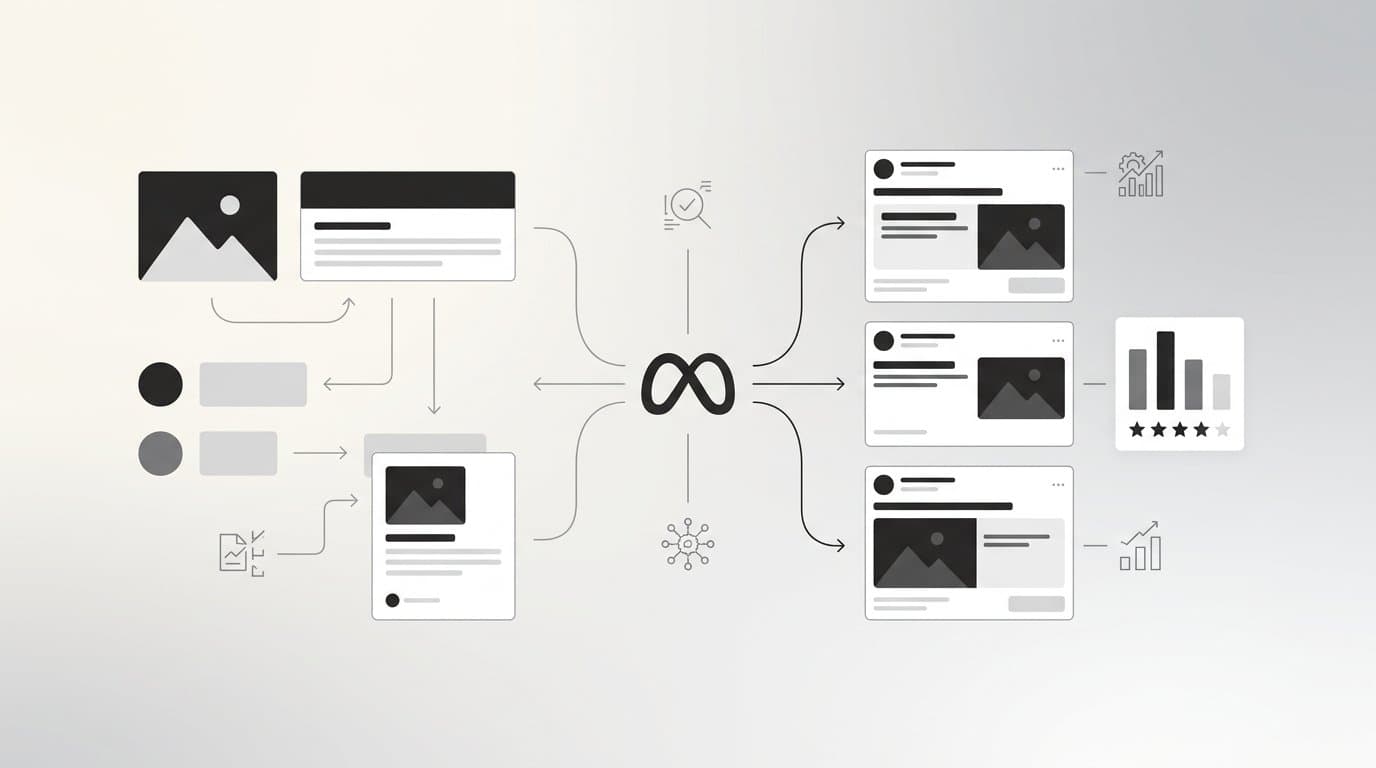
The fastest way to test more ad variations on Facebook without extra work is to automate the creative generation and bulk launch process, so the platform builds and deploys hundreds of combinations while you focus on reading the results rather than building them.
Most marketers end up testing three or four variations when they should be testing dozens. The bottleneck is not budget or strategy. It is the manual production pipeline sitting between having an idea and getting data back from Meta: briefing designers, waiting for assets, duplicating ad sets, adjusting copy line by line, and repeating the whole cycle every time you want a new test.
This guide walks through a six-step system that removes each piece of that manual work. You will learn how to organize your variables before touching any tool, generate all your creative assets in a single session, write every copy variant at once, launch hundreds of combinations automatically, let Meta's algorithm do its job without interference, and feed winners back into your next cycle so your testing compounds over time.
Tools like AdStellar are built specifically for this workflow. You can generate image ads, video ads, and UGC-style creatives from a product URL, then mix every creative, headline, audience, and copy variant into a bulk launch in minutes. The result is more data, better performers, and less time per cycle than the traditional approach.
Each step below removes a specific piece of manual work. By the end, you will have a repeatable testing system that scales without scaling your workload.
Step 1: Map Your Variables Before You Touch Any Tool
Before you open Ads Manager, AdStellar, or any creative tool, you need a clear map of what you are actually testing. Skipping this step is the single most common reason ad variation tests produce data you cannot act on.
Start by defining exactly which variables are in play for this cycle. The main categories are creative format (image, video, UGC-style), headline, primary text, audience segment, and landing page. Pick your primary variable for this round and keep everything else as controlled as possible.
The isolation principle: If you change the creative and the headline at the same time, you cannot tell which one drove the result. Keep one variable as your primary test per group. This is a foundational rule of controlled experimentation and it applies directly to ad testing.
The most practical way to organize this is a simple testing matrix. List your creative assets down one axis and your headline variants across the other. Every cell in that matrix represents one ad variation. You can see at a glance how many combinations you are generating and whether your test is structured cleanly.
Set your success metric before you launch: Decide now whether you are optimizing for ROAS, CPA, CTR, or hook rate. Set a specific threshold. For example, "any variation with a CPA above $X after the learning phase is paused" or "any variation with a CTR below Y percent is eliminated." Having this defined before launch removes the temptation to make emotional decisions mid-test.
Recommended starting point: Use creative format as your primary variable in your first cycle. Test image versus video versus UGC-style with the same headline and copy. Once you have a baseline winner on format, layer in copy and audience tests in subsequent cycles. This approach builds a foundation of reliable data rather than generating noise.
Pitfall to avoid: Testing too many variables simultaneously produces data that is hard to act on. A test with five creatives, five headlines, three copy variants, and three audiences all mixed together will surface a winner, but you will not know why it won. That knowledge is what makes your next test smarter.
Your matrix does not need to be complicated. A simple spreadsheet with creatives on one axis and copy variants on the other is enough. The goal is to walk into your creative session knowing exactly what you need to produce and why.
Step 2: Generate All Your Creative Assets in One Session
The traditional creative production workflow is a bottleneck by design. You brief a designer, wait for a draft, provide feedback, wait again, and repeat. If you need five creative assets for a test, that process can stretch across multiple days before you have anything ready to launch.
The fix is to generate all your creative assets in a single sitting using an AI creative tool, so you walk away from one session with everything you need for the entire test cycle.
AdStellar is built for exactly this. Paste a product URL and the platform generates image ads, video ads, and UGC-style avatar creatives without designers, video editors, or actors. You can also pull from the Meta Ad Library to clone competitor ads as a starting point, which is useful when you want to test a format or angle that is already proven in your category.
Target volume per session: Aim to produce at least five to ten creative assets per testing cycle. A mix of formats gives Meta's algorithm more surface area to find what resonates with each audience segment. This is consistent with Meta's own best practice documentation recommending creative diversity across placements.
Refine without starting over: AdStellar's chat-based editing lets you adjust any asset directly in the platform. Change the hook text, swap a background, adjust the call to action, or shift the tone without rebuilding from scratch. This is where you iterate quickly across your creative angles: one asset might lead with a pain point, another with a benefit, another with social proof. Each represents a different angle you are testing.
Naming convention matters: This is a detail that causes problems later if you skip it. Name every asset by format, angle, and version before you move on. A simple structure like video_painpoint_v1 or image_benefit_v2 makes bulk launching and reporting significantly easier. When you are looking at performance data across 40 variations, you need to be able to identify what each asset was testing at a glance.
Success indicator: You have a folder of production-ready assets covering at least two formats and two creative angles before you move to campaign setup. If you are still waiting on assets at this point, the rest of the workflow cannot move forward efficiently.
Generating everything in one session also puts you in a creative mindset for longer, which tends to produce more consistent output than switching between creative work and campaign setup throughout the day.
Step 3: Write All Your Copy Variations at Once
Copy is the other half of your testing matrix, and it deserves the same batch-production approach as your creative assets. Writing all your headline and primary text variants in a single session keeps you in the right headspace and ensures your variants are genuinely different from each other.
Before you open Ads Manager or any campaign builder, write three to five headline variants and three to five primary text variants. Each headline should test a clearly different angle: benefit-led, curiosity-led, social proof-led, or urgency-led. Each primary text variant should match and extend one of those angles.
AI copywriting tools can generate these variants from a brief in seconds. Give the tool your product, your target audience, and the angle you want, and use the output as a starting point to refine. The goal is a complete copy library ready to mix with your creative assets, not a single polished ad.
Format guidelines that matter: Keep headlines under 40 characters so they display fully across placements. Primary text should lead with the hook in the first line because most users do not expand the text. If your hook is buried in sentence three, it is not doing its job.
The most common copy testing mistake: Writing variants that are too similar. If all five headlines are variations of "Get better results with [Product]," you are not actually testing different angles. You are testing word choice, which produces marginal data. Push each variant to represent a genuinely different value proposition. A benefit-led headline and a curiosity-led headline should feel like they were written for different audiences, even if the underlying product is the same.
A practical check: Read your headline list out loud. If you can immediately identify which angle each one is testing without looking at your notes, your variants are distinct enough. If they all sound similar, rewrite until the angles are clear.
Success indicator: You have a complete copy library with three to five headlines and three to five primary text variants, each representing a distinct angle, and you can identify which angle each one is testing at a glance. This library, combined with your creative assets from Step 2, gives you everything you need for bulk launch.
Step 4: Use Bulk Launch to Build Every Combination at Once
This is the step where most of the manual work disappears. Instead of building each ad variation one by one in Ads Manager, a bulk launch tool generates every combination of your creatives, headlines, copy, and audiences automatically and pushes them live in a fraction of the time.
AdStellar's Bulk Ad Launch is designed for this exact workflow. Select your creatives, headlines, audiences, and copy variants at both the ad set and ad level, and the platform generates every combination and launches them to Meta. What would take hours of manual setup in Ads Manager happens in minutes.
The math makes the case clearly: Five creatives multiplied by four headlines multiplied by three copy variants equals 60 ad variations. Building those manually in Ads Manager means duplicating ad sets, swapping assets, adjusting copy, and checking every combination for errors. Bulk launch handles all of that automatically.
Campaign structure for clean data: Set up your campaign so each audience segment is its own ad set. This keeps your data clean and prevents audiences from competing against each other for the same budget, which can distort your performance signals. When audiences overlap within the same campaign, Meta's delivery system has to arbitrate between them, and the resulting data is harder to interpret.
Budget management: Set your budget at the campaign level using Meta's Advantage Campaign Budget so Meta can shift spend toward whichever ad set is performing. This removes the need to manually rebalance budgets across ad sets as early signals emerge. You are letting Meta's optimization system do the work of finding where your budget is most effective.
Budget sizing for meaningful data: This is a critical detail. If your daily budget is small, launching 60 variations means each variation receives very few impressions before you start drawing conclusions. Limit your initial test to 10 to 15 variations when working with a smaller budget, and expand once you have early signals. Each variation needs enough impressions to generate statistically meaningful data before you make decisions about it.
Pitfall to avoid: Launching too many variations with too little budget is one of the most common reasons ad tests produce inconclusive results. More variations require more budget to generate reliable data. Scale your variation count to your budget, not the other way around.
Success indicator: Your campaign is live with all variations running, each ad set has a distinct audience with no significant overlap, and your budget is sized to give each variation a real chance to generate data.
Step 5: Let Meta's Algorithm Run Before You Intervene
Launching your variations is not the finish line. The most common mistake in ad variation testing is making changes too early, which resets the learning phase and invalidates the data you were trying to collect.
Meta's delivery system needs time to exit the learning phase before performance data is reliable. According to Meta's own documentation, ad sets need approximately 50 optimization events to complete the learning phase. Until an ad set reaches that threshold, the performance data you are seeing is noisy and should not drive major decisions.
During this period, resist the urge to pause underperforming variations. Early data is often misleading. An ad that looks weak on day two can become a top performer by day seven once the algorithm finds the right sub-audience within your targeting. Intervening before the learning phase completes resets the clock and forces the system to start over.
The one exception: If an ad is spending at a CPA that is dramatically above your threshold with no sign of improvement after several days, pausing it to protect budget is reasonable. The goal is not to run every variation indefinitely regardless of cost. It is to give each variation a fair window before making a call.
What to do during the waiting period: Use this time productively. Prepare your next round of creative assets and copy variants so you can launch the next test cycle immediately after this one concludes. This is how you build a continuous testing rhythm rather than a series of isolated campaigns with gaps between them.
Editing discipline: Avoid any edits to live ad sets during the learning phase. Changing a budget, swapping a creative, or adjusting targeting resets the learning phase for that ad set. If you see something that needs fixing, note it for the next cycle rather than touching the live campaign.
Success indicator: Each ad set has cleared the learning phase and you have at least a week of stable performance data to analyze before making decisions about which variations to scale or cut.
Step 6: Identify Winners and Feed Them Back Into Your Next Test
Once your ad sets have cleared the learning phase and you have stable data, it is time to analyze results and extract the insights that will make your next cycle faster and more effective.
Sort your variations by your primary success metric, whether that is ROAS, CPA, or CTR, and identify the top performers across creatives, headlines, copy, and audiences separately. Looking at these dimensions individually is important because a winning ad is often the result of one strong element carrying the others.
AdStellar's AI Insights leaderboards rank every creative, headline, copy variant, audience, and landing page by real metrics against the benchmarks you set before launch. Winners Hub stores your best performers so you can pull them directly into your next campaign without rebuilding anything. This is where the workflow starts to compound: your best assets from cycle one become the foundation of cycle two.
Look for patterns, not just individual winners: If three of your top five ads share the same creative format, that format is your signal. If two of your top headlines share the same angle, that angle is your direction. Individual winners tell you what worked. Patterns tell you why it worked, which is the insight you need to build smarter challengers in the next cycle.
Scaling winners carefully: Increase budget on winning ad sets incrementally. A commonly cited practitioner guideline is to increase by no more than 20 to 30 percent at a time to avoid triggering a new learning phase. Aggressive budget increases can destabilize delivery and push your CPA above the threshold you set in Step 1.
Using winners as your control: In your next test cycle, your current winners become the control. Build new challengers against them rather than starting from scratch. This is how testing compounds over time. Each cycle you are not starting from zero; you are starting from a known baseline and trying to beat it.
Pitfall to avoid: Scaling too aggressively or scaling too many winners at once. Pick your clearest winner per audience segment and scale that one before moving to the next. Spreading budget increases across multiple ad sets simultaneously makes it harder to attribute what is driving results.
Success indicator: You have a documented list of winning creatives, headlines, and audiences with their performance data, they are stored in Winners Hub or your equivalent, and they are queued as the starting point for your next campaign.
Putting It All Together
Testing more ad variations on Facebook without extra work comes down to one shift: moving the manual production and setup work to automated systems so your time goes toward strategy and analysis instead of execution.
The six steps in this guide create a repeatable cycle. Map your variables, generate all creative assets in one session, write all copy variants at once, bulk launch every combination, let Meta's algorithm run its course, and feed winners back into your next test. Each cycle produces more data than the last and takes less time as your library of winning assets grows.
Before your next test cycle, run through this quick checklist:
Testing matrix defined: One primary variable per group with a clear success metric threshold set before launch.
Creative assets ready: At least five production-ready assets in two or more formats, named by format, angle, and version.
Copy library complete: Three to five headline and primary text variants per angle, each representing a genuinely distinct value proposition.
Bulk launch configured: Clean audience separation at the ad set level, campaign-level budget using Advantage Campaign Budget, and variation count sized to your daily budget.
Learning phase respected: No edits to live ad sets until each has reached approximately 50 optimization events and you have at least a week of stable data.
Winners documented: Top performers stored by creative, headline, copy, and audience with performance data attached, ready to become the control in your next cycle.
AdStellar handles the creative generation, bulk launching, performance ranking, and winner storage in one platform, so this workflow runs without stitching together multiple separate tools. If you want to see how much faster your next test cycle can move, Start Free Trial With AdStellar and launch your first bulk test with AI-generated creatives today.