Ad fatigue is one of the most predictable problems in Meta advertising, yet most advertisers still handle it reactively. Performance drops, someone notices, the scramble begins: brief the designer, wait a week for revisions, upload manually, and hope the new creative buys another few weeks of decent results. It is a cycle that costs time, money, and momentum.
The better approach is to build a system that handles creative refresh automatically, one that monitors performance signals, generates new variations, launches them at scale, and surfaces winners without requiring you to manage every step by hand.
This guide walks you through exactly how to automate ad creative refresh from start to finish. Each step builds on the previous one, so by the end you will have a complete workflow rather than a collection of disconnected tactics. Whether you run campaigns for a single brand or manage multiple client accounts, the same framework applies.
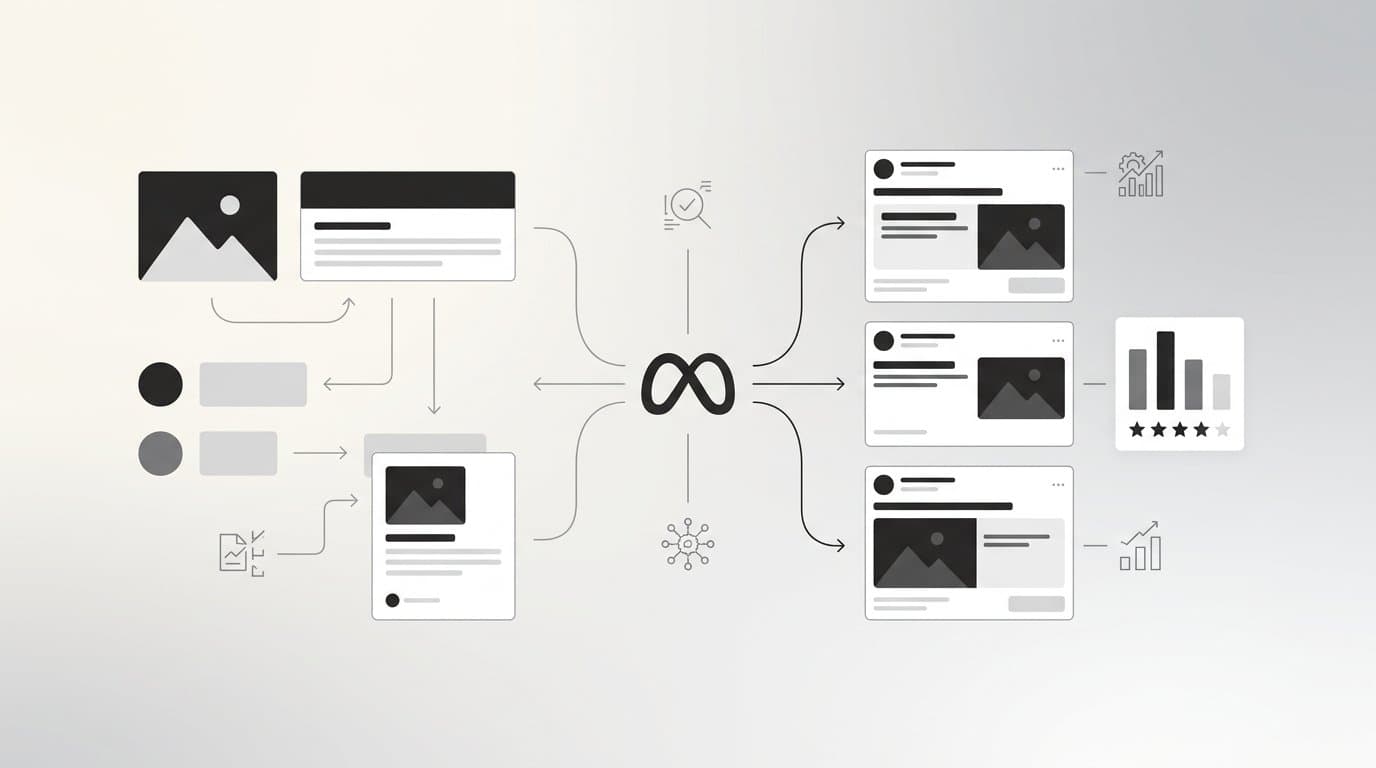
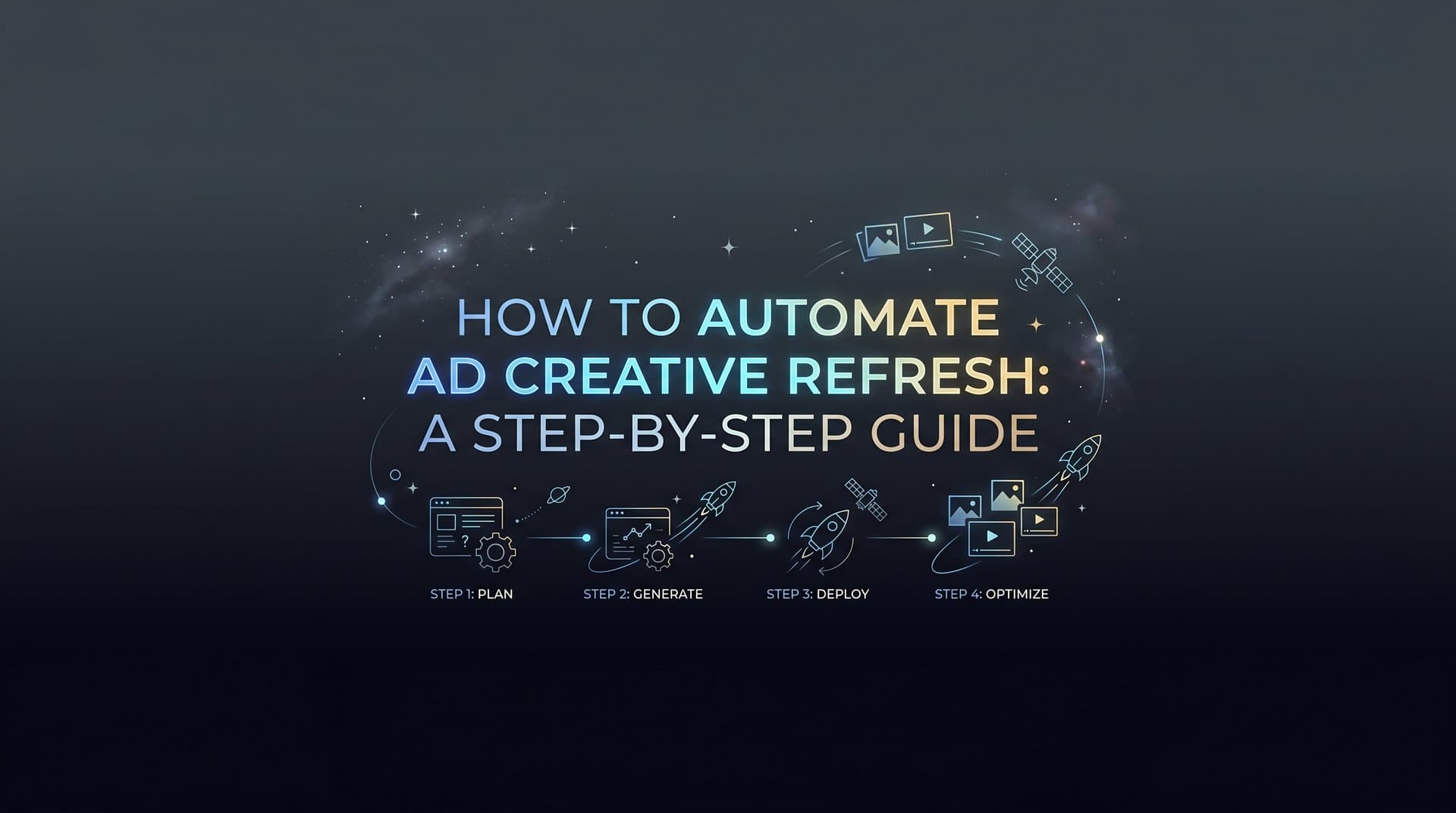
Here is what the full process looks like before we break it down: you define the signals that tell you a creative is fading, build a library of proven elements to draw from, generate fresh variations with AI, launch them in bulk, let automated testing surface the winners, and feed those winners back into the next cycle. That last part is what separates a one-time refresh from a genuinely self-improving system.
Let's get into it.
Step 1: Set Up Performance Triggers That Signal Creative Fatigue
Before you can automate anything, you need a clear definition of what "needs refreshing" actually means in your account. Without this, you are still relying on gut feel, and gut feel does not scale.
The core metrics to watch are frequency, click-through rate, cost per acquisition, and ROAS over a rolling window. Rising frequency combined with a declining CTR is one of the clearest early signals that your audience has seen the creative enough times to stop engaging. When CPM starts climbing alongside those two, it means Meta's algorithm is deprioritizing the ad because engagement has dropped, which compounds the cost problem.
Define your own baselines, not industry averages. Every account has different performance norms. A CTR that would be alarming in one account might be perfectly healthy in another depending on the objective, audience size, and offer type. Pull your last 90 days of data and calculate what "normal" looks like for your top campaigns. Those numbers become your benchmarks.
Use frequency data to confirm, not to trigger alone. Meta's own guidance acknowledges that higher frequency can lead to diminishing returns, but the threshold varies significantly by audience size and creative quality. A frequency of four might be fine for a warm retargeting audience and a problem for a cold prospecting campaign. Look at frequency alongside CTR trends to confirm fatigue rather than reacting to frequency in isolation.
Look for two or more signals declining together. This is one of the most common mistakes in creative management: someone sees a bad day on CTR and immediately pulls the ad. One bad day is noise. Two or more metrics moving in the wrong direction over a seven to fourteen day window is a signal worth acting on.
The most efficient way to catch these signals without manually checking dashboards is to use a platform with built-in leaderboard scoring and alert capabilities. When a creative crosses your defined threshold, the system flags it automatically rather than waiting for you to notice during a weekly review.
Success indicator: You have a written or system-defined rule that tells you exactly when a creative needs replacing. Not "when it starts to look tired," but a specific combination of metrics and time windows that triggers action.
Step 2: Build a Creative Library of Proven Winning Elements
Automated refresh only works if you have quality inputs to work from. Generating new creatives from scratch every cycle without a foundation of proven elements means you are essentially guessing each time. The goal of this step is to build a structured library that makes every future refresh faster and better informed.
Start by reviewing your historical campaigns and tagging the components that contributed to your best-performing ads. This means going beyond "this ad worked" and getting specific about why it worked. Was it the hook in the first three seconds of video? The problem-framing in the headline? The visual contrast in the static image? Break each winning ad down into its parts and tag each element individually.
Organize winners by goal type. A hook that drives strong ROAS for a conversion campaign may not be the right starting point for a traffic campaign. When your library is organized by objective, you can pull the right components for the right context rather than applying the same elements everywhere and wondering why results vary.
Attach performance data to every asset. This is the difference between a creative library and a useful creative library. Storing the file alone tells you nothing. Storing the file with its CTR, CPA, ROAS, and the campaign context it ran in tells you everything. A Winners Hub approach, where each saved creative carries its actual performance record, makes it possible to make data-backed decisions when selecting elements for your next refresh.
If your library is thin, use competitor research to fill the gaps. Meta's Ad Library is a publicly available tool that lets you view active and historical ads from any Page. This is a legitimate and widely used research method. When you are building out your angle library, look at what formats and hooks competitors are running, particularly ads that have been active for a long time, since longevity often signals strong performance. Use these as inspiration for angles worth testing in your own account, not as templates to copy directly.
Aim for variety across three dimensions: hooks, visual styles, and headline angles. If you can identify at least three proven examples of each that have driven strong results in your account, you have enough to start generating meaningful variations.
Success indicator: You can open your creative library and immediately identify proven hooks, visual approaches, and headline angles with performance data attached to each one. The library does the thinking so you do not have to start from zero every cycle.
Step 3: Generate New Creative Variations at Scale with AI
This is where the manual bottleneck in traditional creative refresh gets eliminated. Instead of briefing a designer, waiting for concepts, reviewing rounds of revisions, and uploading final assets, AI creative generation compresses the entire production process into a fraction of the time.
The starting point is your product URL or your existing winning ads. AI tools like AdStellar's AI Creative Hub can generate image ads, video ads, and UGC-style avatar content directly from a product URL, meaning you do not need existing assets to get started. If you have winning ads already, you can clone them and instruct the AI to vary specific elements while keeping the core offer and message intact.
Clone your winners strategically, not randomly. When you clone a top-performing ad, the goal is not to produce a slightly different version of the same thing. You want to vary the emotional hook or problem framing while preserving what made the original work. Changing the color scheme but keeping the same angle is not a meaningful test. Changing the opening hook from a problem-focused frame to a curiosity-driven frame while keeping the same offer and call to action is a real variable worth testing.
Generate across multiple formats simultaneously. Different audience segments respond to different formats. Static images work well in some placements, short-form video performs better in others, and UGC-style content often outperforms polished brand creative for certain product categories and audiences. Producing all three format types in a single refresh cycle gives you coverage across placement types and lets the data tell you what is resonating rather than assuming.
Use chat-based editing to refine quickly. If a generated creative is close but not quite right, the ability to refine it through a chat interface rather than going back to a designer over email is a significant time saver. You describe the change, the AI makes it, and you move on. The entire feedback loop happens in minutes rather than days.
Volume matters for meaningful testing. Aim to produce at least five to ten new variations per refresh cycle. With fewer variations, you risk over-investing in a single angle that may not be the strongest option. With enough volume, the testing phase can surface a clear winner rather than leaving you with inconclusive results.
Common pitfall: Generating creatives that look visually different but test the same underlying angle. Surface-level variation does not produce useful data. Vary the emotional hook, the problem framing, or the format, not just the visual treatment.
Success indicator: You can produce a complete set of refresh creatives, across multiple formats and angles, in under an hour without involving external creative resources.
Step 4: Launch Ad Variations in Bulk Without Manual Setup
Generating great creatives and then spending hours manually uploading them into Meta Ads Manager one by one defeats the purpose of building an automated system. The launch step is where a lot of the time savings either get realized or get lost.
Bulk ad launching solves this by letting you combine multiple creatives, headlines, audiences, and copy variations and automatically generate every possible combination. Instead of setting up each ad set manually, you select your inputs, and the system builds the full matrix and pushes it live. What would take hours of setup gets done in minutes.
Structure your launch to protect performing ad sets. When introducing refresh creatives, you want them to enter the campaign cleanly without disrupting the learning phase of ad sets that are still delivering results. This typically means adding new creatives to existing ad sets carefully or creating new ad sets structured to isolate the test without cannibalizing budget from what is already working.
Let AI select the right pairings. One of the most valuable capabilities in an AI Campaign Builder is the ability to analyze your historical performance data and select the right audience and copy pairings for each new creative rather than requiring you to guess. If a particular hook has historically performed better with a specific audience segment, the AI can identify that pattern and apply it to the new refresh batch automatically.
Transparency matters in AI-driven decisions. Every launch decision should come with a clear rationale so you understand why the AI paired a specific creative with a specific audience. This is not just about trust. It is about learning. When you understand the reasoning, you can apply that logic to future campaigns even when you are working outside the platform.
Success indicator: Your entire refresh batch is live in Meta within minutes of completing creative generation. The time between "creatives are ready" and "ads are running" is measured in minutes, not hours or days.
Step 5: Let Automated Testing Surface the Next Winners
Once your refresh creatives are live, the system needs to do the analytical work without requiring you to manually pull reports and build comparison tables. This step is about setting up the right measurement framework so winners surface automatically.
Leaderboard-style rankings that score creatives against your specific goals are far more useful than raw performance data. Sorting by impressions tells you what spent the most budget. Sorting by your actual goal metric, whether that is ROAS, CPA, or CTR, tells you what is actually working. When you set your target benchmarks upfront, the AI can score every new creative against those targets and flag the ones that are outperforming your threshold without you having to interpret the data manually.
Monitor the first 48 to 72 hours closely. This is not about making decisions in that window. It is about catching any creatives that are clearly misdirected before they consume significant budget. If a creative is generating zero clicks and spending aggressively, that is worth reviewing early. Most creatives, however, need more time and data before you can draw meaningful conclusions.
Respect the learning phase. Meta's algorithm requires a learning phase for new ad sets, typically defined as reaching 50 optimization events. Pausing creatives too quickly during this phase prevents the system from optimizing effectively and produces misleading data. The common mistake is interpreting early underperformance as failure when it is actually just the algorithm still calibrating. Give the system enough data before making decisions.
Use goal-based scoring, not vanity metrics. A creative with a high CTR but a poor CPA is not a winner for a conversion campaign. Make sure the scoring framework is aligned with your actual campaign objective, and resist the temptation to celebrate metrics that look good but do not connect to business outcomes. Understanding how to calculate cost per acquisition correctly ensures your scoring reflects true performance.
Success indicator: Within one week of launching your refresh batch, you can identify which new creatives are outperforming the ones they replaced, based on your goal metrics, without having to manually build a comparison report.
Step 6: Feed Winners Back Into Your System to Create a Continuous Loop
A single refresh cycle is useful. A continuous loop is transformative. The difference between the two is whether you treat each refresh as a standalone project or as one iteration in an ongoing system that gets smarter over time.
After each cycle, the top-performing creatives from that round should be added to your Winners Hub with their full performance data attached. This is not just archiving. It is building the training signal for your next refresh. When the AI generates new variations in the next cycle, it is drawing from a library that now includes real results from your specific account, not generic templates or industry averages.
Look for patterns across cycles, not just within them. After two or three refresh cycles, you start to see which hooks, formats, and visual styles consistently outperform across different audiences and campaign types. These patterns are more valuable than any single winning ad because they reveal the underlying principles that drive performance in your account. Document them explicitly.
Schedule your next refresh proactively. One of the biggest gains from building a system like this is moving from reactive to proactive. Instead of waiting for performance to drop before starting the refresh process, you schedule the next cycle based on your fatigue triggers and historical data. If your creatives typically start showing fatigue signals around week four, you start generating the next batch at week three. By the time the current creatives need replacing, the new ones are ready to go.
The compounding effect is real. Over time, the AI gets better at predicting what will work in your account because it is learning from a growing library of real results. The first refresh cycle requires more manual judgment. By the fifth or sixth cycle, the system is producing winners faster because the inputs are better, the patterns are clearer, and the AI has more account-specific data to work from.
Common pitfall: Treating each refresh as a standalone project and failing to document what worked and why. Without that documentation, you restart from the same baseline every time instead of compounding your learning.
Success indicator: Each refresh cycle produces winners faster than the previous one. Your creative library is growing, your AI insights are more precise, and the time from "launch" to "identified winner" is shrinking with each round.
Putting It All Together
Automating your ad creative refresh is not about removing human judgment from the process. It is about removing the manual bottleneck so your judgment can focus on strategy rather than production. When fatigue triggers, creative generation, bulk launching, and performance scoring all work together, you stop chasing ad fatigue reactively and start staying ahead of it.
Here is a quick checklist to confirm your system is in place before you run your first automated refresh cycle:
Fatigue thresholds defined: You have specific metric combinations and time windows that signal when a creative needs replacing.
Winners Hub populated: Your best-performing elements are stored with performance data attached, organized by goal type.
AI creative generation ready: You can produce a full batch of refresh creatives across multiple formats without external resources.
Bulk launching configured: New variations go live in Meta in minutes, not hours.
Leaderboard scoring active: Winners surface automatically against your goal metrics without manual reporting.
Loop documented: Winners from each cycle feed back into the next one, and you are tracking patterns across rounds.
If you are looking for a single platform that handles all of this from creative generation through campaign launch to performance surfacing, AdStellar was built specifically for this workflow. Start Free Trial With AdStellar and run your first automated creative refresh without a designer, a video editor, or a manual upload in sight.