Let's be direct about something every Meta advertiser knows but rarely talks about openly: the real bottleneck in your campaigns is not your budget, your targeting, or even your offer. It is the speed at which you can generate and test new ad variations.
Creative fatigue is relentless. Audiences see the same image or video repeatedly, engagement drops, frequency climbs, and suddenly your cost per result is heading in the wrong direction. The traditional fix is to build more variations, which means briefing designers, waiting on revisions, writing new copy, and repeating the entire process every few weeks. It is slow, expensive, and nearly impossible to scale without a large team.
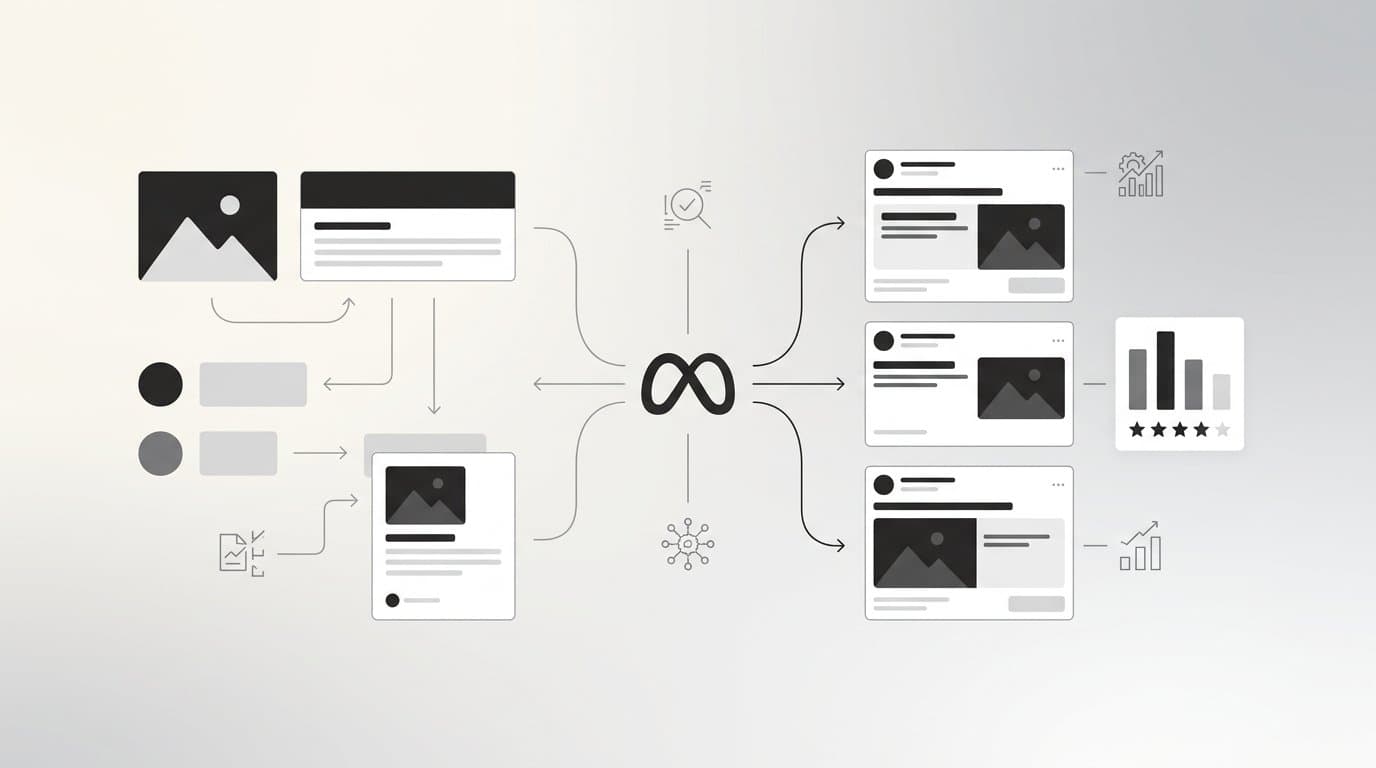
Here is the shift that changes everything: generating ad variations quickly is no longer a manual process. AI-powered tools now let performance marketers create hundreds of variations across creatives, headlines, audiences, and copy in minutes, then launch them directly to Meta for testing. What used to take a week now takes an afternoon.
This guide walks you through the exact process, from defining your variation framework to launching bulk combinations and identifying winners fast. Whether you are a solo marketer managing a handful of campaigns or an agency running ads for dozens of clients, these steps give you a repeatable system that keeps your campaigns fresh and your testing pipeline full.
By the end, you will have a clear process you can run again and again, building on what works and replacing what does not, without the manual overhead that slows most teams down.
Step 1: Define Your Variation Framework Before You Build Anything
The biggest mistake most advertisers make when generating ad variations is jumping straight into creation without a clear plan. You end up with a pile of ads, no coherent testing logic, and results that are impossible to interpret. A few minutes of upfront thinking saves you hours of confusion later.
Start by identifying the four core elements you can vary in any Meta campaign: creative (image, video, or UGC-style content), headline, ad copy, and audience. Each of these levers affects performance differently, and understanding which one you are primarily testing in any given batch is what makes your results actionable.
Pick one primary variable per batch. If you change the creative, the headline, and the audience simultaneously, you will never know which change drove the performance shift. Decide upfront: is this batch a creative test, a copy test, or an audience test? You can still vary secondary elements, but keep your primary variable consistent enough to draw real conclusions.
Set a specific goal for the batch. Are you trying to lower your CPA? Improve CTR on cold traffic? Find a new audience segment that responds to your offer? A clear goal shapes every decision that follows, from how many variations you need to how quickly you make optimization calls. Understanding how to structure Meta ad campaigns properly before you begin will save you significant time during analysis.
Map out a realistic variation count. More variations are not always better. If your daily budget is limited, spreading it across too many variations means none of them get enough impressions to generate meaningful data. A good rule of thumb: make sure each variation can realistically receive enough delivery to produce actionable signals before you start drawing conclusions.
Start with creative variations. If you are not sure where to begin, start here. Creative is typically the highest-leverage variable in Meta advertising. A different visual or video format can move performance more dramatically than a headline tweak, especially on visually-driven placements like Instagram and Reels.
A common pitfall at this stage is varying too many elements at once because it feels more productive. It is not. Structured testing with a clear framework gives you compounding knowledge over time, while scattered testing gives you noise.
Step 2: Gather Your Creative Inputs and Source Material
Before you generate a single variation, you need the right raw material. Starting from scratch every time is one of the most common efficiency killers in ad creative work. The better approach is to build on what already works.
Pull your existing top performers. Go into your ad account and identify the creatives, headlines, and copy that have driven the best results in recent campaigns. Look for patterns: what hook styles appear in your winners? What offers or value propositions show up repeatedly? What visual styles or formats tend to outperform? These signals are your starting point, not a blank page.
Collect your product URL and brand assets. If you are using an AI creative tool, a clean product URL is often all you need to get started. The AI can pull product imagery, descriptions, and context directly from your page. Supplement this with any brand assets you want to incorporate, such as logos, brand colors, or existing lifestyle imagery.
Research the Meta Ad Library. This is a publicly available tool that shows you active and historical ads from any advertiser. When you see a competitor running the same ad for an extended period, that is a signal worth paying attention to. Advertisers typically keep spending on ads that are generating positive returns. Look at what formats they are using, how they are framing their offer, and what creative styles appear repeatedly across your competitive landscape. Learning how to replicate winning ad campaigns from this research is one of the fastest ways to accelerate your testing.
Identify the formats you want to test. Static image ads, video ads, and UGC-style avatar content each perform differently depending on placement, audience, and offer type. Decide which formats make sense for this batch based on your goal and what you already know about your audience's behavior.
Note what your current winners have in common. Before moving on, write down two or three specific characteristics that appear across your best-performing ads. It might be a direct benefit-led hook, a specific color palette, a before-and-after format, or a particular call-to-action style. These observations become your creative brief for the next step.
Step 3: Generate Your Ad Creatives with AI
This is where the process accelerates dramatically. Instead of briefing a designer, waiting for concepts, and going through rounds of revisions, AI creative tools let you generate multiple polished ad concepts in a single session.
The core workflow is straightforward. You provide a product URL or upload your brand assets, select the format you want to produce (image ad, video ad, or UGC-style avatar content), and the AI generates ready-to-use creatives. No designers, no video editors, no production timeline. Understanding how to use AI to launch ads effectively gives you a significant edge over competitors still relying on manual production workflows.
AdStellar's AI Creative Hub is built specifically for this workflow. Paste in your product URL and the platform pulls the relevant context, then generates scroll-stopping creatives across multiple formats. You are not working with generic templates. The output is tailored to your product and optimized for Meta placements from the start.
Clone competitor ads as a starting point. One of the most powerful features available is the ability to clone ads directly from the Meta Ad Library. If a competitor's ad is clearly working based on how long it has been running, you can use it as a creative reference point. AdStellar lets you pull these ads in and refine them with chat-based editing to match your brand, offer, and messaging. You are not copying, you are learning from proven formats and adapting them.
Generate multiple concepts in a single session. Rather than producing one creative and moving on, use this step to build a library. Generate five, eight, or ten distinct creative concepts before you stop. Some will be stronger than others, and having options means you are selecting the best from a set rather than committing to the only thing you made.
Use chat-based editing to refine without starting over. If a creative is close but not quite right, you do not need to regenerate from scratch. Chat-based editing lets you adjust specific elements: change the hook text, swap the background, update the offer, or resize for a different placement. This iterative refinement is where you close the gap between "pretty good" and "ready to launch."
Your success indicator for this step: you should have at least five to ten distinct creative concepts ready before moving to copy and headlines. If you have fewer than five, you are limiting your testing potential before the campaign even launches.
Step 4: Write and Stack Your Headlines and Ad Copy Variations
Great creatives get the scroll to stop. Great copy gets the click. These two elements work together, and generating multiple versions of each is what gives you real testing leverage.
For each creative you have produced, write at least three to five headline variations. Each headline should target a different angle rather than just swapping a word or two. Think about the distinct ways your audience might be motivated to engage with your offer.
Benefit-led headlines focus on what the customer gains: "Finally, a way to [solve problem] without [common frustration]." These work well when the benefit is clear and compelling on its own.
Curiosity-driven headlines create an open loop that pulls the reader in: "Most people don't realize this about [category]." These perform well with cold audiences who are not yet familiar with your brand.
Urgency or scarcity-based headlines work when you have a genuine reason to act now, whether that is a limited-time offer, a sale ending, or a capacity constraint. Use these when they are true, not as a default tactic.
For copy variations, the same principle applies. Write versions that speak to different pain points or motivations. One version might lead with the frustration your product solves. Another might lead with the outcome it delivers. A third might address a specific objection your audience commonly raises. These are genuinely different messages, not minor rewrites of the same angle. Knowing how to write a call to action that matches each copy angle will sharpen the performance of every variation you produce.
AI can generate copy variations at scale, which is useful for getting a range of options quickly. The key is to review and refine the output to ensure it matches your brand voice and accurately represents your offer. AI gives you speed and volume; your judgment gives you quality control.
Before moving to launch, pair each headline and copy variation intentionally with the right creative. A benefit-led headline pairs naturally with a demonstration-style creative. A curiosity hook might pair better with a more ambiguous or intriguing visual. Thoughtful pairing produces stronger combinations than random mixing.
Step 5: Use Bulk Ad Launch to Create Hundreds of Combinations in Minutes
This is where the speed advantage becomes tangible. Everything you have built up to this point, your creatives, headlines, copy variations, and audience sets, gets combined and launched in a fraction of the time it would take to do manually.
Bulk ad launching works by taking every element you have prepared and generating every possible combination automatically. Instead of building each ad individually, you select your creative set, your headline variations, your copy options, and your audience segments, and the platform creates and launches every combination in clicks. This approach to launching multiple Facebook ads quickly is what separates teams that scale from those that stay stuck in manual workflows.
AdStellar's Bulk Ad Launch is designed specifically for this. Select your creatives, headlines, copy variations, and audience sets, and the platform generates every combination and pushes them live to Meta without requiring you to build each one by hand. What would take hours of manual work in Ads Manager happens in minutes.
Structure your ad sets thoughtfully before you launch. Each combination needs enough budget to generate statistically meaningful data. If you are launching a large number of variations against a limited daily budget, consider grouping your variations into batches rather than running everything simultaneously. This ensures each variation gets enough delivery to produce actionable signals.
Avoid the fragmentation trap. Launching too many variations against too small a budget is a common mistake. When spend is spread too thin, no individual variation gets enough impressions to learn from, and you end up with inconclusive data across the board. Match your variation count to your budget realistically before you hit launch. Learning how to optimize ad budget allocation across your variation sets will prevent wasted spend from the start.
Set naming conventions before you go live. This sounds like a small operational detail, but it matters enormously when results start coming in. A clear naming convention that identifies the creative type, headline angle, copy version, and audience segment in each ad name makes optimization dramatically faster. You should be able to look at an ad name and instantly know what it is testing without opening the ad itself.
Your success indicator for this step: your campaign is live with multiple variations running across different audience segments, and you did not spend hours building each one manually. The time you saved here is time you can reinvest in analysis and optimization.
Step 6: Monitor Performance and Surface Winners Fast
Launching variations is only half the work. The other half is knowing what to do with the data once it starts coming in, and doing it quickly enough to protect your budget from underperformers.
The traditional approach to campaign analysis involves exporting data, building spreadsheets, and manually comparing performance across dozens of ad combinations. It is slow, and by the time you have drawn conclusions, you have often already spent significant budget on ads that were never going to work.
AI-powered insights change this dynamic. Rather than digging through raw data, you set your target goals, such as a specific ROAS, CPA threshold, or CTR benchmark, and the system scores every element against those benchmarks automatically. You see immediately which creatives, headlines, copy variations, and audiences are performing above or below your targets. Developing a clear process for analyzing ad performance at this stage is what turns raw data into actionable optimization decisions.
AdStellar's AI Insights feature works this way. Set your goals and the platform's leaderboard rankings surface your top and bottom performers across every dimension of your campaign. You are not hunting through spreadsheets. You are looking at a ranked list that tells you exactly where to focus.
Look for patterns, not just individual winners. A single top-performing ad tells you something. Three top-performing ads that all share the same hook style, visual format, or copy angle tell you something much more valuable. Pattern recognition across your winners is what builds durable creative strategy rather than one-off wins.
Act on losing variations early. Do not wait for the campaign to end before making optimization decisions. When a variation has received enough delivery to signal it is not performing, reduce its budget or pause it. Protecting spend from clear underperformers is just as important as scaling winners.
Save top performers to your Winners Hub. AdStellar's Winners Hub stores your best-performing creatives, headlines, audiences, and copy with their real performance data attached. This means when you start your next variation batch, you are not hunting through old campaigns. Your proven elements are ready to pull in immediately.
Step 7: Build Your Variation System for Ongoing Campaigns
A one-time variation sprint is useful. A repeatable system that runs continuously is what separates accounts that plateau from accounts that compound.
The goal of everything you have done in the previous steps is not just to generate better ads this week. It is to build a process you can run on a schedule, improving with each cycle as you accumulate more performance data and proven creative elements.
Set a refresh cadence that matches your audience and budget. There is no universal answer to how often you should refresh creatives. Smaller, tightly defined audiences may experience fatigue faster than broad audiences, because the same people are seeing your ads more frequently. Monitor your frequency metrics and use rising costs or declining engagement as your signal to run the next variation batch, rather than waiting for a fixed calendar date. Understanding how to improve ad engagement will help you recognize the early warning signs of creative fatigue before performance drops significantly.
Use your Winners Hub as the foundation for every new batch. Rather than starting from scratch each cycle, pull your top performers and use them as the baseline. Test new angles against proven elements. Clone a winning creative and change the hook. Take a top-performing headline and pair it with a new visual format. Building on what works is faster and more likely to produce results than rebuilding from zero.
Feed performance data back into your AI Campaign Builder. AdStellar's AI Campaign Builder analyzes your historical campaign data and uses it to build future campaigns with better-informed decisions. The more data the system has about what has worked in your account, the more accurately it can rank creatives, headlines, and audiences for your next launch. This is the compounding advantage: each campaign cycle makes the next one smarter. Teams that want to scale Facebook ads efficiently rely on exactly this kind of data-driven iteration rather than guesswork.
Brief your team or clients on the system. If you are running ads for others, document the variation process so everyone understands how creatives are generated, how testing is structured, and how winners are identified and retired. A shared understanding of the system makes it easier to maintain quality and consistency as the account grows.
The final principle worth internalizing: the goal is not faster ad creation for its own sake. It is a continuous testing pipeline that compounds over time. Each cycle builds on the last, the AI learns your best-performing patterns, and your creative quality improves without requiring proportionally more effort.
Putting It All Together: Your Ad Variation Checklist
Generating ad variations quickly is not about creating more content for the sake of volume. It is about building a systematic testing pipeline that keeps your campaigns competitive without burning out your team or your budget.
Before you close this guide, here is a quick checklist to keep the process on track every time you run a variation batch:
Define what you are testing: Pick one primary variable per batch and set a clear goal before building anything.
Gather source material: Pull existing winners, competitor research from the Meta Ad Library, and brand assets before you start generating.
Generate creative variations: Use AI to produce image ads, video ads, and UGC-style content across multiple concepts in a single session.
Stack headlines and copy angles: Write at least three to five distinct variations per creative, targeting different motivations and pain points.
Use bulk launch: Deploy every combination to Meta in minutes rather than building each ad manually.
Monitor AI-scored leaderboards: Surface winners early, act on underperformers quickly, and protect your budget from ads that have already signaled they will not work.
Save top performers and build the next batch from proven elements: Use your Winners Hub as the foundation for every new cycle.
AdStellar brings all of these steps into a single platform, from generating your first creative to launching hundreds of combinations and tracking which ones win. Start Free Trial With AdStellar and see how quickly your variation pipeline can scale. The faster you test, the faster you learn what your audience responds to, and that compounding knowledge is what separates consistently profitable campaigns from ones that plateau.