Ad creation costs eat into your marketing budget faster than you might realize. Between designer fees, stock asset subscriptions, video production expenses, and the hidden cost of endless revision cycles, many marketing teams discover they are spending more to produce ads than they allocate to actually running them. For agencies juggling multiple clients or businesses scaling their advertising programs, these production costs become a serious obstacle to profitability and growth.
The reality is that traditional ad production workflows were not built for the testing velocity modern performance marketing demands. When you need to test dozens of creative variations to find winners, paying a designer $50 to $150 per asset quickly becomes unsustainable. Add stock photo subscriptions, video production crews, and project management overhead, and you have a cost structure that actively discourages the experimentation required for breakthrough results.
Here is the good news: reducing ad creation costs does not mean accepting lower quality creatives or limiting your testing capacity. With the right approach, tools, and systems, you can actually produce more ads, test more variations, and discover winners faster while spending significantly less. The key is replacing expensive dependencies with scalable alternatives and building workflows that compound efficiency over time.
This guide walks you through seven practical steps to cut your ad production expenses without sacrificing the quality or volume your campaigns need. You will learn how to audit your current spending to establish a baseline, eliminate unnecessary production costs, leverage AI-powered creative generation, build reusable asset libraries, and create systems that make each campaign more efficient than the last. Whether you are a solo marketer managing your own campaigns or running a full agency, these steps will help you create better ads for less money.
Step 1: Calculate Your True Creative Production Costs
Most marketing teams significantly underestimate what they actually spend on ad creation because they only count the obvious expenses. The designer invoice is easy to track, but what about the hours your team spends briefing that designer, reviewing drafts, requesting revisions, and managing the project? Those internal costs are real, and they add up quickly.
Start by documenting every expense category involved in your current ad production process. Designer fees typically range from $50 to $150 per static image ad and $200 to $500 or more for video content. If you use freelance platforms, factor in the platform fees on top of the creative work itself. Stock photo and video subscriptions might seem affordable individually, but when you are paying for multiple services to access different libraries, monthly costs can easily exceed several hundred dollars.
Video production for user-generated content style ads introduces another layer of expense. Hiring actors or content creators, coordinating shoots, and handling post-production can cost anywhere from $500 to several thousand dollars per video depending on your market and requirements. Even if you handle production in-house, calculate the opportunity cost of your team's time spent on these projects instead of strategic work.
The hidden killer in ad production costs is the revision cycle. Track how many rounds of feedback each creative typically requires before approval. If your average ad goes through three revision rounds and each round takes your designer an hour at $75 per hour, that is $225 in revision costs alone on top of the initial creation fee. Multiply that across dozens of ads per month and you start seeing why Facebook ad costs spiral out of control.
Calculate your cost per creative by dividing your total monthly ad production expenses by the number of unique ads you actually launch. This baseline number is crucial because it gives you a concrete metric to improve against. Many teams discover they are spending $100 to $300 per creative when they factor in all costs. Document this number now so you can measure your progress as you implement the remaining steps.
Step 2: Replace Your Most Expensive Production Dependencies
Once you know where your money goes, you can systematically eliminate the most expensive dependencies in your creative workflow. The goal is not to stop producing certain ad types, but rather to find more efficient ways to create them without relying on costly external resources.
Stock asset subscriptions represent an easy target for immediate savings. If you are paying for multiple stock photo and video services, audit which ones you actually use regularly. Many teams maintain subscriptions to three or four different stock libraries "just in case," wasting hundreds of dollars monthly on redundant access. More importantly, stock assets rarely produce standout creative because your competitors have access to the same libraries.
Freelance designer dependency for routine ad variations is another major cost center you can address. While custom design work has its place for brand campaigns or major launches, most performance marketing ads follow predictable formats. Creating 20 variations of a product ad with different headlines or background colors does not require specialized design talent, yet teams often pay designer rates for this mechanical work. Understanding the difference between automated ad creation versus manual methods helps you identify where to cut costs.
User-generated content style ads have become essential for many campaigns, but traditional production methods make them prohibitively expensive to test at scale. Hiring actors, coordinating shoots, and managing video production for every creative concept you want to test means you can only afford to produce a handful of UGC ads. This limitation forces you to guess which concepts will work rather than testing multiple approaches.
The key is identifying which creative types currently require expensive external resources and finding alternatives that deliver comparable quality at a fraction of the cost. AI-powered creative generation has evolved to the point where it can handle image ads, video content, and even UGC-style avatar videos without the traditional production overhead. By replacing your most expensive dependencies first, you create immediate cost savings that fund the rest of your optimization efforts.
Step 3: Generate Creatives With AI Instead of Traditional Production
AI creative generation fundamentally changes the economics of ad production by eliminating most external dependencies. Instead of briefing a designer, waiting for drafts, and managing revision cycles, you can generate multiple creative variations in minutes and refine them through simple conversation.
Modern AI tools can generate scroll-stopping image ads directly from a product URL. You provide the link, and the AI analyzes your product, understands its key features and benefits, and creates ad creatives designed to stop the scroll. This approach works for e-commerce products, SaaS offerings, and service-based businesses. The output quality has reached the point where AI-generated ads regularly outperform traditionally designed creatives in A/B tests.
Video ad generation follows a similar pattern. AI can create product videos, explainer content, and even UGC-style avatar videos where an AI-generated person presents your product or message. These AI avatars look remarkably realistic and cost a fraction of what you would pay for actor talent, video crews, and post-production. For testing purposes, they allow you to evaluate multiple video concepts before investing in higher-end production for proven winners.
One of the most powerful cost-saving features is the ability to clone high-performing competitor ads directly from the Meta Ad Library. Instead of starting from scratch with concepting and research, you can identify ads your competitors are running successfully, clone the creative approach, and adapt it for your products. Exploring AI ad creation tools for Meta reveals how this capability eliminates weeks of trial and error.
Chat-based creative editing replaces the traditional revision cycle with something far more efficient. Instead of writing detailed feedback emails and waiting for your designer to interpret and implement changes, you simply describe what you want adjusted and the AI makes the changes instantly. Want to try a different headline? Change the background color? Adjust the product positioning? Each change takes seconds rather than hours or days.
The time savings alone justify adopting AI creative generation, but the cost reduction is even more compelling. Teams commonly report reducing their cost per creative from $150 or more down to under $10 when switching from traditional design services to AI generation. That shift makes it economically feasible to produce the volume of creative variations required for effective performance marketing.
Verify your success by comparing both output quality and time investment against your previous methods. Track how many creatives you can produce in an hour with AI versus traditional workflows. More importantly, measure whether your AI-generated ads perform as well or better than traditionally produced creatives in actual campaigns. Most teams find that AI ads perform comparably or better while costing dramatically less to produce.
Step 4: Organize Winning Elements in a Reusable Asset Library
The most expensive creative work is the work you do twice. Every time you recreate a winning headline, rebuild a successful ad layout, or reproduce a proven creative concept from scratch, you waste money on production that should be free. Building a centralized library of your best-performing creative elements ensures you never pay to recreate something that already works.
Your winners hub should contain every creative asset that has proven itself in actual campaigns. This includes full ad creatives, but also the individual components that make ads successful. Winning headlines, proven body copy, effective calls-to-action, successful audiences, and high-performing landing pages all deserve a place in your library. The key is organizing these assets so you can quickly find and reuse them when building new campaigns.
Tag every asset with its actual performance metrics. A headline that generated a 4.2% click-through rate and $32 cost per acquisition is far more valuable than one you simply think might work well. By attaching real performance data like ROAS, CPA, CTR, and conversion rate to each asset, you transform your library from a collection of past work into a strategic resource that guides future creative decisions.
Repurposing proven elements across new campaigns is where the real cost savings compound over time. When you launch a campaign for a new product or target a new audience, you do not need to create every component from scratch. Pull your top-performing headlines and test them with your new offer. Use your best-converting ad layouts as templates. Apply your most successful audience targeting strategies. Each reused element represents production cost you did not have to spend.
Set up a system to continuously add new winners to your library as you discover them. After each campaign, identify which creatives, headlines, and audiences exceeded your benchmarks and add them to your collection. This creates a virtuous cycle where your library becomes more valuable over time, giving you an ever-growing arsenal of proven elements to deploy in future campaigns. The longer you maintain this practice, the less you need to spend on untested creative production.
Step 5: Scale Output Through Bulk Creative Generation
Traditional ad creation workflows force you to build each ad individually. You create one creative, write one headline, select one audience, and manually assemble these elements into a single ad. To test 50 variations, you repeat this process 50 times. This linear approach makes comprehensive testing economically impossible because the labor cost scales directly with the number of ads you want to test.
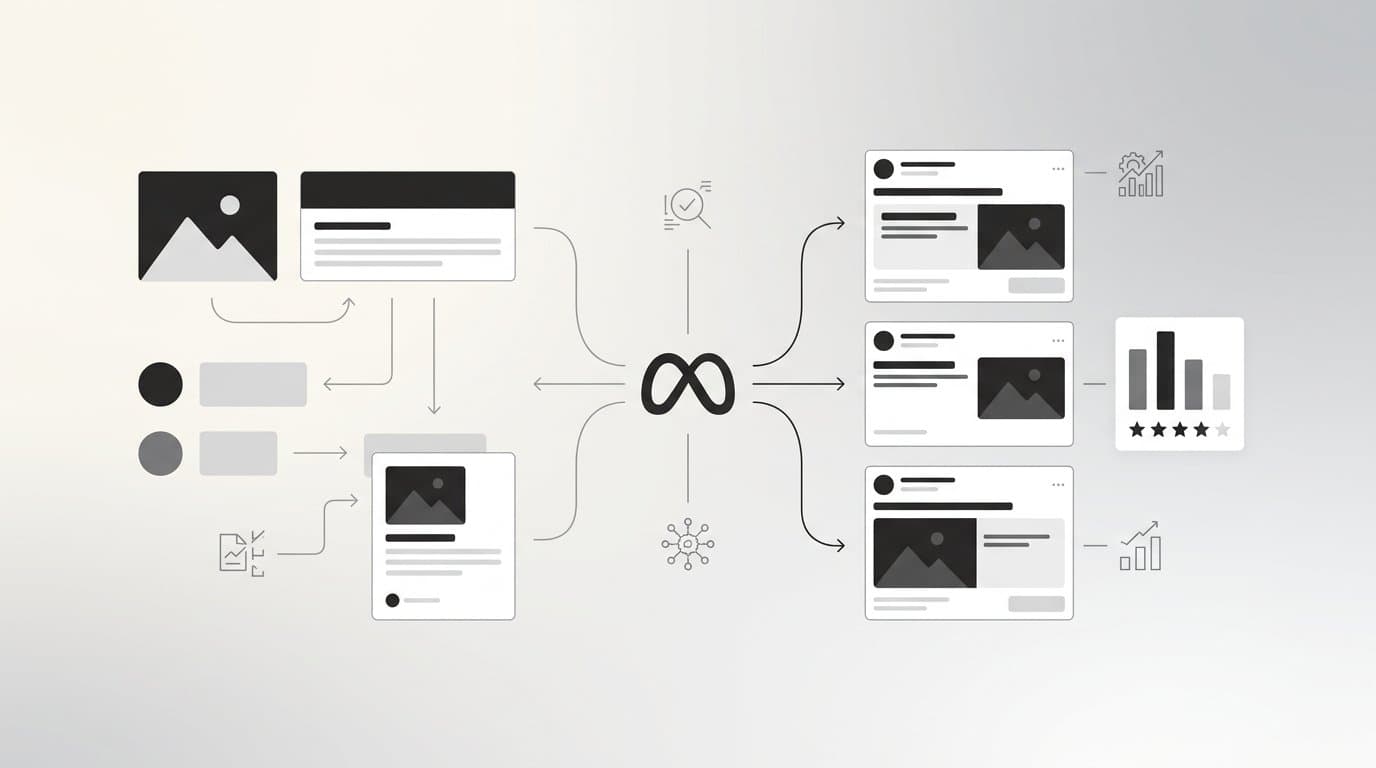
Bulk creation fundamentally changes this equation by letting you generate hundreds of ad variations from a single set of inputs. Instead of manually building each combination, you provide multiple creatives, several headlines, different audience options, and variations of ad copy. The system automatically generates every possible combination and prepares them for launch. Using bulk ad creation for Facebook transforms what previously took hours or days of manual work into minutes.
The math on bulk creation is compelling. If you have 5 creatives, 4 headlines, and 3 audiences you want to test, that represents 60 unique ad combinations. Creating these manually at 5 minutes per ad would take 5 hours of work. With bulk creation, you generate all 60 variations in under 10 minutes. This efficiency makes it economically feasible to run the kind of comprehensive testing that actually finds breakthrough winners.
Calculate your new cost per creative after implementing bulk workflows. If you can generate 100 ad variations in the time it previously took to create 5, your effective cost per ad drops by 95%. This dramatic reduction means you can afford to test far more concepts, iterate faster, and find winning combinations that would have been too expensive to discover with traditional methods.
Avoid diminishing returns by focusing your bulk creation on high-potential concepts rather than generating variations for the sake of volume. Start with your best creative ideas and proven elements from your winners library. Use bulk creation to thoroughly test these strong foundations with different headlines, audiences, and copy variations. This approach ensures you are scaling what works rather than just producing more mediocre ads faster.
Step 6: Invest Creative Budget Based on Performance Data
One of the biggest wastes in ad production is spending money to create ads that never perform well. Many teams allocate creative budget based on intuition, personal preferences, or what they think should work rather than what actually drives results. This approach leads to continuous investment in ad types and creative styles that consistently underperform while proven winners get neglected.
AI insights and performance leaderboards solve this problem by ranking every creative element based on actual campaign results. Your creatives, headlines, copy variations, audiences, and landing pages all get scored against metrics that matter like ROAS, CPA, CTR, and conversion rate. This data-driven ranking immediately shows you which elements deserve more investment and which ones you should stop producing.
Stop spending on ad types or creative styles that consistently underperform in your campaigns. If your data shows that carousel ads generate half the ROAS of single-image ads for your products, quit allocating budget to carousel production. If UGC-style videos consistently outperform product-focused content, shift your creative investment accordingly. Learning how to reduce customer acquisition cost starts with eliminating wasteful creative spending.
Double down on winning formats by allocating more creative budget to the approaches that actually drive results. If certain creative styles, messaging angles, or visual treatments consistently appear in your top performers, produce more variations within those frameworks. This focused investment increases your hit rate because you are working within proven patterns rather than constantly experimenting with unproven approaches.
Goal-based scoring automates this process by flagging which creative elements deserve more investment based on your specific objectives. Set your target CPA, desired ROAS, or minimum conversion rate, and the system automatically identifies which creatives, headlines, and audiences are meeting or exceeding those benchmarks. This removes guesswork from creative investment decisions and ensures you are always allocating budget to what actually works for your business.
Step 7: Build Systems That Learn and Improve Over Time
The most sustainable cost reductions come from systems that get more efficient with every campaign you run. Instead of treating each new campaign as a fresh start, build processes that capture learnings and feed them back into your creative workflow. This continuous improvement loop means your ad production gets cheaper and more effective over time rather than staying static.
Feed campaign results back into your creative process so future recommendations improve based on what actually worked. When AI systems analyze your historical performance data, they identify patterns in what drives results for your specific products and audiences. These insights inform better creative suggestions, more accurate audience targeting, and smarter campaign structures for your next launch. The system gets smarter with each campaign instead of starting from zero every time.
Document what works for your specific audience and products in a format your team can reference and build upon. Create a living document that captures insights like which product angles resonate best, what messaging frameworks drive conversions, which visual styles perform well, and what audience characteristics predict success. Implementing Facebook ad creation automation helps systematize these learnings across your team.
Build institutional knowledge that makes each new campaign cheaper than the last. As your winners library grows, your documented learnings accumulate, and your AI systems improve their recommendations, you spend less time and money on creative production for each subsequent campaign. You know what works, you have proven assets to reuse, and you get better suggestions for what to test next. This compounding efficiency is where the real long-term savings come from.
Measure cost reduction over time and set quarterly improvement targets to maintain momentum. Track your cost per creative, time spent on ad production, and percentage of ads that meet your performance benchmarks. Set specific goals like reducing cost per creative by 30% this quarter or cutting production time in half over the next six months. Regular measurement keeps you focused on continuous improvement rather than accepting whatever efficiency gains happen accidentally.
Your Roadmap to Sustainable Creative Cost Reduction
Reducing ad creation costs is not about cutting corners or accepting lower quality output. It is about working smarter with better tools, building reusable systems, and letting performance data guide your creative investment decisions. The seven steps in this guide give you a clear path from expensive, inefficient ad production to a scalable creative operation that gets better and cheaper over time.
Use this checklist to track your implementation progress. First, complete your cost audit with baseline cost per creative documented so you can measure improvement. Second, identify and replace your most expensive production dependencies like stock subscriptions and freelance designer reliance. Third, implement AI creative tools for generating image ads, video content, and UGC-style creatives. Fourth, organize your winners hub with performance data attached to every asset. Fifth, activate bulk creation workflows to scale your testing capacity. Sixth, put performance-based investment decisions in place to stop wasting budget on underperforming ad types. Seventh, establish your continuous learning loop so each campaign builds on the last.
Start with Step 1 this week. Calculate exactly what you are spending on ad creation right now, including all the hidden costs you have been overlooking. This baseline number is essential because it gives you a concrete metric to improve against and helps you quantify the ROI of the changes you implement. Most teams discover they are spending far more than they realized, which makes the case for optimization even more compelling.
The teams that implement these steps typically see dramatic results within the first month. Cost per creative often drops significantly, production time gets cut substantially, and the volume of ads they can test increases dramatically. More importantly, the quality and performance of their ads improves because they can afford to test more variations and identify true winners rather than settling for the first acceptable option.
Ready to transform your advertising strategy? Start Free Trial With AdStellar and be among the first to launch and scale your ad campaigns 10× faster with our intelligent platform that automatically builds and tests winning ads based on real performance data.