Ad creative production is one of the biggest bottlenecks in modern performance marketing. Teams spend days briefing designers, waiting on revisions, manually uploading variations, and still end up with too few creatives to properly test. By the time a campaign launches, the market has shifted or the budget window has narrowed.
The frustrating part is that most of this friction is avoidable. The problem is not a lack of creative talent or budget. It is a workflow problem: too many handoffs, too many disconnected tools, and no systematic way to turn performance data back into better creatives.
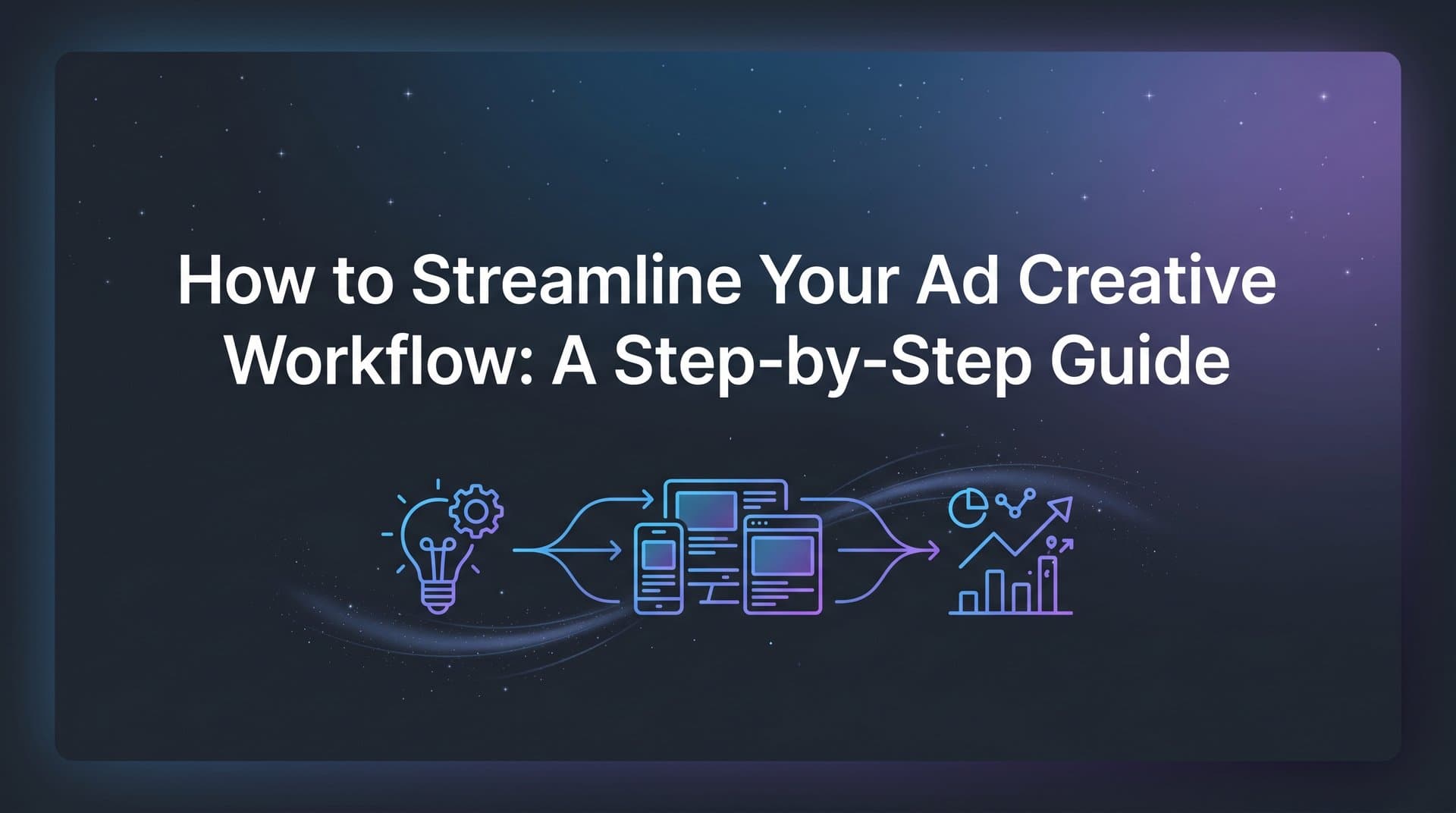
This guide walks you through a practical, repeatable process to streamline your ad creative workflow from ideation to launch. You will learn how to produce more creatives in less time, test more variations, and consistently surface winners. Whether you are managing Meta campaigns for a single brand or running ads across multiple client accounts, the steps below will help you cut production time, reduce dependencies on external creative teams, and build a system that gets smarter with every campaign.
By the end, you will have a structured workflow covering creative generation, variation building, bulk launching, and performance analysis, all feeding back into a continuous improvement loop. Let's get into it.
Step 1: Audit Your Current Creative Bottlenecks
Before you can fix your workflow, you need to understand exactly where it breaks. Most teams have a general sense that things are slow, but they have not mapped out where the time actually goes. That vagueness makes it impossible to prioritize improvements.
Start by walking through every stage of your current process from brief to live ad. Write it out as a simple list or flowchart. A typical workflow might look like: creative brief written, brief sent to designer, first draft received, revisions requested, revised draft approved, assets exported, ad copy written, assets uploaded to Ads Manager, campaign structured, campaign reviewed, campaign launched. That is ten stages before a single ad goes live.
Now mark each stage with an honest time estimate. Where are the biggest gaps? Common culprits include:
Designer handoffs: Waiting for a designer to pick up the brief and return a first draft often takes one to three days, even with internal teams.
Revision cycles: Back-and-forth feedback loops compound quickly. Two rounds of revisions on five creatives can easily consume a full week.
Manual ad set duplication: Uploading variations one by one into Ads Manager is tedious and error-prone, especially when testing multiple audiences and copy combinations.
Approval gates: Waiting for stakeholder sign-off at multiple stages adds calendar time that has nothing to do with the actual work.
Next, categorize each bottleneck as people-dependent (relies on a specific person being available), tool-dependent (the tool itself is slow or requires manual steps), or process-dependent (the sequence of steps creates unnecessary waiting). This categorization tells you what kind of solution to apply.
Also document your current creative output volume. How many new creatives do you produce per week? How many do you actually need to run meaningful tests? If you are launching campaigns with two or three creatives, you are not generating enough signal to know what is working. Most performance marketers need at least five to ten variations per campaign to draw useful conclusions.
Finally, note which ad formats are consistently underproduced. Video and UGC-style content often fall into this category because they require more production resources than static image ads. If you are skipping these formats due to resource constraints, that is a significant gap in your testing coverage. Teams dealing with this challenge regularly will find AdStellar's breakdown of Meta advertising workflow bottlenecks a useful companion to this audit.
Success indicator: A written bottleneck map that shows exactly where your workflow stalls, how long each stage takes, and which bottlenecks are people-dependent versus tool or process issues.
Step 2: Centralize Your Creative Inputs and Brand Assets
One of the most underrated time sinks in ad creative production is the hunt for assets. Designers ask for the latest logo. Copywriters cannot find the approved tagline. Someone needs the product image from last quarter's campaign and it is buried in an email thread. Every search is a small delay, but they add up fast across a team.
The fix is straightforward: consolidate everything into a single accessible location before you start producing anything. This does not need to be a complex system. A well-organized shared folder works. What matters is that everyone on the team knows where to find what they need without asking.
Your centralized asset library should include:
Brand assets: Logos in all required formats, approved color palettes, font files, product images, and any brand guidelines documents.
Approved copy: Headline formulas that have worked, approved taglines, product descriptions, key offer language, and calls to action. Keep these versioned so you always know which copy is current.
Past ad performance data: A swipe file of your top-performing ads with notes on why they worked. Include the creative format, the angle used, the audience it ran against, and the key metrics.
Competitor reference ads: The Meta Ad Library is a free and powerful research tool. Spend time reviewing what your competitors are running, which formats they favor, which angles they use repeatedly, and which offers they are promoting. Ads that run for a long time are usually working. Save the ones worth referencing.
Beyond assets, define your core creative briefs in a standardized format. Each brief should cover the product benefit being highlighted, the audience pain point being addressed, the key offer or hook, and the desired call to action. When your briefs follow a consistent structure, both human team members and AI tools can work from them without needing clarification.
This last point matters more than it might seem. AI-powered creative tools perform significantly better when they have well-organized inputs to work from. A clear product URL, a defined offer, and a set of approved copy elements give the AI enough context to generate on-brand creatives without multiple rounds of correction. The more organized your inputs, the faster the output.
If you are using a platform like AdStellar, your centralized assets feed directly into the AI Creative Hub, where they inform the creatives generated from your product URL or brief. The cleaner your inputs, the less refinement you need on the back end. For agencies managing this process across multiple clients, AdStellar's guide on how to manage Facebook ads for clients covers the organizational layer in more detail.
Success indicator: One centralized folder or workspace containing all brand assets, approved copy, past ad references, and standardized creative briefs, accessible to everyone involved in the workflow.
Step 3: Generate Ad Creatives with AI Instead of Starting from Scratch
This is where the workflow starts to look fundamentally different from a traditional process. Instead of writing a brief, waiting for a designer, reviewing drafts, and cycling through revisions, you generate a full batch of creatives in a single session.
AI creative tools can produce image ads, video ads, and UGC-style content directly from a product URL or a written brief. You are not starting from a blank canvas. You are directing the AI with your inputs and refining the output through a conversational editing interface. The result is a compressed creative cycle that takes hours instead of days.
AdStellar's AI Creative Hub is built specifically for this. Input your product URL and the platform generates multiple creative formats without requiring designers, video editors, or actors. You can produce image ads, video ads, and UGC-style avatar content from the same session. If you want to refine a creative, you do it through chat-based editing rather than sending a revision brief back to someone and waiting.
One of the more powerful features in this step is the ability to clone competitor ads directly from the Meta Ad Library. Rather than starting from scratch, you pull a competitor ad that is clearly resonating with your shared audience and use it as a structural starting point. You are not copying the ad. You are borrowing the format, angle, or structure and building your own version around your product and offer. This is a legitimate and widely used research strategy in performance marketing.
When generating creatives in this step, aim to cover multiple angles in the same session. Different audiences respond to different messaging, and you will not know which angle works until you test them. A useful set of angles to cover includes:
Benefit-led: Lead with the primary outcome the product delivers. What does the customer get?
Problem-solution: Open with the pain point, then position the product as the fix.
Social proof: Lead with results, reviews, or evidence that other people have succeeded with the product.
Offer-focused: Put the deal or promotion front and center. Works well for direct response campaigns.
A common mistake at this stage is generating one or two creatives and moving on. That is not enough to run a meaningful test. Aim for at least five to ten diverse creatives per campaign. With an AI creative tool, producing ten variations takes a fraction of the time it would take to brief and receive one creative through a traditional design process. You can read more about how AI is changing creative production in AdStellar's guide to AI ad creation. For a broader look at the top tools available, AdStellar's roundup of AI-driven ad creative generation is worth reviewing before you commit to a platform.
Success indicator: A batch of diverse creatives covering multiple formats and angles, ready for variation building, produced in a single session without designer involvement.
Step 4: Build Hundreds of Ad Variations with Bulk Creation
Having ten strong creatives is a good start. But a creative does not exist in isolation. It runs alongside a headline, a copy block, and an audience. The combination of those elements determines performance, and you want to test as many combinations as your budget can support.
This is where bulk ad creation changes the math entirely. Instead of manually duplicating ad sets and swapping in elements one by one, you build a variation matrix and let a tool generate every combination automatically.
The concept is simple. You define your variables: a set of creatives, a set of headlines, a set of copy variations, and a set of audiences. The tool then generates every possible combination and prepares them for launch. A basic matrix might look like this:
5 creatives x 3 headlines x 2 audiences = 30 ad variations, ready to launch in minutes rather than hours.
AdStellar's Bulk Ad Launch feature does exactly this. You mix creatives, headlines, audiences, and copy at both the ad set and ad level, and the platform generates every combination automatically. What would take a media buyer several hours of manual work in Ads Manager is done in clicks. You can explore the full mechanics of this in AdStellar's breakdown of bulk ad creation.
A few structural tips for building your variation matrix:
Keep variables isolated where possible: If you change both the creative and the headline between two ad variations, you cannot cleanly attribute a performance difference to either element. Where your testing budget allows, change one variable at a time so the data tells you something specific.
Prioritize your highest-uncertainty variables first: If you have never tested video ads against static images for your product, that is a higher-value test than trying a third headline variation. Use your bottleneck audit from Step 1 to guide which variables deserve the most testing attention.
Set a naming convention before you launch: With thirty or more variations in a campaign, clear naming is the difference between readable data and a chaotic ad account. Include the creative identifier, headline version, and audience segment in every ad name.
Bulk creation is not about launching noise. It is about systematically testing the combinations that matter, at a scale that produces statistically useful signals, without the manual effort that used to make that scale impossible. For a deeper look at how to structure your testing strategy, AdStellar's guide to automated ad testing covers the methodology in detail. Teams running this at scale will also benefit from reviewing the Facebook ad creative testing at scale framework before building out their matrix.
Success indicator: A complete variation matrix built and ready to launch, covering your key creative, headline, copy, and audience combinations, without any manual duplication.
Step 5: Launch Campaigns Directly from Your Creative Workflow
Here is a friction point that most teams do not think of as a problem until they measure it: switching between tools. You generate creatives in one platform, download assets, upload them to Ads Manager, manually enter headlines and copy, configure audiences, set budgets, and structure the campaign from scratch. Every switch between tools is a chance for an error, a delay, or a misalignment between what you intended and what actually goes live.
An integrated workflow eliminates that gap. When your creative generation, variation building, and campaign launching all live in the same platform, you go from creative to live campaign without the translation layer. The assets are already there. The structure is already built. You are reviewing and confirming, not rebuilding.
AdStellar's AI Campaign Builder takes this further by bringing intelligence into the launch step. Rather than manually selecting audiences and structuring campaigns based on intuition, the AI analyzes your historical campaign data and builds a complete Meta Ad campaign informed by what has actually worked before. It ranks past creatives, headlines, and audiences by performance and uses that ranking to inform the new campaign structure.
Every decision the AI makes comes with a clear explanation. You can see why a particular audience was selected, why a specific headline was prioritized, and what the strategic rationale is behind the campaign structure. This transparency matters because it means you are not just accepting AI output blindly. You are reviewing a reasoned recommendation and approving it with full context. The AI gets smarter with each campaign as it accumulates more performance data to work from.
The AI also handles audience selection, headline ranking, and copy recommendations based on past performance, which removes a significant amount of guesswork from the launch process. Instead of wondering which audience to test next, you are working from a ranked list of what has historically performed against your goals. For teams looking to get the most out of this step, AdStellar's guide on how to use AI to launch ads walks through the process in practical detail.
One important warning: do not skip the review step. The AI Campaign Builder produces recommendations, not mandates. Always sanity-check the campaign structure before going live. Confirm that the budget allocation makes sense, that the audiences align with the campaign objective, and that the selected creatives match the angle you intend to test. The AI is a powerful starting point, not a replacement for your judgment.
For a broader look at how AI is reshaping campaign management, AdStellar's overview of Meta advertising automation covers the landscape in useful detail.
Success indicator: Campaign live in Meta with AI-selected audiences and creatives, launched directly from your workflow tool without manual rebuilding in Ads Manager.
Step 6: Use Performance Data to Feed Your Next Creative Cycle
Most teams break their workflow right here. They launch a campaign, check the ROAS after a few days, pause what is not working, and then start the next campaign from scratch. The data from the previous campaign sits in the ad account, rarely consulted, slowly becoming irrelevant as the account grows and older campaigns get buried.
That is not a workflow. That is a series of disconnected launches. A streamlined ad creative workflow is a loop, and performance data is what closes it.
The principle is straightforward: your winners from this campaign become the inputs for the next one. The creative angle that outperformed the others, the headline that drove the lowest CPA, the audience that delivered the best ROAS against your target, these are not just results. They are instructions for what to produce and test next.
AdStellar's AI Insights feature surfaces this information through leaderboards that rank your creatives, headlines, copy variations, audiences, and landing pages by the metrics that matter: ROAS, CPA, and CTR. You set your performance goals, and the AI scores every element against those benchmarks. This is more useful than raw performance numbers because it tells you not just what performed, but what performed against your specific targets.
The distinction matters. A creative with a high CTR but a poor CPA might look like a winner in one view and a loser in another. Goal-based scoring cuts through that ambiguity by anchoring every result to your actual objective. For teams that want to sharpen their understanding of these metrics, AdStellar's guide on how to improve click-through rate is a useful reference for interpreting what the data is telling you.
The Winners Hub takes this a step further by storing your top-performing creatives, headlines, audiences, and other elements in one place with their performance data attached. When you start your next campaign, you do not have to hunt through old ad accounts or try to remember which version of a headline performed best six weeks ago. You pull directly from a curated library of proven elements. AdStellar's dedicated guide on building a Meta ads winning creative library explains how to structure this for long-term compounding value.
This is the mechanism that makes the workflow compound over time. Each campaign adds to your Winners Hub. Each round of production starts from a stronger foundation. The creative decisions you make become increasingly informed by real performance data rather than intuition.
For teams that want to build more rigorous reporting habits around this, AdStellar's guides on performance analytics for ads and how to calculate ROAS are worth reading alongside this step.
Success indicator: A documented set of winning creative elements stored in your Winners Hub with clear performance data attached, ready to inform the next round of production.
Putting It All Together: Your Streamlined Creative Workflow
A streamlined ad creative workflow is not about working faster on the same broken process. It is about removing the steps that create delays, dependencies, and guesswork, and replacing them with a system that generates, tests, learns, and improves automatically.
Here is your quick-reference checklist for the full process:
1. Audit your current bottlenecks and map where time is lost across every stage from brief to live ad.
2. Centralize brand assets and creative briefs into one accessible location so nothing gets lost in handoffs.
3. Use AI to generate diverse creative formats, including image ads, video ads, and UGC-style content, without designers or video editors.
4. Build a full variation matrix using bulk creation tools so you can test every meaningful combination without manual duplication.
5. Launch campaigns directly from your creative workflow using AI-optimized audiences, headlines, and campaign structure.
6. Feed performance data back into your next creative cycle using winner tracking and leaderboard-style insights.
Each step in this process reinforces the next. Better inputs produce better creatives. More creatives produce more useful test data. Better data produces smarter campaigns. Over time, the workflow does not just run faster. It gets more effective with every cycle.
AdStellar is built to handle this entire workflow in one place, from generating creatives with AI to launching campaigns and surfacing winners with real-time insights. If your current process involves too many tools, too many handoffs, and too little testing, it is worth exploring what a fully integrated platform can do for your output.
Start Free Trial With AdStellar and run your next campaign through the full workflow, from AI creative generation to bulk launch to performance analysis, all without leaving the platform.