Ad copy is one of the most powerful levers in any Meta campaign, yet it's also one of the most time-consuming elements to get right. The right headline stops the scroll. The right body copy earns the click. The right call to action closes the conversion. But consistently producing copy that performs across dozens of variations, multiple audiences, and different placements is a grind when done manually.
Most marketers either write too few variations (limiting what they can learn) or spend hours producing copy that still feels generic. Neither approach scales.
AI changes the equation. When used correctly, it lets you generate more copy in less time, structure it for systematic testing, and build a library of proven winners that compound over time. The key phrase there is "when used correctly." Feeding a vague prompt into an AI tool and hoping for magic is not a strategy. It is wishful thinking.
This guide gives you a practical, step-by-step process for using AI to write, test, and optimize ad copy specifically for Facebook and Instagram campaigns. Whether you are a solo performance marketer or managing accounts across multiple clients, these steps will help you produce copy that actually sounds like your brand, test it at scale, and use real performance data to get better with every campaign.
No guesswork. No generic output. No staring at a blank screen wondering where to start.
Step 1: Build Your Copy Brief Before Touching Any AI Tool
Here is the step most marketers skip, and it is the reason so much AI-generated copy feels flat and forgettable. If you go straight to the AI tool without a clear brief, you are essentially asking it to guess what you need. It will give you something, but it will be generic, and generic does not convert.
Your copy brief is the foundation. It is what transforms AI output from "sounds like every other ad in the feed" to "this speaks directly to my customer."
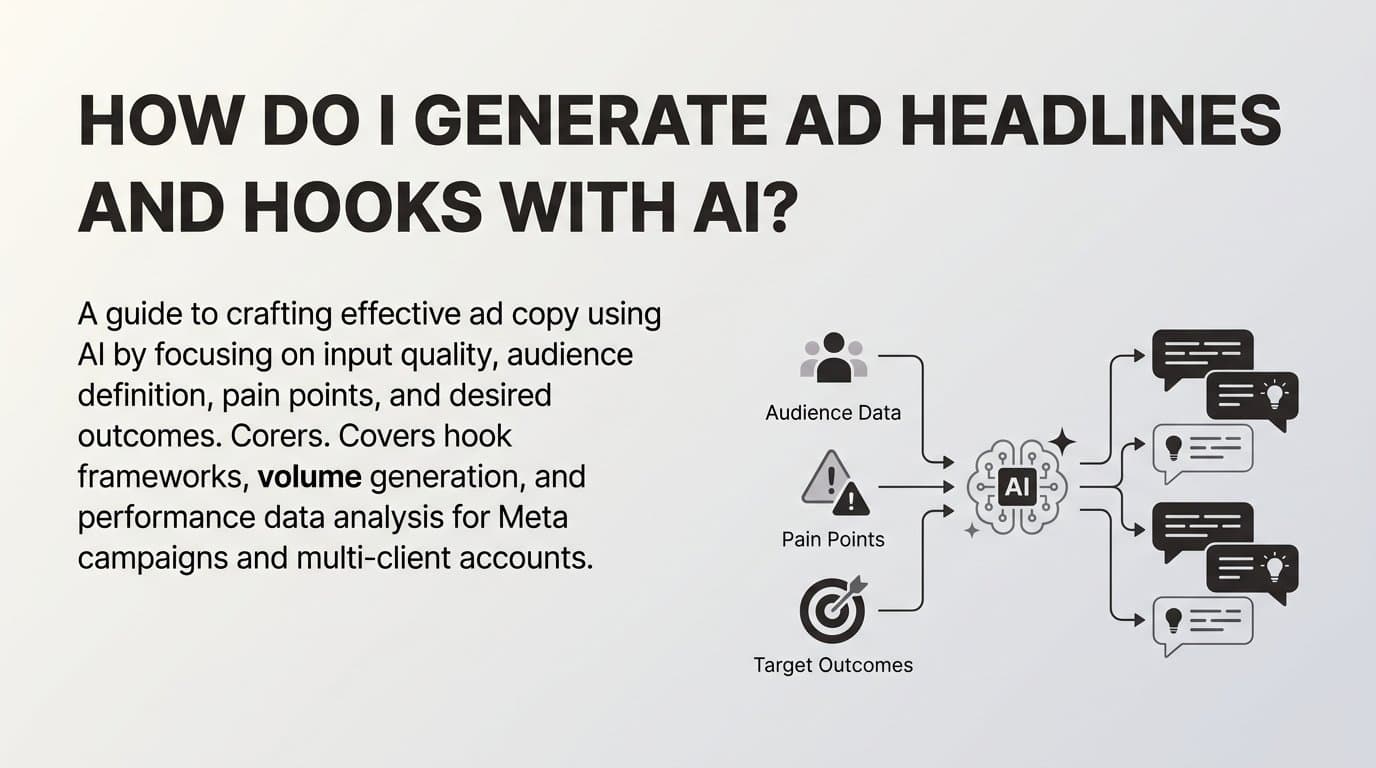
Before generating a single line of copy, get these four things down in writing:
The Offer and Goal: What exactly are you promoting, and what action do you want someone to take? Be specific. "Drive purchases of our $49 starter plan from first-time buyers" is a brief. "Promote our software" is not.
The Audience Segment: Who is this ad for, and what do they care about? Define their primary pain point, what they want instead, and the objection most likely to stop them from clicking. Different audience segments need different copy angles, so treat each segment as its own brief.
Brand Voice and Constraints: Pull your brand voice guidelines, key differentiators, and any copy restrictions. If you have a tone of voice document, reference it. If you have phrases you never use or claims you cannot make, list them. This keeps AI output on-brand and compliant with your standards.
Placement Specifications: Meta ad copy is not one-size-fits-all. Feed ads, Stories, and Reels each have different character limits, visual contexts, and audience mindsets. A long-form primary text that works in the feed will not translate to a six-second Reels hook. List the placements you are writing for before you start.
The common pitfall here is treating the brief as optional. Skipping it does not save time. It costs time, because you end up editing mediocre output instead of refining strong output. A 15-minute brief will save you an hour of revision. Many marketers recognize this as one of the core ad copywriting bottlenecks that slows down campaign production.
Success indicator: You can answer every question in your brief in writing before you open an AI tool. If you cannot, you do not have enough clarity yet to generate useful copy.
Step 2: Structure Your AI Prompts for High-Converting Output
The quality of your AI-generated copy is directly tied to the quality of your prompt. This is not a cliche. It is a practical reality. Vague prompts produce vague copy. Specific, structured prompts produce copy that requires minimal editing and reads like a human wrote it for your exact audience.
Use this prompt structure as your template:
Role: Tell the AI what role to play. "You are a direct response copywriter specializing in Facebook and Instagram ads for DTC brands."
Context: Describe the product, the offer, and what makes it different. Paste in your brief details here.
Audience: Describe who you are writing for, including their pain points, desires, and the objection you need to address.
Goal: Specify the outcome. "The goal is to drive clicks to a product page from cold-audience Facebook users who have never heard of our brand."
Constraints: Include character count limits for each element. Meta primary text performs best under 125 characters for mobile, headlines under 40 characters. State these explicitly.
Format: Ask for multiple variations in a single prompt. "Generate five variations of the headline and five variations of the primary text. Format them as numbered lists."
Beyond structure, two additional inputs make a significant difference. First, specify the copywriting framework you want applied. PAS (Problem-Agitate-Solution) works well for audiences already aware of a pain point. AIDA (Attention-Interest-Desire-Action) is effective for cold audiences discovering a product for the first time. A hook-proof-CTA structure is common in direct response and DTC. Giving the AI a framework to follow produces more coherent, conversion-focused output than open-ended instructions.
Second, specify the emotional trigger you want to activate. Curiosity, urgency, FOMO, relief, aspiration. Different emotions work better for different audiences and offers. Include this in your prompt and you will see the output shift noticeably. Reviewing Facebook ad copywriting best practices can help you identify which emotional triggers consistently drive conversions for your category.
One more tip that consistently improves results: paste in two or three of your top-performing existing ads as reference examples. Tell the AI to match the tone and style. This anchors the output in what has already worked for your brand rather than what the AI thinks sounds good in general.
Success indicator: The AI returns copy that you would be comfortable running with minimal editing. If you are rewriting most of what it produces, your prompt needs more specificity.
Step 3: Generate Copy Variations Across Every Key Ad Element
One of the most common mistakes in AI-assisted copywriting is treating the ad as a single unit. You ask for "an ad," get one block of text, and call it done. This approach misses the entire point of using AI at scale.
Meta ad copy is made up of distinct elements, and each one should be generated and tested separately:
Primary Text: The body copy that appears above the creative in feed placements. This is where you develop the hook, build interest, and set up the CTA.
Headline: The bold line below the creative. Often the first thing a user reads. It needs to be punchy, specific, and benefit-driven.
Description: The optional secondary line below the headline. Use it to reinforce the offer or add a secondary benefit.
CTA Button: While Meta controls the button options, your copy should align with whichever CTA you select. "Learn More" copy reads differently than "Shop Now" copy.
For each element, generate at least three to five variations rather than settling on one. Vary the angle across variations so you are testing genuinely different approaches, not just slightly different phrasing. A useful framework: one variation focused on pain, one on aspiration, one on social proof or credibility, and one on urgency or scarcity.
AI also makes it fast to adapt copy for different audience segments without rewriting from scratch. Once you have a strong set of variations for one segment, prompt the AI to reframe them for a different audience profile. The core message stays consistent while the language shifts to match what resonates with each group. This is one of the key advantages of automated ad copywriting for Meta campaigns at scale.
Keep a running document of every variation you generate, including the ones you do not use immediately. This becomes your swipe file. Copy that does not fit the current campaign often becomes exactly right for the next one, and having it already written saves significant time.
Platforms like AdStellar take this further by pairing AI-generated copy variations with matching creatives automatically, removing the manual assembly step entirely. Instead of building combinations by hand, the system handles the pairing and organization so you can move directly to launch.
Success indicator: You have a matrix of copy elements ready to mix and match. Multiple headlines, multiple primary text variations, and multiple CTA approaches, all organized and ready to combine.
Step 4: Launch Copy Variations at Scale Without Manual Setup
Generating strong copy variations is only half the job. Getting them live efficiently is where many marketers lose time and momentum. Manually building individual ads for every copy and creative combination is slow, error-prone, and does not scale.
This is where bulk ad creation becomes essential. The goal is to combine your copy variations with your creative variations programmatically, so every possible combination goes live without you having to build each one by hand.
Before you launch, there is one structural principle worth getting right: avoid testing copy and creative simultaneously in the same variable. When both change at once, you cannot determine which element drove the difference in performance. Where possible, hold the creative consistent while testing copy variations, or hold copy consistent while testing creative. This produces cleaner data and faster learning. Understanding how to use AI to launch ads efficiently can dramatically reduce the time between copy creation and campaign go-live.
AdStellar's Bulk Ad Launch feature is built for exactly this workflow. You bring in multiple headlines, body copy variations, and creatives, and the platform generates every combination automatically. What would take hours of manual ad setup in Ads Manager gets done in minutes. The combinations launch directly to Meta without requiring you to build each ad individually.
Before hitting launch, set clear parameters for your test period. Define your budget per variation, your minimum run time before evaluating performance, and the metrics you will use to make decisions. Going into the test without these defined leads to premature optimization based on too little data.
One common pitfall to avoid: spreading budget too thin across too many variations. If each variation gets only a few dollars a day, none of them will accumulate enough data to reach statistical significance. It is better to test fewer variations with enough budget to generate meaningful results than to launch 30 variations that never get enough impressions to tell you anything useful.
A practical approach is to start with your strongest three to five copy variations per element, launch them with adequate budget, and expand from there once you have initial performance signals. Many teams managing multiple accounts find that managing Facebook ads for clients becomes far more efficient once this bulk launch workflow is in place.
Success indicator: Your campaign is live with multiple copy variations running simultaneously, and you did not spend hours on manual ad-by-ad setup to get there.
Step 5: Read the Performance Data to Find Your Copy Winners
Data is where the AI copywriting process pays off. Once your variations are running, your job shifts from creation to interpretation. You are looking for signals that tell you which copy angles are working and why.
Start with the right metrics for the right questions:
CTR (Click-Through Rate) tells you how effectively your headline and hook are earning attention. A high CTR means the copy is compelling enough to make someone stop and click. It is a strong indicator of hook and headline quality.
CPA (Cost Per Acquisition) tells you whether the copy is attracting the right people. Copy that overpromises or appeals to a broad audience may drive strong CTR but poor conversion. High CTR with high CPA is a red flag that the copy is misleading or misaligned with the landing page.
ROAS (Return on Ad Spend) is the ultimate measure. It tells you whether the copy is driving profitable action, not just traffic or clicks.
Do not optimize on CTR alone. This is one of the most common mistakes in ad copy evaluation. A headline that generates curiosity clicks from unqualified audiences looks great in the CTR column but kills your CPA. Always look at the full funnel before declaring a winner. A solid understanding of Meta ads performance metrics will help you interpret these signals accurately rather than chasing the wrong numbers.
AdStellar's AI Insights feature makes this evaluation faster by ranking your headlines, copy variations, and audiences by ROAS, CPA, and CTR against the specific goals you have set. Instead of pulling data manually and building your own comparison, the leaderboard surfaces what is working and what is not in real time.
As you review the data, look for patterns across your winners. Are shorter hooks consistently outperforming longer ones? Is the pain-focused angle winning over the aspiration angle for this audience? Is one specific word or phrase appearing in every top performer? These patterns become the inputs for your next round of copy generation. Tools built for analyzing ad performance make it significantly easier to spot these patterns at scale.
Success indicator: You can identify your top two or three copy angles with data to back the decision, and you understand not just what won but why it won.
Step 6: Feed Winners Back Into Your AI Process to Compound Results
Most marketers treat each campaign as a standalone event. They launch, they optimize, they move on. The copy that worked gets filed away somewhere, and the next campaign starts from scratch. This approach wastes the most valuable asset you have: institutional knowledge about what messaging resonates with your audience.
The compounding loop is where AI copywriting becomes a genuine competitive advantage. Each campaign produces data. That data reveals what works. What works becomes the input for better prompts. Better prompts produce stronger copy. Stronger copy produces better data. The loop compounds, and over time, your campaigns get meaningfully better without requiring proportionally more effort.
Here is how to implement it practically:
Save winning copy elements into a structured library. Do not just note that a headline performed well. Record the headline, the audience it ran against, the offer it promoted, the CTR and CPA it achieved, and the emotional angle it used. This context is what makes the example useful in future prompts.
Use winners as reference examples in new prompts. When you start a new campaign, paste your top-performing headlines and hooks into the prompt and instruct the AI to generate new variations that build on what worked. This anchors the output in proven performance rather than starting from zero.
Document why copy won. Was it the specific word choice? The way the offer was framed? The emotional trigger? The length? The more precisely you can articulate why something worked, the more useful that insight becomes when briefing AI for future campaigns.
AdStellar's Winners Hub is designed for exactly this purpose. It stores your best-performing creatives, headlines, and copy in one place with real performance data attached. When you are ready to build your next campaign, you can pull directly from your proven winners and add them into the new campaign without hunting through spreadsheets or old ad accounts.
Use AI to iterate on winners rather than replace them. When a piece of copy is working, do not abandon it. Use AI to generate variations that maintain the core angle while testing new hooks, different CTAs, or adapted language for new audience segments. This extends the life of what is working while still generating new learning.
Success indicator: Your AI prompts are getting more specific with each campaign cycle, your output requires less editing, and your copy performance is improving over time rather than staying flat.
Putting It All Together
Using AI for ad copywriting is not about replacing the creative process. It is about removing the bottlenecks that slow it down. When you start with a strong brief, structure your prompts deliberately, generate variations across every key element, launch them efficiently, and use real performance data to identify winners, you build a system that improves with every campaign.
The marketers who get the most from AI are not the ones generating the most copy. They are the ones testing the most systematically and learning the fastest. That distinction matters. Volume without structure just produces more noise. Volume with a clear process produces compounding results.
The six steps in this guide give you that process. Brief before you generate. Prompt with specificity. Generate across elements. Launch at scale. Read the data correctly. Feed winners back in. Repeat.
AdStellar brings this entire workflow into one platform, from generating copy and creatives with AI to launching campaigns in bulk and surfacing winners through AI-powered insights and leaderboards. Every step in this guide has a corresponding feature built to support it, so you are not stitching together multiple tools or managing the process manually.
If you are ready to see how much faster your next campaign comes together, Start Free Trial With AdStellar and put this entire workflow into practice from day one.