A creative brief is one of those documents that separates teams who consistently produce great ads from teams who spend half their time in revision cycles wondering why nothing is landing. It is not a bureaucratic formality. It is the single clearest signal you can give to anyone involved in producing your campaign, whether that is a designer, a copywriter, a freelance creative, or an AI tool generating variations at scale.
Without a brief, everyone fills in the gaps with their own assumptions. The designer goes minimal when you wanted bold. The copywriter writes for a general audience when you needed to speak to a specific buyer. The media buyer sets up targeting that does not match the message. The result is a campaign that feels slightly off in ways that are hard to diagnose but very easy to see in your metrics.
This guide walks you through exactly how to write a creative brief for ads, step by step. Each section covers a distinct part of the document, what to include, how to frame it, and what to avoid. Whether you are briefing an in-house team, a freelancer, or feeding structured inputs into an AI-powered creative platform like AdStellar, the same framework applies.
The goal is simple: anyone who reads your brief should be able to produce on-target work without a follow-up call. Follow the steps in order the first time through, and by the end you will have a repeatable process you can apply to every campaign you run.
Step 1: Define the Campaign Objective
Every strong creative brief starts with a single, unambiguous objective. Not two objectives. Not a primary and a secondary. One goal that drives every creative decision that follows.
The objective tells the entire team what success looks like before a single pixel is placed or a word is written. Without it, creative choices become subjective. With it, every decision has a clear filter: does this serve the goal or not?
Start by identifying the category your campaign falls into. Common options for Meta ad campaigns include awareness (reaching new people who have never heard of you), lead generation (capturing contact information), direct purchases or conversions (driving people to buy), app installs, or traffic to a landing page. These are not interchangeable, and the creative approach for each looks very different.
Once you have named the category, tie it to a measurable metric. This is where many briefs stay vague and pay for it later. "Increase brand awareness" is not a goal. "Achieve a CPM under $X while reaching a cold audience of 500,000 in our target market" is a goal. For conversion campaigns, define your target CPA or ROAS. For lead generation, set a CPL benchmark. For traffic campaigns, define the target CTR. The specific number matters less than the act of committing to one, because it gives the creative team a concrete standard to aim for.
Next, match the objective to the corresponding Meta campaign objective inside Ads Manager. If you want purchases, select Conversions or Sales. If you want leads, select Lead Generation. If you want reach, select Awareness. The campaign objective in Ads Manager determines how Meta's algorithm optimizes delivery, so misalignment between your stated goal and your selected campaign type will undermine the brief before the creative even launches.
Common pitfall: Listing multiple objectives in a single brief. It feels thorough, but it actually makes the creative harder to produce and harder to evaluate. A campaign designed to drive both awareness and purchases will usually do neither well. Pick one objective and make it explicit.
Success indicator: After writing this section, ask a colleague who was not in the briefing meeting to read it and state the campaign goal in one sentence. If they can do it without asking a follow-up question, the objective section is working.
Step 2: Describe Your Target Audience in Specific Terms
Audience description is the section most briefs get wrong, and it is the section that has the most direct impact on creative quality. Generic audience descriptions produce generic ads. Specific audience descriptions produce ads that make people stop scrolling because the message feels like it was written for them personally.
Start with the basics: age range, location, income level, and relevant life stage if applicable. But do not stop there. Demographics tell you who the person is on paper. Psychographics tell you what they actually care about, and that is what drives creative decisions.
Document the audience's primary pain points. What problem are they trying to solve, and what have they already tried? What frustrates them about the current options available? Then layer in their desires: what does success look like to them, what outcome are they hoping for, and what would make them feel good about making a purchase or taking action?
Include the buying triggers that are most relevant to this audience. Is urgency a factor? Is social proof what tips them over the line? Are they price-sensitive or value-driven? Do they respond to data and specifics, or to emotional storytelling? These details directly inform the copy direction and creative tone you will define later in the brief.
One of the most underused tactics in audience description is defining who the ad is not for. If your product is premium-priced and designed for experienced buyers, say so explicitly. This prevents creatives from softening the message to appeal to a broader group, which usually means it resonates with nobody in particular.
Also specify where this audience sits in the funnel. Cold audiences have never encountered your brand and need context. Warm audiences have visited your site or engaged with your content and need a reason to come back. Retargeting audiences have already expressed intent and need a nudge or an incentive. The funnel stage changes the tone, the message, and the creative approach entirely, so it must be stated clearly.
Finally, note any Meta-specific targeting signals that are relevant: interest categories, behavioral signals, or lookalike sources such as a customer list or a high-value purchaser segment. This helps media buyers set up targeting that is consistent with the creative message.
Common pitfall: Writing "anyone who needs our product" as the audience description. This is not an audience. It is the absence of an audience. The more specific you are, the better the creative will perform.
Success indicator: A copywriter who has never spoken to one of your customers should be able to read this section and write copy that sounds like it was made for that person specifically.
Step 3: Write the Core Message and Value Proposition
If the objective tells the team where you are going and the audience description tells them who you are talking to, the core message tells them what to say. This is the heart of the brief, and it is worth spending real time on.
Begin by identifying the single most compelling reason this specific audience should take action right now. Not the most impressive feature. Not the most technically accurate claim. The most compelling reason, from the audience's perspective, given where they are in the funnel and what they care about most.
There is a critical distinction to make here between features and benefits. Features describe what the product does. Benefits describe what the customer gains or avoids as a result. Features live in your product documentation. Benefits live in your ads. A feature is "AI-powered creative generation." A benefit is "launch scroll-stopping ads in minutes without a designer." The brief should lead with benefits and use features as supporting evidence.
Write a primary message statement: a single sentence that captures the offer and the core benefit. Think of it as the one thing you would say if you only had five seconds of someone's attention. This sentence does not have to be the final ad headline, but it should be the north star that every headline, body copy, and visual choice points toward.
Below the primary message, list three to five supporting proof points. These are the claims that back up the main message and give the audience a reason to believe it. They can include awards, guarantees, specific results (if you have documented ones), customer counts, satisfaction ratings, or any social proof that is verifiable and relevant to the audience's concerns.
Common pitfall: Burying the value proposition under brand language or clever copy that prioritizes wit over clarity. Clever is fine when it serves the message. When it obscures the offer, it costs you conversions.
Tip: Test your primary message statement by showing it to someone unfamiliar with your product and asking them to explain back to you what you are offering and why they should care. If they can do it in under five seconds, the message is clear. If they hesitate or ask a clarifying question, rewrite it.
Step 4: Set Creative Direction and Format Requirements
This section translates everything you have established so far into specific production requirements. It is where abstract strategy becomes concrete instructions for the people or tools doing the actual creative work.
Start by specifying the ad formats you need. Meta supports a range of formats including static images, short-form video, carousels, UGC-style content, Stories, and Reels. Each format has different strengths and suits different campaign objectives and audience types. List exactly which formats are required for this campaign and whether any are optional variations for testing.
Define the visual tone with enough specificity that two different designers would produce something in the same ballpark. Vague direction like "modern and clean" means different things to different people. More useful direction sounds like: "Product-focused with a white background, bold typography, and a single clear CTA overlay. Reference: direct-response e-commerce style, not lifestyle or editorial." If you have visual references or competitor examples that illustrate the right direction, include links or attach them to the brief.
List all mandatory brand elements. This includes logo placement requirements, approved color palette with hex codes if available, approved fonts, and any visual restrictions such as imagery that is off-brand or elements that must always appear together. If there are brand guidelines, reference them directly rather than summarizing them, since the full document is more reliable than a summary.
Specify the technical requirements for each placement. Meta Feed ads typically perform well at 1:1 or 4:5 aspect ratios. Stories and Reels require 9:16. If you are running across multiple placements, you may need separate crops or versions for each. State this explicitly so production accounts for it from the start rather than scrambling to reformat after the fact.
Include a clear list of what to avoid. Competitor brand colors, imagery that feels obviously stock, visual clichés that undermine credibility, or anything that conflicts with the audience's expectations. This negative direction is often more useful than positive direction because it prevents the most common missteps.
Common pitfall: Leaving creative direction vague and then rejecting outputs that technically followed the brief. If you know what you do not want, write it down. The brief is the place to say it.
Step 5: Write the Copy Direction and Call to Action
Copy direction gives the writer a framework without writing the copy for them. The goal is to define the approach clearly enough that the output is on-strategy, while leaving room for the writer to do their best work within those constraints.
Start with the headline approach. There are several proven structures to choose from: a direct question that names the audience's pain point, a bold statement that leads with the outcome, an offer-led headline that puts the deal front and center, a curiosity-driven hook that creates a gap the reader wants to close, or a social proof headline that leads with credibility. Pick the approach that best fits the audience's mindset and the funnel stage, and state it explicitly in the brief.
Define the tone of voice for the copy. Options include conversational and peer-to-peer, authoritative and expert-led, urgent and time-sensitive, warm and encouraging, or aspirational and aspirational. The tone should match both the brand voice and the audience's expectations. A cold audience seeing your brand for the first time needs a different tone than a retargeting audience who already knows what you offer.
Specify the primary call to action and explain why it fits the funnel stage. "Shop Now" works for bottom-funnel audiences who are ready to buy. "Learn More" suits cold audiences who need more context before committing. "Get Started" fits SaaS or service products where the first step is low-friction. The CTA should match the level of commitment you are asking for, which should match where the audience is in their decision-making process.
Include any character limits or platform-specific copy constraints. Meta has guidelines around text overlay on images and recommended copy lengths for different placements. Note these so the writer produces copy that works within the actual constraints rather than requiring edits after the fact.
List any words or phrases that are off-limits. This might include competitor brand names, unsubstantiated superlatives like "the best" or "number one" without supporting evidence, or terms that fall into restricted categories on Meta.
Common pitfall: Writing copy direction that contradicts the audience description from Step 2. If the audience section describes a skeptical, research-driven buyer, copy direction that calls for "hype-driven urgency" will produce ads that feel wrong. Keep the sections consistent.
Step 6: Add Logistics, Approvals, and Testing Notes
The final section of the brief covers the operational details that determine whether the campaign actually launches on time and in a form that can be optimized. These details are often skipped or added as an afterthought, and that is usually where campaigns run into avoidable delays.
Set the delivery deadline and any hard launch dates tied to promotions, product launches, or seasonal windows. If there is a date the campaign must be live by, state it and work backward from it to set intermediate milestones for drafts, reviews, and approvals. Vague deadlines produce vague timelines.
Name the approval stakeholders. Who needs to sign off on the creative before it goes live? What is the order of review? How many rounds of revisions are included in scope? Defining this upfront prevents the situation where a campaign is approved by one person and then sent back by another who was not part of the original review, adding days or weeks to the process.
Specify how many creative variations are needed for testing. Launching a single creative with no variation plan means you have no way to improve performance over time. At a minimum, plan for two to three variations per format. These do not need to be radically different from each other. Structured testing works best when you isolate the variable you are testing, whether that is the headline, the visual, the CTA, or the offer, and keep everything else consistent.
Note which elements should vary across versions. If you are testing headlines, keep the visual and CTA consistent across variations. If you are testing visual style, keep the copy consistent. This gives you clean data on what is actually driving performance differences.
Include budget context if it is relevant to creative decisions. A campaign with a limited daily budget may not be able to support five creative variations simultaneously. Knowing the budget helps the creative and media buying teams make decisions that are realistic for the campaign's scale.
Common pitfall: Skipping the testing notes entirely and launching a single creative. Even a simple two-variation test gives you learning that compounds over time. Build it into the brief from the start.
Putting It All Together: Your Creative Brief Checklist
A complete creative brief covers six sections in sequence: campaign objective with a measurable KPI, target audience with psychographic depth and funnel stage, core message and value proposition, creative direction with format specifications, copy direction with CTA rationale, and logistics with an explicit testing plan. Each section informs the next, which is why the order matters.
Here is a quick checklist to confirm your brief is complete before you hand it off:
Objective: Single goal stated, tied to a measurable metric, matched to a Meta campaign objective.
Audience: Demographics, psychographics, pain points, buying triggers, funnel stage, and Meta targeting signals all documented.
Core Message: Primary message statement written in one sentence, supporting proof points listed.
Creative Direction: Formats specified, visual tone defined with references, brand elements listed, aspect ratios confirmed, and visual restrictions noted.
Copy Direction: Headline approach defined, tone of voice set, primary CTA specified with rationale, character limits noted, and restricted terms listed.
Logistics: Deadline set, approval stakeholders named, revision rounds defined, variation count specified, and testing variables isolated.
Treat the brief as a living document. After each campaign, update it with what you learned. Which message resonated? Which format outperformed? Which audience segment responded best? That feedback loop is what turns a one-time brief into a compounding asset.
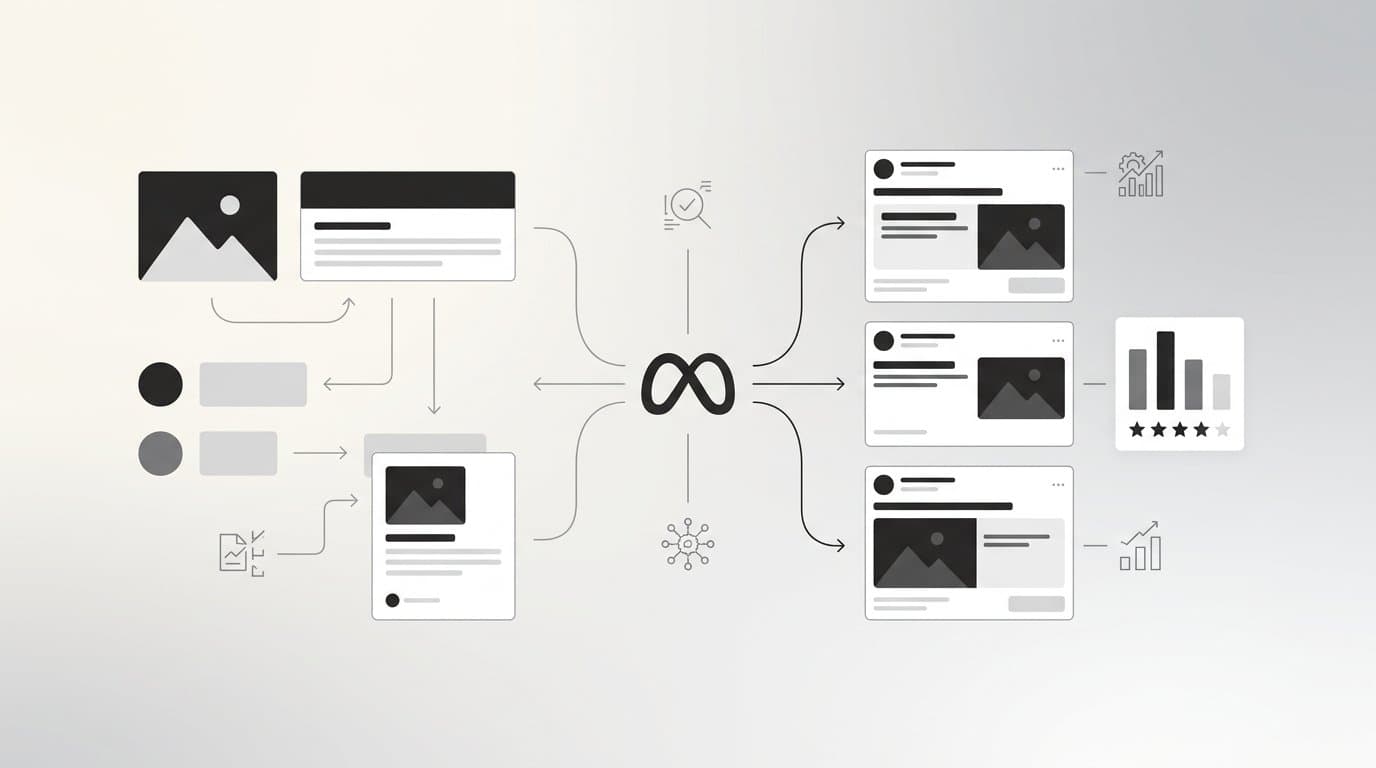
If you are using an AI creative platform, the brief becomes your primary input. AdStellar, for example, can take the objective, audience, message, and format requirements from your brief and generate image ads, video ads, and UGC-style creatives without a designer or video editor. The Bulk Ad Launch feature can create hundreds of variations by mixing the creatives, headlines, and audiences defined in your brief, and the AI Insights feature ranks every variation against the KPIs you set in your objective section. The brief does not just inform one campaign. It feeds a continuously improving creative system.
Start simple. A one-page brief that covers all six sections is more useful than a ten-page document that nobody reads. Refine the format over time as you learn what your team or your tools need most.
A well-written creative brief saves time, reduces revision cycles, and produces better-performing ads. Not because it adds process for its own sake, but because it gives every person and every tool involved the clearest possible signal before production begins. The brief is not about control. It is about clarity, and clarity is what converts.
Once your brief is written, the fastest path from strategy to live campaign is putting it into a platform built to act on it. AdStellar generates scroll-stopping image ads, video ads, and UGC-style creatives directly from your inputs, launches them to Meta with AI-optimized audiences and copy, and automatically surfaces the top performers so your brief informs not just one ad but a continuously improving creative strategy. Start Free Trial With AdStellar and launch your next campaign with a team that never sleeps, never needs a revision call, and gets smarter with every result.