The Instagram advertising landscape has reached a breaking point. Your competitors are launching dozens of new ad creatives weekly while your team is still waiting on design revisions from last month's campaign. The platform's algorithm rewards fresh content, but your manual production workflow can barely keep pace with testing one creative variation at a time.
This isn't just a creative problem. It's a competitive disadvantage that compounds daily.
Instagram ad creative automation changes the equation entirely. Instead of waiting weeks for designers to produce a handful of variations, AI-powered systems generate scroll-stopping image ads, video ads, and UGC-style content in minutes. The bottleneck that once limited your testing velocity disappears, replaced by a systematic approach to creative production that scales with your ambitions rather than your headcount.
How AI Transforms Instagram Ad Creative Production
Traditional creative workflows follow a predictable pattern. You brief a designer, wait for initial concepts, provide feedback, wait for revisions, and eventually launch a single ad variation. By the time you've produced five different creatives, your competitors have already tested fifty and identified their winners.
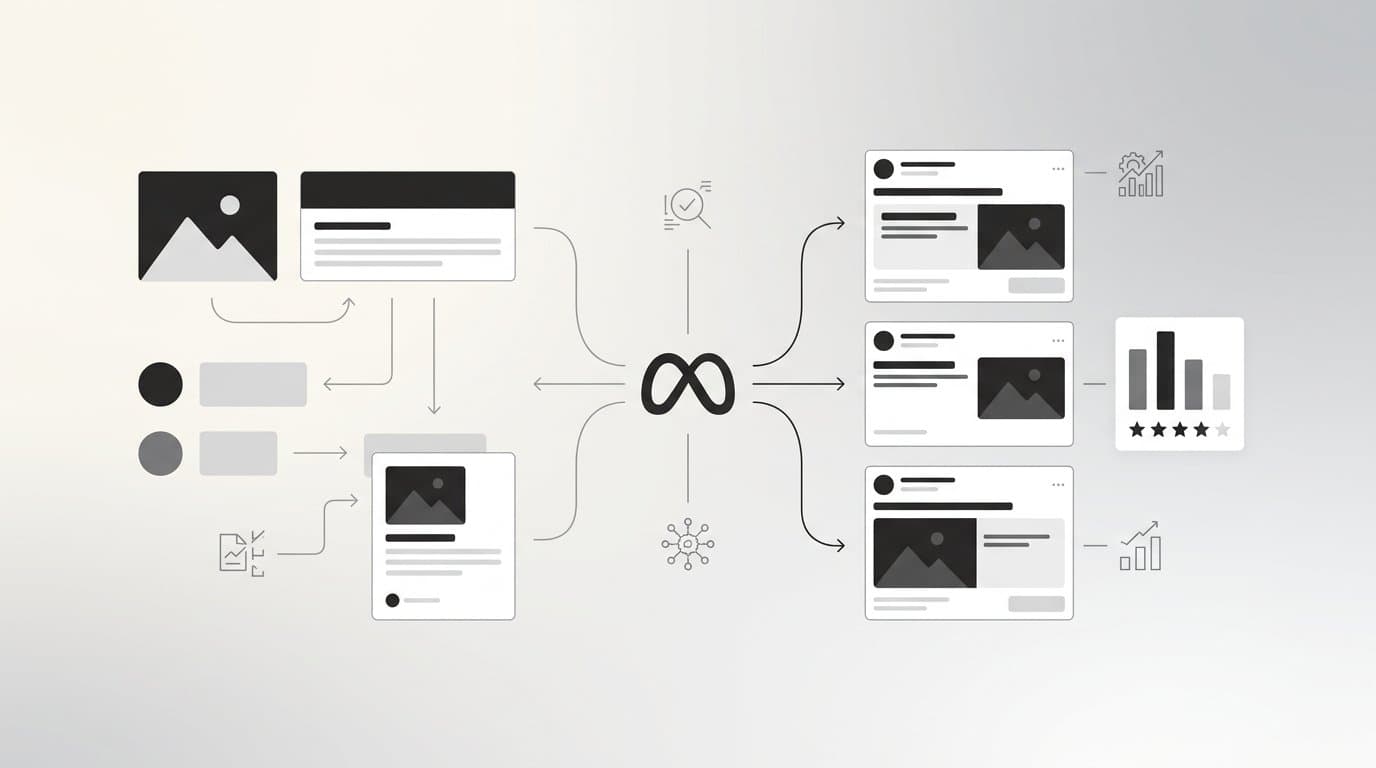
AI creative generation flips this model completely. Modern automation platforms analyze your product URL and generate multiple ad variations instantly. The system examines your product images, extracts key features and benefits, and creates scroll-stopping visuals designed specifically for Instagram's feed and Stories placements.
The quality gap between AI-generated and manually designed ads has collapsed. These aren't template-based graphics with your logo slapped on generic backgrounds. AI systems understand composition principles, color psychology, and the visual patterns that stop thumbs mid-scroll. They create image ads that look professionally designed because they apply the same principles professional designers use.
Video content presents an even more dramatic transformation. Creating video ads traditionally requires videographers, editors, and actors. AI automation generates video ads and UGC-style avatar content without any of these resources. Feed a product URL into the system and receive multiple video variations featuring different hooks, visual approaches, and messaging angles.
Chat-based editing eliminates the endless revision cycles that plague traditional workflows. Instead of writing detailed feedback documents and waiting for designers to interpret your notes, you refine creatives conversationally. "Make the headline bolder." "Try a warmer color palette." "Add more urgency to the call-to-action." Each adjustment happens in real-time, compressing what used to take days into minutes.
The velocity advantage becomes multiplicative. When you can generate and refine ten creative variations in the time it previously took to produce one, you're not just working faster. You're fundamentally changing what's possible in your testing strategy. You can explore different messaging angles, visual styles, and creative approaches simultaneously rather than sequentially.
This speed matters because Instagram's algorithm favors recency and engagement. Fresh creatives get preferential distribution, and high-performing ads receive more exposure. When you can continuously feed the algorithm new variations and quickly identify winners, you're working with the platform's mechanics rather than fighting against them.
Core Components of a Creative Automation System
Effective Instagram ad creative automation rests on three foundational capabilities that work together to transform how you produce and test advertising content.
AI Creative Generation: The system's ability to transform product information into multiple ad variations forms the foundation. Advanced platforms don't just resize existing images or swap text on templates. They analyze product features, identify key selling points, and create original visual compositions that highlight what makes your offering compelling. This includes generating image ads with different layouts, video ads with varied pacing and hooks, and UGC-style content that mimics authentic user testimonials.
The generation process considers Instagram-specific requirements. Aspect ratios optimized for feed versus Stories placements. Visual hierarchies that work on mobile screens. Composition choices that account for Instagram's interface elements. The AI understands these platform nuances and creates creatives that look native to where they'll appear.
Competitor Intelligence: The Meta Ad Library provides a legitimate window into what's working for other advertisers in your space. Creative automation platforms can clone winning ads directly from this public resource, giving you proven starting points rather than blank canvases. This isn't about copying competitors. It's about learning from market-validated approaches and adapting successful patterns to your brand.
When you identify a competitor's ad that's been running for months, you know it's performing. Long-running ads indicate positive ROI. Cloning that creative's structure, visual approach, or messaging angle provides a foundation you can customize with your product details and brand voice. You're starting from a position of evidence rather than guesswork.
The adaptation process maintains your brand identity while incorporating proven elements. The AI understands which components to preserve (the structural approach that's working) and which to customize (your specific product benefits, brand colors, and unique value proposition).
Bulk Variation Creation: The true power of automation emerges when you can mix multiple creatives, headlines, audiences, and copy variations to generate hundreds of combinations. This capability transforms creative testing from a linear process into an exponential one. Instead of testing Creative A versus Creative B, you're simultaneously testing dozens of creative and copy combinations to identify winning patterns.
Bulk launching works at both the ad set and ad level. You might create five different creative variations, pair each with three headline options and two different audience segments, generating thirty unique ad combinations in a single workflow. The platform handles the technical complexity of setting up these variations in Meta's advertising system, turning what would be hours of manual configuration into a few clicks.
This approach reveals insights impossible to discover through sequential testing. You might find that Creative A performs best with Headline 2 and Audience B, while Creative C works better with Headline 1 and Audience A. These interaction effects only become visible when you test combinations simultaneously rather than one variable at a time.
From Creative to Campaign: The Full Automation Workflow
Creative automation reaches its full potential when generation capabilities connect directly to campaign deployment. The most sophisticated platforms don't just create ads. They build complete campaigns informed by your historical performance data.
AI campaign builders analyze your past Instagram campaigns to understand what's worked for your specific business. They examine which creatives drove the highest ROAS, which headlines generated the best click-through rates, and which audiences converted most efficiently. This historical analysis identifies patterns that inform future campaign construction.
The system ranks every element by performance. Your creative library gets organized by actual results rather than subjective preferences. Headlines are scored based on engagement metrics. Audiences are evaluated by conversion efficiency. This data-driven approach ensures that new campaigns build on proven success rather than starting from scratch.
When you launch a new campaign, the AI selects winning elements from your history and combines them with fresh creative variations. It might pair your top-performing headline from last quarter with a newly generated video ad and an audience segment that's shown strong conversion rates. The campaign structure reflects both what's worked before and new variations designed to discover what might work even better.
Direct launching to Meta eliminates the manual campaign setup process entirely. The platform generates AI-optimized audiences based on your target customer profile and historical conversion data. It creates multiple headline variations that align with proven messaging approaches. Ad copy gets written to match the creative's visual hook and your product's key benefits.
The transparency factor distinguishes sophisticated automation from black-box systems. Every decision comes with clear rationale. Why did the AI select this particular creative? Because it uses a visual approach similar to your top performer from last month. Why this headline? Because variations with this structure have consistently generated above-average CTR for your campaigns. Why this audience configuration? Because similar segments have delivered your lowest CPA.
This explainability builds confidence in automation. You're not blindly trusting an algorithm. You understand the strategy behind each choice, which helps you learn what works and refine your approach over time. The AI becomes a collaborator that executes faster than any human could while maintaining strategic transparency.
Measuring Success: AI Insights and Performance Tracking
Creative automation generates more variations and launches campaigns faster, but that velocity only creates value when paired with intelligent performance tracking. The measurement layer determines whether automation actually improves your results or just creates more noise.
Leaderboard rankings transform raw performance data into actionable insights. Instead of manually comparing metrics across dozens of ads, the system automatically surfaces top performers by the metrics that matter most to your business. ROAS leaderboards show which creative and audience combinations generate the highest return. CPA rankings identify the most cost-efficient acquisition paths. CTR leaderboards reveal which visuals and headlines best capture attention.
These rankings update continuously as campaign data accumulates. A creative that starts strong might fade as audience fatigue sets in. An ad that begins slowly might gain momentum as the algorithm finds its ideal audience. Real-time rankings help you spot these trends early and make informed decisions about budget allocation and creative rotation.
Goal-based scoring adds another layer of intelligence by benchmarking every element against your specific targets. If your target CPA is thirty dollars, the system scores each creative, headline, audience, and landing page based on how it performs relative to that benchmark. This approach makes it immediately obvious which combinations exceed your goals and deserve increased investment versus which fall short and need optimization or retirement.
The scoring system adapts to your business model and objectives. E-commerce advertisers might prioritize ROAS above all else. Lead generation businesses might focus on cost per qualified lead. Brand awareness campaigns might emphasize reach and engagement metrics. The platform scores performance against whatever matters most to your specific situation.
Building a Winners Hub creates institutional memory that compounds over time. Your best-performing creatives, headlines, audiences, and landing pages all live in one place with complete performance data attached. When you're building a new campaign, you don't start from zero. You start from your library of proven winners.
This repository becomes increasingly valuable as it grows. Six months of automation generates hundreds of tested variations and clear performance data about what works for your brand. You can quickly identify patterns: certain visual styles consistently outperform others, specific messaging angles resonate with different audience segments, particular product benefits drive higher conversion rates.
The Winners Hub makes these insights actionable. Select any proven element and instantly add it to your next campaign. Clone a winning creative and generate new variations that maintain its successful approach while testing different details. The system remembers what worked so you can build on success rather than constantly reinventing your approach.
Implementing Automation Without Losing Brand Control
The fear that automation sacrifices brand consistency for production speed reflects outdated assumptions about how modern systems work. Today's creative automation platforms maintain brand integrity while dramatically increasing output.
Brand consistency starts with proper system configuration. You define your brand colors, fonts, logo usage guidelines, and visual style preferences upfront. The AI generates creatives that adhere to these parameters automatically. Every image ad uses your approved color palette. Every video maintains your brand's visual tone. The automation works within your brand guidelines rather than ignoring them.
Many platforms allow you to upload brand assets that inform creative generation. Your product photography, brand imagery, and existing creative examples teach the AI what your brand looks like. The system learns your aesthetic preferences and applies them to new variations. The result feels authentically yours because it's built from your actual brand elements.
Knowing when to use AI-generated creatives versus custom productions requires understanding each approach's strengths. Automation excels at high-volume testing and rapid iteration. When you need twenty variations to test different hooks, benefits, and visual approaches, AI generation makes sense. When you're launching a major campaign that requires custom photography or specific brand moments, traditional production might still be appropriate.
The most effective approach combines both methods strategically. Use automation for the bulk of your testing and iteration. Deploy custom production for hero creatives, brand campaigns, and situations requiring specific assets that don't exist yet. This hybrid model maintains creative excellence where it matters most while using automation to scale your testing velocity.
Chat-based refinement provides the control layer that ensures AI-generated creatives meet your standards. If a generated ad doesn't quite capture your brand voice, you refine it conversationally until it does. This iterative process maintains quality while preserving automation's speed advantage. You're not accepting whatever the AI produces. You're using AI to accelerate the creative process while maintaining final approval.
The continuous learning loop represents automation's most powerful long-term benefit. Each campaign's results inform the AI's future decisions. When certain creative approaches consistently outperform others, the system learns to favor those patterns. When specific messaging angles resonate with your audience, future generations incorporate similar approaches. The platform becomes better at creating ads that work for your specific brand over time.
This learning happens automatically as you run campaigns. You don't need to manually update preferences or retrain models. The system observes which creatives achieve your goals and adjusts its generation approach accordingly. Your automation becomes increasingly aligned with what actually drives results for your business.
Putting It All Together: Your Automation Action Plan
Implementing Instagram ad creative automation successfully requires focusing on the right capabilities and following a systematic rollout approach.
When evaluating automation platforms, prioritize these core capabilities. The system should generate multiple creative formats including image ads, video ads, and UGC-style content from minimal input. It should connect creative generation directly to campaign deployment so you can launch to Meta without manual setup. Performance tracking needs to surface winning elements automatically through leaderboards and goal-based scoring. The platform should maintain a library of proven creatives you can reuse and build upon in future campaigns.
Integration with your existing workflow matters as much as feature completeness. The automation should work with your current Meta advertising account structure. It needs to respect your existing audience segments and campaign organization. Look for platforms that enhance your current approach rather than requiring you to rebuild everything from scratch.
Starting small reduces risk while demonstrating value quickly. Run your first automated creative test on a campaign you know well. Choose a product or service you've advertised before so you have performance benchmarks to compare against. Generate five to ten creative variations using automation and launch them alongside or instead of your traditional creatives.
This initial test reveals how automation performs in your specific context. You'll see whether AI-generated creatives match or exceed your manually produced ads. You'll discover how much time the process actually saves. You'll identify any adjustments needed to align the system with your brand standards. Keep the scope limited so you can learn quickly without major risk.
Track specific metrics during your test: time from concept to launch, number of variations produced, creative performance compared to your benchmarks, and overall campaign efficiency. These measurements provide concrete evidence of automation's impact on your workflow and results.
Scaling up becomes systematic once you've validated the approach. Expand automation to additional products or campaign types one at a time. Build your Winners Hub by identifying top performers from each test. Develop templates for different campaign objectives so you can quickly deploy proven structures.
As your library of tested creatives grows, your automation becomes more powerful. You're no longer starting each campaign from scratch. You're building on months of performance data and proven creative approaches. The velocity advantage compounds because you're testing new variations against an increasingly strong baseline of known winners.
The Competitive Advantage of Creative Velocity
Instagram ad creative automation represents more than a productivity tool. It's a fundamental shift in how marketers approach paid social advertising. The ability to test more creatives, identify winners faster, and scale what works without traditional production bottlenecks creates a compounding competitive advantage.
Your competitors running manual workflows can test perhaps ten creative variations per month. With automation, you can test that many in a day. This velocity difference doesn't just make you faster. It makes you smarter because you're learning from exponentially more data about what resonates with your audience.
The platforms that combine creative generation, campaign building, and performance tracking into one integrated system deliver the greatest impact. You're not just creating ads faster. You're building campaigns informed by historical performance, launching them directly to Meta with AI-optimized settings, and automatically surfacing which combinations drive your best results.
This end-to-end automation eliminates the gaps where momentum dies in traditional workflows. No waiting for designers. No manual campaign setup. No spreadsheet analysis to identify top performers. The entire cycle from creative concept to performance insight becomes continuous and accelerating.
The marketers who embrace this shift gain an edge that grows over time. While competitors slowly produce and test creatives one at a time, automated workflows generate libraries of proven winners. While others guess at which creative approaches might work, automation systems learn from hundreds of tests what actually drives results. The gap between automated and manual approaches widens with each campaign cycle.
Ready to transform your advertising strategy? Start Free Trial With AdStellar and be among the first to launch and scale your ad campaigns 10× faster with our intelligent platform that automatically builds and tests winning ads based on real performance data.