Every Meta Ads manager hits the wall eventually. Your creative library looks full on paper: carousels, static images, Reels-style clips, lifestyle shots, product close-ups. Yet nothing is converting the way it used to. The scroll keeps moving, and your ads are disappearing into the noise.
Creative fatigue is real, and it compounds fast on Instagram where audiences process and dismiss ads in milliseconds. The frustrating part is that this usually isn't a motivation problem. Most teams are putting in the work. The issue is a lack of a repeatable system for generating fresh angles consistently.
When inspiration runs dry, the default response is minor tweaks: swap a headline, change a background color, reuse last quarter's top performer with a different caption. These patches buy a little time but don't fix the root problem. What you actually need are strategies that surface new creative directions, formats, and angles without starting from scratch every single time.
The seven strategies below each address a distinct root cause of creative exhaustion. Whether you manage ads for one brand or run campaigns across dozens of client accounts, these approaches will help you move from reactive scrambling to a proactive creative pipeline that keeps your account fresh and your results climbing.
1. Mine Your Competitors' Winning Ads for Inspiration
The Challenge It Solves
When your own creative well feels dry, the instinct is to look inward: dig through old campaigns, brainstorm in a vacuum, or wait for a spark. The problem is that this approach ignores a massive source of real-world creative intelligence sitting right in front of you. Your competitors are running live experiments every day, and their results are publicly visible.
The Strategy Explained
The Meta Ad Library is one of the most underused tools in a performance marketer's toolkit. Any advertiser can search for active ads from any brand on Facebook and Instagram, filter by country, ad type, and date range, and see exactly what's running right now.
The key signal to look for is longevity. Ads that have been running for several weeks or months without being pulled are almost always performing well. Brands don't keep spending on losing ads. If a competitor is running the same video format or the same messaging angle for an extended period, that's a strong indicator the format is working with a shared audience.
The goal isn't to copy. It's to understand the structure: the hook style, the format choice, the offer framing, the visual approach. Then you adapt that structure using your own brand voice, product, and unique selling points.
Implementation Steps
1. Search three to five direct competitors in the Meta Ad Library and filter for active ads only.
2. Note which formats appear most frequently and which ads have the oldest start dates, since longevity signals performance.
3. Identify the underlying angle each ad uses: problem-solution, social proof, urgency, transformation, or feature-led.
4. Build your own creative brief using the same structural approach but with your brand's offer and voice.
Pro Tips
Don't limit your research to direct competitors. Look at adjacent categories and aspirational brands in your space. Sometimes the freshest creative angles come from industries that haven't been copied yet. Tools like AdStellar's AI Creative Hub let you clone competitor ad formats directly from the Meta Ad Library and regenerate them with your own product and messaging, compressing hours of research and production into minutes.
2. Reframe Your Existing Ads Around a New Angle
The Challenge It Solves
Building new creatives from scratch every time is expensive and slow. But running the same creatives repeatedly leads to audience fatigue and diminishing returns. There's a middle path that most teams overlook: your existing top performers already have proven visual structures, offers, and production quality. The only thing that needs to change is the angle.
The Strategy Explained
Every successful ad is built around a core messaging angle. That angle might be pain-point focused, aspirational, feature-led, social-proof-driven, or urgency-based. When an ad starts to fatigue, the audience hasn't necessarily stopped caring about the product. They've stopped responding to that specific angle.
The fix is to keep everything that's working: the product, the visual structure, the offer, the production quality. Change only the angle. A product demo ad that leads with convenience can be recut to lead with the outcome instead. A testimonial ad focused on ease of use can be reframed around the cost savings the customer experienced.
This approach generates multiple fresh variations from a single proven asset, which means faster production cycles and lower creative costs while still introducing genuine novelty to the audience.
Implementation Steps
1. Pull your top five performing creatives from the last 90 days and write down the core messaging angle each one uses.
2. List three to four alternative angles you haven't used for each asset: transformation, fear of missing out, community, comparison, behind-the-scenes.
3. Rewrite the hook, headline, and opening three seconds of each creative around the new angle while keeping the visual structure intact.
4. Test the reframed variations against the original to see which angle resonates most with your current audience.
Pro Tips
Keep a running document of every angle you've tested for each product or offer. Over time this becomes a creative intelligence asset that prevents you from accidentally repeating angles and helps you identify which messaging themes your audience responds to across different seasons and campaign objectives. Understanding ad creative refresh frequency can help you build a smarter schedule for rotating angles before fatigue sets in.
3. Introduce UGC-Style Creatives Without Hiring Creators
The Challenge It Solves
UGC-style content performs well on Instagram because it blends with the platform's native content experience. Audiences are conditioned to scroll past polished brand ads, but a genuine-feeling review, unboxing, or demo stops the scroll. The traditional barrier is cost and logistics: finding creators, negotiating rates, managing revisions, and waiting weeks for deliverables.
The Strategy Explained
AI-generated UGC-style and avatar creatives remove the production bottleneck entirely. Instead of coordinating with multiple creators, you can generate authentic-feeling video content at scale using AI avatars that deliver your script in a conversational, native-feeling style.
The formats that typically perform best in this category include unboxing-style reveals, first-person product reviews, before-and-after demonstrations, and quick tutorial walkthroughs. Each of these mirrors the type of organic content Instagram users already engage with, which makes the ad feel less like an interruption and more like a discovery.
Platforms like AdStellar let you generate UGC-style avatar ads directly from a product URL without actors, video editors, or creator budgets. You can test multiple formats and scripts quickly, identify which resonates most with your audience, and scale production without adding headcount.
Implementation Steps
1. Choose two to three UGC formats to test first: review-style, demo, or before-and-after work well as starting points.
2. Write short scripts for each format that mirror how a real customer would naturally talk about your product.
3. Generate AI avatar creatives using your product details and scripts, then produce multiple variations with different hooks.
4. Run these alongside your existing creative types to measure whether UGC-style content improves engagement and conversion rates for your specific audience.
Pro Tips
The hook in the first two to three seconds determines whether anyone watches the rest. Test multiple opening lines for the same UGC script before scaling. A hook that leads with a specific outcome or relatable frustration typically outperforms a hook that leads with a product feature. Exploring AI for Instagram advertising campaigns can give you a broader view of how automation is reshaping UGC-style creative production.
4. Build a Systematic Format Rotation Schedule
The Challenge It Solves
Creative exhaustion often isn't about running out of ideas. It's about over-relying on the same format until the audience stops responding. Many ad accounts default to whatever format produced the best results historically, then keep pushing that format until performance collapses. A rotation system prevents this from happening in the first place.
The Strategy Explained
A format rotation schedule means deliberately cycling through different creative types across your campaigns on a planned basis rather than waiting for performance to drop before switching. The formats available on Instagram include static images, single-image ads with motion or animation, short-form video, longer-form video, carousels, UGC-style content, and text-forward creatives.
Each format reaches your audience differently. Some people respond to a quick visual product shot. Others engage more with a 15-second demo video. Carousels work well for comparison or multi-feature storytelling. Rotating systematically means you're always testing format preferences rather than assuming you already know the answer.
A practical approach is to designate each week or two-week period as a testing window for a specific format type. This creates a natural cadence that keeps your account fresh and generates ongoing data about which formats your audience prefers at different stages of the funnel.
Implementation Steps
1. Audit your last 90 days of creative spend and categorize every ad by format type to see where you're over-indexed.
2. Build a simple rotation calendar that assigns a primary format to each testing window over the next 60 days.
3. Set a minimum spend threshold for each format before drawing conclusions, so you're making decisions based on meaningful data.
4. After each rotation cycle, review performance by format and adjust the schedule based on what's working for your specific audience and offer.
Pro Tips
Don't rotate formats randomly. Pair format choices with funnel stage intentionally. Awareness campaigns often benefit from short-form video and motion content that captures attention quickly. Retargeting campaigns tend to respond well to carousels and static images that show product detail or reinforce social proof for audiences already familiar with your brand.
5. Let Performance Data Tell You What to Make Next
The Challenge It Solves
Most creative briefs are built on intuition, trends, and what the team thinks will work. This is fine as a starting point, but it means every new creative is essentially a guess. When you're already running campaigns with real performance data, you have something far more valuable than intuition: evidence about what your specific audience actually responds to.
The Strategy Explained
Your existing campaign data contains a blueprint for your next creative. The headlines that generated the highest click-through rates tell you which value propositions resonate. The hooks that held attention longest tell you which pain points or outcomes matter most to your audience. The visual elements associated with the lowest cost per acquisition tell you what kind of imagery converts.
AI-powered leaderboards and goal-based scoring systems make this analysis fast and actionable. Rather than manually sorting through dozens of ad variations, you get ranked lists of your top-performing creatives, headlines, copy, audiences, and landing pages based on real metrics like ROAS, CPA, and CTR. You can set your own performance benchmarks and let the system score every element against your goals automatically.
AdStellar's AI Insights feature does exactly this, surfacing leaderboard rankings across every creative element so you can immediately identify what's working and build your next round of creatives from a foundation of evidence rather than guesswork.
Implementation Steps
1. Define your primary goal metric for the current campaign period: ROAS, CPA, CTR, or another relevant KPI.
2. Pull performance data at the individual creative element level: headlines, hooks, visuals, and copy separately rather than just overall ad performance.
3. Identify the top three to five performing elements in each category and note what they have in common.
4. Brief your next creative round around combinations of those proven elements rather than building from scratch.
Pro Tips
Pay attention to what's performing in the middle of your leaderboard, not just the top. Mid-tier performers often contain elements that work well but are being held back by one weak component. Isolating and fixing that weak element can turn a mediocre ad into a top performer faster than building a completely new creative. Tracking down the root causes of Instagram ad performance tracking difficulty is often the first step toward building a more reliable data-driven creative process.
6. Repurpose Organic Content Into Paid Ad Creatives
The Challenge It Solves
Organic content and paid content are often managed as completely separate workflows, which means a significant source of proven creative material gets ignored. High-engagement organic posts have already passed the most important test: real people chose to stop, engage, and respond. That signal is worth taking seriously when you're looking for paid creative ideas.
The Strategy Explained
When an organic post generates strong engagement, it means the content format, message, or visual style resonated with your audience without any paid distribution behind it. Adapting that content for paid campaigns gives you a creative starting point with built-in validation.
The adaptation process isn't just a direct copy. Organic content often needs adjustments for paid placement: correct aspect ratios for Stories and Feed placements, a clear call to action that organic posts don't always include, captions optimized for viewers who see the ad without sound, and a hook strong enough to stop a paid scroll rather than an organic one. Getting the size of Instagram Stories right is one of those technical details that can make or break how a repurposed organic asset performs in paid placements.
This approach also creates a feedback loop between your organic and paid teams. When organic content consistently surfaces strong creative signals, those signals can inform your paid creative briefs before you spend budget testing new concepts cold.
Implementation Steps
1. Review your last 30 to 60 days of organic Instagram content and identify the top performers by engagement rate, saves, and shares rather than just likes.
2. Analyze what those posts have in common: format, topic, visual style, caption length, or content type.
3. Adapt the top three to five organic posts for paid placement by adding a CTA, adjusting aspect ratios, and optimizing the first three seconds as a hook.
4. Test the repurposed organic content against your current paid creatives to see whether the organic engagement signal translates to paid performance.
Pro Tips
Saves and shares are stronger signals than likes when evaluating which organic content to repurpose. A post with many saves indicates the audience found it genuinely useful or inspiring enough to want to return to it. That depth of engagement often correlates with higher intent, which is exactly what you want in a paid creative.
7. Automate Creative Variation at Scale to Test Your Way Out of Exhaustion
The Challenge It Solves
Manual creative production is a bottleneck that limits how quickly you can test and learn. When it takes days to produce each new variation, you can only run a handful of tests per month. That slow pace means creative fatigue wins by default because you simply can't generate fresh material fast enough to stay ahead of audience burnout.
The Strategy Explained
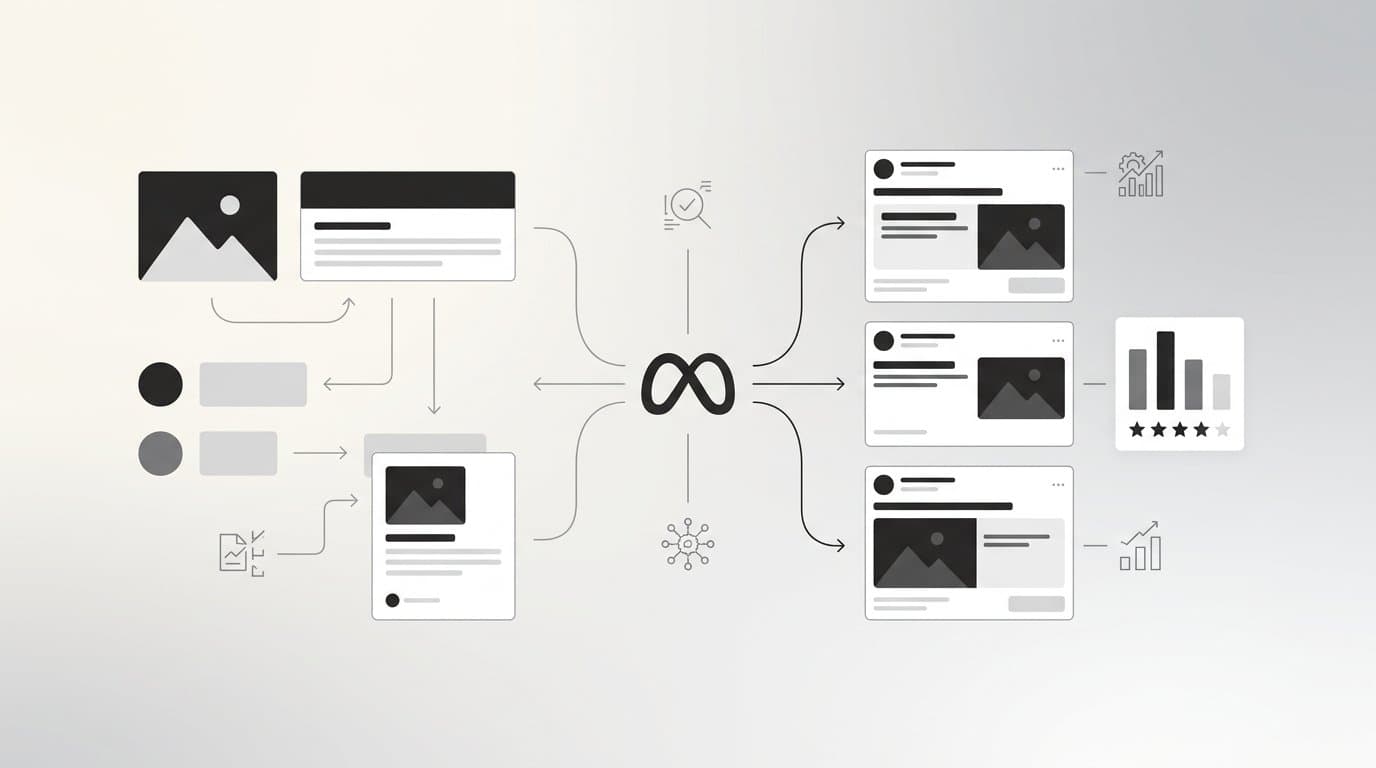
Bulk ad launching and AI-driven variation testing flip this equation entirely. Instead of producing one creative at a time and launching it manually, you generate hundreds of combinations across creatives, headlines, audiences, and copy simultaneously. The system then identifies winners automatically based on real performance data, so you're not spending time manually reviewing every variation.
The real value isn't just speed. It's the learning loop. Every variation you test adds data to your performance model. Over time, the system gets better at predicting which combinations will work for your specific audience and offer. What starts as a solution to creative exhaustion becomes a compounding advantage: the more you test, the smarter your creative decisions become.
AdStellar's Bulk Ad Launch feature lets you mix multiple creatives, headlines, audiences, and copy at both the ad set and ad level. The platform generates every combination and launches them to Meta in clicks rather than hours. Combined with the Winners Hub, which collects your best-performing creatives, headlines, and audiences in one place, you build a growing library of proven elements that feed directly into your next campaign.
Implementation Steps
1. Identify the variables you want to test in your next campaign: at minimum, two to three creative variations, two headline options, and two audience segments.
2. Use a bulk launching tool to generate all combinations automatically rather than setting up each ad variation manually.
3. Set clear performance thresholds for pausing underperformers and scaling winners so the system can optimize without constant manual intervention.
4. After each campaign cycle, add winning elements to a centralized library and use them as the foundation for the next round of variations.
Pro Tips
Resist the urge to test too many variables at once when you're first building this system. Start with creative as the primary variable while holding audiences and copy relatively constant. Once you have clear creative winners, layer in headline and audience testing. This staged approach gives you cleaner data and faster learning than testing everything simultaneously from the start. Learning how to navigate creative testing bottlenecks will help you build a more efficient variation system from the ground up.
Putting It All Together
Creative exhaustion on Instagram is not a sign that you've run out of ideas. It's a signal that your current process for generating, testing, and scaling creatives needs a structural upgrade.
Each of the seven strategies above addresses a different root cause. Competitor research solves the problem of building in a vacuum. Angle reframing extracts more value from proven assets. UGC-style generation removes the production bottleneck for authentic content. Format rotation prevents over-reliance on a single creative type. Performance data analysis replaces guesswork with evidence. Organic repurposing creates a pipeline from content that's already validated. Bulk launching and automation remove the manual bottleneck that limits how fast you can test and learn.
The fastest path forward is to pick one or two strategies that match where you're actually stuck right now. If your creative library is genuinely thin, start with competitor research and UGC-style generation. If you have plenty of assets but nothing is converting, start with performance data analysis and angle reframing. If production speed is the issue, bulk launching and format rotation will have the biggest immediate impact.
AdStellar is built specifically to solve this problem end to end. You can generate image ads, video ads, and UGC-style creatives from a product URL, clone competitor formats from the Meta Ad Library, launch hundreds of variations at once, and let AI surface your winners automatically through real-time leaderboards and goal-based scoring. The AI Campaign Builder analyzes your historical data and builds complete Meta campaigns with full transparency on every decision, and it gets smarter with every campaign you run.
The goal is to stop treating creative ideation as a one-time sprint and start building a system that consistently generates, tests, and scales what works. Start Free Trial With AdStellar and see how fast your creative pipeline can move when the process is automated from creative generation all the way through to surfacing your winners.