Running the same Instagram ad creative until performance tanks is one of the most common and costly mistakes in paid social. When audiences see the same image or video repeatedly, engagement drops, costs rise, and your campaigns lose momentum.
The fix is not simply making more ads. It is building a deliberate system for creative variety that keeps your messaging fresh, tests multiple angles simultaneously, and continuously surfaces what actually works.
This guide breaks down eight actionable strategies for building genuine creative variety into your Instagram ad campaigns. Whether you are managing a single brand or dozens of client accounts, these approaches will help you move beyond creative fatigue, generate more winning combinations, and scale what performs.
Each strategy covers not just the concept but exactly how to put it into practice, so you can start building a more resilient, high-performing creative library today.
1. Build a Creative Angle Framework Before You Design Anything
The Challenge It Solves
Most teams jump straight into design without defining what each creative is actually trying to communicate. The result is a library full of ads that look different on the surface but all say roughly the same thing. Without a deliberate angle framework, variety becomes cosmetic rather than strategic, and you end up testing the same message in slightly different wrappers.
The Strategy Explained
A creative angle framework maps distinct messaging approaches to different audience awareness stages before a single design decision is made. Think of it like a content brief for every ad concept. At the awareness stage, your angle might focus on the problem your product solves. At the consideration stage, it shifts to social proof or feature comparisons. At the conversion stage, urgency and risk-reversal take over.
When you define five to eight distinct angles upfront, each creative has a clear strategic purpose. This makes variety intentional rather than random, and it gives your testing a logical structure so you can learn which angles resonate with which audiences.
Implementation Steps
1. Map your audience across three awareness stages: problem-aware, solution-aware, and product-aware. Write one sentence describing what each stage needs to hear.
2. Develop two to three distinct messaging angles per stage. For example, problem-aware angles might include pain amplification, missed opportunity framing, or social comparison.
3. Assign each angle a brief creative brief covering the core message, the emotional trigger, and the desired action. Use this brief as the foundation for every creative produced under that angle.
4. Review your existing creative library against this framework. Identify which angles are overrepresented and which have never been tested.
Pro Tips
Keep your angle framework as a living document and update it after each campaign cycle based on what resonated. The angles that win in one quarter may shift as your audience evolves. Treat the framework as your creative strategy, not a one-time exercise.
2. Diversify Across All Three Core Creative Formats
The Challenge It Solves
Many advertisers default to one creative format out of habit or resource constraints, typically static images. While static ads are fast to produce, relying on a single format creates a fragile creative strategy. Different formats reach audiences differently, occupy different placements, and trigger different engagement behaviors. Ignoring format diversity means leaving performance on the table.
The Strategy Explained
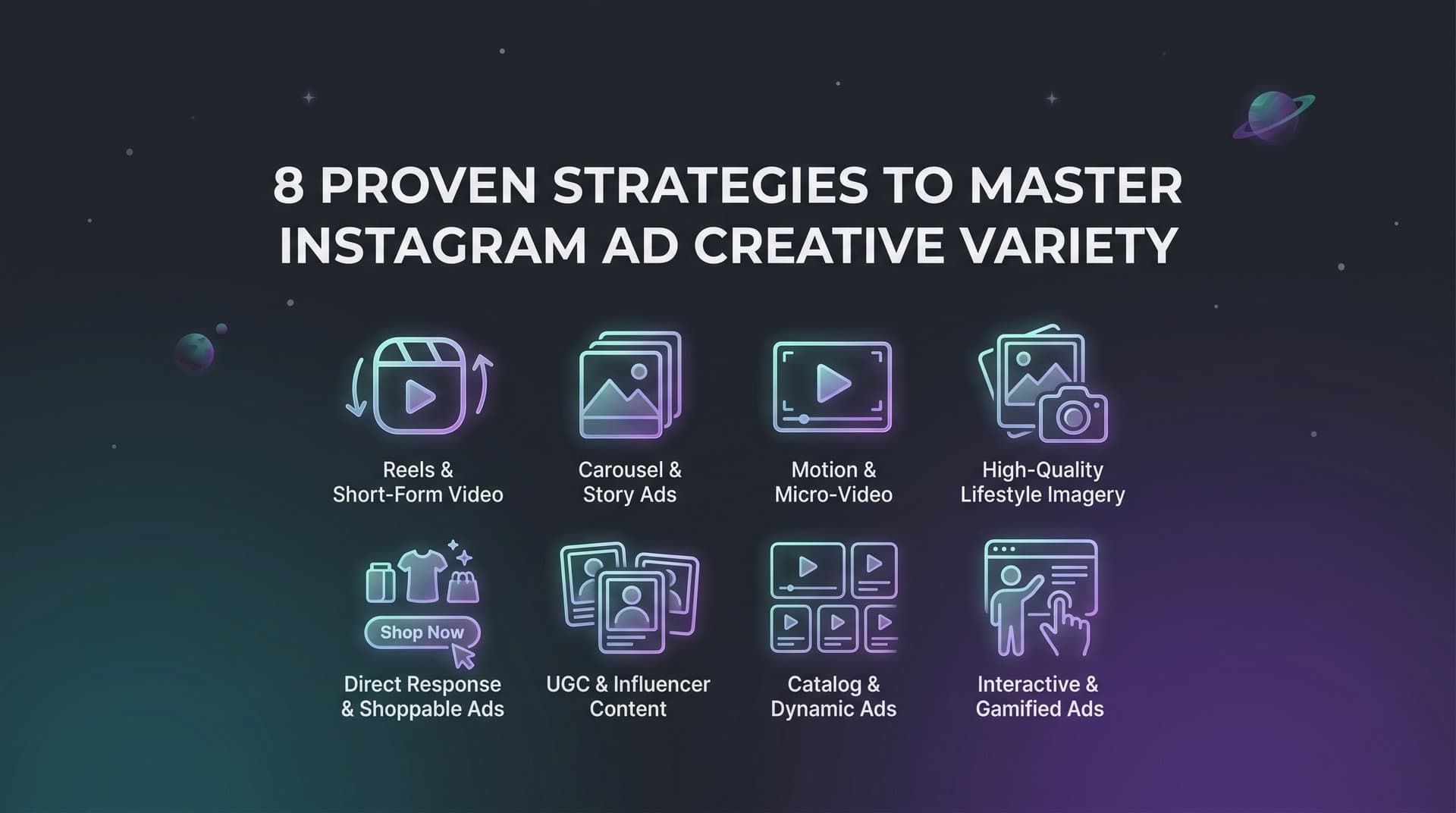
Instagram supports multiple ad formats including single image, video, carousel, Stories, and Reels, as documented in Meta's Business Help Center. Each format has distinct placement behavior and interaction patterns. Static image ads are strong for clear, direct offers. Video ads build narrative and demonstrate products in motion. UGC-style creatives, which mimic organic content from real users, tend to feel native to the feed and can lower audience resistance to promotional messaging.
Building a systematic rotation across all three core formats, static, video, and UGC-style, means your campaigns are not dependent on any single format performing well. Platforms like AdStellar let you generate all three from a single product URL, removing the production barrier that typically forces teams to default to statics.
Implementation Steps
1. Audit your current creative library and calculate the percentage split across formats. If more than two-thirds of your ads are one format, you have a concentration risk.
2. Identify the two formats you use least and commit to producing at least three new creatives in each for your next campaign cycle.
3. Use AI creative tools to generate video and UGC-style content without requiring video editors or actors. This removes the production cost barrier that often keeps teams stuck on static-only strategies.
4. Track performance by format, not just by individual ad. This tells you which formats are structurally stronger for your audience and offer.
Pro Tips
UGC-style creatives often perform well not because of production quality but because they feel authentic. When generating UGC avatar ads, prioritize natural language and realistic scenarios over polished scripts. The goal is to blend into the feed, not stand out from it.
3. Rotate Visual Hooks Systematically to Fight Ad Fatigue
The Challenge It Solves
Ad fatigue is a well-documented phenomenon in paid social advertising. When the same creative is shown to the same audience repeatedly, engagement declines, CPMs rise, and click-through rates fall. Meta's own advertising documentation acknowledges this pattern. The problem is that most advertisers only respond to fatigue after it has already damaged performance, rather than building a rotation system that prevents it.
The Strategy Explained
A visual hook is the first element of your ad that stops the scroll. It might be a bold text overlay, a lifestyle shot, a tight product close-up, a before-and-after comparison, or a high-contrast background. Each hook type creates a different first impression and attracts attention in a different way.
Building a deliberate library of five or more distinct hook types, and rotating them on a scheduled basis, means your audience sees something visually new even when the underlying message stays consistent. The key is to refresh based on frequency data rather than guesswork. When your frequency metrics start climbing and engagement starts declining, that is your signal to rotate, not a week later.
Implementation Steps
1. Identify five distinct visual hook types relevant to your product category. Examples include: bold text-only hooks, product hero shots, lifestyle context shots, problem visualization, and testimonial stills.
2. Produce at least two creative executions for each hook type so you always have a ready replacement when fatigue signals appear.
3. Set a frequency threshold in your campaign monitoring. When frequency exceeds your defined limit, trigger a creative rotation rather than waiting for CTR to drop.
4. Use AdStellar's AI Insights leaderboard to track which hook types are maintaining engagement longest. This tells you which visual approaches have the most staying power with your specific audience.
Pro Tips
Do not confuse visual variety with messaging variety. You can rotate hooks while keeping the same core angle, or you can change both simultaneously. Be deliberate about which variable you are changing so your testing stays clean and your learnings stay actionable.
4. Mix Headlines and Copy Variants Independently from Visuals
The Challenge It Solves
A common mistake is treating the visual and the copy as a single unit, always pairing the same headline with the same image. This dramatically limits your creative combinations and means you can never isolate whether a winning ad succeeded because of the visual, the headline, or the combination of both. It also means you are producing far fewer effective variations than you could be.
The Strategy Explained
Treating ad copy as its own independent creative variable unlocks a multiplier effect. If you have four visuals and four headline styles, that is sixteen potential combinations rather than four. When you also vary body copy angles, the combinations multiply further.
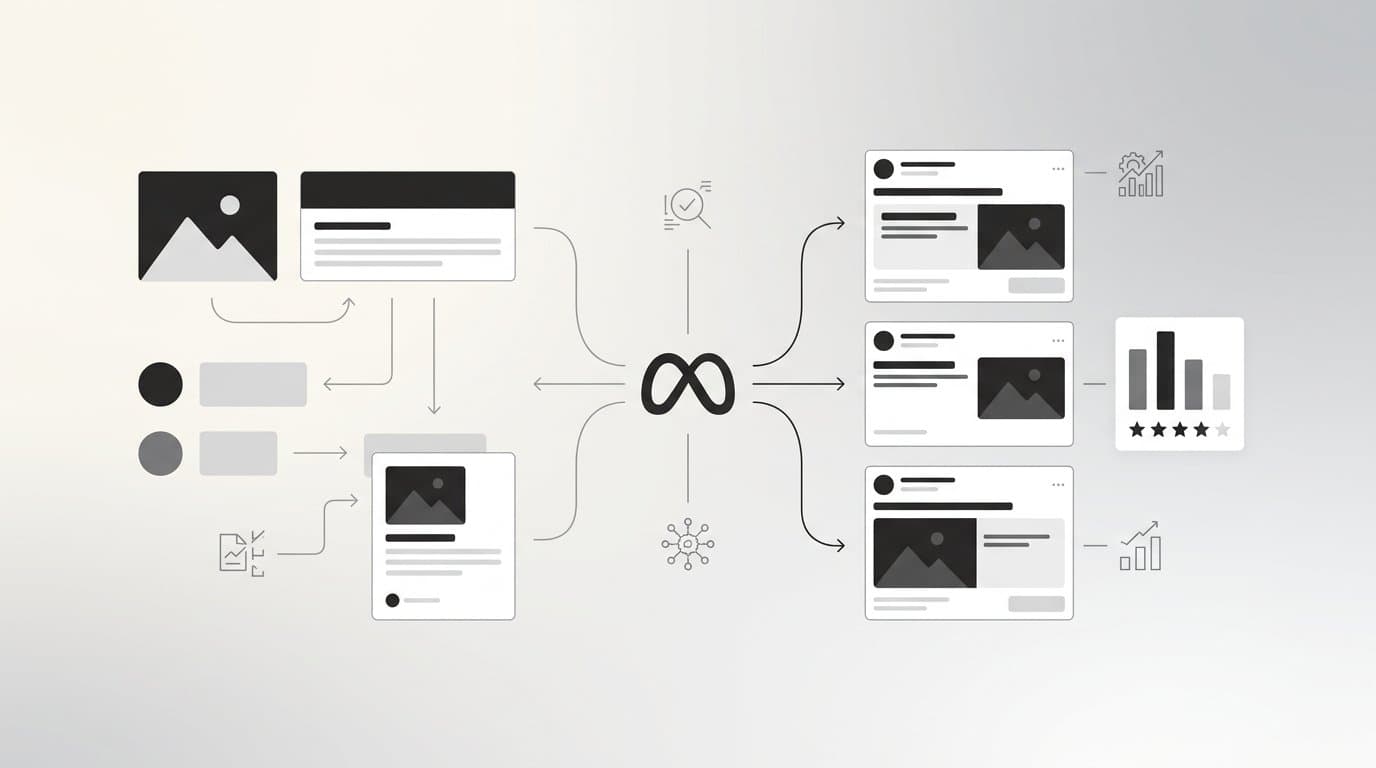
Develop distinct headline styles that approach your offer from different angles: curiosity-driven, benefit-led, social proof, urgency-based, and question-format are five solid starting categories. Write two to three executions per style, then use bulk creation tools to combine them with your visual library automatically. AdStellar's Bulk Ad Launch feature does exactly this, mixing multiple creatives, headlines, and copy variants at both the ad set and ad level to generate every combination and launch them to Meta in minutes rather than hours.
Implementation Steps
1. Write a minimum of ten headline variants for your current offer, covering at least five distinct styles. Avoid writing ten versions of the same approach with slightly different wording.
2. Develop three to four body copy angles that match your creative angle framework from Strategy 1. Each angle should have a distinct emotional tone and call-to-action framing.
3. Use a bulk launching workflow to combine your headline and copy variants with your visual library. Let the tool generate every combination automatically rather than building each ad manually.
4. After your test period, analyze performance at the headline level and the copy level separately. This tells you which elements are driving results independently of the visual.
Pro Tips
Keep your headline variants in a shared document organized by style category. When one headline style consistently outperforms others, use it as the template for your next batch of variants rather than starting from scratch every time.
5. Clone and Adapt Competitor Creatives as a Research Shortcut
The Challenge It Solves
Generating original creative concepts from scratch is time-consuming and often relies on internal assumptions about what will resonate. Before investing heavily in original production, it makes sense to understand what is already working in your niche. Most advertisers skip this step entirely, missing a significant research shortcut that can dramatically improve their starting point.
The Strategy Explained
The Meta Ad Library is a publicly available tool that lets you search active ads running across Meta platforms. By searching for competitors or category keywords, you can identify which creative formats, visual styles, and messaging angles are being actively invested in, a strong signal that they are performing.
The goal is not to copy but to learn. Identify the structural patterns in high-frequency competitor ads: What hook type are they using? What awareness stage are they targeting? What call-to-action format appears most often? Then build your own adapted variations that apply those proven structures to your unique offer and brand voice. AdStellar's AI Creative Hub lets you clone competitor ads directly from the Meta Ad Library and generate adapted versions using AI, compressing what used to be a multi-day research and production process into minutes.
Implementation Steps
1. Search the Meta Ad Library for three to five direct competitors and three to five category-adjacent brands. Filter for active ads and note which creatives have been running longest, a proxy for strong performance.
2. Identify two to three structural patterns that appear repeatedly across multiple competitors. Document the hook type, format, messaging angle, and CTA style for each pattern.
3. Use an AI cloning tool to generate adapted versions of these patterns with your own product, brand assets, and messaging. Do not replicate copy or visuals directly.
4. Test your adapted versions alongside your original concepts to see whether the competitor-informed structures outperform your baseline.
Pro Tips
Pay particular attention to ads that have been running for several months without changes. Advertisers rarely keep losing ads live for extended periods, so longevity is one of the best free signals available in the Meta Ad Library.
6. Run Structured Creative Tests to Find Winners Faster
The Challenge It Solves
Simple A/B testing tells you which of two options performed better, but it does not tell you why, and it tests only one variable at a time. At the pace most Instagram campaigns need to move, running sequential single-variable tests is too slow to generate meaningful learning. Many advertisers end up making decisions based on limited data and miss the combinations that would actually drive the best results.
The Strategy Explained
Structured multivariate testing involves testing multiple variables simultaneously, such as visual hook, headline style, and copy angle, in a way that isolates the contribution of each element to overall performance. This generates more learning per dollar spent and surfaces winning combinations faster than sequential testing.
The critical enabler is having a ranking system that goes beyond simple click-through rate. AdStellar's AI Insights feature uses leaderboards to rank every creative element, including creatives, headlines, copy, audiences, and landing pages, by real metrics like ROAS, CPA, and CTR. You set your target goals and the AI scores everything against your benchmarks, so you can instantly identify which variables are driving results and which are dragging performance down. For a deeper look at how this works in practice, the Instagram ad creative testing methods guide covers multivariate testing approaches in detail.
Implementation Steps
1. Define the variables you want to test in each campaign cycle. Limit yourself to three to four variables at a time to keep analysis manageable: for example, hook type, headline style, and audience segment.
2. Ensure you have enough creative volume to meaningfully test each variable. A minimum of two to three executions per variable gives the algorithm enough to work with.
3. Set clear success metrics before the test begins. Define what ROAS, CPA, or CTR threshold constitutes a winner for your specific campaign goal.
4. Use AI-powered leaderboards to rank performance at the element level, not just the ad level. This tells you whether a winning ad succeeded because of the visual, the headline, or a specific combination.
Pro Tips
Resist the urge to pause underperforming ads too quickly. Early data can be misleading, especially for upper-funnel creatives where the conversion path is longer. Set a minimum spend threshold before making any optimization decisions.
7. Build a Winners Hub to Recycle Proven Creative Elements
The Challenge It Solves
Most advertising accounts have a graveyard problem. Winning creatives, headlines, and audience combinations get buried in archived campaigns and are never reused. Every new campaign cycle starts from scratch, wasting the institutional knowledge built up through months of testing. This is one of the most preventable sources of inefficiency in paid social management.
The Strategy Explained
A Winners Hub is a centralized, organized library of your best-performing creative elements, complete with real performance data attached. Rather than hunting through archived campaigns to remember what worked, you have a curated collection of proven elements ready to deploy in future campaigns.
This is not just about saving time. It is about building compounding performance. When you consistently start new campaigns with elements that have already proven themselves, your baseline performance improves over time. AdStellar's Winners Hub feature does this automatically, organizing your top-performing creatives, headlines, audiences, and more in one place with their actual performance data. You can select any winner and instantly add it to your next campaign without rebuilding it from scratch.
Implementation Steps
1. At the end of every campaign cycle, identify the top-performing creative elements across each variable category: visual, headline, copy, and audience. Document their performance metrics alongside the asset itself.
2. Organize your winners by angle type and format so you can quickly find the right asset for your next campaign's strategic needs.
3. When building new campaigns, start by reviewing your Winners Hub before commissioning new creative. Ask whether a proven element could serve as the foundation, with a fresh variation built on top of it.
4. Set a quarterly review to retire winners that have aged out due to creative fatigue and identify which elements have the longest performance shelf life for your audience.
Pro Tips
Winners are not just the top-performing ads. They are the specific elements within those ads that drove performance. A headline that worked in one campaign context may work even better in a different creative pairing. Track elements individually, not just as complete ad units.
8. Use Bulk Launching to Deploy Variety at Scale Without the Manual Work
The Challenge It Solves
Creative variety sounds great in theory, but in practice, manually building hundreds of ad variations is a significant operational bottleneck. If it takes your team hours to set up each campaign, you will naturally default to fewer creatives and less variation. The manual work becomes the limiting factor, not the strategy.
The Strategy Explained
Bulk launching replaces the manual ad creation process with an automated workflow that combines creatives, headlines, copy variants, and audiences into every possible combination, then launches them to Meta in one action. What used to take hours of repetitive setup can be completed in minutes.
This changes the economics of creative variety entirely. When deploying fifty ad variations takes the same time as deploying five, there is no longer a practical reason to limit your creative volume. AdStellar's Bulk Ad Launch feature works at both the ad set and ad level, mixing multiple creatives, headlines, and audiences to generate every combination automatically. This removes the bottleneck that keeps most accounts from achieving genuine creative variety at scale.
Implementation Steps
1. Prepare your creative inputs in batches: a set of visuals, a set of headlines, a set of copy variants, and a set of audience segments. Think of these as the ingredients rather than the finished ads.
2. Use a bulk launching tool to define your combination logic. Decide whether you want every possible combination or a structured subset based on your testing priorities.
3. Review the generated combinations before launching to confirm the pairings make strategic sense. Bulk launching automates the assembly, but your angle framework from Strategy 1 should still guide which combinations are worth testing.
4. After launch, use your AI Insights leaderboard to monitor performance across all combinations simultaneously. The volume of data generated by bulk launching makes AI-powered ranking essential for making sense of results quickly.
Pro Tips
Bulk launching is most powerful when your creative inputs are already well-organized and strategically diverse. If you bulk launch ten variations of the same message with minor visual tweaks, you will generate volume without variety. Use the angle framework and format diversification strategies first, then use bulk launching to scale what you have built.
Putting It All Together
Creative variety on Instagram is not about producing more content for its own sake. It is about building a systematic approach to testing, learning, and scaling what resonates with your audience.
The eight strategies above form a complete loop. Start with a clear angle framework so every creative has a strategic purpose. Diversify your formats so you are not dependent on a single type performing well. Rotate your visual hooks before fatigue sets in rather than after. Vary your copy independently from your visuals to multiply your combinations. Use competitor research to accelerate your starting point. Test with structure so you generate real learning rather than noise. Preserve your winners so each campaign builds on the last. And deploy at scale so operational limits never constrain your creative ambition.
When these strategies work together, you stop guessing and start compounding. Each campaign teaches you something that makes the next one sharper.
Platforms like AdStellar are built specifically for this kind of systematic creative variety. From AI-generated image ads, video ads, and UGC-style creatives to bulk launching, AI-powered leaderboards, and a centralized Winners Hub, it handles the full workflow from creative to conversion in one place. No designers, no video editors, no manual assembly required.
If you are ready to move beyond creative fatigue and build a high-output ad system that continuously surfaces what works, Start Free Trial With AdStellar and launch your next campaign with the systematic variety that turns testing into compounding performance.