Fashion advertising on Instagram has become intensely competitive. With thousands of brands fighting for attention in the same feed, the difference between a scroll-past and a sale often comes down to creative strategy. Whether you are a fashion brand owner managing your own ads or an agency handling multiple fashion clients, the way you create, test, and optimize Instagram ad creatives directly determines your return on ad spend.
The challenge is real: fashion audiences expect visually stunning, trend-aware content that feels native to their feed, and they expect it to change constantly. Static strategies that worked even a year ago can feel stale today. Ad fatigue sets in faster in fashion than almost any other vertical because your audience is scrolling through competitor content all day long.
This guide breaks down seven actionable strategies that modern Instagram ad creators use to build high-performing campaigns for fashion brands. From leveraging AI-generated creatives to building systematic testing frameworks, each strategy addresses a specific pain point in the fashion ad workflow and gives you a clear path forward.
1. Generate Scroll-Stopping Creatives from Product URLs Instead of Photoshoots
The Challenge It Solves
Traditional fashion ad production is expensive and slow. Booking photographers, sourcing models, arranging locations, and editing final assets can take weeks and cost thousands of dollars per shoot. For brands that need to refresh creatives frequently to stay ahead of ad fatigue, this model simply does not scale. You end up running the same three creatives long after they have stopped performing because producing new ones takes too long.
The Strategy Explained
AI-powered creative generation lets you produce image ads, video ads, and lifestyle creatives directly from a product URL, without a single photoshoot. You feed the platform your product link, and AI builds polished, on-brand ad creatives that are ready to launch. This means you can go from new product to live ad in minutes rather than weeks.
Tools like AdStellar's AI Creative Hub allow you to generate multiple creative formats from the same product input, including static image ads, video ads, and UGC-style avatar content. You can also refine any creative using chat-based editing, so you stay in control of the final output without needing a designer on standby.
Implementation Steps
1. Collect product URLs for your current collection or the specific items you want to promote in your next campaign.
2. Run each URL through your AI creative tool and generate at least three to five variations per product, covering different formats such as lifestyle image, product-focused image, and short video.
3. Use chat-based editing to adjust colors, copy overlays, or framing to align with your brand aesthetic before launching.
4. Build a creative calendar that maps new product launches to AI-generated ad batches so your creative pipeline never stalls.
Pro Tips
Generate creatives for your top sellers on a rolling basis rather than waiting for a campaign to need them. Having a library of ready-to-launch assets means you can respond to trends and seasonal moments quickly. Fashion moves fast, and the brands that win are the ones that can publish relevant creatives the same week a trend peaks. Leveraging an automated ad creation for Instagram workflow makes this process seamless.
2. Clone What Already Works by Mining the Meta Ad Library
The Challenge It Solves
Most fashion brands spend significant time and budget figuring out what ad formats and creative angles resonate with their target audience. But your competitors have already done a lot of that testing for you. The problem is that most marketers do not have a systematic way to turn competitor research into actionable creative production. They browse the Meta Ad Library, feel inspired, and then start from scratch anyway.
The Strategy Explained
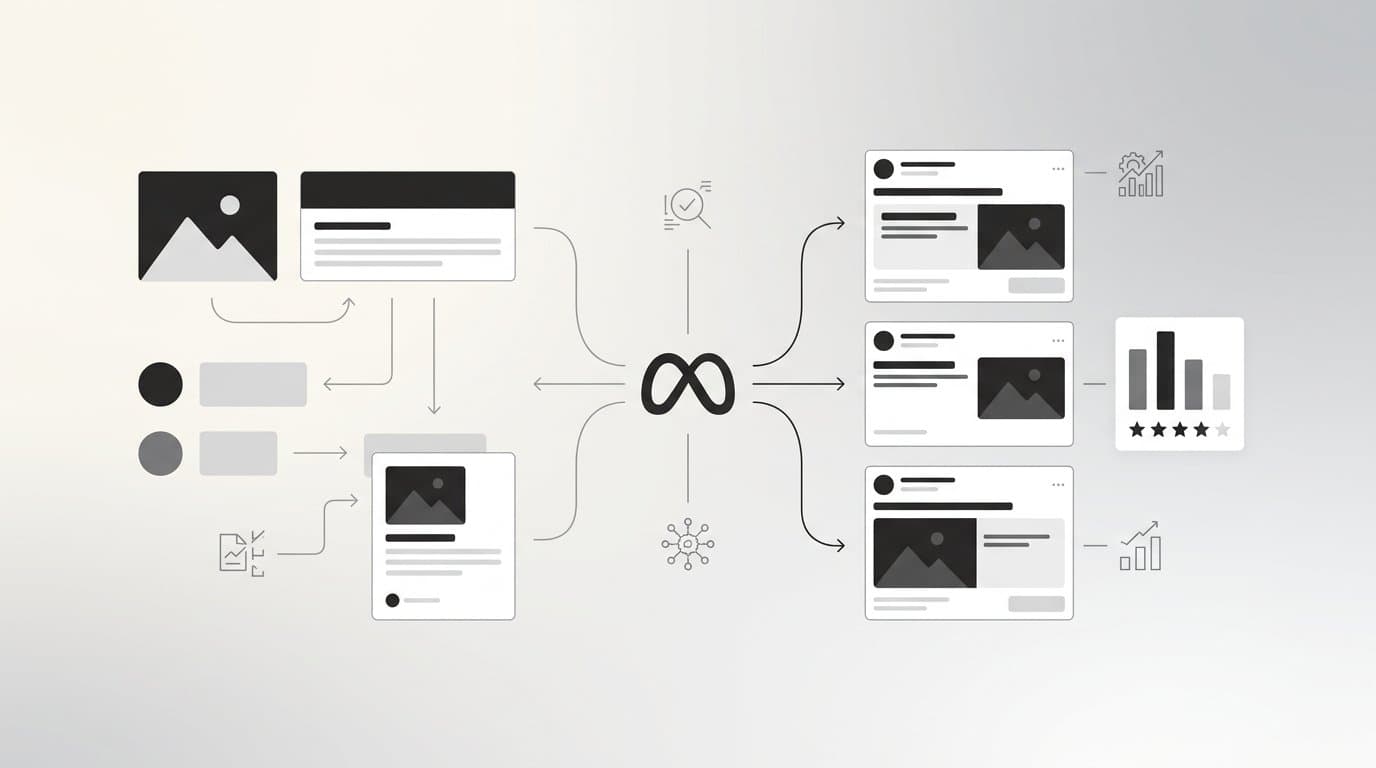
The Meta Ad Library is a publicly accessible database of active ads from any advertiser on Facebook and Instagram. For fashion brands, it is a goldmine of proven formats, hooks, copy structures, and visual approaches. The real power comes when you combine competitor research with AI tools that can clone and adapt winning ad structures for your own products.
Rather than manually recreating what you see, AdStellar lets you clone competitor ads directly from the Meta Ad Library and rebuild them with your own products and branding. You are not copying anyone's content. You are borrowing the structural logic of what is already working and applying it to your own creative. This approach is especially powerful for Meta advertising for ecommerce brands looking to accelerate their testing cycles.
Implementation Steps
1. Search the Meta Ad Library for your top three to five direct competitors and filter for active ads that have been running for several weeks, as longevity often indicates strong performance.
2. Identify patterns across their top ads: What hooks do they use? What formats appear most often? What emotional angles do they lead with?
3. Use an AI creative tool to clone the structural format of those ads with your own products, swapping in your imagery, branding, and copy.
4. Test your cloned variations against your existing creatives to see whether the proven format translates to your audience.
Pro Tips
Look beyond your direct competitors. Fashion-adjacent brands in beauty, accessories, and lifestyle often use creative formats that your core fashion audience responds to but that your direct competitors have not yet adopted. Cross-vertical inspiration can give you a meaningful edge.
3. Add UGC-Style Avatar Ads to Your Creative Mix
The Challenge It Solves
Polished brand creatives have their place, but Instagram feeds are increasingly dominated by authentic, person-to-camera content. Fashion audiences have become skilled at identifying overly produced ads and scrolling past them. Sourcing real UGC from customers is time-consuming, and working with influencers at scale is expensive. Many brands end up with a creative mix that is too polished and too uniform to feel native to the feed.
The Strategy Explained
AI-generated UGC avatar ads replicate the look and feel of authentic person-to-camera content without requiring real people, filming equipment, or influencer contracts. These creatives use AI avatars that speak directly to the camera, review products, or demonstrate styling options in a way that blends naturally into organic Instagram content.
The result is a creative format that tends to earn higher trust and engagement because it does not look like a traditional ad. For fashion brands specifically, avatar ads work particularly well for product introductions, styling tips, and social proof-style messaging. AdStellar's AI Creative Hub generates UGC-style avatar content as part of the same workflow you use for image and video ads, so you can include it in every campaign without adding production complexity. If you want to dive deeper into video creative strategies, explore how an AI Instagram ad video creator can scale your output.
Implementation Steps
1. Identify the messaging angles that typically perform well for your brand, such as product highlights, styling advice, or customer-style testimonials.
2. Generate UGC avatar ads for those angles using your AI creative platform, selecting avatar styles that match your target demographic.
3. Include at least one UGC-style creative in every ad set alongside your polished brand creatives to give the algorithm options to test.
4. Monitor performance separately for UGC-style formats versus brand-produced formats to understand which resonates better with each audience segment.
Pro Tips
UGC-style ads often perform differently by placement. They tend to shine in Stories and Reels where authentic content feels most at home. Test your avatar ads in these placements specifically before drawing conclusions about overall performance.
4. Build a Bulk Testing Framework with Hundreds of Ad Variations
The Challenge It Solves
Most fashion brands test ads one at a time or in small batches. They launch a handful of creatives, wait for data, make a judgment call, and repeat. This approach is too slow to find winners at the speed the fashion market demands. By the time you have identified a winning creative through manual testing, the trend it was tied to may have already peaked.
The Strategy Explained
Bulk ad launching flips the testing model entirely. Instead of testing a few combinations carefully, you generate hundreds of ad variations by mixing different creatives, headlines, audiences, and copy at both the ad set and ad level simultaneously. The algorithm then distributes spend across those variations and surfaces the winners through real performance data rather than your best guess.
Think of it like casting a wide net instead of fishing with a single line. You are not spending more money. You are distributing the same budget across far more combinations, which means you get meaningful data on what works much faster. AdStellar's Bulk Ad Launch feature generates every possible combination and pushes them all to Meta in minutes, not hours. Media buyers managing fashion accounts at scale can also benefit from strategies outlined in bulk Facebook ad creation for media buyers.
Implementation Steps
1. Prepare a batch of creatives, at least five to ten, covering different formats and angles for the products you are promoting.
2. Write three to five headline variations and three to five copy variations for each campaign objective.
3. Define two to four audience segments you want to test, such as different lookalikes, interest combinations, or retargeting pools.
4. Use your bulk launching tool to generate every combination and launch them as a structured test campaign with consistent budget allocation across variations.
5. Allow the campaign to run until you have statistically meaningful data, then move budget toward the top performers.
Pro Tips
Keep your creative variables isolated when possible. If you change the creative, the headline, and the audience all at once, you will not know which variable drove the improvement. Use bulk launching to test many combinations, but structure your analysis so you can identify which elements are actually moving the needle.
5. Let AI Analyze Historical Data to Build Smarter Campaigns
The Challenge It Solves
Every campaign you have ever run contains valuable information about what works for your specific audience. Most marketers acknowledge this but lack the time or analytical capacity to systematically extract those insights and apply them to new campaigns. The result is that each new campaign is built largely from intuition rather than from accumulated learning, which means you keep repeating the same experiments instead of building on proven results.
The Strategy Explained
AI campaign builders ingest your historical performance data and use it to construct new campaigns based on proven winning elements. Rather than starting from a blank slate, the AI ranks every creative, headline, audience, and copy variation by past performance and builds your next campaign around the combinations most likely to succeed. This approach represents the future of AI for Instagram advertising campaigns, where data-driven decisions replace guesswork.
This is not just automation. It is institutional memory at scale. AdStellar's AI Campaign Builder uses specialized AI agents that analyze your past campaigns, surface the highest-performing elements, and assemble complete Meta ad campaigns in minutes. Every decision comes with a transparent rationale so you understand the strategy, not just the output. And the system gets smarter with every campaign you run.
Implementation Steps
1. Ensure your Meta ad account has at least a few months of campaign history for the AI to analyze. The more data available, the more accurate the recommendations.
2. Connect your ad account to your AI campaign builder and allow it to ingest and rank your historical creative, audience, and copy performance.
3. Review the AI's campaign proposal, paying attention to the rationale it provides for each element it selected.
4. Launch the AI-built campaign alongside your manually built campaigns to compare performance and build confidence in the AI's recommendations over time.
Pro Tips
Do not skip reading the AI's reasoning even when you are in a hurry. Understanding why the AI selected certain elements helps you develop better creative instincts and gives you the context to override its recommendations when you have information it does not, such as an upcoming sale or a new product launch that changes the strategic context.
6. Use Leaderboard-Based Insights to Identify and Recycle Winners
The Challenge It Solves
Running lots of ad variations is only valuable if you have a clear system for identifying what is working and acting on it quickly. Many fashion brands collect performance data but struggle to translate it into clear decisions. They know their ROAS and their CPA, but they cannot easily answer questions like which specific creative is driving the most efficient conversions or which headline is consistently outperforming across multiple audiences.
The Strategy Explained
Leaderboard-based analytics rank every element of your advertising, including creatives, headlines, copy, audiences, and landing pages, by real performance metrics like ROAS, CPA, and CTR. Instead of digging through spreadsheets or campaign managers to find patterns, you get a ranked view of what is working right now, scored against your specific goals. Overcoming the challenges of Instagram ad performance tracking is essential for making this system work effectively.
AdStellar's AI Insights feature does exactly this. You set your target goals, and the AI scores every ad element against your benchmarks so you can instantly spot winners. Those winners then flow into the Winners Hub, where your best-performing creatives, headlines, and audiences are stored with full performance data, ready to be pulled into your next campaign with a single click.
Implementation Steps
1. Define your primary campaign goals clearly, whether that is ROAS, CPA, CTR, or a combination, so the scoring system has a benchmark to work against.
2. After each campaign cycle, review your leaderboard rankings to identify the top-performing creative formats, headlines, and audiences.
3. Move top performers into your Winners Hub so they are preserved and easily accessible for future campaigns.
4. When building your next campaign, start by reviewing your Winners Hub and incorporating proven elements before adding new untested variables.
5. Retire consistently underperforming elements rather than recycling them out of habit or familiarity.
Pro Tips
Treat your Winners Hub as a living creative asset library, not a trophy case. The goal is not just to celebrate what worked. It is to systematically reuse winning elements to raise the floor of every future campaign. A creative that performed well for one product may work equally well for a new product in the same category.
7. Target Fashion-Specific Audiences with Lookalike and Interest Layering
The Challenge It Solves
Great creatives can only take you so far if they are being shown to the wrong people. Fashion brands often struggle with audience targeting because fashion interests are broad and overlapping. Targeting "fashion" as an interest reaches an enormous and highly varied audience, much of which has no real purchase intent for your specific brand positioning. Broad targeting wastes budget on impressions that will never convert.
The Strategy Explained
The most effective fashion audience strategy combines lookalike audiences built from your best customers with layered fashion-specific interests that narrow the pool to high-intent shoppers. Lookalike audiences use Meta's algorithm to find new users who share behavioral and demographic characteristics with your existing purchasers. Interest layering adds additional filters to ensure you are reaching people who are actively engaged with fashion content relevant to your brand positioning. Platforms that offer automated targeting for Instagram ads can streamline this entire process significantly.
For example, a premium womenswear brand might build a lookalike from their top-spending customers and then layer in interests related to luxury fashion, specific designer brands, or fashion publications that align with their positioning. This combination targets users who both look like your best customers and are demonstrably engaged with relevant fashion content.
Implementation Steps
1. Segment your customer list by value. Build your primary lookalike audience from your top purchasers or highest-LTV customers rather than your entire customer base.
2. Create lookalike audiences at different similarity percentages, typically one percent for highest similarity and three to five percent for broader reach, and test them separately.
3. Identify four to six fashion-specific interest categories that align with your brand positioning, such as specific publications, brands, or style categories your target customer follows.
4. Layer those interests onto your lookalike audiences to create tighter, higher-intent targeting pools.
5. Test your layered audiences against broader lookalikes without interest filters to measure the trade-off between audience size and targeting precision.
Pro Tips
Refresh your lookalike source audiences regularly. If your customer list has grown significantly in the past six months, rebuilding your lookalikes from updated data can meaningfully improve targeting accuracy. Fashion audiences also shift seasonally, so audiences that performed well in spring may need recalibration heading into fall.
Putting It All Together
Building a high-performing Instagram ad strategy for fashion brands is not about any single tactic. It is about creating a system where creative generation, testing, analysis, and optimization all feed into each other continuously.
Start by solving your biggest bottleneck first. If creative production is slowing you down, begin with AI-powered creative generation and competitor cloning. If you already have plenty of creatives but lack clarity on what works, implement leaderboard-based insights and a Winners Hub workflow. If you are ready to scale, bulk ad launching and AI-built campaigns will help you move from testing dozens of ads to testing hundreds.
Here is a practical prioritization guide based on where you are right now:
If you are resource-constrained: Start with strategies one and two. AI creative generation and competitor cloning give you the highest creative output for the lowest investment of time and money.
If you are data-rich but insight-poor: Focus on strategies five and six. AI campaign building and leaderboard analytics will help you extract the value from the performance data you are already sitting on.
If you are ready to scale: Combine strategies three, four, and seven. UGC-style ads, bulk launching, and precision audience targeting work together to expand your reach without sacrificing efficiency.
The fashion brands that win on Instagram are the ones that treat ad creation as a systematic, data-driven process rather than a guessing game. Every strategy in this guide becomes significantly more powerful when the tools supporting it are integrated into a single workflow rather than scattered across multiple platforms.
Tools like AdStellar bring creative generation, campaign building, bulk launching, and performance insights into one platform, so you can move from idea to live ad to proven winner without switching between a dozen tools. No designers, no video editors, no guesswork. Just a continuous loop of creation, testing, and optimization that gets smarter with every campaign you run.
Start Free Trial With AdStellar and be among the first to launch and scale your ad campaigns faster with an intelligent platform that automatically builds and tests winning ads based on real performance data.