Most performance marketers have experienced the same frustrating scenario: a campaign with solid targeting, competitive bids, and a reasonable budget that simply refuses to perform. You dig into the data, adjust audiences, tweak the bidding strategy, and still nothing moves. Then a competitor runs what looks like a simpler ad and absolutely cleans up. The difference, almost always, comes down to creative.
Creative has quietly become the most powerful lever in paid social advertising. Yet despite this shift, most teams still rely on gut instinct, slow design cycles, and manual A/B testing to figure out what resonates. The process is expensive, time-consuming, and largely reactive. By the time you have enough data to know something is not working, you have already burned through a meaningful portion of your budget.
This is the problem that ad creative intelligence was built to solve. It is an emerging discipline that applies artificial intelligence to every stage of the ad creative lifecycle: generating visuals and copy, predicting which combinations will perform, learning from live results, and iterating automatically. Think of it as giving your creative process a data-driven brain that never sleeps and gets smarter with every campaign.
This article breaks down exactly what ad creative intelligence is, how the technology works under the hood, why it matters more than ever in today's advertising environment, and how you can put it to work in your own campaigns. Whether you manage ads for a single brand or run campaigns across dozens of clients, understanding this category will change how you think about creative strategy.
The Creative Problem That Sparked a New Category
For years, the dominant narrative in performance marketing was that targeting was everything. Find the right audience, serve them an ad, and conversions would follow. Sophisticated audience segmentation, lookalike modeling, and interest-based targeting were the primary battlegrounds where campaigns were won or lost.
That playbook has changed significantly. Privacy shifts, including Apple's App Tracking Transparency update and ongoing signal loss across the web, have reduced the precision of audience targeting across the board. Meta's own advertiser resources have been explicit about this: the algorithm increasingly relies on creative quality and variety to identify the right people to show your ads to. In other words, the creative itself has become a targeting signal. A compelling ad finds its audience. A weak one does not, regardless of how well you have defined your targeting parameters.
This shift has placed enormous pressure on creative output. The algorithm rewards fresh, varied creatives. It needs multiple signals to optimize effectively. The more high-quality variations you feed it, the more data it has to work with, and the better it performs. Creative velocity, the ability to produce and test a high volume of ad variations quickly, has become a genuine competitive advantage.
The problem is that the traditional creative workflow was never designed for this kind of volume. The typical cycle looks something like this: brief the designer, wait for concepts, review and revise, hand off to the copywriter, another round of reviews, get approvals, set up the ad in the platform, launch, wait two weeks for statistically meaningful data, analyze, and then start the whole process over. That cycle might produce three to five creative variations per month if a team is moving quickly.
Modern algorithmic platforms want dozens. Some practitioners argue for testing even more variations than that, particularly when you factor in different headlines, copy angles, and audience combinations layered on top of each creative.
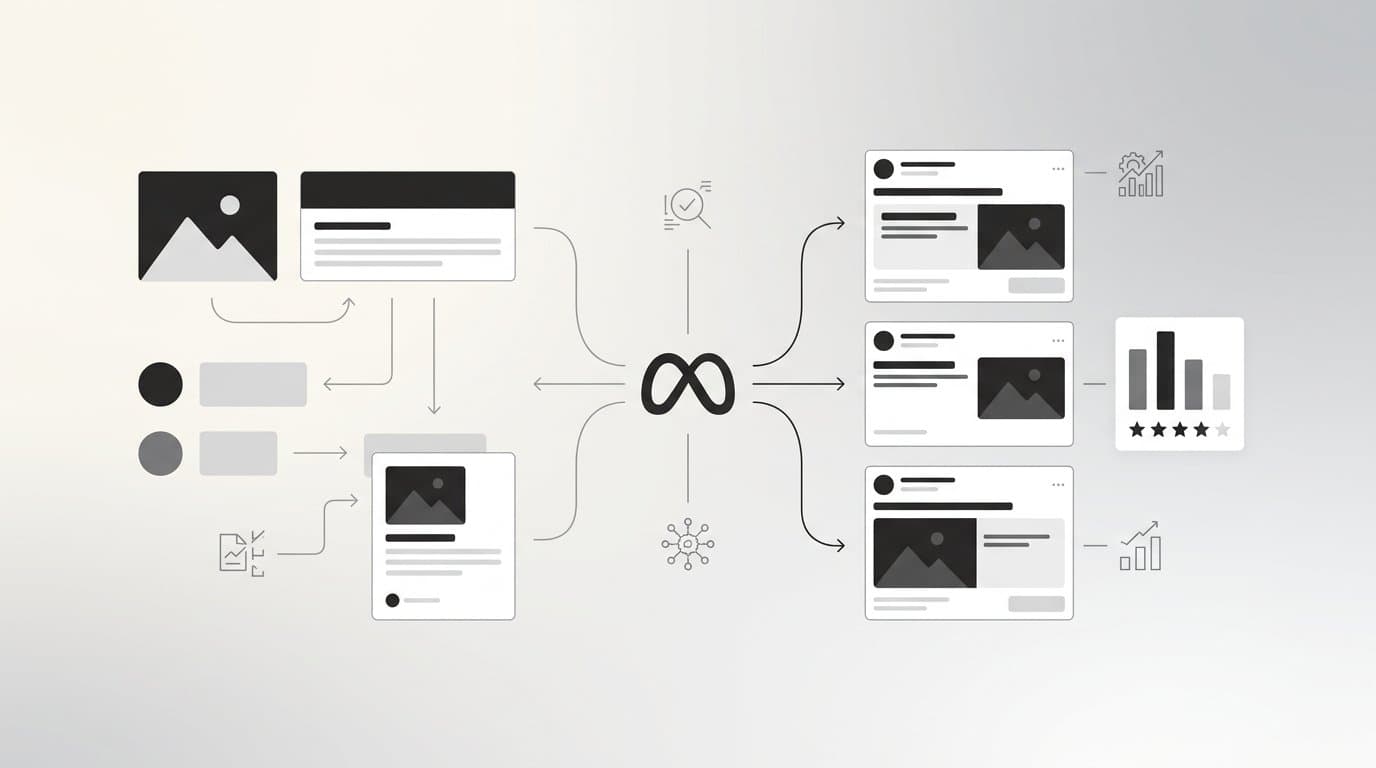
This is where ad creative intelligence enters as a defined category. It is the application of artificial intelligence to every stage of the ad creative lifecycle: from generating the initial visual and copy concepts, to scoring predicted performance before a dollar is spent, to analyzing results at a granular element level, to feeding those learnings back into the next round of creative production. It is not a single tool or feature. It is a systematic approach to creative that replaces slow, manual workflows with creative automation.
How the Technology Actually Works
Understanding ad creative intelligence at a conceptual level is useful. Understanding what is happening under the hood is what separates marketers who use these tools effectively from those who treat them as a black box.
The technology stack typically operates across three interconnected layers.
Generative AI for creative production: This layer uses large-scale AI models to produce image ads, video ads, and UGC-style content from minimal inputs. Feed the system a product URL, a reference image, or a description, and it generates visual and copy variations at a speed and volume no human team can match. This is not template-based resizing or color swapping. Modern generative models create genuinely novel creative concepts informed by the inputs you provide.
Performance scoring models: This is where ad creative intelligence separates itself from simple creative generation tools. Scoring models are trained on historical campaign performance data, meaning they have learned which types of visuals, headlines, copy structures, and calls to action tend to drive results for specific goals like return on ad spend, CPA, or CTR. When a new creative is generated, these models evaluate it against established performance benchmarks before it ever goes live. The system is making an educated prediction about what will work based on what has worked before.
Continuous learning loops: Once campaigns run and real performance data comes in, that data flows back into the system. The scoring models update. Creative recommendations become more refined. The AI learns which elements drove results in your specific account, for your specific audience, against your specific goals. This feedback loop is what makes the system compound in value over time. Each campaign makes the next one smarter.
Critically, the data inputs that guide these systems go beyond your own historical performance. Competitor creative analysis, including the ability to pull and analyze ads running in the Meta Ad Library, gives the AI additional signals about what is performing in your market. Goal-based benchmarks let you define what success looks like for your specific campaigns, so the scoring is calibrated to your objectives rather than generic industry averages.
One of the more sophisticated concepts in this space is creative element decomposition. Rather than judging an ad as simply good or bad, the AI scores individual components separately. The headline gets a score. The visual gets a score. The primary copy gets a score. The CTA gets a score. This granular breakdown means you understand exactly which pieces of an ad are driving performance and which are dragging it down. That insight is enormously valuable when you are building the next campaign, because you can carry forward the winning elements and replace the underperforming ones rather than starting from scratch.
Five Core Capabilities That Define Ad Creative Intelligence
Not every tool that claims AI-powered creative features qualifies as a true ad creative intelligence platform. The category is defined by a specific set of capabilities that work together as a system. Here are the five that matter most.
AI-powered creative generation: The ability to produce image ads, video ads, and UGC avatar content from minimal inputs like a product URL, a reference creative, or even a competitor's ad pulled directly from the Meta Ad Library. The key distinction here is that this eliminates the need for designers, video editors, and actors. A marketer with no design background can generate professional-quality ad creatives in minutes. This is not about replacing human creativity entirely; it is about removing the creative testing bottleneck that limits how many creative concepts a team can explore and test.
Intelligent campaign construction: AI agents that do more than generate creatives. They analyze your historical performance data, rank every creative, headline, audience, and copy combination by how well it has performed against your goals, and then build complete campaign structures with recommended pairings. Crucially, the best platforms provide full transparency into the AI's rationale. You do not just get a campaign recommendation; you get an explanation of why the AI made each decision. This keeps marketers in control and builds genuine understanding of what is driving results.
Bulk variation launching: The ability to mix multiple creatives, headlines, audiences, and copy variants and generate every possible combination, then launch them all to Meta in minutes rather than hours. This is what makes creative velocity practically achievable. Instead of manually setting up each ad variation, the system handles the combinatorial work automatically. A team that previously launched ten variations per campaign can now launch hundreds without adding headcount or working extra hours.
Performance intelligence and leaderboards: Real-time ranking of your creatives, headlines, copy, audiences, and landing pages by actual performance metrics like ROAS, CPA, and CTR. Goal-based scoring means every element is evaluated against your specific benchmarks, not generic averages. This makes it immediately obvious which elements are winning and which are not, so you can act on the information rather than spending time digging through dashboards trying to interpret raw numbers.
Winners Hub and reuse infrastructure: A dedicated system for capturing and organizing your best-performing creative elements with their associated performance data. The value here is compounding. When you identify a winning headline, a high-performing visual, or an audience that consistently converts, you can pull it directly into your next campaign without having to search through old ad accounts or recreate it from memory. Your best work becomes a winning creative library that grows more valuable over time.
Ad Creative Intelligence vs. Traditional Creative Testing
It is worth drawing a clear line between what ad creative intelligence enables and what traditional creative testing looks like in practice, because the difference is not just incremental. It is a fundamentally different way of operating.
Traditional A/B testing works by isolating one variable at a time. You run Version A against Version B, wait for enough data to reach statistical significance, declare a winner, and move on. The process is methodologically sound but painfully slow. Most teams can realistically test a handful of creative variations per campaign cycle. Add in the production time required to create each variation and the waiting period for meaningful data, and you might complete two or three proper tests per quarter.
Ad creative intelligence flips this model entirely. Instead of testing a few variations sequentially, you launch hundreds of variations simultaneously. The AI handles creative production, so the bottleneck of design and copywriting capacity disappears. The scoring models and real-time performance data surface winners quickly, so you are not waiting weeks to understand what is working. The result is a testing velocity that was simply not achievable before without a large dedicated team.
There is also a meaningful shift in how multivariate testing becomes practical. Traditional multivariate testing, where you test multiple variables simultaneously, requires large audience sizes and long run times to produce reliable results. It is often out of reach for teams without significant budgets. When AI handles both the creative production and the analysis, the resource constraint that previously limited multivariate testing largely disappears. You can test headlines against visuals against copy angles all at once, and the performance intelligence layer tells you which combinations are winning across each dimension.
Perhaps the most significant shift is from reactive to proactive optimization. Traditional testing is inherently reactive: you spend money, collect data, identify what did not work, and then make changes. Ad creative intelligence introduces a proactive element through performance scoring. The AI evaluates creative combinations before significant spend is committed, surfacing the highest-probability winners for prioritization. You are not eliminating the need for real-world testing, but you are reducing the amount of budget spent on variations that were unlikely to perform in the first place.
Putting Ad Creative Intelligence to Work in Your Campaigns
Understanding the category conceptually is one thing. Knowing how to actually implement it is where the value gets realized. The practical starting point is simpler than most marketers expect.
The first step is connecting your ad account so the AI can analyze your historical performance data. This is the foundation everything else builds on. The system needs to understand what has worked in your account before it can make intelligent recommendations. The more campaign history you have, the more accurate the initial scoring and recommendations will be. If you are starting with a new account, the AI will rely more heavily on general performance patterns and improve rapidly as your own data accumulates.
From there, you feed the system your inputs. This might be a product URL, from which the AI extracts visual and copy elements to generate creative concepts. It might be a reference ad you want to iterate on. It might be a competitor ad pulled from the Meta Ad Library that you want to use as a creative starting point. The AI-driven ad creative generation produces variations across image ads, video ads, and UGC-style content, giving you a diverse set of creative options to work with immediately.
Once you have your creatives, the campaign builder takes over. It analyzes your historical data, selects the best-performing combinations of creative, headline, audience, and copy, and builds a complete campaign structure with transparent rationale for every decision. You review the recommendations, make any adjustments using chat-based editing tools, and launch. The bulk variation capability means you can launch dozens or hundreds of combinations in the time it used to take to set up a single ad.
As campaigns run, the feedback loop activates. Real performance data flows back into the system, refining the scoring models and improving future recommendations. The Winners Hub captures your top performers so they are immediately available for your next campaign. Over time, the system develops a detailed picture of what works specifically for your brand, your audience, and your goals.
A common concern among marketers exploring these tools is brand control. The worry is that AI-generated creatives will feel generic or off-brand. Modern platforms address this through chat-based editing that lets you refine any creative in natural language, transparent AI rationale that explains every decision so you can evaluate and override it, and the ability to use your own existing creatives as reference points. The AI amplifies your creative direction rather than replacing it.
The Direction This Category Is Moving
Ad creative intelligence is still a relatively young category, and the platforms building in this space are evolving quickly. A few directional trends are worth paying attention to as you think about where to invest your time and tooling.
The most significant trend is convergence. The marketing technology landscape has historically been fragmented: one tool for creative production, another for campaign management, another for performance analytics, and yet another for attribution. Ad campaign intelligence platforms are collapsing these into unified systems where creative generation, campaign construction, performance scoring, and winner identification all happen in one place. This convergence reduces the friction of moving between tools and, more importantly, creates a tighter feedback loop between creative performance data and future creative decisions.
Creative velocity is becoming a more explicit competitive factor. As Meta's algorithm increasingly rewards creative freshness and variety, the teams that can produce and test the most high-quality variations in a given period will have a structural advantage. This is not about producing volume for its own sake. It is about giving the algorithm more signals to optimize against, which translates directly into better campaign optimization over time. Platforms that can compress the creative production and testing cycle will become increasingly central to how performance marketing teams operate.
The integration of attribution data into creative intelligence is also developing rapidly. When platforms can connect creative performance to actual revenue outcomes, rather than just platform metrics like CTR or ROAS reported within the ad platform, the scoring models become significantly more powerful. This is the direction the category is heading: closed-loop intelligence where every creative decision is informed by real business outcomes.
The Compounding Advantage of Getting This Right
Ad creative intelligence is not a buzzword layered on top of existing marketing processes. It represents a genuine shift in how performance marketing teams can operate, moving from slow, intuition-driven creative cycles to fast, data-informed systems that improve with every campaign.
The teams that adopt this approach gain a compounding advantage. More creative variations mean more signals for the algorithm. Faster testing cycles mean faster learning. Clearer performance insights mean better decisions. And a continuous learning loop means every campaign builds on the last. The gap between teams using ad creative intelligence and those still relying on manual processes will widen over time, not narrow.
AdStellar is built around exactly this philosophy. From AI creative generation that produces image ads, video ads, and UGC-style content from a product URL, to an AI Campaign Builder that analyzes your historical data and constructs complete campaigns with full transparency, to bulk launching that creates hundreds of variations in minutes, to the Winners Hub that captures and organizes your best performers, AdStellar handles the entire journey from creative to conversion in one platform. No designers, no video editors, no guesswork.
If you are ready to see what ad creative intelligence looks like in practice, Start Free Trial With AdStellar and experience firsthand how the platform automatically builds and tests winning ads based on real performance data. Seven days, no commitment, and a fundamentally different way of running your Meta ad campaigns.