Picture this: It's Tuesday morning, and you're staring at Meta Ads Manager with a sinking feeling. You need to launch a new campaign by end of day. That means creating three different ad creatives, writing variations of headlines and descriptions, setting up audience targeting, configuring budget splits across ad sets, and manually duplicating everything to test different combinations. By the time you're done, it's 4 PM, you've launched exactly one campaign variation, and you're already dreading tomorrow when you'll need to do it all over again for a different product.
This isn't a productivity problem. This isn't about working harder or managing your time better.
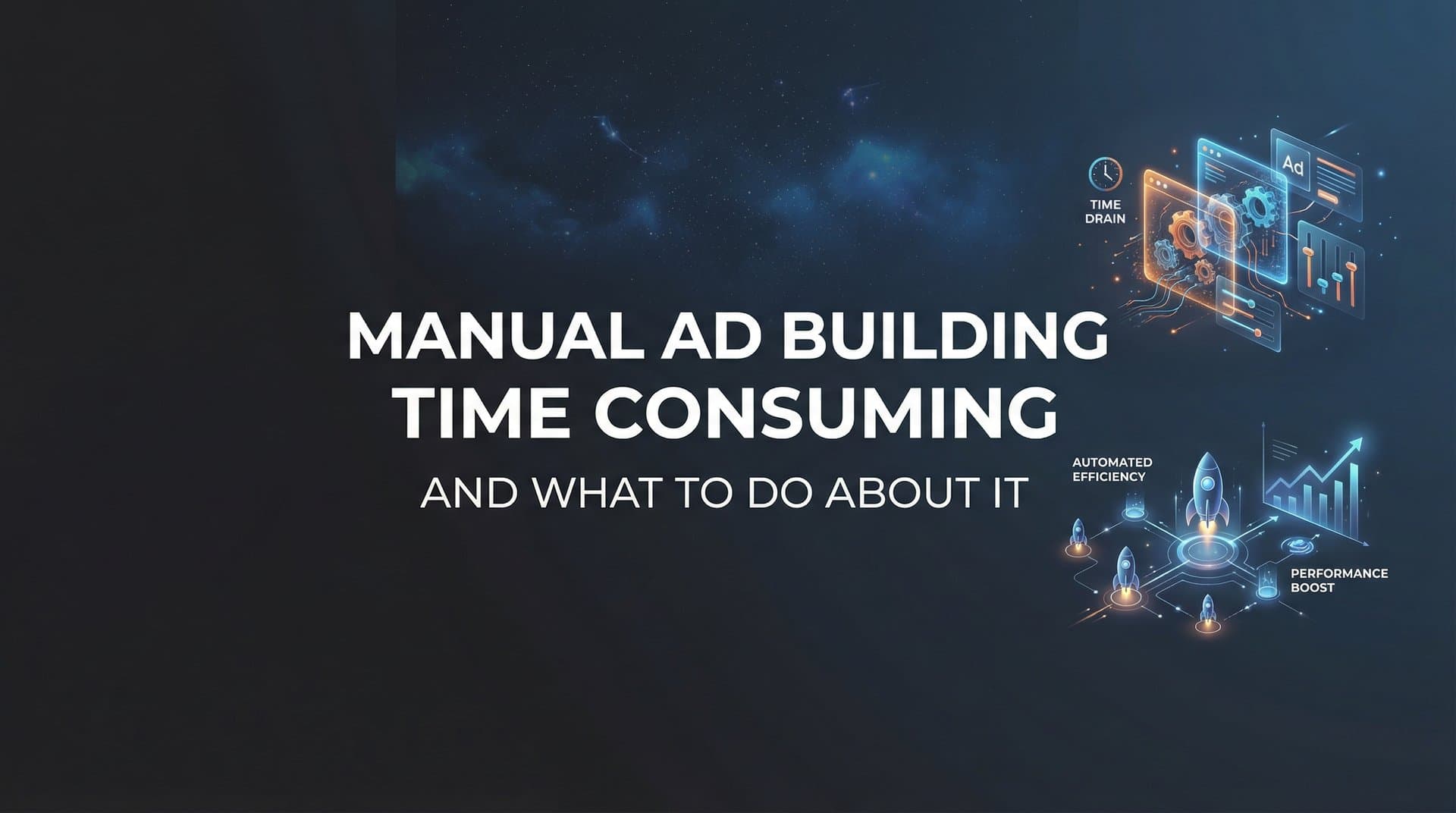
Manual ad building is fundamentally time consuming because the process itself hasn't evolved to match the complexity of modern advertising. What used to be "create an ad and launch it" has become "create dozens of variations, test multiple audiences, optimize across placements, and somehow keep track of what's working" while still using the same manual, one-at-a-time workflow.
The frustration you feel isn't unique. It's the natural consequence of trying to run sophisticated, data-driven campaigns using tools designed for a simpler era. This article breaks down exactly where your time disappears in the manual ad building process and explores how modern marketers are reclaiming those hours without sacrificing campaign quality or testing rigor.
The Creative Production Bottleneck That Stops You Before You Start
Before you can even think about campaign setup, you need ad creatives. And this is where the first major time drain hits.
If you're working with a designer, you're looking at a multi-day turnaround for each asset. Send the brief. Wait for the first draft. Request revisions. Wait again. Get the final version. Repeat for every variation you want to test. A single campaign requiring three image ads can easily consume a week before you've even opened Ads Manager.
Video content multiplies the problem. Finding a video editor, providing footage or direction, reviewing cuts, requesting changes, and getting final exports can stretch into weeks. Many marketers simply skip video testing altogether because the production timeline doesn't fit campaign deadlines.
Even if you're creating assets yourself, the time cost is brutal. Designing ads in Canva or Photoshop, sourcing stock images, writing copy variations, and formatting everything to Meta's specifications eats hours that could be spent on strategy or analysis. Understanding the full scope of manual Facebook ad building challenges helps explain why so many marketers feel stuck in this cycle.
Then there's the copy variation challenge. Best practices say you should test multiple headlines, different description lengths, and various calls-to-action. Writing these variations manually means context-switching between creative thinking and technical execution. You'll write a headline, then immediately need to check character limits, then write another variation, then wonder if you're differentiating enough between versions.
The asset formatting requirements add another layer. That single image ad you created? It needs to work in Feed, Stories, and Reels. Which means resizing, repositioning text elements, and ensuring visual hierarchy works in both portrait and square formats. Multiply this by every creative variation, and you're spending significant time on technical formatting rather than creative strategy.
What makes this bottleneck particularly painful is that it happens before you've launched anything. You're investing hours into assets that might not perform. There's no data yet, no validation, just time spent creating variations based on educated guesses about what might resonate with your audience.
Campaign Configuration: The Repetitive Setup That Never Ends
You've finally got your creatives ready. Now the real manual grind begins.
Building audiences in Meta Ads Manager is tedious work. You're clicking through multiple menus to define demographics, interests, and behaviors. Want to test a lookalike audience? That's a separate process: select your source, choose your percentage, pick your location, save it, name it. Need to test three different lookalike percentages? Triple the work.
Custom audiences require even more steps. Upload a customer list, wait for it to process, create exclusions, set up website traffic audiences based on specific page visits, and organize everything so you can actually find these audiences later. Many marketers end up with dozens of saved audiences with names like "Lookalike 1%" and "Website Visitors 2" that become impossible to distinguish without opening each one.
Then comes ad set configuration. For each variation you want to test, you're manually setting budgets, choosing optimization goals, selecting placements, setting schedules, and configuring delivery options. The reality is that time consuming ad campaign setup has become the norm rather than the exception for performance marketers.
The placement decision alone can consume surprising amounts of time. Do you let Meta automatically place ads, or do you manually select Feed, Stories, Reels, and right column? If you're testing placement performance, you need separate ad sets for each, multiplying your configuration work.
Budget allocation becomes a mental math exercise. You want to spend $500 total, split across five ad sets, but you want to weight two of them higher because the audiences are more valuable. Now you're calculating percentages, entering amounts, double-checking that everything adds up, and hoping you didn't make a typo that blows your budget on the wrong variation.
And let's talk about naming conventions. When you're managing multiple campaigns with multiple ad sets and multiple ads, clear naming becomes critical. But creating a systematic naming structure and actually applying it consistently while you're clicking through setup screens is exhausting. You end up with campaigns named "Test 3 Final" and "New Campaign Copy 2" that make no sense two weeks later when you're trying to analyze results.
The Mathematics of Testing That Makes Manual Building Impossible
Here's where manual ad building hits a mathematical wall that no amount of efficiency can overcome.
Proper testing requires combinations. You want to test three different creatives to see which visual approach resonates. You want to test three headline variations to find the most compelling message. You want to test three audience segments to identify your best customers. That's not nine ads. That's 27 unique combinations.
Each of those 27 ads needs to be manually created in Ads Manager. Select the campaign. Create a new ad. Choose your creative. Enter your headline. Write your description. Set your call-to-action. Preview it. Save it. Repeat 26 more times.
The physical act of clicking through this process for 27 ads takes hours. And that's just for one campaign. If you're managing multiple products or running campaigns for multiple clients, you're looking at hundreds of individual ads that need manual creation. This is precisely why Facebook ad testing becomes too time consuming for most teams to execute properly.
This is why most marketers don't actually test at the scale they should. The manual effort required makes comprehensive testing impractical. Instead of testing every combination that could yield insights, you test a handful of variations and hope you're making the right choices about which elements to combine.
The opportunity cost is massive. There are campaigns you'd like to run but don't because the setup time isn't justified by the potential return. There are audiences you'd like to test but skip because you can't face building another set of ad variations. There are creative concepts that never get validated because producing and launching them manually would consume your entire week.
Think about what you're not testing because the manual process is too time consuming. That's where the real cost lives, not in the hours you spend building ads, but in the winning combinations you never discover because testing them manually isn't feasible.
The Never-Ending Analysis and Optimization Cycle
Your campaigns are finally live. Now you need to figure out what's working.
Meta Ads Manager gives you data, but it doesn't give you answers. You're looking at tables of numbers across multiple campaigns, ad sets, and individual ads. To understand performance, you're exporting data to spreadsheets, creating pivot tables, calculating ROAS manually, and trying to identify patterns across dozens of variables.
Which creative performed best? You need to aggregate results across all the ad sets where that creative appeared. Which headline drove the lowest cost per acquisition? You're filtering, sorting, and comparing numbers that aren't automatically compiled anywhere.
Attribution adds another layer of complexity. Your Meta data shows one story, but your analytics platform shows another. Reconciling these sources means more spreadsheets, more manual calculation, and more time spent on analysis instead of action. The Facebook ad management time drain extends far beyond initial setup into ongoing optimization work.
Identifying your actual winners requires looking beyond surface metrics. An ad with a high click-through rate might have terrible conversion performance. An audience with a low cost per click might deliver high-value customers with strong lifetime value. Evaluating all these dimensions manually means you're constantly switching between different reports and mentally tracking which combinations actually matter for your business goals.
Then comes the optimization phase, which often means starting over. You've identified that Creative A works better than Creative B, and Audience 1 outperforms Audience 2. Great. Now you need to build a new campaign that combines these winners. Which means going back into Ads Manager and manually recreating everything you just learned, one ad at a time.
There's no "winners library" where you can quickly grab your best-performing creatives, headlines, and audiences and instantly recombine them. You're rebuilding from scratch, hoping you remember all the specific settings and configurations that made the original ads successful.
This iteration loop never ends. Every insight requires manual implementation. Every optimization means more hours in Ads Manager clicking through the same setup process. The time spent analyzing and acting on data often exceeds the time spent on initial campaign creation.
How Modern Ad Platforms Eliminate the Manual Grind
The fundamental shift happening in advertising technology is moving from manual, sequential workflows to automated, parallel processes. Instead of spending hours on execution, modern platforms handle the repetitive work and let you focus on strategy.
AI creative generation addresses the first major bottleneck. Platforms like AdStellar can generate scroll-stopping image ads, video ads, and UGC-style avatar content directly from a product URL. No designer wait times, no video editor dependencies, no manual asset creation. You can produce dozens of creative variations in minutes instead of waiting days or weeks for production.
The creative generation isn't just about speed. It's about enabling testing that was previously impractical. When you can generate 20 different visual approaches in the time it used to take to create one, you can actually test comprehensively instead of making educated guesses about what might work. The comparison between AI vs manual Facebook ad creation reveals just how significant this efficiency gap has become.
Bulk launching capabilities solve the combination problem. Instead of manually creating 27 individual ads to test three creatives, three headlines, and three audiences, you select your elements and the platform generates every combination automatically. What used to take hours of clicking through Ads Manager now happens in minutes.
This isn't just efficiency. It's a fundamental change in what's possible. You can test at a scale that reveals insights manual building would never uncover. You can launch comprehensive campaigns that explore the full possibility space instead of limiting yourself to what's manually feasible.
AI campaign building takes this further by analyzing your historical performance data to make intelligent decisions about what to test. Instead of starting from scratch with every campaign, the AI identifies which creatives, headlines, audiences, and copy performed well in the past and prioritizes those elements in new campaigns.
The transparency matters here. You're not blindly trusting an algorithm. The AI explains its reasoning for every decision, showing you which historical data informed each choice. You maintain strategic control while eliminating the manual execution work.
Automated performance analysis replaces the spreadsheet nightmare. Leaderboards automatically rank your creatives, headlines, audiences, and landing pages by the metrics that matter to your business. Want to see which creatives drive the lowest CPA? It's instantly visible. Need to identify which audiences deliver the best ROAS? The platform scores everything against your goals automatically.
Winners libraries solve the iteration problem. Your best-performing elements are automatically organized in one place with real performance data attached. When you're building your next campaign, you can instantly select proven winners instead of trying to remember what worked three campaigns ago.
Building a Practical Transition Strategy
Moving from manual ad building to automated workflows doesn't happen overnight, and it shouldn't. The goal is to systematically eliminate time drains while maintaining campaign quality.
Start by auditing where your time actually goes. For one week, track how many hours you spend on creative production, campaign setup, testing implementation, and performance analysis. You'll likely find that 70% or more of your time goes to execution rather than strategy. Those execution hours are your automation opportunity.
Prioritize based on pain points, not a predetermined sequence. If creative production is your biggest bottleneck, start there. If you're drowning in manual campaign configuration, tackle that first. The highest-impact automation is whichever eliminates your most time-consuming task. Learning how to reduce time spent on ad campaigns starts with identifying your specific workflow inefficiencies.
For most marketers, creative generation and bulk launching deliver the fastest time savings. Being able to produce ad variations in minutes instead of days and launch comprehensive tests in one session instead of hours of manual work reclaims significant weekly hours almost immediately.
Build your winners library as you transition. Even if you're still running some campaigns manually, start documenting what performs well. Create a system for tracking your best creatives, most effective headlines, and highest-converting audiences. This repository becomes increasingly valuable as you move toward automated workflows that can intelligently reuse proven elements.
Don't try to automate everything at once. Run parallel workflows where some campaigns use new automated tools while others follow your established manual process. This lets you validate that automation delivers comparable or better results before fully committing. Exploring Facebook automation vs manual campaigns side by side gives you concrete data to inform your transition decisions.
The transition isn't about replacing your expertise with software. It's about redirecting your expertise from execution to strategy. The hours you save on manual ad building can go toward deeper audience research, more sophisticated testing strategies, creative concepting, and business-level campaign planning.
Moving Beyond the Manual Bottleneck
Manual ad building being time consuming isn't an inevitable reality of performance marketing. It's a workflow problem that modern technology has solved.
The hours you currently spend clicking through campaign setup, waiting for creative production, manually launching test variations, and compiling performance data in spreadsheets represent time that could be spent on strategic work that actually moves your business forward. The question isn't whether automation can handle execution tasks. It's whether you're ready to reclaim those hours.
The marketers seeing the biggest impact aren't necessarily the ones with the largest budgets or the most sophisticated strategies. They're the ones who recognized that manual workflows limit what's possible and made the shift to platforms that handle execution automatically while keeping them in strategic control.
When creative generation takes minutes instead of days, when comprehensive testing launches in one session instead of requiring hours of manual work, and when performance insights surface automatically instead of demanding spreadsheet analysis, you're not just saving time. You're unlocking campaign sophistication that manual processes make impractical.
The difference between managing five campaign variations because that's all you can manually handle and testing 50 combinations because your platform generates them automatically isn't just efficiency. It's the difference between guessing what might work and systematically discovering what actually performs.
Ready to transform how you build and manage ad campaigns? Start Free Trial With AdStellar and experience an AI-powered platform that generates creatives, builds campaigns from historical data, and launches comprehensive tests in the time it currently takes you to set up a single ad set. No more manual bottlenecks. No more execution limiting your strategy. Just intelligent automation that handles the grind so you can focus on the work that actually matters.