Picture this: You've blocked off your entire Tuesday morning for campaign launches. Coffee's hot, inbox is closed, and you're ready to crush it. Three hours later, you're still in Ads Manager, toggling between audience builder tabs, copying and pasting ad copy variations into a spreadsheet, and second-guessing your placement selections. You've built exactly one campaign. You have four more to go.
If this scenario feels painfully familiar, you're not alone. Time consuming ad campaign setup has become the silent productivity killer for digital marketers everywhere. While the promise of Meta advertising is reaching millions of targeted users, the reality is that getting campaigns live often feels like assembling furniture without instructions—tedious, frustrating, and far more complicated than it should be.
The worst part? All those hours spent clicking through settings and duplicating ad sets aren't making your campaigns perform better. They're just keeping you from the strategic work that actually moves the needle: analyzing results, developing creative concepts, and optimizing based on real performance data.
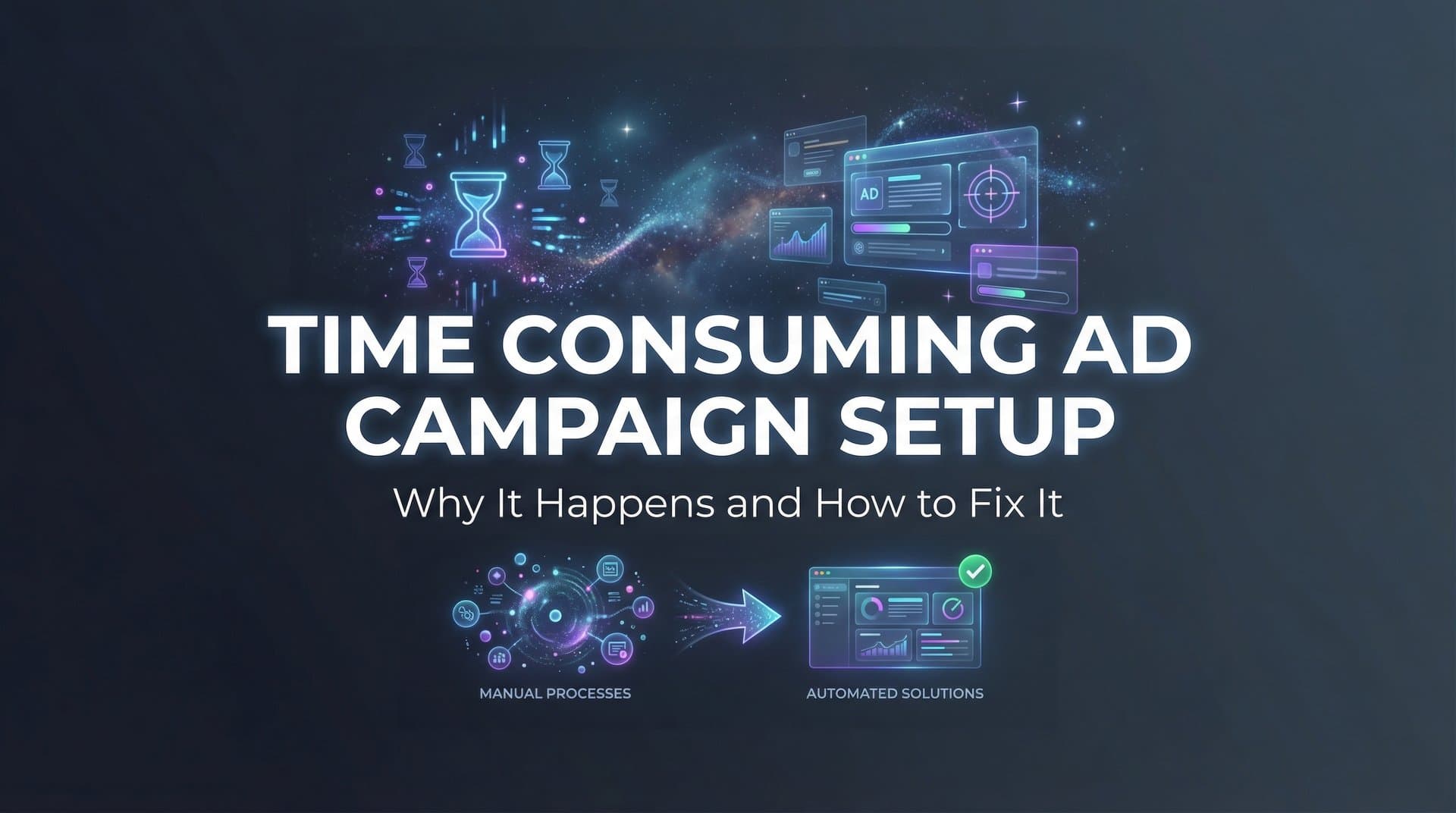
This article breaks down exactly why campaign setup devours so much time and, more importantly, how to fix it. We'll explore the hidden time drains lurking in every campaign build, calculate what slow launches are really costing you, and reveal practical solutions that can transform your workflow from hours to minutes.
The Hidden Time Drains in Meta Campaign Setup
When you think about campaign setup time, you probably picture the obvious tasks: uploading creatives, writing copy, setting budgets. But the real time killers are the invisible preparation steps that happen before you even open Ads Manager.
Audience Research and Segmentation: Building a single custom audience sounds simple until you're actually doing it. You need to pull customer lists from your CRM, upload them to Meta, wait for matching, then create lookalikes at different percentage levels. Want to exclude past converters? That's another audience build. Testing geographic variations? More audiences. A campaign targeting three customer segments with exclusions can easily require building eight to ten separate audiences before you write a single word of copy.
The audience builder interface doesn't help. Each audience requires navigating through multiple screens, setting parameters, naming conventions that make sense three months from now, and waiting for Meta to process and estimate reach. If you discover you've made a mistake—say, selected the wrong source audience for a lookalike—you're starting over from scratch. Understanding why Meta campaign setup feels too complex is the first step toward finding solutions.
Creative Asset Preparation: Meta's placement diversity is powerful for reach but brutal for asset management. That single product photo? It needs to be 1080x1080 for feed, 1080x1920 for Stories, 1200x628 for right column, and ideally variations of each to test different crops and focal points. Videos need to work both with and without sound, respect safe zones for different placements, and stay under file size limits.
Then comes the organizational nightmare. You need a naming system that lets you identify "Product_A_Lifestyle_Square_v2" from "Product_A_Lifestyle_Square_v3" six weeks from now when you're analyzing which creative drove conversions. Without a systematic approach, your Media Library becomes a graveyard of files with names like "final_FINAL_use_this_one_v4.jpg".
Copy Variation Development: Professional testing requires multiple variations of every text element. You're not just writing one headline—you're writing five to seven options that emphasize different benefits, emotional triggers, and value propositions. Each needs a corresponding primary text block and CTA combination that maintains message consistency. Many marketers find that Facebook ad copywriting becomes time consuming when they're managing dozens of variations across multiple campaigns.
This multiplies fast. Three headline variations, three primary text options, and two CTAs create 18 unique combinations. Want to test those across three different audiences? You're managing 54 distinct ad variations. Even using dynamic creative, you still need to write and organize all those options, ensure they work together coherently, and track which combinations are actually being tested.
Why Manual Processes Multiply Your Setup Hours
Here's where it gets interesting: the time drain isn't just about individual tasks taking long. It's about how those tasks compound and cascade into exponentially more work.
The Compounding Effect: Every decision you make during setup creates downstream consequences that require more decisions. Choose to test three ad sets? Now you need to decide budget allocation across all three. Testing multiple placements? Each placement might need creative adjustments. Want to run the same campaign across different regions? You're duplicating everything and adjusting for time zones, currencies, and local holidays.
This branching complexity means a "simple" campaign can explode into dozens of configuration choices. And unlike decisions you can automate with rules, these require human judgment about strategy, brand voice, and market positioning. You can't just batch process your way through them.
Context Switching Costs: Campaign setup isn't a linear process—it's a chaotic dance between multiple tools and platforms. You start in Ads Manager, jump to Canva to adjust an image dimension, switch to your analytics platform to pull conversion data for audience building, open a Google Doc to finalize copy with your team, check email for creative approvals, return to Ads Manager, realize you need to verify pixel implementation, and open Chrome DevTools to inspect your website.
Research consistently shows that context switching destroys productivity. Every time you shift tools, you lose momentum and cognitive load. What should take two minutes—uploading a creative—turns into ten because you had to re-orient yourself after checking email. Multiply this across every element of campaign setup, and you've added hours to your process without accomplishing anything meaningful. If you're constantly wasting time on Facebook ad setup, context switching is likely a major culprit.
Quality Control Bottlenecks: The fear of launching a broken campaign creates its own time sink. You triple-check audience exclusions to avoid wasting budget on existing customers. You verify pixel tracking is firing correctly. You preview ads across every possible placement to ensure nothing looks broken. You confirm budget pacing won't blow through your monthly allocation in three days.
These quality checks are necessary—a targeting mistake can waste thousands of dollars—but they add significant time. And if you're managing campaigns for clients or need stakeholder approval, add another layer of review cycles, feedback rounds, and revision requests. What started as a one-hour setup becomes a multi-day project waiting for sign-offs.
Calculating the True Cost of Slow Campaign Launches
Time consuming ad campaign setup isn't just annoying—it's actively costing you money and competitive advantage in ways that don't show up in your Ads Manager dashboard.
Opportunity Cost: Every hour your campaign sits in draft status is an hour your competitors are capturing market attention. This matters especially for time-sensitive opportunities: product launches, seasonal promotions, trending topics, or competitive responses. If it takes you three days to get a Black Friday campaign live while your competitor launches in hours, they've already captured early shopper attention and built momentum.
The opportunity cost extends beyond individual campaigns. Slow setup means you launch fewer tests, which means you learn slower about what works. Your competitor running three campaign variations to your one isn't just spending more—they're gathering three times the performance data to inform future decisions. Over months, this compounds into a significant strategic disadvantage.
Team Bandwidth Drain: Here's a question worth asking: What's the hourly cost of your marketing team? If a senior media buyer earning a competitive salary spends 15 hours per week on campaign setup instead of strategic optimization, you're paying premium rates for administrative work.
This bandwidth drain has ripple effects across your marketing operation. Strategy sessions get postponed because everyone's buried in campaign builds. Creative development slows because designers are resizing assets instead of concepting new approaches. Performance analysis gets rushed because there's no time left after setup marathons. You're not just losing the hours spent on setup—you're losing the higher-value work that doesn't happen because those hours are gone. Learning how to reduce time spent on ad campaigns directly impacts your team's capacity for strategic work.
Testing Velocity Impact: Meta's algorithm learns from data. The faster you can test hypotheses and feed the algorithm performance signals, the faster it optimizes delivery. Slow campaign launches create a vicious cycle: you test less, gather data slower, and make optimization decisions based on limited information.
Consider two advertisers with identical budgets. Advertiser A's efficient setup process allows them to launch and test five campaign variations per month. Advertiser B's slow process limits them to two. After three months, Advertiser A has gathered data from 15 different approaches while Advertiser B has only tested six. Who do you think has better-optimized campaigns and lower cost per acquisition? The speed advantage compounds over time into a performance advantage that's difficult to overcome.
Streamlining Your Campaign Setup Workflow
The good news? You don't have to accept time consuming ad campaign setup as an inevitable reality. Smart workflow improvements can dramatically reduce setup time even before you consider automation tools.
Template Systems: Stop building every campaign from scratch. Create reusable campaign templates for your most common objectives—lead generation, conversion optimization, awareness building, retargeting. These templates should include pre-configured settings for placements, optimization goals, bid strategies, and naming conventions that work for your reporting needs. Leveraging Meta ads campaign templates can cut your setup time dramatically while maintaining consistency across campaigns.
The key is building templates at the right level of specificity. Too generic and you still need extensive customization. Too specific and you need dozens of templates. Start with templates for objective-based frameworks, then customize for specific products or audiences. Many advertisers find that three to five well-designed templates cover 80% of their campaign needs.
Asset Libraries: Organize your creative assets and copy variations in a centralized, searchable repository before you need them. This means more than just storing files—it means tagging them with metadata that makes retrieval instant. Tag creatives by product, message angle, format, performance tier, and seasonal relevance.
Build a similar system for copy. Maintain a swipe file of proven headlines, value propositions, and CTAs organized by product category and campaign objective. When you need to build a new campaign, you're pulling from a library of tested elements rather than staring at a blank screen wondering what to write. This doesn't mean recycling the same content endlessly—it means having strong starting points that reduce creation time from hours to minutes.
Batch Processing: Group similar tasks together to minimize context switching. Instead of building one complete campaign at a time, batch your work by task type. Spend one focused session creating all the audiences you'll need for the week. Another session preparing and organizing all creative assets. Another writing all copy variations. For high-volume advertisers, exploring Facebook ads bulk campaign creation can transform how you approach large-scale launches.
This approach leverages what psychologists call "task momentum." When you're in "audience building mode," you develop a rhythm and efficiency that would be lost if you kept switching to other tasks. You also reduce the mental overhead of constantly shifting between different types of work. The result is faster execution and fewer errors from distraction.
How AI Automation Eliminates Setup Bottlenecks
Workflow improvements help, but they still require human effort for every campaign. This is where AI-powered automation transforms the game entirely by eliminating repetitive decisions and execution tasks.
Intelligent Audience Selection: Advanced AI systems can analyze your historical campaign performance to identify which audience segments, lookalike percentages, and targeting parameters have driven the best results. Instead of manually building and testing audience variations, AI recommends or automatically selects targeting based on what's actually worked for your account.
This goes beyond simple rules-based automation. AI can identify patterns humans miss—like discovering that 3% lookalikes of your purchasers perform better than 1% lookalikes for a specific product category, or that excluding certain interest combinations improves efficiency. The system learns continuously, refining audience recommendations as it gathers more performance data.
Automated Creative Curation: Rather than manually sorting through hundreds of creative assets to decide which to test, AI can analyze historical performance to identify your winning creative patterns. It recognizes which image styles, video formats, and visual elements have driven engagement and conversions, then automatically pulls those proven elements for new campaigns.
The sophistication here matters. Basic automation might just select your highest-performing creative. Advanced AI understands context—it knows that a creative that worked brilliantly for awareness might not be optimal for conversion campaigns, or that seasonal variations matter. It can match creative style to campaign objective and audience segment automatically. Exploring AI ad campaign automation reveals how machine learning is reshaping what's possible in digital advertising.
One-Click Campaign Generation: This is where everything comes together. Platforms like AdStellar AI use specialized AI agents to handle every aspect of campaign creation—analyzing your landing page, selecting optimal campaign structure, choosing targeting parameters, curating creative assets, writing copy variations, and allocating budgets—all in under 60 seconds.
The transformation is dramatic. What previously required hours of manual work across multiple tools becomes a single action. You provide the campaign objective and landing page, and AI handles the execution based on your account's historical performance data. The system shows its reasoning for each decision, so you maintain strategic control while eliminating execution busywork. Comprehensive Meta ads campaign automation software makes this level of efficiency accessible to teams of any size.
Even more powerful: these systems create a continuous improvement loop. Every campaign launched feeds more data back into the AI, making future recommendations smarter. Your setup doesn't just get faster—it gets better over time as the AI learns what works specifically for your business, audience, and creative style.
Your Path to Faster Launches
Knowing what's possible is different from knowing where to start. Here's how to prioritize improvements that deliver the biggest time savings fastest.
Start With Your Biggest Time Sink: Track where your setup hours actually go for two weeks. You might discover that audience building consumes 40% of your time, or that creative resizing is the real bottleneck. Focus your first optimization efforts on whatever task is eating the most hours. If audience management is your pain point, invest in building a robust audience library and consider tools that automate audience creation. If creative prep is the issue, develop templates and batch your asset production.
This focused approach delivers visible results quickly, which builds momentum for tackling other inefficiencies. Trying to optimize everything simultaneously usually means making minimal progress on multiple fronts instead of solving one problem completely. A detailed guide on how to reduce Facebook ad setup time can help you identify and address your specific bottlenecks.
Build a Continuous Improvement Loop: Set a baseline metric for campaign setup time—how long does it currently take to launch a standard campaign from concept to live? Track this weekly. As you implement workflow improvements or automation tools, measure the impact. If a change doesn't reduce setup time or improve campaign performance, abandon it and try something else.
The goal isn't perfection—it's progress. Reducing average setup time from four hours to three hours is a 25% improvement that compounds significantly over months. Keep iterating, keep measuring, and keep asking "what's the next bottleneck to eliminate?"
Shift Focus From Execution to Strategy: The ultimate goal of streamlining setup isn't just saving time—it's redirecting that time toward higher-value work. As setup becomes faster, you gain bandwidth for deeper performance analysis, creative strategy development, and market research. You can test more hypotheses, launch campaigns faster in response to market changes, and spend more time understanding your audience.
This strategic shift is where the real competitive advantage emerges. Your competitors still spending 20 hours per week on campaign setup can't match the testing velocity and strategic depth you achieve when setup takes a fraction of that time. You're playing a different game entirely.
The Setup Revolution Is Here
Time consuming ad campaign setup isn't an inevitable cost of doing business—it's a solvable problem that's holding back your marketing performance. The culprits are clear: manual audience building that multiplies with every segment, creative preparation across endless placement variations, copy development for comprehensive testing, and quality control processes that add friction to every launch.
But the solutions are equally clear. Workflow improvements like template systems, organized asset libraries, and batch processing can immediately reduce setup time. AI-powered automation takes this further by eliminating repetitive decisions entirely—analyzing historical data to select audiences, curate creative, and build complete campaigns in seconds rather than hours.
The marketers winning in this landscape aren't necessarily those with bigger budgets. They're the ones who've solved the setup problem and redirected those saved hours toward strategic advantages: faster testing, deeper optimization, and more creative experimentation. They launch campaigns while competitors are still building audiences. They test five variations while others are manually configuring one.
The question isn't whether to streamline your setup process—it's how quickly you can make it happen. Every week you spend in the old manual workflow is a week of competitive disadvantage that's difficult to recover.
Ready to transform your advertising strategy? Start Free Trial With AdStellar AI and be among the first to launch and scale your ad campaigns 10× faster with our intelligent platform that automatically builds and tests winning ads based on real performance data.