Most advertisers think scaling Meta ads is a budget problem. Pour in more money, get more results. But if you have ever doubled your spend only to watch your ROAS drop, you already know the real issue is creative volume, not dollars.
The Meta algorithm needs variety to do its job. It needs different hooks, different formats, and different messages to find the right combination for the right audience. When your creative library is thin, the algorithm runs out of options fast, delivery stalls, and you end up paying more for the same tired results.
The bottleneck most advertisers hit is not strategy. It is production. Designers get overwhelmed. Video shoots take weeks to schedule. By the time a new batch of ads is ready, the previous ones have already fatigued. The cycle repeats, budgets drain, and campaigns stall.
Producing Meta ad creative at scale does not require a full creative department or a massive production budget. It requires a repeatable system. One that moves from brief to live campaign quickly, tests multiple formats and angles simultaneously, and continuously feeds winning elements back into the next round.
This guide walks you through exactly that system. Six steps that take you from building a creative foundation to launching hundreds of ad variations and identifying your top performers, without burning out your team in the process. Whether you are a solo performance marketer, an agency juggling multiple client accounts, or an in-house team running Facebook and Instagram campaigns, this process is built to work at your scale.
Let's get into it.
Step 1: Build Your Creative Brief Before You Touch Any Tool
Before you generate a single ad, you need a brief. This is the step most people skip, and it is the reason they end up with twenty ad variations that all say the same thing in slightly different fonts.
A creative brief does not have to be a formal document. It just needs to answer a few critical questions that will shape every creative decision that follows.
Define your core offer and campaign goal. Are you driving purchases, leads, app installs, or awareness? Your goal determines your creative format, your call to action, and how you measure success. Be specific. "Drive purchases of Product X at a CPA under $40" is a useful goal. "Get more sales" is not.
Map out your audience segments. Who are you talking to, and what do they care about? A first-time buyer needs different messaging than a returning customer. A cold audience needs education. A warm retargeting audience needs urgency. Identify two or three distinct segments before you start creating.
List your key messages and value propositions. What are the three to five things your product does that genuinely matter to your audience? Think about the problem it solves, the outcome it delivers, and the reason someone should choose you over an alternative. These become the raw material for your ad copy and hooks.
Choose your creative angles. This is where most briefs fall short. Creative angles are the conceptual frames you use to communicate your message. Common ones include problem-solution, social proof, product demo, lifestyle fit, and before-and-after transformation. Each angle speaks to a different part of the buyer's psychology, which is why you need more than one.
Identify the ad formats you need. Static image, video, and UGC-style content each serve different purposes and perform differently across placements. Decide upfront whether you are producing a mix or leading with one format, and plan your creative volume accordingly.
A practical target: aim for at least three distinct creative angles per campaign. Not three variations of the same angle with different background colors. Three genuinely different ideas that approach your offer from different directions. This is what real creative testing looks like, and it is what gives you meaningful data to act on.
With a brief in hand, every subsequent step moves faster because you are not making creative decisions on the fly. You are executing a plan.
Step 2: Generate Multiple Ad Formats with AI
Once your brief is locked, it is time to produce creative at volume. This is where AI changes the game entirely.
Traditionally, producing image ads, video ads, and UGC-style content meant three separate workflows: a designer for static ads, a video editor for motion content, and either a talent shoot or a UGC creator network for authentic-feeling video. Each format had its own timeline, its own cost, and its own bottleneck.
With AI creative tools, all three formats come from a single workflow. The starting point is usually your product URL. From there, AI can pull product details, visuals, and copy automatically and generate ad creatives across formats without requiring you to upload assets or brief a creative team.
Start with your product URL. Let the AI extract the core product information, imagery, and key selling points. This removes the manual setup work and gets you to creative output faster. It also ensures your ads are grounded in accurate product details from the start.
Generate across all three formats in one pass. Do not treat image ads, video ads, and UGC-style creatives as separate projects. Generate all three in the same session so you have format variety built into your creative set from the beginning. Different formats perform differently across placements and audiences, and you will not know which one wins until you test them.
Use chat-based editing to refine without starting over. One of the most practical advantages of AI creative tools is the ability to iterate through conversation. Instead of going back to a designer with a list of revision notes, you can refine an ad directly by describing what you want to change. Adjust the headline, swap the hook, change the tone, or test a different call to action without rebuilding the entire creative.
Clone competitor ads to learn from what is already working. The Meta Ad Library is a publicly available resource that shows you what ads are running in your niche. Rather than guessing at formats and angles, you can analyze what competitors are using and build on proven structures. This is not about copying. It is about understanding what resonates in your market and applying those insights to your own creative.
Aim to produce a minimum of ten to fifteen unique creatives per campaign before moving to launch. The key word is unique. Vary the format, the hook, the message, and the visual approach across your creative set. Generating twenty versions of the same image with different button colors is not testing. It is noise.
AdStellar's AI Creative Hub lets you generate image ads, video ads, and UGC-style avatar creatives from a single product URL, clone competitor ads directly from the Meta Ad Library, and refine any ad through chat-based editing. No designers, no video editors, no actors required. The entire creative production workflow lives in one place.
Step 3: Build Your Campaign Structure Around Testing
Having great creative is only half the equation. How you structure your campaign determines whether you actually learn anything from the test.
A poorly structured campaign can make a winning creative look like a loser, or hide a losing audience behind a strong creative. Structure is how you isolate variables so your data tells you something useful.
Organize creatives into logical ad sets. Group your ads by audience segment, creative angle, or format type depending on what you are trying to learn. If you want to know which audience converts best, keep the creative consistent across ad sets and vary the audience. If you want to know which creative angle wins, keep the audience consistent and vary the creative. Mixing variables in the same ad set makes it impossible to draw clean conclusions.
Let AI analyze your historical data before you build. If you have run Meta campaigns before, that data is a goldmine. Which creatives drove the lowest CPA? Which headlines generated the highest CTR? Which audiences converted at the best ROAS? AI can surface these patterns quickly and use them to inform your new campaign structure rather than starting from zero every time.
Use AI to build the full campaign structure. Assembling audiences, writing headlines, and matching copy to creative manually is time-consuming and prone to error. AI can handle this assembly work, building complete campaign structures including ad sets, audiences, headlines, and copy combinations based on what has performed historically. The important thing is that every decision comes with a rationale. You should understand why the AI made each structural choice, not just accept the output blindly.
If you are starting without historical data, structure for fast learning. Run a broad audience with varied creative angles in your first campaign. The goal is not necessarily to hit your target CPA on day one. It is to collect enough signal quickly so that your next campaign has real data to build on. Think of the first campaign as your data collection phase.
AdStellar's AI Campaign Builder analyzes your past performance data and builds complete Meta Ad campaigns in minutes. Every decision comes with full transparency into the reasoning behind it, so you understand the strategy, not just the output. And because the AI learns from each campaign you run, the recommendations get sharper over time.
A well-structured campaign does not just improve your results. It also makes the analysis phase much easier, which is critical when you are running at scale.
Step 4: Launch Hundreds of Ad Variations in Minutes with Bulk Creation
Here is where scale actually happens. You have your creatives, your campaign structure, and your audience segments. Now it is time to combine them and launch at volume.
The traditional approach to this is painful. You manually create each ad combination one by one, uploading creatives, writing copy, selecting audiences, and repeating the process dozens of times. For a campaign with ten creatives, five headlines, and three audiences, that is 150 individual ad combinations to build by hand. It takes hours and introduces plenty of room for error.
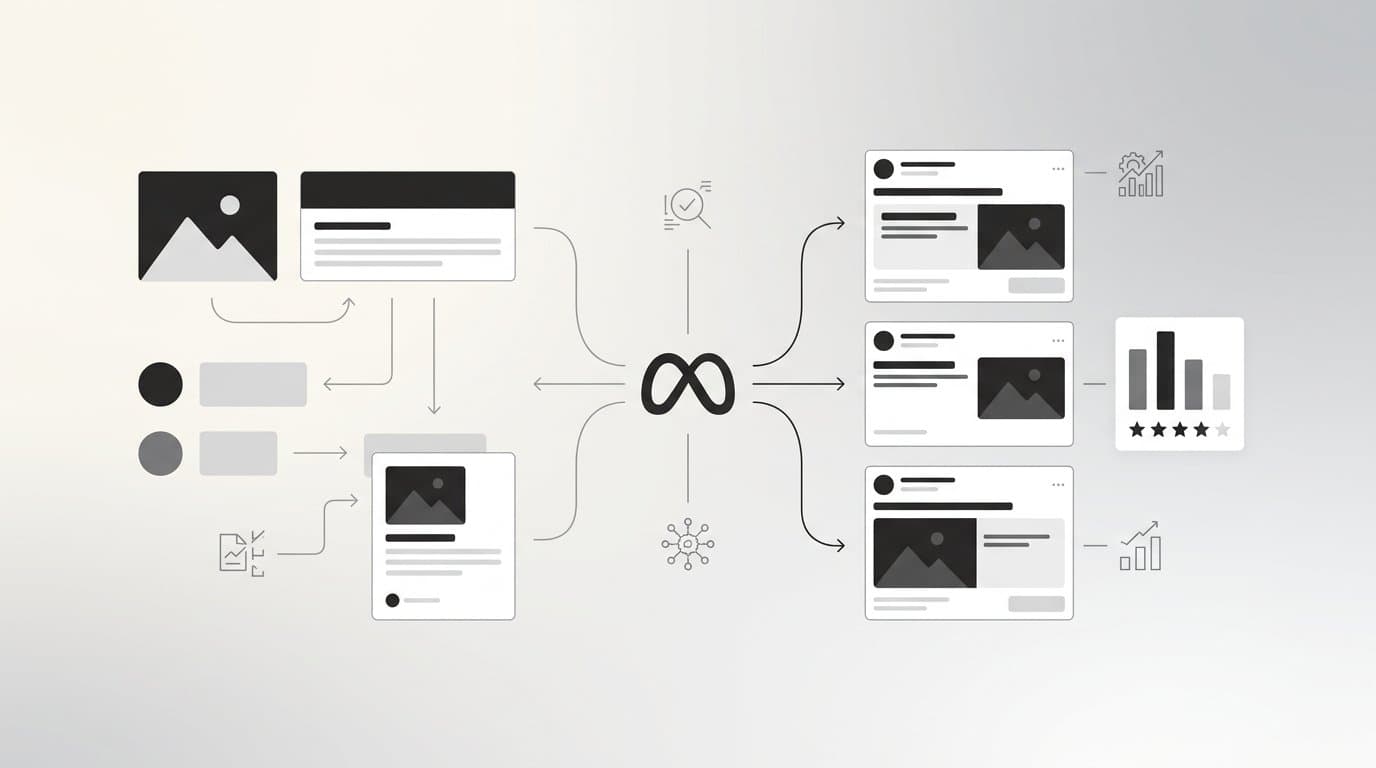
Bulk creation flips this entirely. Instead of building combinations manually, you feed in your creative assets, headlines, copy variants, and audience selections, and let the system generate every possible combination automatically. Then you push them all live in one action.
Mix variables at both the ad set and ad level. Effective bulk testing means varying elements at multiple levels of your campaign. At the ad set level, you vary audiences and placements. At the ad level, you vary creatives, headlines, and copy. When you combine these across your full creative set, the number of unique variations scales quickly, giving the Meta algorithm a rich set of signals to work with from the start.
More variations give the algorithm more to optimize. Meta's delivery system learns which ad is most likely to achieve your objective for each user it encounters. The more creative variations you give it, the more options it has to match the right ad to the right person. A thin creative set forces the algorithm to over-serve the same ads, which accelerates ad creative fatigue and drives up costs.
Set naming conventions before you launch. When you are running hundreds of ad variations, organization matters. Establish a consistent naming convention for your campaigns, ad sets, and ads before you hit publish. Something like [Campaign Goal] - [Audience] - [Creative Angle] - [Format] gives you enough information to understand what each variation is testing without having to open every ad individually. This becomes critical when you move into the analysis phase.
Match your budget to your variation volume. This is a common pitfall. Launching two hundred ad variations with a $50 daily budget means each variation gets almost no spend, and you will not collect enough data to make meaningful decisions. As a general principle, make sure your daily budget can support enough impressions across your active variations to generate statistically useful signals. If budget is limited, reduce the number of active variations rather than spreading spend too thin.
AdStellar's Bulk Ad Launch feature generates every combination of your creatives, headlines, audiences, and copy and launches them to Meta in minutes. What used to take a full day of manual setup now takes clicks.
Step 5: Use AI Insights to Spot Winners Fast
Launching at volume is only valuable if you can make sense of what comes back. With hundreds of ad variations running simultaneously, the data can feel overwhelming. This is where AI-powered insights shift from a nice-to-have to a necessity.
The goal of this step is not to review every ad individually. It is to quickly identify which elements are driving performance and which ones are wasting budget, so you can act on that information fast.
Set your performance goals before you review results. Before you start analyzing, define what success looks like. Is it a target ROAS? A maximum CPA? A minimum CTR threshold? Having clear benchmarks lets AI score every element against your goals rather than just showing you raw numbers. An ad with a 2% CTR might be a winner in one context and a loser in another depending on what you are optimizing for.
Use leaderboards to rank at the element level. Campaign-level reporting tells you whether a campaign is profitable. Element-level reporting tells you why. Look at how individual creatives, headlines, copy variants, audiences, and landing pages rank against each other on the metrics that matter to your goal. This granularity is what lets you make smart decisions about what to scale, what to pause, and what to iterate on.
Look for patterns in your top performers. Which creative format is winning most consistently: image, video, or UGC? Which creative angle is driving the lowest CPA: problem-solution, social proof, or product demo? Which audience segment is converting at the best ROAS? These patterns are more valuable than any individual ad result because they inform how you build your next campaign.
Pause underperformers quickly. One of the biggest advantages of running at scale is the ability to cut losing ads fast before they drain significant budget. Set a clear threshold for when you will pause an ad, whether that is after a certain number of impressions without a conversion or after spend exceeds a multiple of your target CPA without hitting it. Discipline here protects your budget and keeps your data clean.
AdStellar's AI Insights feature ranks your creatives, headlines, copy, audiences, and landing pages using real metrics like ROAS, CPA, and CTR. Set your target goals and the AI scores everything against your benchmarks automatically, so you can spot winners and cut losers without building custom spreadsheets or digging through Ads Manager reports.
Step 6: Save Winners and Feed Them Back Into Your Next Campaign
This is the step that separates teams who scale sustainably from teams who stay stuck in a constant creative production loop. Most advertisers treat each campaign as a standalone effort: build, launch, analyze, and then start from scratch again. That approach leaves a lot of value on the table.
Your top-performing creatives, headlines, audiences, and copy are not just campaign results. They are assets. And when you treat them that way, every campaign you run makes the next one better.
Archive winners with their performance data attached. A creative without context is just a file. A creative with its historical ROAS, CPA, and CTR attached is a decision-making tool. When you save your best performers alongside real performance data, you can make informed choices about what to reuse, what to iterate on, and what to retire.
Use proven winners as your starting point. When you build your next campaign, do not start with a blank brief. Start with your best performers from the previous campaign and ask what you can learn from them. Which elements made them work? Can you apply the same hook to a different product? Can you use the same audience with a new creative angle? Winners give you a foundation to build on rather than a void to fill.
Clone and iterate on winners one element at a time. Rather than overhauling a winning creative entirely, try changing one variable at a time. Swap the headline while keeping the visual. Change the opening hook while keeping the offer. Adjust the call to action while keeping everything else the same. This disciplined iteration approach lets you improve on what is already working without abandoning what made it successful in the first place.
Build a compounding creative library over time. Each campaign adds new winners to your library. Over time, you accumulate a growing collection of proven creative elements that span multiple formats, angles, audiences, and offers. This winning creative library becomes one of your most valuable marketing assets because it represents real, tested knowledge about what resonates with your audience.
AdStellar's Winners Hub stores your best performing creatives, headlines, audiences, and copy in one place with real performance data attached. When you are ready to build your next campaign, you can pull proven winners directly into your new campaign structure without hunting through old Ads Manager reports.
Putting It All Together
Producing Meta ad creative at scale is not about having more resources. It is about having a better system. When each step in your process feeds naturally into the next, the whole operation gets faster and smarter over time.
You start with a brief that gives your creative work direction. You generate multiple formats with AI so production does not become the bottleneck. You structure your campaign to isolate variables and collect clean data. You launch at volume to give the algorithm enough signals to optimize. You analyze at the element level to understand what is actually driving results. And you save your winners so each new campaign starts from a stronger position than the last.
The bottleneck shifts from creative production to creative strategy, which is exactly where your focus should be. The repetitive, time-consuming work gets handled by the system. Your energy goes toward the decisions that actually move the needle.
If you want to run this entire process inside one platform, AdStellar handles everything from generating image ads, video ads, and UGC creatives to building campaigns, launching at scale, and surfacing your top performers with real-time insights. No designers, no video editors, no spreadsheets required.
Start Free Trial With AdStellar and see how many ad variations you can launch this week.