Most Meta advertisers are running a guessing game. They launch a creative, watch the numbers for a few days, swap it out when performance dips, and repeat the cycle indefinitely. There is no structure, no hypothesis, no documented learning. Just a rotating door of ads driven by instinct and hope.
This approach is expensive. Not just because it wastes budget on underperformers, but because it squanders the compounding advantage that comes from actually knowing what works. Every test you run without a framework is a missed opportunity to build institutional knowledge about your audience.
Here is the reality that separates high-performing Meta advertisers from everyone else: creative is the single biggest lever you have. Meta's algorithm has become remarkably capable at handling targeting and delivery on its own. What it cannot do is produce better creative for you. That part is still your job, and the teams that approach it systematically are the ones consistently winning.
This guide covers a complete meta ads creative testing methodology designed for performance marketers who want to replace guesswork with a repeatable system. You will walk away understanding how to structure tests, read data accurately, scale what works, and build a feedback loop that gets smarter over time.
Why Creative Is the Variable That Actually Moves the Needle
A few years ago, sophisticated audience targeting was a meaningful competitive advantage on Meta. You could outmaneuver competitors by building tighter custom audiences, layering interest stacks, and finding pockets of underpriced inventory. That edge has largely eroded.
Meta has invested heavily in autonomous delivery optimization. Features like Advantage+ audiences and broad targeting recommendations reflect a clear product direction: let the algorithm handle distribution, and focus your energy on what you put in front of people. The practical implication is significant. When targeting becomes a commodity, creative becomes the primary differentiator.
This shift means that the advertiser with the best creative wins, not the one with the most sophisticated audience segmentation. And "best creative" is not a fixed state. It is a moving target because of creative fatigue.
Creative fatigue is one of the most underestimated problems in Meta advertising. Audiences on Facebook and Instagram are exposed to enormous volumes of ads daily, and even a genuinely strong creative has a finite lifespan. You will typically see the signal in your frequency metrics first: as the same people see your ad repeatedly, CTR drops and CPM rises. The creative that drove strong results in week one can become a drag on performance by week three.
The rate at which fatigue sets in varies by audience size, budget, and vertical. Smaller audiences burn through creatives faster. Higher spend accelerates saturation. The point is not to predict exactly when fatigue will hit, but to have a pipeline of tested alternatives ready before it does.
This is where the absence of a structured testing methodology becomes genuinely costly. Without a repeatable system, teams are always reacting. They notice performance declining, scramble to produce something new, launch it without a clear hypothesis, and hope it works. The cycle repeats with no accumulated learning.
With a structured methodology, you are always running controlled tests alongside your scaling campaigns. You know which elements are being tested, what you expect to learn, and how you will make decisions based on the results. Over time, this produces a compounding advantage: each test cycle informs the next, and your creative briefs get sharper because they are grounded in actual performance data rather than assumptions.
The Building Blocks of a Structured Testing Framework
Before you launch a single test, you need to define exactly what you are testing. This sounds obvious, but it is where most teams go wrong. They launch multiple new creatives simultaneously, each with different formats, hooks, headlines, and copy, then try to figure out why one outperformed another. When you change too many variables at once, the data cannot tell you anything useful.
A structured framework requires isolating variables. The main creative elements you can test fall into distinct categories:
Creative format: Image ads, video ads, and UGC-style content perform differently across audiences and placements. Testing format as an isolated variable tells you whether your audience responds better to motion or static, polished or authentic.
Visual hook: The first frame of a video or the hero image of a static ad determines whether someone stops scrolling. Testing different visual hooks while keeping everything else constant reveals what captures attention in your specific market.
Headline: The headline carries a significant portion of your message and often determines whether someone reads further. Testing benefit-led versus curiosity-driven versus direct-offer headlines can produce meaningfully different results.
Primary text: Long-form versus short-form copy, emotional versus rational framing, and different value proposition angles all belong in your testing queue.
Call to action: The CTA button and the language surrounding it can influence click-through rates more than most advertisers expect.
Beyond isolating variables, every test needs a hypothesis written before launch. Not a vague goal like "see which performs better," but a specific prediction: "We expect the UGC-style video to outperform the static image on CPA because our audience skews toward mobile and authenticity-driven content tends to drive higher intent." Documenting your reasoning forces clarity and creates a record you can learn from whether the hypothesis proves right or wrong.
The third building block is defining success metrics before the test begins. The right metric depends on your campaign objective. If you are optimizing for purchases, ROAS and CPA are your primary signals. If you are in the awareness or consideration phase, CTR, thumb-stop rate, and video completion rate become more relevant. Set minimum thresholds in advance: what ROAS or CPA constitutes a winner in your specific context? What result means the creative is a clear loser that should be cut? Having these benchmarks documented before the data comes in removes the temptation to move goalposts after the fact. Understanding Meta ads performance metrics in depth will help you set more accurate thresholds from the start.
How to Structure Your Test Campaigns on Meta
Campaign structure is where good intentions often fall apart. The most common mistake is running tests inside the same campaigns as your scaling ads. This creates budget contamination: Meta's algorithm will naturally favor the ad it has already learned performs well, starving your new test creatives of the impressions needed to generate meaningful data. Keep your testing campaigns completely separate.
A clean testing architecture typically looks like this: one dedicated testing campaign with controlled budgets, separate from your performance campaigns. The testing campaign exists purely to gather signal. Once a creative proves itself there, it graduates to your scaling campaigns. Following Meta ads campaign structure best practices ensures this separation is maintained consistently across every account you manage.
Within that testing structure, you have three main approaches to choose from on Meta, each with real trade-offs.
Meta's native A/B split test: This is Meta's built-in feature for controlled comparison. It splits your audience randomly and ensures each variation gets a fair shot. The advantage is statistical integrity. The limitation is that it tests one variable at a time and requires a minimum budget and time commitment to reach significance. It is the right choice when you need clean, defensible results on a specific variable.
Dynamic Creative Optimization (DCO): Meta's DCO feature lets you upload multiple creative assets, headlines, and copy variations, and the algorithm automatically serves combinations to find what performs best. It is efficient and requires less manual management, but it gives you less control over which specific combinations are being tested and can make it harder to attribute performance to individual elements. It works well when you want broad creative exploration rather than controlled variable testing.
Manual variation launches: Creating and launching individual ad variations yourself gives you maximum control and transparency. You know exactly what is being tested and can monitor each variation independently. The trade-off is that it requires more setup time and relies on you to allocate budget thoughtfully across variations.
On budget allocation: the goal is to generate enough data to make a confident decision without burning significant spend on unproven creatives. A practical approach is to set a daily budget at the testing campaign level that allows each variation to accumulate enough conversion events or clicks to be meaningful, while keeping the absolute spend low enough that losses are contained. The right number varies by your CPA and audience size, but the principle is consistent: enough data to decide, not enough to hurt if the creative fails. For a deeper look at how to handle this, explore common Meta ads budget allocation issues that trip up even experienced teams.
Reading the Data: How to Identify a Real Winner
Data interpretation is where many otherwise solid testing frameworks break down. The numbers come in, people get excited about early leaders, and decisions get made before the data is actually telling you anything reliable.
Start by understanding which metrics matter at each stage. Early in a test, before you have enough conversion data, look at engagement signals: CTR, video view rates, and cost per link click can indicate whether the creative is resonating. These are not your final success metrics, but they help you identify obvious losers early. A creative with a dramatically lower CTR than its competitors is probably not going to flip into a conversion winner.
As spend accumulates and conversion data becomes available, shift your focus to the metrics tied to your actual goal: CPA, ROAS, or whatever benchmark you defined before the test. This is when you compare against the thresholds you set in advance, not against each other in isolation. A creative with a better CPA than a competitor is not necessarily a winner if it still misses your target CPA threshold.
The most common mistake in reading test data is calling winners too early. Early data spikes are common and often misleading. A creative might show a strong CPA on its first fifty dollars of spend, then regress toward average as the algorithm explores a broader audience. Ending a test on early positive signals wastes the budget you already spent setting up the test, because you walk away with a conclusion that the data does not actually support.
Equally problematic is waiting too long. Running a clearly underperforming creative past the point where the data is conclusive burns budget that could be going toward better options. The discipline is in holding the line on the thresholds you defined upfront.
Using performance leaderboards and goal-based scoring helps cut through the noise. When every creative is ranked against your specific benchmarks rather than vague industry averages, the picture becomes much clearer. You are not asking "is this ad good?" You are asking "does this ad hit our CPA target?" That is a question the data can actually answer. Teams that rely on a strong Meta ads dashboard find it significantly easier to maintain this discipline at scale.
Scaling Winners and Building a Creative Feedback Loop
Identifying a winning creative is only half the work. The other half is extracting the learning from that win and feeding it back into your creative process so that each new round of testing starts from a smarter baseline.
When a creative is confirmed as a winner, do not just move it to your scaling campaign and move on. Document specifically what drove the performance. Was it the format? The visual hook in the first two seconds? The headline angle? The offer framing in the primary text? This level of analysis is what turns a single winning ad into a template for future creative briefs.
On the other side of the equation, systematically retiring underperformers is just as important as scaling winners. Leaving weak creatives running is not neutral. It wastes budget and, in some campaign structures, can drag down the performance of stronger ads by diluting budget allocation. Cut losers cleanly based on your predefined thresholds and move on. Understanding how to scale Meta ads efficiently means knowing when to cut as much as when to push spend behind a winner.
When you introduce new creative variations, iterate on proven winning elements rather than starting from scratch. If a UGC-style video with a pain-point hook consistently outperforms polished brand videos, your next round of tests should explore variations within that format: different pain points, different talent, different offers. You are not abandoning experimentation. You are building on what the data has already told you.
This is the core of what a Winners Hub mentality looks like in practice. Your best-performing creatives, headlines, audiences, and copy variations should be organized and accessible in one place, tagged with real performance data. When it is time to build a new campaign, you are not starting from a blank page. You are pulling proven elements, combining them in new ways, and testing at the margins rather than from zero. Building a Meta ads winning creative library is the structural foundation that makes this compounding effect possible over time.
Using AI to Accelerate Your Testing Velocity
The methodology described in this guide is sound, but it has a practical constraint: creative production takes time. Briefing a designer, waiting for revisions, producing a video, writing copy variations. This production bottleneck limits how many tests most teams can actually run in a given period, which limits how fast they can learn.
This is where AI fundamentally changes the equation. AI creative generation removes the production constraint by allowing teams to create image ads, video ads, and UGC-style content at a scale that would be impossible with traditional production workflows. The constraint shifts from "how long does it take to make the creative" to "how many hypotheses do we have worth testing." If your Meta ads creative testing feels slow, the bottleneck is almost always production volume rather than strategy.
AdStellar's AI Creative Hub is built around this idea. You can generate scroll-stopping image and video ads from a product URL, clone competitor ads directly from the Meta Ad Library, or build creatives from scratch with AI. Chat-based editing lets you refine any ad without going back to a designer. No production queue, no waiting. This means you can run more tests in the same timeframe, which means faster learning cycles and a compounding advantage over teams still bottlenecked by manual production.
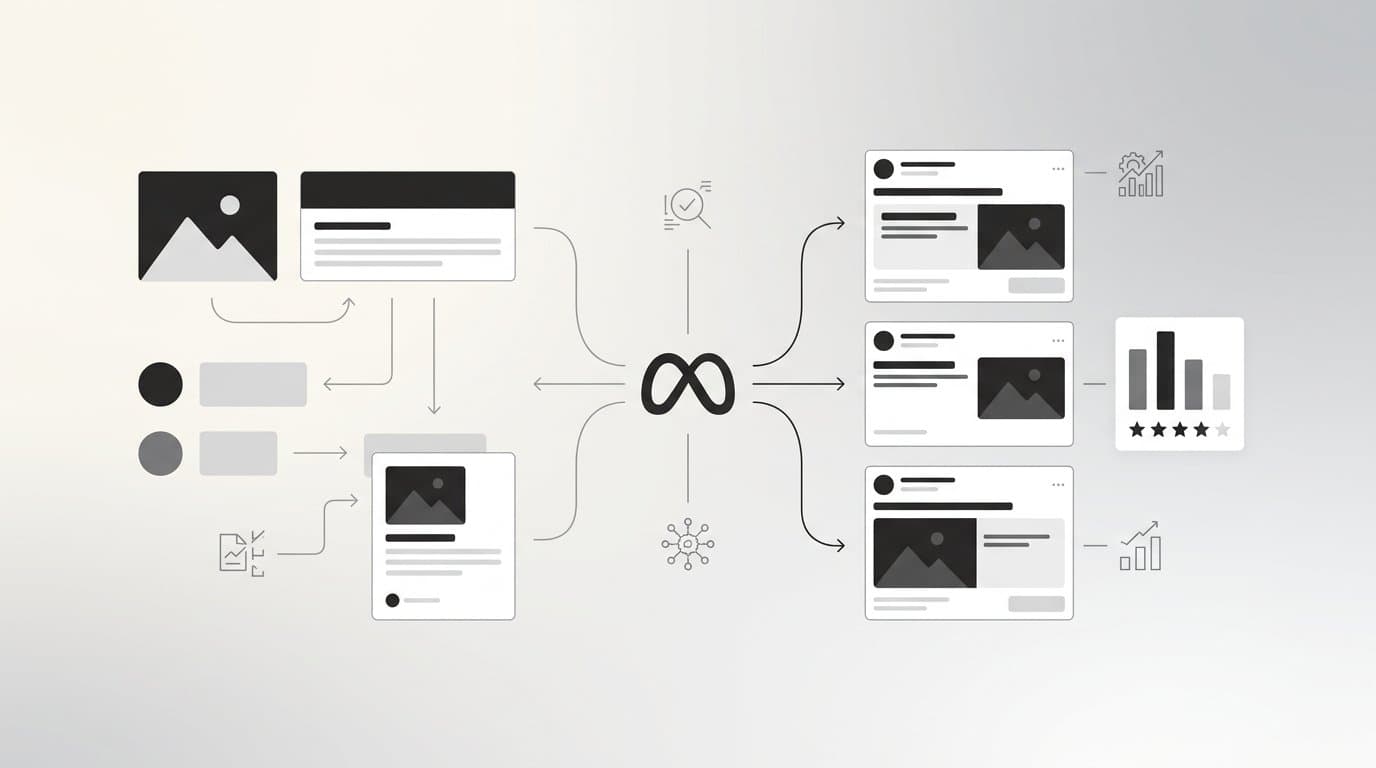
Bulk launching takes this further. Instead of manually assembling ad sets one by one, AdStellar's Bulk Ad Launch lets you combine multiple creatives, headlines, audiences, and copy variations into hundreds of ad combinations in minutes. The testing surface area expands dramatically without a proportional increase in time spent. Teams looking to launch multiple Meta ads at once will find this approach dramatically reduces setup time without sacrificing control.
The AI Campaign Builder adds another layer by analyzing your historical campaign data before building new campaigns. It ranks every creative, headline, and audience by actual performance, explains the reasoning behind every decision, and builds complete Meta ad campaigns informed by what has already worked. This is not a black box: the transparency is built in so you understand the strategy, not just the output. And critically, the system gets smarter with each campaign cycle because it is continuously learning from new performance data.
AI Insights leaderboards bring the performance analysis side together. Every creative, headline, copy variation, audience, and landing page is ranked by real metrics: ROAS, CPA, CTR. You set your target goals, and the AI scores everything against your specific benchmarks. Combined with the Winners Hub, where your top performers are organized and ready to pull into new campaigns instantly, the entire system functions as a continuous testing and learning engine rather than a series of disconnected one-off experiments.
Putting It All Together
Creative testing methodology is not a project with a finish line. It is an operational system that runs continuously alongside your campaigns, producing a steady stream of learning that compounds over time.
The framework comes down to a few core disciplines: isolate the variables you are testing so the data is attributable, structure your campaigns cleanly to keep testing separate from scaling, define success metrics before the test begins rather than after, read data against your own benchmarks rather than gut feel, and feed every insight back into the next creative brief.
Teams that run this system consistently develop a real and durable advantage. Their creative quality improves because each round of tests builds on documented wins. Their budget efficiency improves because decisions are grounded in data rather than instinct. And their speed improves because they have a pipeline of tested alternatives ready before fatigue hits, rather than scrambling to produce something new after performance has already declined.
The bottleneck that stops most teams from operating this way is creative production volume and the time required to analyze results at scale. That is exactly the problem AdStellar is built to solve. From generating image ads, video ads, and UGC-style creatives with AI, to bulk launching hundreds of variations in minutes, to surfacing winners through goal-based leaderboards and a centralized Winners Hub, AdStellar handles the operational heavy lifting so you can focus on the strategic decisions.
If you are ready to replace guesswork with a system that actually learns, Start Free Trial With AdStellar and see how fast your testing velocity can move when creative production and performance analysis are handled in one place. The 7-day free trial gives you full access to put the methodology into practice immediately.