Running Meta ads as a small business often feels like competing against brands with unlimited budgets and dedicated marketing teams. The reality is that small businesses face unique challenges: limited time to manage campaigns, tight budgets that demand every dollar works hard, and the constant pressure to create fresh ad creatives without a design team on staff.
The good news? Effective Meta ads management doesn't require enterprise resources. It requires smart strategy, efficient workflows, and knowing which levers actually move the needle for businesses your size.
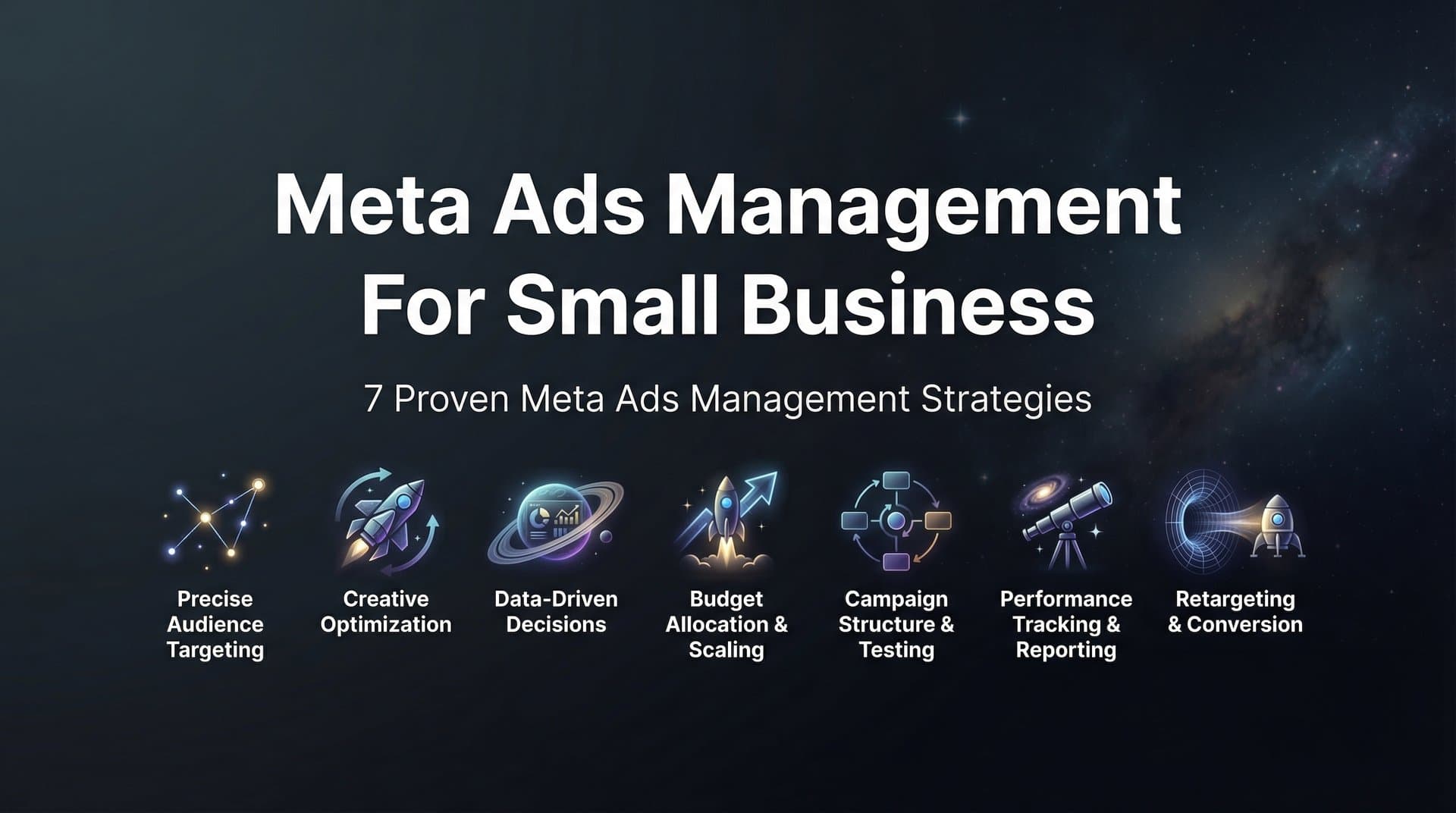
This guide breaks down seven battle-tested strategies specifically designed for small business owners and lean marketing teams. Each approach focuses on maximizing results while minimizing the time and budget drain that makes paid advertising feel overwhelming. Whether you're launching your first campaign or looking to improve existing efforts, these strategies will help you compete effectively on Meta platforms.
1. Start With Precise Audience Targeting Instead of Broad Reach
The Challenge It Solves
When you're working with a limited budget, casting a wide net burns through cash without meaningful returns. Broad targeting might work for brands spending thousands daily, but small businesses need every impression to count. The problem is that reaching everyone means connecting with no one in particular.
Generic audience targeting wastes budget on people who will never convert while missing the high-intent prospects who are ready to buy right now.
The Strategy Explained
Precision targeting starts with your existing customer data. Your current customers represent your best template for finding new ones. By building custom audiences from your customer list, website visitors, and engagement data, you create a foundation of people who already know your brand.
From there, lookalike audiences extend your reach to people who share characteristics with your best customers. Think of it like this: instead of shouting into a crowded room hoping someone is interested, you're having conversations with people who already fit the profile of your ideal buyer.
The key is starting narrow and expanding only after you've proven success with your core audience segments. Many businesses find success using a dedicated Meta ads platform for small business to manage these audience segments efficiently.
Implementation Steps
1. Upload your customer email list to create a custom audience in Meta Ads Manager, then build a 1% lookalike audience from your highest-value customers.
2. Install the Meta Pixel on your website and create audiences based on specific actions like product page views, add-to-cart events, and time spent on site.
3. Layer interest and behavior targeting on top of your lookalike audiences to further refine who sees your ads, focusing on 2-3 highly relevant interests rather than dozens of loosely related ones.
4. Start with your smallest, most qualified audience first and expand to broader segments only after achieving profitable results with your core group.
Pro Tips
Exclude existing customers from acquisition campaigns to avoid wasting budget on people who already bought. Create separate retention campaigns specifically for your customer list. Test different lookalike percentages (1%, 3%, 5%) to find the sweet spot between audience size and conversion quality for your specific business.
2. Create Multiple Ad Variations Without a Design Team
The Challenge It Solves
Traditional ad creation requires designers, video editors, and often paid actors for UGC-style content. For small businesses, this creates a bottleneck where you're stuck running the same tired creatives because producing new ones takes too long and costs too much.
Meanwhile, your competitors are testing fresh angles while your ad fatigue sets in and performance tanks.
The Strategy Explained
AI-powered creative tools have fundamentally changed what's possible for small businesses. You can now generate professional image ads, video ads, and even UGC-style avatar content without hiring anyone. The process is simple: provide a product URL or clone a competitor's ad format from the Meta Ad Library, and AI generates multiple variations.
This approach solves two problems simultaneously. First, you get the volume of creative variations needed for effective testing. Second, you can iterate quickly based on performance data rather than waiting weeks for design revisions. Exploring AI tools for small business marketing can dramatically accelerate your creative production.
The real power comes from generating dozens of variations in the time it used to take to brief a designer on a single concept.
Implementation Steps
1. Use AI creative tools to generate your first batch of 10-15 ad variations from your product URL, testing different angles, value propositions, and visual styles.
2. Browse the Meta Ad Library to find competitor ads in your niche that are running long-term (which signals they're working), then clone their format while adapting the message to your brand.
3. Generate both static image ads and video variations for each concept, since different audience segments respond to different formats.
4. Refine any generated creative using chat-based editing to adjust colors, text placement, or specific elements without starting from scratch.
Pro Tips
Create a swipe file of competitor ads that have been running for months. Long-running ads indicate proven performance. Generate your own versions of these winning formats rather than trying to reinvent the wheel. Test UGC-style avatar ads alongside polished product shots to see which resonates better with your specific audience.
3. Structure Campaigns for Clear Performance Insights
The Challenge It Solves
Messy campaign organization makes optimization impossible. When everything is jumbled together with generic names like "Campaign 1" and "Ad Set 2," you can't quickly identify what's working or make confident decisions about where to allocate budget.
Poor structure wastes time during every optimization session and leads to mistakes like accidentally pausing winning ad sets or scaling underperformers.
The Strategy Explained
Campaign structure is your roadmap for decision-making. A clear naming convention tells you exactly what you're looking at without clicking through multiple levels. The goal is to make your account so organized that you can spot opportunities and problems at a glance.
Think of it like organizing your finances. You wouldn't dump all transactions into one category and hope for the best. You create categories that make tracking and optimization obvious. Understanding proper campaign structure for Meta ads is essential for long-term success.
Effective structure separates campaigns by objective, ad sets by audience, and ads by creative variation. This separation makes performance comparison straightforward.
Implementation Steps
1. Implement a naming convention that includes campaign objective, audience type, and date, such as "CONV_Lookalike1%_ProductA_Apr2026" for easy scanning.
2. Separate campaigns by funnel stage with distinct objectives: awareness campaigns for cold audiences, consideration campaigns for warm traffic, and conversion campaigns for hot prospects.
3. Keep ad sets focused on single audience segments rather than combining multiple audiences, which makes it impossible to determine which segment drove results.
4. Name individual ads to reflect the creative variation being tested, like "VideoAd_PainPoint_CTA1" so you can instantly identify what's being tested.
Pro Tips
Create a simple spreadsheet documenting your naming convention so anyone who touches the account (including future you) understands the system. Use consistent abbreviations across all campaigns. Review and archive underperforming campaigns monthly to keep your account clean and focused on active tests.
4. Test Systematically With Bulk Ad Launching
The Challenge It Solves
Traditional A/B testing is painfully slow for small businesses. Testing one variable at a time means waiting weeks to gather meaningful data, and by the time you finish testing headlines, your original creative is already fatigued. Sequential testing simply doesn't match the pace of modern advertising.
You need faster learning cycles to compete effectively without wasting months on inconclusive tests.
The Strategy Explained
Bulk ad launching flips the testing paradigm. Instead of testing one element at a time, you create every combination of your best creatives, headlines, audiences, and copy variations, then launch them all simultaneously. This approach generates hundreds of ad variations in minutes rather than weeks.
Picture this: you have 5 creatives, 4 headline variations, and 3 audience segments. Traditional testing would take months to test each combination sequentially. Bulk launching creates all 60 combinations (5 × 4 × 3) and launches them at once, letting Meta's algorithm quickly identify the winning combinations.
The speed of learning is the competitive advantage. While competitors are still testing headline A versus headline B, you've already identified your top performers across multiple variables. This is where Meta ads automation for small business becomes invaluable.
Implementation Steps
1. Select your top 3-5 creative variations, 3-4 headline options, and 2-3 audience segments to test simultaneously.
2. Use bulk launching tools to automatically generate every combination at both the ad set and ad level, creating comprehensive test coverage in one setup session.
3. Set a modest daily budget for each ad set during the testing phase, typically $10-20 per day depending on your total budget, to gather data without overspending on unproven combinations.
4. Let combinations run for 3-5 days to accumulate sufficient data, then analyze which specific combinations of creative, headline, and audience are delivering the best results.
Pro Tips
Don't test too many variables at once when starting out. Begin with 3 creatives × 3 headlines × 2 audiences for 18 total combinations. As you get comfortable with the approach, expand your testing matrix. Focus on combinations that work rather than trying to understand why individual elements failed in isolation.
5. Use Performance Leaderboards to Identify Winners Fast
The Challenge It Solves
Standard Meta reporting shows you data, but it doesn't tell you what matters for your specific business goals. You can see that Creative A has a 2.1% CTR and Creative B has a 1.8% CTR, but is that difference meaningful? Which headline actually drives purchases, not just clicks? Generic metrics create analysis paralysis.
Small business owners need clear answers about what's working against their actual goals, not generic performance indicators.
The Strategy Explained
Performance leaderboards rank every element of your campaigns by the metrics that actually matter to your business. Instead of sorting by impressions or reach, you rank creatives, headlines, audiences, and landing pages by ROAS, CPA, conversion rate, or whatever goal drives your business forward.
The power comes from setting your target benchmarks upfront. If your target CPA is $25, the leaderboard scores everything against that standard. A robust Meta ads performance analytics platform can automate this ranking process for you.
This approach eliminates guesswork and focuses your optimization efforts on the elements that move your specific business metrics.
Implementation Steps
1. Define your primary success metric based on business goals, whether that's ROAS for e-commerce, cost per lead for service businesses, or cost per acquisition for subscription models.
2. Set realistic benchmark targets based on your unit economics, like a target CPA that maintains profitability or a minimum ROAS that covers costs and desired profit margin.
3. Create custom reports or use AI-powered insights tools that automatically rank your creatives, headlines, copy variations, and audiences by performance against your benchmarks.
4. Review leaderboards weekly to identify top performers for scaling and bottom performers for pausing, making optimization decisions based on ranked performance rather than gut feel.
Pro Tips
Track secondary metrics alongside your primary goal. A creative might have amazing ROAS but terrible volume, which limits scaling potential. Conversely, a creative with slightly lower ROAS but 3x the volume might be the better scaling candidate. Context matters as much as rankings.
6. Automate Campaign Building With Historical Data Analysis
The Challenge It Solves
Every time you build a new campaign, you're starting from scratch and hoping your gut instinct about audiences, creatives, and copy is correct. Meanwhile, you're sitting on months of performance data that could tell you exactly which elements work best together. The disconnect between what you know and what you do wastes time and money.
Manual campaign building ignores the patterns hiding in your historical performance data.
The Strategy Explained
AI-powered campaign builders analyze your past performance to identify winning patterns across creatives, headlines, audiences, and copy. Instead of guessing which elements to combine in your next campaign, the system shows you which combinations historically drove the best results for your specific business.
Here's how it works in practice. The AI examines your previous campaigns, ranks every creative by performance, identifies your top-converting headlines, and determines which audiences delivered the lowest CPA. Leveraging AI marketing automation for Meta ads transforms this data into actionable campaign recommendations.
The transparency is crucial. You're not blindly trusting a black box. You understand why the AI selected Creative A over Creative B because you see the performance data backing each decision.
Implementation Steps
1. Connect your Meta Ads account to AI campaign building tools that can analyze your historical performance data across all previous campaigns.
2. Review the AI's analysis of your top-performing creatives, headlines, audiences, and copy based on your specific conversion goals and cost targets.
3. Let the AI build your next campaign using proven winning elements, but review the recommendations to ensure they align with your current objectives and any seasonal considerations.
4. Track how AI-built campaigns perform compared to manually built campaigns to validate that data-driven decisions outperform intuition over time.
Pro Tips
The AI gets smarter with every campaign you run because it has more data to analyze. Early campaigns might not show dramatic improvements, but after 3-4 campaign iterations, the pattern recognition becomes powerful. Feed the system by consistently running tests and capturing performance data.
7. Scale What Works With Controlled Budget Increases
The Challenge It Solves
You finally found a winning campaign. The natural instinct is to triple the budget immediately and ride the wave. But aggressive budget increases often tank performance by disrupting Meta's learning phase and changing auction dynamics. Suddenly your profitable campaign is burning cash without delivering results.
Scaling too fast kills winners. Scaling too slow leaves money on the table. Small businesses need the middle path.
The Strategy Explained
Controlled scaling follows two approaches: horizontal and vertical. Horizontal scaling duplicates winning campaigns or ad sets to new audiences while keeping budgets stable. Vertical scaling increases budgets on existing winners using gradual increments that avoid triggering a reset of the learning phase.
The commonly cited guideline is the 20% rule: don't increase budgets by more than 20% at a time, and wait at least 3-4 days between increases to let the algorithm stabilize. If you're managing multiple clients, understanding scaling Meta ads for agencies provides additional frameworks for controlled growth.
Think of it like growing a plant. You don't dump a month's worth of water on it at once. You provide consistent, measured increases that support healthy growth without shocking the system.
Implementation Steps
1. Identify campaigns or ad sets that have been profitable for at least 7 days with consistent performance, avoiding the temptation to scale based on one good day.
2. For vertical scaling, increase daily budgets by 15-20% maximum, wait 3-4 days to assess impact, then increase again if performance remains stable.
3. For horizontal scaling, duplicate winning ad sets to new lookalike audience percentages or similar interest groups, keeping the original winner running unchanged.
4. Monitor cost per result closely during scaling periods, and be ready to pause or reduce budgets if your CPA increases by more than 30% or ROAS drops below your profitability threshold.
Pro Tips
Set up automated rules in Ads Manager to pause ad sets automatically if CPA exceeds your maximum threshold during scaling. This prevents runaway spending while you sleep. Consider time-of-day scheduling during initial scaling to control when increased budgets are active, especially if you know certain hours convert better for your business.
Putting It All Together
Effective Meta ads management for small businesses comes down to working smarter with limited resources. Start by tightening your audience targeting to stretch every dollar further. Build a system for creating ad variations quickly using AI tools so you can test more without hiring designers.
Structure campaigns clearly so you can actually understand what's working. Use bulk launching to test multiple combinations simultaneously rather than waiting weeks for sequential A/B tests. Track performance against your specific business goals, not vanity metrics.
Let AI analyze your historical data to build smarter campaigns over time. And when you find winners, scale them methodically using controlled budget increases that maintain performance while expanding reach.
The small businesses that succeed with Meta ads aren't the ones with the biggest budgets. They're the ones with the most efficient systems. Start implementing one strategy this week, measure the results, and build from there.
Ready to transform your advertising strategy? Start Free Trial With AdStellar and be among the first to launch and scale your ad campaigns 10× faster with our intelligent platform that automatically builds and tests winning ads based on real performance data. Generate scroll-stopping creatives with AI, launch hundreds of variations in minutes, and let performance leaderboards surface your winners automatically. No designers, no guesswork, no wasted budget.