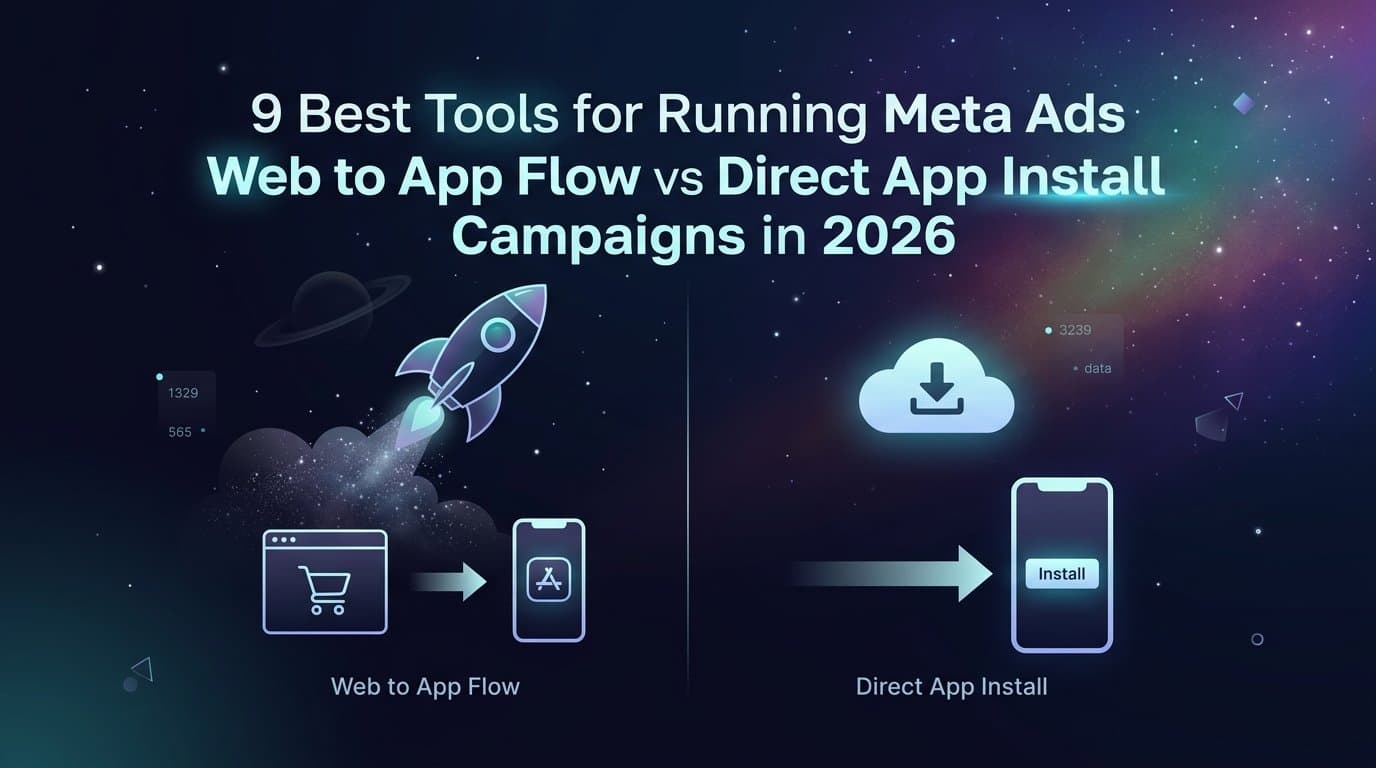
Choosing between a web-to-app flow and direct app install ads on Meta is one of the most consequential decisions an app marketer can make. Each path has a distinct conversion funnel, attribution model, and creative requirement. Web-to-app flows warm users up on a landing page before the install. Direct app install ads send users straight to the App Store or Google Play. Both can work, but the tools you use to build, test, launch, and optimize each approach determine whether you find winners fast or burn budget slowly.
This list covers the best tools for planning, executing, and scaling both campaign types on Meta. From AI-powered creative and campaign platforms to attribution, deep linking, and landing page solutions, these tools cover every layer of the stack. Whether you are a solo media buyer or managing campaigns for multiple apps, there is something here for every stage of your funnel.
1. AdStellar
Best for: App marketers who need to generate, launch, and optimize Meta ad creatives at scale across both funnel types
AdStellar is an AI-powered ad platform that generates image ads, video ads, and UGC-style creatives, then builds and launches full Meta campaigns with AI-optimized audiences, headlines, and copy.

Where This Tool Shines
The biggest challenge when running both web-to-app and direct install campaigns simultaneously is creative volume. Each funnel type needs different messaging, different hooks, and different calls to action. AdStellar handles this by generating hundreds of ad variations from a product URL or from scratch, mixing creatives, headlines, and audiences, then launching every combination to Meta in clicks rather than hours.
The AI Campaign Builder goes beyond just launching ads. It analyzes your past campaign performance, ranks every creative and audience by what actually drove results, and builds the next campaign around those insights. Every decision comes with a transparent explanation so you understand the strategy behind it, not just the output.
Key Features
AI Ad Creative: Generate image ads, video ads, and UGC-style avatar content from a product URL or from scratch, with chat-based editing to refine any creative without needing designers or video editors.
AI Campaign Builder: Analyzes past campaign performance, ranks creatives and audiences by results, and builds complete Meta campaigns in minutes with full strategic transparency.
Bulk Ad Launch: Create hundreds of ad variations by mixing creatives, headlines, audiences, and copy at both the ad set and ad level, then launch all combinations to Meta in a few clicks.
AI Insights: Leaderboards rank your creatives, headlines, copy, audiences, and landing pages by ROAS, CPA, and CTR against your target benchmarks so you can instantly identify what is working.
Winners Hub: Stores your top-performing creatives, headlines, and audiences with real performance data so you can instantly pull them into the next campaign without starting from scratch.
Best For
AdStellar is ideal for performance marketers and media buyers running Meta app campaigns who want to compress the time between creative idea and live campaign. It is particularly valuable when you are testing both funnel approaches simultaneously and need a single platform to generate, launch, and surface winners across both.
Pricing
Pricing is available on the AdStellar website. Visit adstellar.ai for current plan details and to explore trial options.
2. Meta Ads Manager
Best for: The foundational campaign setup layer for both direct app install and web-to-app funnel campaigns
Meta Ads Manager is the native campaign management platform and the required starting point for running any Meta advertising campaign, including both App Install and Traffic or Conversion objectives.

Where This Tool Shines
For direct app install campaigns, Ads Manager provides the App Install objective with native routing to the App Store and Google Play. For web-to-app flows, you shift to the Traffic or Conversion objective, firing Meta Pixel events on your landing page before the install happens. Both setups live inside the same interface, making it straightforward to run both campaign types in parallel and compare results.
The platform's Advantage+ automation has matured significantly, handling audience expansion and placement optimization across both funnel types. Native A/B testing lets you pit web-to-app against direct install head-to-head with statistical controls built in.
Key Features
App Install Objective: Direct campaign type that routes users to the App Store or Google Play with Meta's algorithm optimizing for likely installers.
Traffic and Conversion Objectives: Used to build web-to-app funnels by driving users to a landing page with Pixel-tracked conversion events.
SKAdNetwork and AEM Integration: Native support for iOS attribution through SKAdNetwork and Aggregated Event Measurement to maintain measurement despite privacy changes.
Advantage+ Automation: AI-driven audience expansion and placement optimization that works across both campaign types.
Native A/B Testing: Built-in split testing tools for comparing creative, audience, placement, and funnel type without third-party tools.
Best For
Every app marketer running Meta campaigns needs Ads Manager. It is not optional. The question is what tools you layer on top of it to speed up creative production, improve attribution, and automate optimization.
Pricing
Free to use. You pay only for your ad spend with no platform fee from Meta.
3. AppsFlyer
Best for: Mobile attribution across both funnel types with deep Meta integration and cohort-level LTV analysis
AppsFlyer is one of the most widely used mobile measurement partners, offering deterministic and probabilistic attribution across iOS and Android with deep integration into Meta's measurement ecosystem.

Where This Tool Shines
Attribution gets complicated fast when you are running web-to-app flows alongside direct install campaigns. Web-to-app flows fire web conversion events through the Meta Pixel, while direct install campaigns rely on SKAdNetwork on iOS or the Meta SDK on Android. AppsFlyer handles both measurement paths and lets you compare user quality across funnel types through cohort analysis.
The deep linking support is also relevant for web-to-app flows, helping route users to the correct in-app screen after they install from a landing page. This is a detail that significantly affects post-install experience and ultimately affects the revenue metrics you are trying to improve.
Key Features
Multi-Platform Attribution: Deterministic and probabilistic attribution across iOS and Android, covering both Meta Pixel web events and SKAdNetwork install signals.
Deep Linking Support: Routes users to the correct in-app destination post-install, essential for maintaining context in web-to-app flows.
Meta AEM and SKAdNetwork Integration: Native integration with Meta's privacy-compliant measurement solutions for iOS campaigns.
Cohort Analysis: Compare user LTV, retention, and revenue by acquisition source and funnel type to understand which campaign approach delivers better long-term users.
Protect360 Fraud Prevention: Built-in fraud detection layer to filter invalid installs from your attribution data.
Best For
App marketing teams that need a reliable, widely recognized MMP with strong Meta integration and the cohort reporting tools to evaluate funnel type performance over time, not just at install.
Pricing
Usage-based pricing with a free tier available for smaller apps. Paid plans scale with install volume and feature requirements.
4. Adjust
Best for: Attribution with built-in fraud prevention and audience building for retargeting web-to-app visitors who did not convert
Adjust is a mobile attribution and analytics platform with a strong emphasis on fraud prevention and audience segmentation, used by app marketing teams managing significant Meta budgets.

Where This Tool Shines
Adjust's fraud prevention is baked into the measurement layer rather than added as an afterthought. For teams running high-volume direct install campaigns where invalid install fraud is a real concern, this matters. The platform also includes an audience builder that lets you create retargeting segments from users who visited your web landing page but did not complete the install, which is a particularly useful capability for web-to-app flow optimization.
The Datascape dashboard consolidates cross-channel reporting so you can view web-to-app and direct install campaign performance side by side without exporting data manually.
Key Features
Multi-Touch Attribution with Fraud Prevention: Attribution measurement with fraud detection integrated at the data collection level, not applied after the fact.
Audience Builder: Create retargeting audiences from users who engaged with your web landing page but did not install, enabling follow-up campaigns for unconverted web-to-app visitors.
Cohort Reporting: Compare retention rates and revenue by campaign type to evaluate which funnel approach produces more valuable users over time.
Meta and SKAdNetwork Integration: Full support for Meta's iOS measurement framework alongside direct Android attribution.
Datascape Dashboard: Unified analytics view across channels and campaign types for consolidated performance reporting.
Best For
Teams running large-scale Meta app campaigns where fraud risk is a concern, and marketers who want to retarget unconverted web-to-app landing page visitors with precision.
Pricing
Enterprise pricing. Contact Adjust directly for a quote based on your volume and feature needs.
5. Branch
Best for: Deep linking infrastructure that makes web-to-app flows work correctly after the install
Branch is the leading mobile linking platform, providing the deep linking infrastructure that web-to-app flows depend on to route users to the right in-app screen after they install from a landing page.

Where This Tool Shines
Here is a detail many marketers overlook: sending users from an ad to a landing page and then to the App Store is only half of the web-to-app flow. What happens after they install matters just as much. Without proper deep linking, a user who clicked an ad for a specific feature lands on a generic app home screen with no context. Branch's deferred deep links solve this by preserving the routing intent through the install process and delivering users to the correct in-app destination.
Branch also offers Journey banners, which prompt existing mobile web visitors to open or install the app. This adds an additional conversion layer to your web-to-app traffic that does not require a dedicated landing page.
Key Features
Deferred Deep Links: Preserves routing intent through the App Store install process, delivering users to the correct in-app screen even on first open.
Universal Links: Cross-platform link handling across iOS, Android, and desktop that degrades gracefully when the app is not installed.
Attribution Data: Complementary attribution data to support your primary MMP with link-level engagement signals.
Journey Banners: Smart app install banners for mobile web visitors that prompt installs from existing web traffic without requiring a dedicated landing page.
Deep Link Analytics: Identify where users drop off in the web-to-app path so you can diagnose and fix conversion leaks.
Best For
Any app marketer running web-to-app flows who wants users to land in the right place after installing. This is infrastructure, not optional, if post-install experience matters to your conversion rates.
Pricing
Free tier available for smaller apps. Paid plans scale with link volume and feature requirements.
6. Unbounce
Best for: Building and A/B testing mobile landing pages for web-to-app funnel campaigns without developer involvement
Unbounce is a landing page platform with AI-assisted building and testing tools, used by app marketers to create and iterate on mobile landing pages that sit between the Meta ad and the app store.

Where This Tool Shines
The landing page is the most variable element in a web-to-app flow. Ad creative gets users to click. The landing page determines whether they actually go to the App Store. Unbounce lets you build, test, and iterate on landing pages without writing code or waiting on a developer, which is critical when you need to move fast based on campaign data.
The Smart Traffic feature is particularly useful for app marketers running multiple ad variations. It automatically routes visitors to the landing page variant most likely to convert based on their attributes, rather than splitting traffic evenly regardless of fit.
Key Features
Mobile Landing Page Builder: Drag-and-drop editor optimized for mobile with no developer required for building or updating pages.
AI Copywriting and Layout Suggestions: AI-assisted content generation to speed up page creation and reduce the time between concept and live test.
A/B and Multivariate Testing: Test multiple page variants simultaneously to optimize conversion rates at the landing page level before users reach the app store.
Fast Mobile Load Speeds: Optimized for mobile page performance to reduce drop-off before users reach the app store call to action.
Smart Traffic AI: Automatically routes visitors to the highest-converting page variant based on visitor attributes rather than random traffic splits.
Best For
App marketers running web-to-app flows who need to iterate on landing pages quickly and want testing capabilities that go beyond basic A/B splits.
Pricing
Starts at approximately $99 per month. Higher tiers unlock more monthly traffic, additional domains, and advanced testing features.
7. Superwall
Best for: Subscription apps that need to A/B test paywalls and onboarding without waiting for app store review cycles
Superwall is a paywall and onboarding experimentation platform built specifically for subscription apps, enabling server-side A/B tests on the post-install experience without requiring app store updates.
Where This Tool Shines
Web-to-app flows are particularly popular with subscription apps because the landing page can prime users on pricing and value before the install, which often improves subscription conversion after install. Superwall picks up where the landing page leaves off. Once the user is inside the app, Superwall controls what paywall they see, when they see it, and in what format, all without pushing an app update.
The ability to run server-side paywall experiments means you can test pricing copy, layout, and trigger timing in days rather than weeks. For teams trying to understand which acquisition path produces better subscribers, this is a critical piece of the post-install measurement stack.
Key Features
Server-Side Paywall A/B Testing: Run paywall experiments without submitting app store updates, dramatically compressing the iteration cycle.
Drag-and-Drop Paywall Editor: Non-technical teams can build and modify paywall designs without developer involvement.
Event-Triggered Paywall Presentation: Show paywalls based on specific user behaviors rather than fixed timing, allowing more contextually relevant monetization moments.
Revenue Analytics by Variant: See which paywall design and trigger timing produces the most subscription revenue, not just the most views.
Attribution Platform Integration: Connects with MMP data to link ad spend from web-to-app and direct install campaigns to actual subscription revenue.
Best For
Subscription app teams who want to optimize the post-install conversion experience in parallel with their Meta campaign testing, particularly those using web-to-app flows to pre-qualify users before the install.
Pricing
Free tier available. Paid plans are based on monthly tracked users and scale with app size.
8. Madgicx
Best for: Meta-focused campaign optimization with AI audience segmentation and creative performance insights layered on top of Ads Manager
Madgicx is a Meta ad optimization platform that adds AI-driven audience targeting, budget automation, and creative analytics on top of what Meta Ads Manager provides natively.
Where This Tool Shines
Madgicx is designed specifically for Meta, which means its audience and creative insights are tuned to how Meta's algorithm actually behaves. The autonomous budget allocation rules let you set conditions for scaling winning ad sets automatically, which is useful when you are running both funnel types and want to shift spend toward whichever is performing better without manual intervention.
The creative insights dashboard breaks down performance by individual ad elements, helping you understand whether it is the hook, the headline, or the call to action that is driving results in each funnel type.
Key Features
AI Audience Targeting Suggestions: Recommends audience segments based on campaign performance data rather than manual research.
Autonomous Budget Allocation: Rule-based automation that scales winning ad sets and pauses underperformers without requiring manual budget adjustments.
Creative Insights Dashboard: Breaks down ad performance by creative element to identify what is actually driving clicks and conversions.
One-Click Audience Creation: Build new audiences from Meta data signals directly within the platform.
Multi-Ad-Set Ad Launcher: Publish ads across multiple ad sets simultaneously to speed up campaign deployment.
Best For
Performance marketers who are already running Meta app campaigns and want an optimization layer that automates budget decisions and surfaces creative insights without switching platforms entirely.
Pricing
Starts at approximately $49 per month. Pricing scales with ad spend volume.
9. Northbeam
Best for: Understanding the true incremental impact of web-to-app versus direct install campaigns when both are running simultaneously
Northbeam is a multi-touch attribution and media mix modeling platform that helps performance teams measure the real impact of each channel and campaign type beyond last-click attribution.
Where This Tool Shines
When you are running web-to-app flows and direct install campaigns at the same time, last-click attribution gives you a distorted view of what is actually driving growth. A user might see a direct install ad, visit the landing page from a web-to-app ad days later, and then install. Standard attribution models struggle with this. Northbeam's media mix modeling approach assigns credit more accurately across the full conversion path.
The creative reporting tied to revenue outcomes is also valuable here. Rather than optimizing toward installs alone, you can evaluate which campaign type and which specific creatives are contributing to actual revenue, which is the number that matters for subscription and in-app purchase apps.
Key Features
Media Mix Modeling: Measures the incremental impact of each campaign type beyond what last-click attribution reports, giving a more accurate picture of what is driving installs and revenue.
Multi-Touch Attribution: Assigns credit across Meta and other paid channels based on the full conversion path rather than the final touchpoint.
Spend Pacing and Budget Forecasting: Tools to manage budget allocation across campaign types based on projected performance rather than reactive adjustments.
Creative Reporting Tied to Revenue: Connects creative performance to downstream revenue outcomes rather than stopping at install or click metrics.
Custom Attribution Windows: Adjust the attribution window to match your app's typical conversion cycle, which can vary significantly between direct install and web-to-app flows.
Best For
Performance teams running significant Meta budgets across both funnel types who need incrementality measurement and media mix modeling to make confident budget allocation decisions.
Pricing
Enterprise pricing. Contact Northbeam directly for a quote based on your spend volume and measurement needs.
Which Tool Is Right for Your Stack
The right combination of tools depends on where you are in your testing process and which funnel type you are prioritizing. Here is a quick guide to help you build the right stack.
If your primary goal is generating and testing creative at scale across both funnel types, start with AdStellar. The ability to generate hundreds of ad variations, launch them to Meta in minutes, and surface winners through AI-powered insights compresses the testing cycle that typically takes weeks into days. It is the fastest path from concept to data.
If you are building or optimizing a web-to-app flow, Branch and Unbounce are the two tools to prioritize alongside your ad platform. Branch handles the deep linking infrastructure that makes post-install routing work correctly. Unbounce handles the landing page testing that determines whether users actually make it to the App Store in the first place.
For attribution, AppsFlyer and Adjust are both strong choices. AppsFlyer tends to be the default for teams that want broad platform support and cohort reporting depth. Adjust is worth considering if fraud prevention is a higher priority for your specific campaigns.
If you are running a subscription app, add Superwall to the stack. It closes the loop between your ad funnel and the post-install monetization experience, letting you test paywalls in parallel with your Meta campaigns without waiting on app store review cycles.
For teams running both funnel types at meaningful scale and needing to understand true incrementality, Northbeam provides the media mix modeling layer that standard attribution tools cannot.
The best starting point for most app marketers is getting the creative and campaign layer right first. Start Free Trial With AdStellar and be among the first to launch and scale your ad campaigns faster with an intelligent platform that automatically builds and tests winning ads based on real performance data.