Most Meta advertisers are not failing because they lack strategy. They are failing because they cannot see clearly. The campaigns are live, the budget is spending, the dashboard is full of numbers, but when you try to answer the simple question "what is actually working?", the answer is frustratingly vague.
This is not a skill problem. It is a visibility problem. Meta Ads Manager was built to manage ad delivery and report billing metrics. It was not built to tell you whether your headline beat your creative or whether your audience was carrying a weak offer. That distinction sounds small, but it changes everything about how you optimize.
The result is that most advertisers end up making decisions based on aggregate signals that blend too many variables together. You see a campaign ROAS and call it good or bad without knowing which of the four elements inside that campaign actually produced the result. You pause an ad that looks like it is underperforming when the real culprit is audience fatigue. You keep running a creative that looks strong when it is actually being propped up by a very specific audience that is about to saturate.
By the end of this article, you will understand exactly why winning elements stay hidden inside Meta's reporting structure, what you should actually be measuring for each variable, how to build tests that produce clean and reliable answers, and how to set up a system that surfaces winners automatically rather than making you hunt for them manually.
The Visibility Problem Hidden Inside Meta Ads Manager
Here is the fundamental issue: Meta Ads Manager is organized around campaigns, ad sets, and ads. Its default reporting rolls performance up to the campaign and ad set level, which means the granular signal you actually need, the performance of a specific creative, a specific headline, or a specific audience in isolation, gets buried under layers of aggregation.
When you look at an ad set's CPA, you are looking at the blended result of every ad running inside it. If you have three creatives in that ad set, you cannot tell from the ad set view which creative is responsible for the good results or which one is dragging the average down. You have to drill into the ad level, and even there, the numbers are not as clean as they look.
Attribution adds another layer of distortion. Meta's default attribution window credits conversions across a 7-day click and 1-day view window. This means a single purchase can be attributed to multiple ad variants that a user saw or clicked across different sessions. When you are running several ad variations simultaneously, that attribution overlap makes it genuinely difficult to know which specific element drove the conversion. The platform is not lying to you. It is just reporting what it can measure, and what it can measure is not the same as what you need to know.
The delivery algorithm compounds the problem further. Meta allocates impressions based on predicted conversion probability. This sounds helpful, but what it means in practice is that the algorithm starts favoring one ad variant very early in a campaign's life, often before you have enough data to draw any meaningful conclusions. The variant that gets more impressions will naturally accumulate more conversions, which makes it look like the winner. But the algorithm's early preference was based on initial signals that may have had nothing to do with creative quality. It may have simply matched a slightly different slice of your audience first.
There is also the question of budget pacing. A campaign with uneven budget distribution across ad sets will show skewed performance data. An ad set that received twice the budget will almost always show more conversions, even if the underlying efficiency is lower. Comparing CPA across ad sets without accounting for budget allocation is comparing apples to oranges.
The net effect of all these factors is that the numbers you see in Meta Ads Manager are real, but they are not telling you what you think they are telling you. They reflect delivery outcomes, not element-level quality. Fixing that requires a different approach to both measurement and structure.
The Four Elements That Actually Determine Ad Performance
Every Meta ad is made up of four independently influential variables: the creative (your image or video), the headline, the primary text (your ad copy), and the audience. Each one controls a distinct moment in the user's decision to stop, click, and convert. Understanding what each element does makes it much easier to measure them correctly.
Creative: The visual is the first thing a user encounters in the feed. Its job is to interrupt the scroll. Before anyone reads your headline or processes your offer, the image or video has already succeeded or failed at capturing attention. A strong creative earns a second of consideration. A weak one gets passed over before any other element gets a chance to do its job. This is why creative quality cannot be evaluated purely on conversion metrics. A creative that stops the scroll but has a weak headline attached to it will show low CTR, and you might incorrectly conclude the creative failed when it actually did its part.
Headline: Once the creative earns attention, the headline has to do the work of creating enough curiosity or clarity to motivate a click. A headline that speaks directly to a pain point or a specific outcome will outperform a generic one even when the creative is identical. This is the most undertested element in most advertisers' accounts because it feels like a small detail. It is not.
Ad Copy: The primary text gives context, builds desire, and handles objections. It works best when it speaks to the audience's specific situation rather than describing the product in general terms. Copy that resonates with one audience may completely miss another, which is why copy and audience are deeply intertwined variables.
Audience: The audience determines who sees all of the above. A brilliant creative, headline, and copy combination shown to the wrong audience will produce poor results and make every element look weaker than it is. Conversely, a strong audience can carry a mediocre creative for a while, which is one of the main reasons it is so hard to isolate creative quality from audience quality in standard campaign structures.
The interaction between these four elements is where things get complicated. A strong creative paired with a weak headline will underperform its potential. A perfect headline attached to the wrong audience will never find traction. Most advertisers test one or two variables at a time, which gives them partial answers at best. The interaction effects between all four elements remain completely unmeasured, and those interaction effects are often where the biggest performance gains are hiding.
Why Standard A/B Testing Falls Short
The instinct to run A/B tests is correct. The way most advertisers execute them on Meta creates more confusion than clarity.
Traditional A/B testing requires statistical significance before you can confidently declare a winner. On Meta, reaching statistical significance demands a meaningful volume of conversions per variant, which in turn requires either a large budget or a long test window. Most advertisers running mid-sized budgets do not have enough conversion volume to reach significance quickly, so they either end the test early (and act on unreliable data) or run it so long that market conditions have changed by the time they get an answer.
Meta's delivery algorithm makes this worse in a very specific way. As mentioned earlier, the algorithm begins allocating impressions based on early predicted performance. In a split test, this means one variant will start receiving a disproportionate share of impressions within the first few days. The variant that gets fewer impressions is effectively starved before the test reaches significance. The result that emerges reflects the algorithm's early preference as much as it reflects actual creative or copy quality. This is a well-documented behavior of Meta's optimization system, and it is the primary reason why native A/B testing results are unreliable at lower budgets.
Sequential testing creates a different set of problems. Running tests one after another seems like a logical workaround, but it introduces time-based variables that contaminate the comparison. Audience conditions change. Seasonality shifts. Competitor activity fluctuates. CPMs rise and fall based on auction dynamics. A creative that ran in January is competing in a different environment than one that ran in March, and comparing their CPAs directly is not a meaningful comparison. You are not measuring the difference between two creatives. You are measuring the difference between two creatives plus every external variable that changed between the two test periods.
The solution is not to abandon testing. It is to structure tests differently. Running multiple variants simultaneously with controlled budgets per variant, in comparable market conditions, with a fixed evaluation window gives you much cleaner signal. The goal is to minimize the number of variables that change between variants so that the performance difference you observe is actually attributable to the element you changed.
The Right Metrics to Measure Each Winning Element
One of the most common mistakes in Meta advertising is using the same metric to evaluate every element. ROAS and CPA are outcome metrics. They tell you whether a campaign is profitable. They do not tell you which element inside the campaign is responsible for that outcome. For that, you need leading indicators that are specific to each variable.
For creatives: The metric you want is thumb-stop rate, sometimes called hook rate. This measures the percentage of people who paused on your ad after seeing it, rather than scrolling past. For video ads, video view rate (the percentage who watched beyond the first three seconds) serves the same purpose. These metrics tell you whether the visual is doing its job of capturing attention before you ever look at what happened downstream. A creative with a high thumb-stop rate but a low CTR tells you the visual is working but the headline is not. A low thumb-stop rate tells you the visual needs to change regardless of what the headline says.
For headlines and copy: Isolate CTR at the ad level, not the ad set level. Compare cost-per-click across variants that share the same creative and audience so that the only variable changing between them is the headline or copy. This isolation is critical. If you change the creative and the headline at the same time, you cannot tell which change produced the CTR difference you observe.
For audiences: The most important signal is frequency in combination with CPA trend over time. Rising frequency means your audience is seeing your ads repeatedly. If CPA rises alongside frequency, that is audience fatigue: the same people have seen your ad enough times that the marginal impact of each additional impression is declining. This is not a creative problem. It is an audience problem. Many advertisers misread this signal and replace their creatives when they should be expanding or refreshing their audience. Making the wrong optimization decision here can kill a campaign that had a genuinely strong creative at its core.
Keeping these metrics separate and mapping each one to the element it measures is the foundation of any testing system that produces clear answers. Without this mapping, you are looking at blended outcomes and guessing at causes. Understanding the full range of Meta ads performance metrics is essential before you can build a reliable measurement framework.
Building a Testing Structure That Produces Clear Answers
Understanding what to measure is half the battle. The other half is structuring your campaigns so that measurement is actually possible.
The most effective approach is the creative testing campaign: a dedicated campaign structure where each ad set contains a single controlled variable, has a fixed budget per variant, and runs for a defined evaluation window. The fixed budget per variant matters because it prevents the algorithm from starving one variant early. The fixed evaluation window matters because it gives the algorithm enough time to learn without letting market conditions drift too far between the start and end of the test.
The evaluation window depends on your conversion volume. A rough principle is that each variant should accumulate enough conversion events for the algorithm to exit the learning phase before you draw conclusions. If your budget is too low to reach that threshold in a reasonable timeframe, you can use upper-funnel metrics like CTR and cost-per-click as proxies while you wait for conversion data to accumulate.
The winners library is the second structural piece that most advertisers skip. A winners library is a documented record of your top-performing creatives, headlines, copy, and audiences across all campaigns. Rather than starting each new campaign from scratch, you pull proven components from the library and give your new campaigns a head start with elements that have already demonstrated they work. Over time, this winning creative library becomes one of your most valuable assets because it represents real market signal, not assumptions.
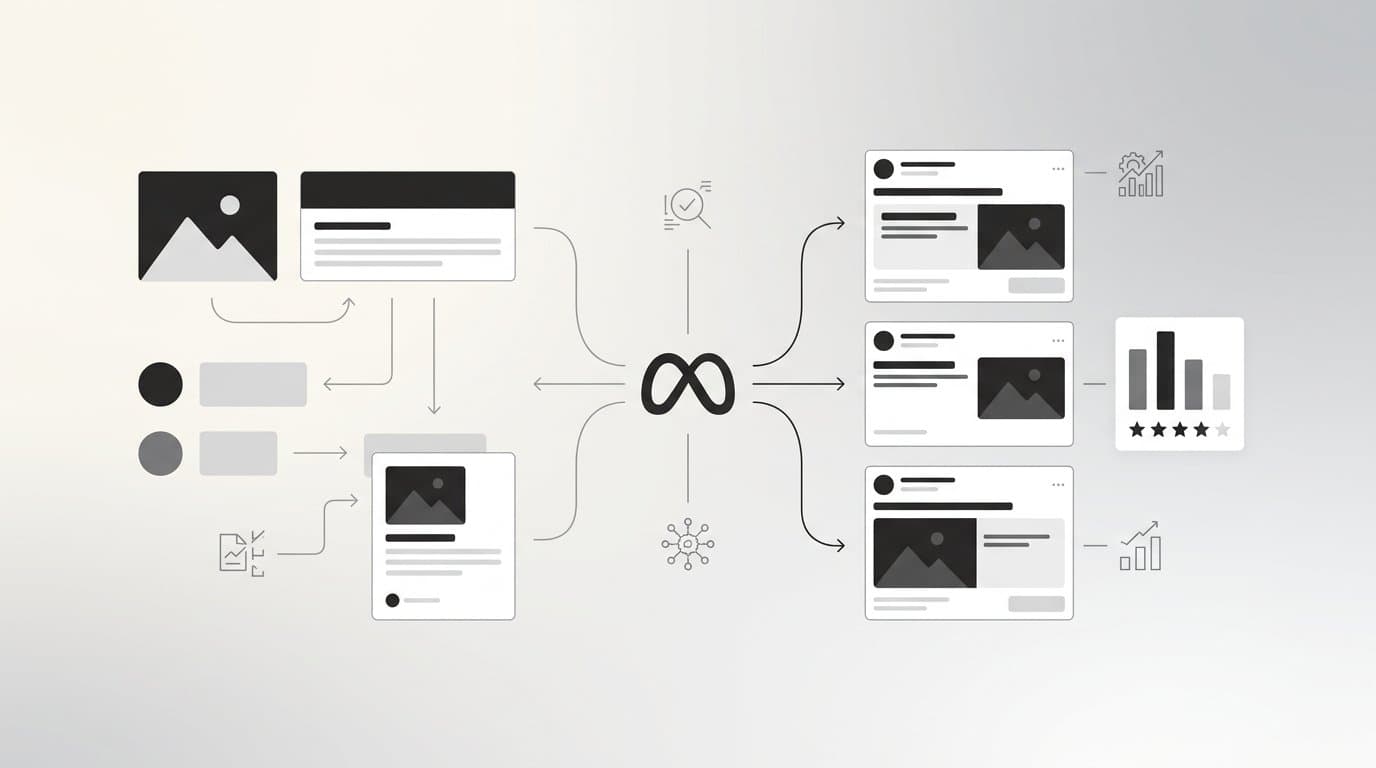
Bulk variation launching is the third piece that accelerates the entire process. Instead of testing one or two variants at a time, you generate and deploy many combinations simultaneously. Every combination runs in comparable market conditions, and you collect signal on all of them at once rather than waiting weeks for sequential tests to complete. The time between forming a hypothesis and getting data on it compresses dramatically, which means you can iterate faster and find winners sooner.
This is exactly what AdStellar's Bulk Ad Launch feature is built for. You mix multiple creatives, headlines, audiences, and copy variations, and AdStellar generates every combination and launches them to Meta in clicks rather than hours. What used to take a full day of manual setup becomes a matter of minutes.
Turning Unclear Data Into a Repeatable System With AI
Even with a well-structured testing framework, the volume of data that a multi-variant campaign generates can be overwhelming to analyze manually. When you are running dozens of creative and audience combinations simultaneously, manually comparing performance across every permutation is not a realistic workflow. This is where AI changes the equation.
AI-powered platforms can process performance data across every creative, headline, audience, and landing page simultaneously and rank each element against your actual goals, whether that is ROAS, CPA, or CTR, rather than defaulting to platform-level metrics that may not align with what you care about. The difference between this and manual analysis is not just speed. It is comprehensiveness. A human analyst reviewing a campaign will naturally focus on the top and bottom performers and miss the nuanced patterns in the middle. An AI system for Meta ads scores every element against your benchmarks without bias or fatigue.
The practical impact is that you stop spending time interpreting data and start spending time acting on ranked signal. Instead of asking "which of these 40 ad variants is performing best?", you get a ranked leaderboard that answers that question automatically. Instead of manually tracking which creatives have worked across past campaigns, a winners library surfaces proven elements automatically when you are ready to build your next campaign.
AdStellar's AI Insights feature does exactly this. Leaderboards rank your creatives, headlines, copy, audiences, and landing pages by real metrics: ROAS, CPA, and CTR. You set your target goals and the AI scores everything against your benchmarks, so you can instantly spot winners and understand why they are winning. The Winners Hub then collects your best-performing elements in one place with real performance data attached, so selecting proven components for your next campaign takes seconds rather than hours of cross-referencing spreadsheets.
The system also improves over time. Every campaign adds more data to the model, which means the AI's ability to predict which combinations are likely to perform improves with each iteration. This is the compounding advantage that separates advertisers who build intelligent systems from those who start from scratch every time.
AdStellar's AI Campaign Builder ties it all together by analyzing your past campaigns, ranking every creative, headline, and audience by performance, and building complete Meta ad campaigns in minutes. Every decision is explained with full transparency so you understand the strategy behind the output, not just the output itself.
The Bottom Line on Winning Elements
Unclear winning elements are not evidence that Meta advertising is unpredictable. They are evidence that the measurement and testing infrastructure is not set up to isolate signal from noise. The platform's default reporting, the algorithm's early delivery bias, and the interaction effects between creative, headline, copy, and audience all work together to obscure what is actually driving results.
The path forward is straightforward even if the execution takes some discipline. Understand what each element controls and measure it with the metric that corresponds to its function in the funnel. Structure tests so that only one variable changes at a time and all variants run in comparable conditions. Build a winners library so that proven elements compound across campaigns rather than getting lost in old ad account history. And use a system that surfaces winners automatically rather than requiring you to manually interpret hundreds of data points every week.
When those pieces are in place, the fog lifts. You stop guessing and start making decisions based on ranked, verified signal. That is the difference between running ads and running a system that learns and improves over time.
If you are ready to stop digging through Ads Manager trying to piece together what is working, Start Free Trial With AdStellar and be among the first to launch and scale your ad campaigns faster with an intelligent platform that automatically builds and tests winning ads based on real performance data, from creative generation to winner identification, all in one place.