Budget approved. Audiences dialed in. Campaign strategy mapped out and ready to execute. The only thing standing between you and launch is the creative, and it's not ready.
The designer has three other projects in the queue. The video needs another round of revisions. The UGC concept you wanted to test is still waiting on a brief. Meanwhile, the trending moment you were planning to capitalize on is already fading, and your competitor just dropped a fresh batch of ads that are almost certainly eating into your audience.
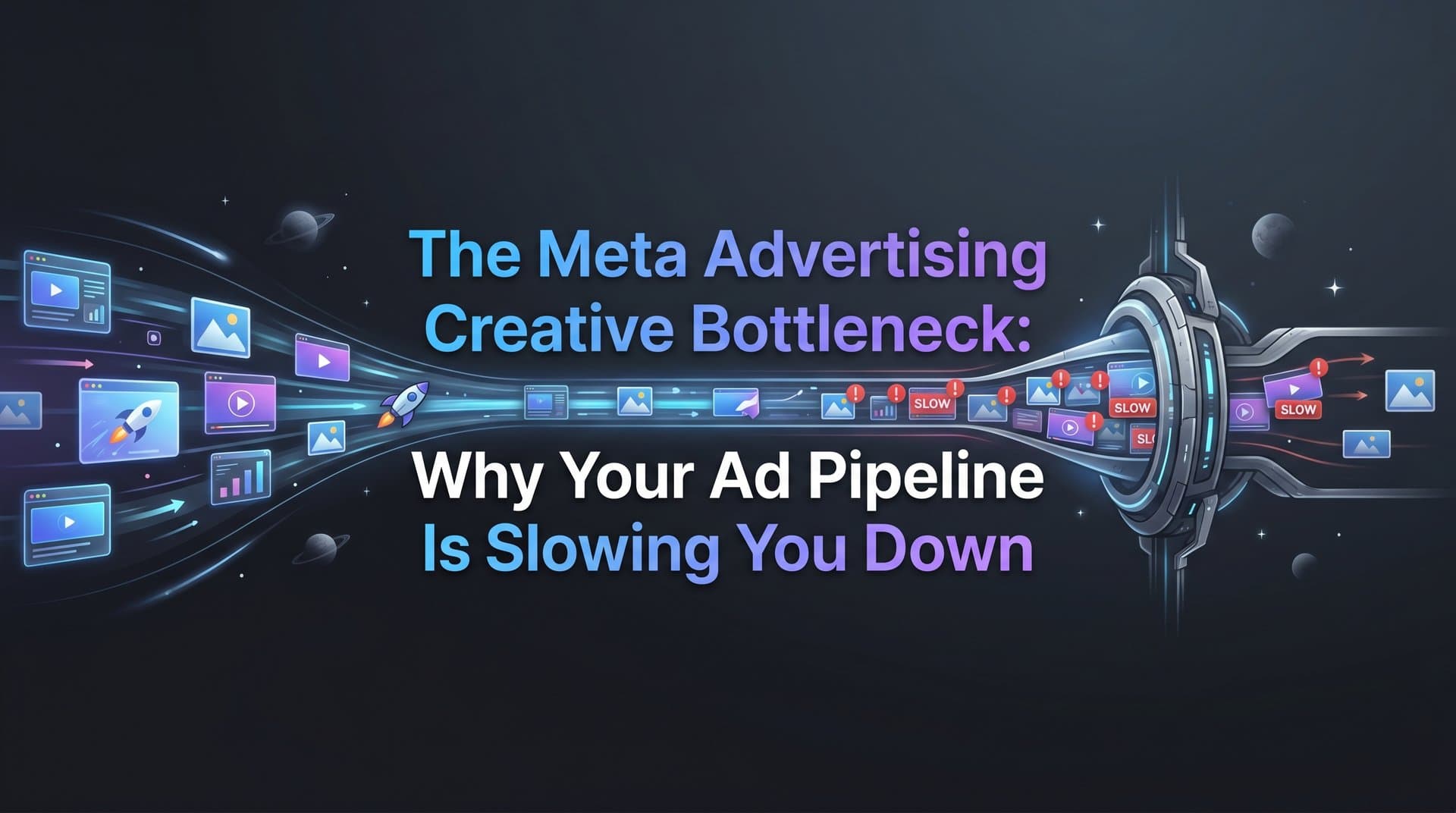
This is the meta advertising creative bottleneck, and if you run performance campaigns on Facebook or Instagram, you have almost certainly felt it. It's that specific friction where everything else is ready to go, but the creative pipeline can't keep up with the pace the platform actually demands.
Here's the underlying tension: Meta's algorithm is built to reward volume, variety, and speed. It wants fresh creative combinations to test, multiple formats to place across surfaces, and a steady stream of new assets to optimize against your goals. But most creative production workflows were designed for a completely different era of advertising, one with longer lead times, fewer formats, and far less pressure to iterate continuously.
The gap between what Meta rewards and what traditional production can deliver is where performance gets lost. This article breaks down exactly where that bottleneck forms, what it actually costs you, and how modern teams are building systems to get out of it permanently.
How the Creative Bottleneck Actually Forms
To understand why the bottleneck exists, you have to look at where the creative production process came from. The traditional chain, briefing, design, review, revision, approval, was built for brand campaigns. Those campaigns had weeks of lead time, consistent formats, and the expectation that a single polished asset would run for months. The workflow made sense for that context.
Performance advertising on Meta operates on a completely different clock. Creative fatigue is a documented platform behavior where repeated exposure to the same ad causes engagement to drop and costs to rise. Meta's Ads Manager even surfaces frequency and fatigue warnings directly in the interface. What performed well last week can show declining returns this week, not because the targeting changed or the budget shifted, but simply because the audience has seen it too many times.
This creates a baseline production requirement that traditional workflows were never designed to meet. You're not refreshing creative quarterly or even monthly. You're refreshing it continuously, sometimes weekly, sometimes faster in competitive categories.
The problem compounds at scale. A single campaign doesn't need one ad, it needs multiple creative formats for different placements, audience-specific messaging variations, and enough A/B test variants to generate statistically meaningful data. What feels like a simple request, "can you make a few new ads for this campaign," quickly expands into dozens of individual production tasks when you map it out.
Each of those tasks moves through the same briefing, design, review, revision, approval chain. Each one waits for designer availability. Each one can get held up by a single round of feedback that takes 48 hours to resolve. Multiply that across a team running multiple campaigns simultaneously, and the bottleneck isn't just a minor inconvenience. It becomes a structural constraint on how aggressively you can compete.
The root issue is a mismatch between the pace of performance advertising and the pace of the production system supporting it. Closing that gap requires understanding not just that the bottleneck exists, but exactly where it forms and what it's costing you in real terms. Teams dealing with these Meta advertising workflow bottlenecks often find the problem runs deeper than a single process failure.
The Real Cost of Slow Creative Production
The most immediate cost shows up in your metrics. When teams can't refresh assets quickly enough, ad frequency climbs. Audiences see the same creative repeatedly, engagement drops, and Meta's algorithm responds by increasing CPM to find new people who haven't seen the ad yet. The result is a rising cost-per-result and declining ROAS, not because your targeting is wrong or your offer is weak, but because the creative is exhausted and there's nothing new to replace it with.
This is a particularly frustrating performance pattern because it can look like a targeting problem or a bidding problem when it's actually a production problem. Teams spend time adjusting audiences and budgets when what they actually need is fresh creative, but fresh creative isn't ready, so the cycle continues.
Beyond the direct metrics impact, slow creative pipelines generate significant opportunity cost. Trending moments on social platforms have short windows. Seasonal peaks like major shopping events or cultural moments create brief periods where the right creative at the right time can deliver outsized results. Competitor gaps, moments when a major player in your space pulls back or runs ineffective ads, close quickly. If your production pipeline takes five to seven days to move a concept from brief to live ad, most of those windows will close before you can capitalize on them.
There's also a hidden cost that rarely shows up in performance reports: team strain. Designers and creative professionals pulled into performance ad production often face a specific kind of friction. The briefs arrive late and are frequently unclear. Revision requests come in after hours. The feedback cycle is driven by urgency rather than craft. Over time, this creates a dynamic where creative quality suffers, team morale declines, and the people responsible for production become a source of organizational tension rather than a strategic asset.
Lean marketing teams running Meta advertising feel this most acutely. When one or two designers are responsible for supporting multiple campaigns across multiple channels, performance ad requests compete directly with brand work, social content, website updates, and everything else on the production queue. Something always gets deprioritized, and it's usually the performance creative that needs to move fastest.
The cumulative effect is a team that's perpetually behind, running ads that are older than they should be, spending more than necessary to maintain performance, and missing opportunities that faster competitors are capturing instead.
Where Most Teams Get Stuck: The Three Chokepoints
The creative bottleneck isn't one single problem. It's three distinct chokepoints that compound each other, and most teams are dealing with all three simultaneously without necessarily recognizing them as separate issues.
Chokepoint One: Ideation and Briefing
Performance marketers are typically strong at reading data. They can identify that a particular audience segment is underperforming, that a specific placement is driving higher CPAs, or that a competitor appears to be testing a new angle. What's harder is translating those data insights into clear, actionable creative direction that a designer can execute without extensive back-and-forth.
The result is briefs that are either too vague, "make something that converts better," or too prescriptive in ways that miss the actual creative opportunity. First drafts come back misaligned. Revision rounds multiply. By the time the creative is actually usable, the insight that prompted it may already be outdated.
Chokepoint Two: Production Capacity
Even with a perfect brief, producing image ads, video ads, and UGC-style content requires specialized skills, specific tools, and dedicated time. Most lean marketing teams simply don't have these resources in abundance. Video production in particular requires equipment, editing software, and significant time investment that scales poorly when you need to produce dozens of variations across multiple campaigns.
UGC-style content, which industry practitioners widely report tends to drive strong engagement on Meta, typically requires either actors, paid creators, or both. For small teams without established creator relationships, this is a significant production barrier every single time a new concept needs to be tested.
Chokepoint Three: Testing Throughput
This is the chokepoint that often goes unrecognized until a team starts seriously analyzing their testing data. Producing one or two creative variants per campaign isn't enough to generate meaningful performance signals. Meta's algorithm needs sufficient volume of creative combinations to identify what's actually working versus what's performing well by chance.
But generating that volume through manual production is impractical for most teams. If each creative variant takes a day or more to produce, getting to ten or fifteen meaningful test variations requires weeks of production time. By then, the campaign context has changed, the data is stale, and you're back to guessing rather than optimizing. A structured Meta ads creative testing strategy is essential to breaking through this specific chokepoint.
Each of these chokepoints reinforces the others. Slow ideation delays production. Limited production capacity restricts testing volume. Insufficient testing data makes the next round of ideation harder because there are fewer clear signals to brief from. The bottleneck becomes self-reinforcing.
Why Meta's Algorithm Makes This Worse, Not Better
If Meta's ad delivery system were neutral on creative volume, the bottleneck would be painful but manageable. The problem is that the algorithm actively favors advertisers who can feed it more. More creative variations, more combinations to test, more fresh assets to optimize against your campaign goals.
This is foundational to how features like Advantage+ Shopping Campaigns and dynamic creative work. The system is designed to find the best-performing combination of creative, headline, copy, and audience from the inputs you provide. The more inputs you give it, the more combinations it can explore, and the better it can optimize toward your target metrics. A team that can generate fifty creative variations gives the algorithm dramatically more to work with than a team running three.
Advantage+ placements add another layer of complexity. A single creative asset gets stretched across Feed, Stories, Reels, Marketplace, and the Audience Network, each with different aspect ratios, different audience contexts, and different creative best practices. An image designed specifically for Feed may render awkwardly in Stories. A video optimized for Reels may not translate effectively to a sidebar placement. Assets built without multi-format considerations in mind often underperform across placements, which shows up as inconsistent delivery and inflated CPMs.
Creative fatigue signals arrive faster in competitive categories. Rising frequency, declining CTR, and increasing CPM are the visible symptoms, and they compound quickly once they start. In highly competitive niches like DTC ecommerce, direct response, and subscription products, the effective lifespan of a given ad can be surprisingly short. The baseline production volume a team needs just to maintain stable performance, not to grow, not to test aggressively, but simply to hold position, is higher than most teams initially plan for. Understanding Meta advertising best practices around creative refresh cycles can help teams set more realistic production benchmarks from the start.
The algorithm isn't doing anything wrong. It's doing exactly what it's designed to do. But its design assumes a level of creative throughput that traditional production workflows can't match. The teams that perform best on Meta are the ones who have figured out how to close that gap.
Breaking the Bottleneck: How AI-Powered Creative Changes the Equation
The core problem with the creative bottleneck is a throughput problem. Traditional production can't generate enough volume, fast enough, to match what Meta's algorithm rewards. AI-powered creative generation directly addresses that constraint.
Platforms like AdStellar can produce image ads, video ads, and UGC-style avatar content directly from a product URL or brief. The ideation-to-production timeline, which traditionally spans days or weeks across briefing, design, revision, and approval, compresses to minutes. You don't need a designer on call, a video editor in the queue, or an actor booked for a UGC shoot. The creative generates from your product inputs, and you can refine it through chat-based editing without starting over from scratch.
This changes the fundamental economics of creative production. Instead of treating each ad as a resource-intensive project, you can treat creative generation as an ongoing operational process that runs in parallel with your campaign strategy rather than behind it. The rise of Meta ads creative automation has made this shift accessible even for teams without dedicated production resources.
The volume question gets solved through bulk creation. AdStellar's Bulk Ad Launch lets you mix multiple creatives, headlines, audiences, and copy variations simultaneously, generating hundreds of ad combinations and launching them to Meta in minutes rather than hours. This is the throughput the algorithm needs to do its job effectively. Instead of giving Meta three variations to optimize, you're giving it fifty, and the performance gap between three inputs and fifty is not marginal.
But volume without performance intelligence just creates noise. The platforms that actually break the bottleneck permanently are the ones that close the loop between creative production and performance data. AdStellar's AI Insights feature surfaces leaderboard rankings across creatives, headlines, copy, audiences, and landing pages, scored against real metrics like ROAS, CPA, and CTR. You set your target goals, and the AI scores every asset against your benchmarks so you can immediately identify what's winning and what isn't.
The Winners Hub takes this further by centralizing your best-performing assets with their actual performance data attached. When you're ready to build the next campaign, you're not starting from a blank brief. You're starting from a library of validated winners, which accelerates ideation, reduces revision cycles, and gives the next round of creative a much stronger foundation than guesswork.
The AI Campaign Builder adds another layer: it analyzes your historical campaign data, ranks every creative and audience element by performance, and builds complete Meta campaigns in minutes with full transparency into the reasoning behind every decision. The system gets smarter with each campaign cycle, meaning the longer you use it, the better its recommendations become. Teams evaluating the best AI Meta advertising tools consistently find that closed-loop platforms outperform point solutions that handle only one part of the workflow.
Building a Creative System That Scales With Your Campaigns
Breaking the bottleneck once is useful. Breaking it permanently requires a shift in how you think about creative production at the operational level.
The most important shift is moving from a project-based model to a systems-based model. In a project-based model, each creative request is a discrete task with its own brief, timeline, and approval process. In a systems-based model, creative production is an always-on workflow with clear frameworks for generating, testing, scoring, and retiring assets on a continuous cycle. The difference isn't just efficiency. It's the difference between reacting to creative fatigue after it's already hurting performance and staying ahead of it proactively. Investing in Meta advertising workflow optimization is what separates teams that consistently scale from those that plateau.
Competitor intelligence is an underused accelerant in this system. Meta's Ad Library is publicly accessible and contains a searchable archive of active ads across the platform. Rather than starting every creative cycle from scratch, teams can analyze what competitors and category leaders are running, identify the creative frameworks and formats that appear to be gaining traction, and use those as validated starting points for their own testing. AdStellar's AI Creative Hub lets you clone competitor ads directly from the Meta Ad Library, which collapses the ideation phase even further by giving you real-world creative frameworks to build from rather than hypothetical concepts to validate.
The teams that escape the creative bottleneck permanently are the ones that close the loop between production and analytics. This means treating performance data not just as a reporting output, but as a creative input. When your AI Insights leaderboard shows that a specific headline structure consistently outperforms alternatives, that insight should directly inform the next batch of creative briefs. When your Winners Hub shows that a particular visual style drives stronger ROAS in a specific audience segment, that element should be systematically tested across more variations rather than treated as a one-off win.
This feedback loop is what separates teams that are always scrambling to catch up from teams that are continuously improving. Each campaign cycle generates data. That data informs the next creative generation. The next generation produces better performance signals. The system compounds over time in a way that purely manual, project-based production never can.
Scaling this system doesn't require scaling headcount. It requires the right infrastructure. Clear frameworks for briefing and generation, AI tools that handle the production heavy lifting, performance analytics that surface actionable signals, and a centralized hub for winners that makes institutional knowledge accessible rather than locked in individual memory.
The Bottom Line on Creative Bottlenecks
The meta advertising creative bottleneck is not fundamentally a creative problem. It's a systems problem. The gap between what Meta's algorithm rewards and what traditional production workflows can deliver is real, and it widens as campaigns scale and competition intensifies.
The path forward isn't hiring more designers or pushing creative teams harder. It's building a production system that matches the pace of performance advertising. One that generates volume without sacrificing quality, surfaces winners without requiring hours of manual analysis, and continuously learns from what works to make the next cycle faster and more effective.
Every element of that system exists today. AI creative generation that produces image ads, video ads, and UGC-style content in minutes. Bulk launching that gives the Meta algorithm hundreds of combinations to optimize. Performance insights that score every asset against your actual goals. A winners library that feeds institutional knowledge back into the next campaign. And an AI campaign builder that gets smarter with every cycle.
If your creative pipeline is the thing holding your Meta campaigns back, the solution isn't to work around the bottleneck. It's to build a system that eliminates it. Start Free Trial With AdStellar and be among the first to launch and scale your ad campaigns faster with an intelligent platform that automatically builds and tests winning ads based on real performance data.