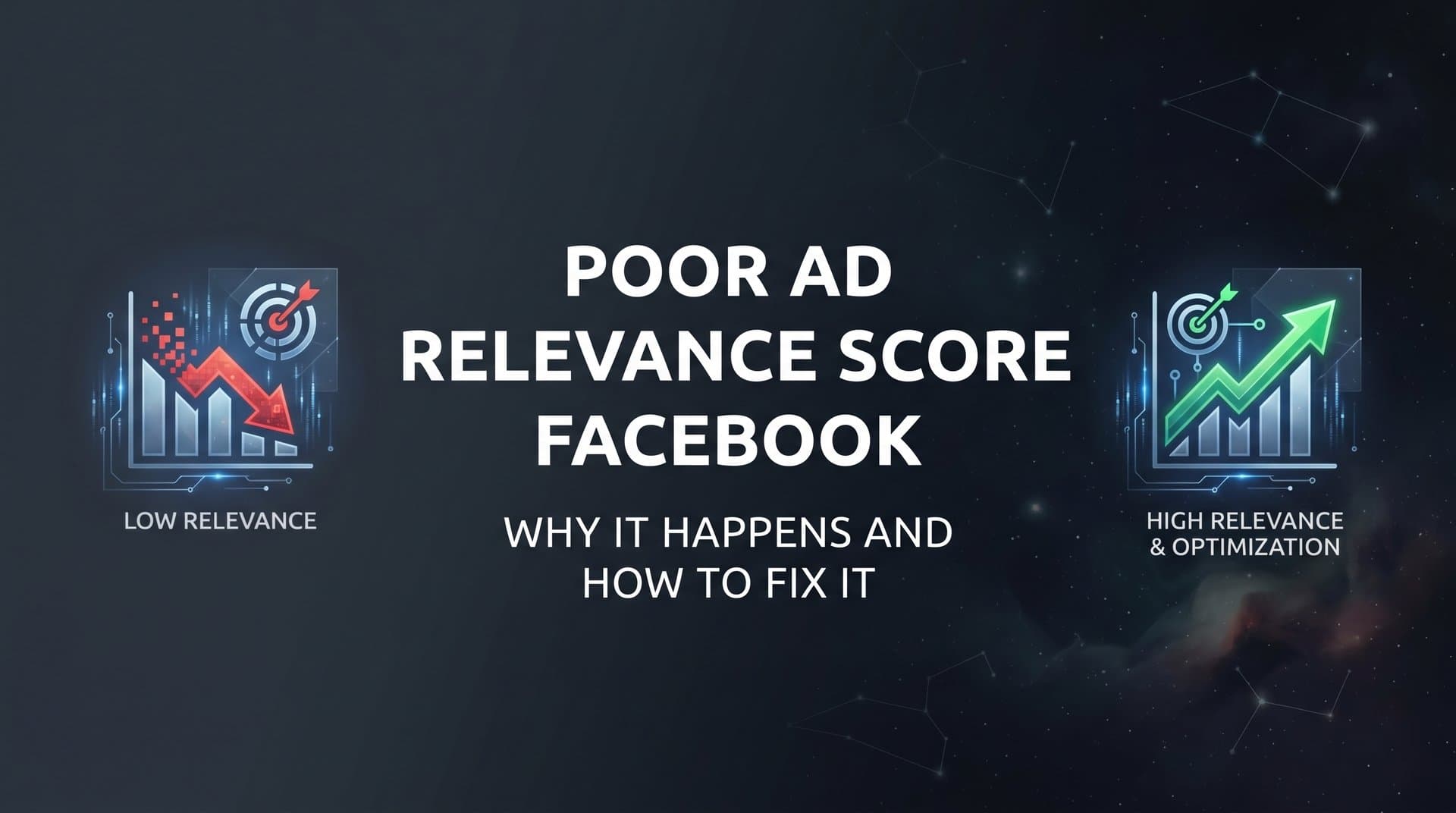
Budget is flowing, the campaign is live, and you're refreshing the dashboard expecting results. Instead, you're staring at underwhelming numbers: high costs, low engagement, and delivery that barely makes a dent. Then you dig into the diagnostics tab and there it is. A below-average relevance ranking staring back at you.
If this feels familiar, you're not alone. A poor ad relevance score on Facebook is one of the most common (and most misunderstood) signals that Meta surfaces for advertisers. Many people either ignore it entirely or panic and kill the campaign. Neither response is the right move.
What Meta's ad relevance diagnostics are actually telling you is something more useful: your ad isn't connecting with the audience you're targeting. That disconnect could be rooted in the creative, the targeting, the post-click experience, or some combination of all three. The good news is that each of those problems has a concrete fix.
This article breaks down exactly how Facebook's relevance diagnostics work, what drives poor scores, and the specific strategies you can use to turn things around. Whether you're managing campaigns for a single brand or running ads across dozens of client accounts, understanding these signals is one of the fastest ways to reduce wasted spend and improve overall performance.
Understanding Facebook's Ad Relevance Diagnostics
Back in 2019, Meta retired the single ad relevance score and replaced it with three separate diagnostics. This change was significant because it gave advertisers a much more granular view of where their ads were underperforming. Instead of one vague number, you now get three distinct signals that point to specific areas for improvement.
The three diagnostics are Quality Ranking, Engagement Rate Ranking, and Conversion Rate Ranking. Each one measures something different, and understanding the distinction matters a lot when you're trying to diagnose what's actually going wrong.
Quality Ranking measures how your ad's perceived quality compares to other ads competing for the same audience. Meta evaluates quality signals like negative feedback (people hiding or reporting your ad), engagement patterns, and overall creative quality. Think of this as how well your ad holds up against the competition in the same auction.
Engagement Rate Ranking compares your expected engagement rate against ads targeting the same audience. This covers likes, comments, shares, link clicks, and other interactions. A below-average engagement ranking usually signals that your creative or copy isn't resonating with the people you're trying to reach, which is a key factor behind poor Facebook ad performance overall.
Conversion Rate Ranking is where things get interesting. This diagnostic compares your expected conversion rate against ads with the same optimization goal competing for the same audience. Crucially, this ranking is influenced by what happens after the click, not just the ad itself. If your landing page is slow, confusing, or misaligned with your ad's promise, it will show up here.
Each diagnostic is rated on a simple scale: Below Average (bottom 35% of ads), Average, Above Average (top 55%), or Top (top 10%). According to Meta's own documentation, these rankings compare your ad's performance against other ads that competed for the same audience during the same time period.
There are two important caveats worth noting. First, these diagnostics are only meaningful after your ad has received at least 500 impressions. Before that threshold, the data isn't statistically reliable. Second, Meta is clear that relevance diagnostics are supplementary diagnostic tools, not direct inputs into the ad auction. Your primary optimization focus should still be on business outcomes like purchases, leads, and ROAS. The diagnostics help you understand why those outcomes might be suffering, not replace them as your north star.
What a Poor Relevance Score Is Actually Costing You
Here's where things get expensive. Meta's ad auction doesn't just consider your bid. It weighs a combination of bid amount, estimated action rates, and ad quality. When your relevance diagnostics are poor, it's a signal that your ad is delivering a subpar experience to users, and Meta's system responds accordingly.
The most direct impact is on your CPM (cost per thousand impressions) and CPA (cost per acquisition). Ads that Meta's system perceives as low quality or low relevance tend to cost more per result because they have to "outbid" their way into delivery rather than earning favorable placement through strong quality signals. You end up paying a premium for worse outcomes, which is why learning how to improve Facebook ad ROI starts with understanding these diagnostics.
Beyond raw cost, there's a delivery throttling effect that compounds the problem. When your ad relevance diagnostics are poor, Meta's algorithm deprioritizes your ads in the auction. You get fewer impressions, and the impressions you do get are often lower-quality placements. The budget gets spent, but it's working much harder than it should for much less return.
The most insidious problem is the compounding cycle that poor relevance creates over time. Here's how it works: low relevance leads to fewer impressions, fewer impressions mean fewer clicks, fewer clicks mean fewer conversions, and fewer conversions starve Meta's algorithm of the conversion signals it needs to optimize delivery. The algorithm learns from your campaign's data, and if that data is sparse or skewed toward low-quality interactions, performance degrades further.
This is why catching a poor ad relevance score on Facebook early matters so much. The longer you let a low-relevance ad run without intervention, the harder it becomes to recover because the algorithm has already learned unfavorable patterns from your campaign data. Early detection and quick iteration aren't just best practices; they're the difference between a recoverable campaign and one that needs to be rebuilt from scratch.
Five Root Causes Behind Below-Average Rankings
Most poor relevance scores trace back to a handful of recurring problems. Identifying which one (or which combination) is affecting your campaign is the critical first step before making any changes.
Audience Mismatch: This is the most common culprit. When your ad is shown to people who have no real interest in your offer, you get low engagement, high negative feedback, and poor conversion rates. Targeting too broadly means your ad competes in auctions where it simply doesn't belong. Targeting too narrowly can limit your reach so severely that the algorithm can't find the right people within your constraints. Both extremes hurt relevance.
Creative Fatigue: Running the same ad creative for too long is a well-documented performance killer. As your target audience sees the same visual and copy repeatedly, engagement drops, negative feedback increases, and your Quality Ranking slides. This happens faster than most advertisers expect, especially with smaller, more defined audiences who cycle through your ad quickly. Generic stock imagery compounds this problem because it fails to stop the scroll even on first exposure.
Weak Creative-Audience Alignment: Even a technically strong creative can underperform if it's shown to the wrong audience. An ad that resonates perfectly with a 35-year-old fitness enthusiast might fall completely flat with a 22-year-old college student, even if both theoretically fit your customer profile. The message, tone, and visual style need to match the specific audience segment you're targeting. Managing too many Facebook ad variables without a systematic approach makes this alignment even harder to achieve.
Post-Click Disconnect: This one directly impacts your Conversion Rate Ranking and is often overlooked because advertisers focus on the ad itself rather than what happens after the click. If your ad promises a specific product or offer but lands users on a generic homepage, conversions suffer. Slow page load times have a similar effect. Meta tracks post-click behavior including bounce signals and conversion events, and that data feeds directly back into how your conversion rate for Facebook ads is calculated.
Misaligned Campaign Objective: Choosing the wrong campaign objective for your actual goal creates a fundamental mismatch. If you're running a Traffic objective but your real goal is purchases, Meta will optimize for clicks rather than buyers. The people who click may have no purchase intent, which tanks your conversion metrics and, over time, your Conversion Rate Ranking. Aligning your objective with your actual business goal is a foundational step that many advertisers skip when troubleshooting relevance issues.
Fixing Your Quality Ranking: Creative That Actually Connects
If your Quality Ranking is below average, the message is clear: your creative isn't holding up against the competition in your auction. The fix requires a deliberate approach to both what you're showing and how quickly you're refreshing it.
The most effective creative formats for improving quality signals tend to be those that feel native to the platform. UGC-style video content, where someone speaks directly to camera about a product or demonstrates it in a real-world context, consistently outperforms polished studio creative in many verticals. It feels less like an ad, which means users are less likely to scroll past or hide it. Benefit-driven imagery that shows the outcome or transformation rather than just the product also tends to perform stronger than feature-focused visuals.
Testing multiple formats matters as much as the format itself. Static images, video ads, and carousels each have different strengths depending on the audience, placement, and offer. Running variations across formats lets the data tell you what works rather than relying on assumptions. The goal is to enter every auction with multiple creative options so Meta's system can identify and favor the strongest performers. Understanding how to create a successful Facebook ad means embracing this multi-format testing approach.
Ad copy alignment is often underestimated as a quality signal. Your headline and primary text need to speak directly to the pain point or desire that your target audience has, not just describe what you're selling. "Stop wasting budget on ads that don't convert" hits differently than "Try our ad platform today." The former speaks to a felt frustration; the latter is just a product pitch. When your copy connects with your audience's actual mindset, engagement improves and negative feedback drops.
The practical challenge for most advertisers is the time and resources required to produce fresh creative at the pace the algorithm demands. This is where AI-powered Facebook ads tools change the equation. Platforms like AdStellar can generate multiple ad variations from a single product URL, including image ads, video ads, and UGC-style avatar content, without requiring designers, video editors, or production budgets. You can also clone competitor ads directly from the Meta Ad Library and use them as a starting point for your own creative testing. The ability to rapidly generate and test new creative variations means you're never stuck running fatigued ads while waiting for new assets to be produced.
Boosting Engagement and Conversion Rankings Through Smarter Targeting
Creative quality gets your foot in the door, but targeting precision determines whether your ad lands in front of people who are genuinely likely to engage and convert. Improving your Engagement Rate Ranking and Conversion Rate Ranking requires both better audience selection and a systematic approach to learning from performance data.
Lookalike audiences built from your highest-value customers remain one of the most reliable targeting strategies on Meta. When you seed a lookalike with a list of people who have actually purchased, subscribed, or completed a high-value action, Meta's algorithm identifies the common characteristics of that group and finds similar users. The resulting audience is far more likely to engage meaningfully with your ad than a broad interest-based audience. Proper Facebook campaign optimization starts with getting this audience foundation right.
Interest layering and exclusions add another layer of precision. Layering multiple relevant interests narrows your audience to people who fit multiple criteria simultaneously. Exclusions are equally important: removing existing customers, recent purchasers, or people who have already converted prevents wasted spend and keeps your engagement rates clean. An audience of people who have already bought your product is unlikely to convert again, and their lack of response will drag down your Engagement Rate Ranking.
The real competitive advantage comes from using performance data to make targeting decisions rather than intuition. Leaderboard-style analytics that rank your audiences, creatives, headlines, and copy by actual metrics like ROAS, CPA, and CTR give you a clear picture of what's working and what isn't. AdStellar's AI Insights feature does exactly this: it ranks every element of your campaign against your stated goals so you can instantly identify which audience segments are driving results and which are dragging performance down.
Bulk ad launching takes this a step further by letting you systematically test creative-audience combinations at scale. Instead of manually building individual ad sets to test each hypothesis, you can generate hundreds of variations mixing different creatives, headlines, audiences, and copy, then launch multiple Facebook ads quickly in minutes. The data comes back faster, winners emerge sooner, and you stop guessing which combination will resonate. This kind of systematic testing is how you move from reactive troubleshooting to proactive optimization.
Building a System That Keeps Relevance Strong Over Time
Fixing a poor ad relevance score on Facebook is a meaningful win. Keeping scores strong across all your campaigns over time requires building a system, not just applying one-time fixes.
Start with a regular review cadence. Checking your relevance diagnostics alongside core metrics like ROAS, CPA, and CTR on a weekly basis lets you catch declining scores before they drain significant budget. A Quality Ranking that drops from Average to Below Average is a signal to refresh creative immediately, not in two weeks when performance has already deteriorated. Early intervention costs far less than campaign recovery.
Building a winners library is one of the highest-leverage habits you can develop as a performance marketer. Every time a creative, headline, audience segment, or piece of copy significantly outperforms your benchmarks, it gets saved. When you launch a new campaign, you start with proven elements rather than building from zero. This approach of reusing winning Facebook ad elements compresses the learning phase, reduces the budget required to find winners, and keeps your relevance diagnostics consistently strong because you're entering the auction with assets that have already demonstrated their ability to resonate.
AdStellar's Winners Hub is built specifically for this purpose. It aggregates your best-performing creatives, headlines, audiences, and more in one place with the real performance data attached. When you're ready to launch a new campaign, you can pull directly from your winners and combine them with fresh variations through the AI Campaign Builder. The AI analyzes your historical campaign data, ranks every element by performance, and builds Facebook ad campaigns faster in minutes with full transparency into the rationale behind every decision.
The result is a continuous improvement loop where every campaign makes the next one smarter. Creative generation feeds testing, testing surfaces winners, winners inform future campaigns, and the AI gets better at predicting what will work as it accumulates more data from your account. This is the difference between treating relevance as a problem to fix and treating it as a system to optimize.
Your Next Steps Toward Better Ad Performance
A poor ad relevance score on Facebook is not a verdict on your product or your marketing ability. It's a diagnostic signal pointing toward a specific gap between what you're showing, who you're showing it to, and what happens after they click. That's actually good news because all three of those gaps are fixable.
The path forward is straightforward. Audit your three diagnostics to identify whether the issue is quality, engagement, conversion, or some combination. Refresh your creative if Quality Ranking is suffering. Tighten your targeting and add meaningful exclusions if Engagement Rate Ranking is below average. Fix your landing page alignment and post-click experience if Conversion Rate Ranking is the problem. Then build a system for ongoing testing so you catch issues early and continuously improve.
The advertisers who consistently maintain strong relevance diagnostics aren't necessarily the ones with the biggest budgets or the most experienced teams. They're the ones who test more, iterate faster, and make decisions based on data rather than assumptions.
If you want to accelerate that process, Start Free Trial With AdStellar and be among the first to launch and scale your ad campaigns faster with an intelligent platform that automatically builds and tests winning ads based on real performance data. Generate fresh creatives, launch optimized campaigns, and surface your winners, all from a single platform with a 7-day free trial and no guesswork required.