Ready to actually move the needle on your conversion rate on Facebook ads? Let's be honest, throwing random tactics at the wall and hoping something sticks is a recipe for burning cash. The real key is building a data-driven system.
A killer conversion rate isn't magic. It's built on three core pillars: flawless tracking, thumb-stopping creative, and a frictionless user journey. Get these right, and you're golden.
Establishing Your Foundation for Higher Conversions
Before you can even think about improving your numbers, you need to know where you stand. What does a "good" conversion rate even look like for you? It's not some universal number; it varies wildly from one industry to another. Long-term success on Meta requires a holistic view, grounded in comprehensive conversion optimization best practices.
This is your pre-flight check. It’s time to stop guessing and start measuring with a proper system.
Defining Your Baseline With Industry Benchmarks
It’s so tempting to chase a big, round number you heard somewhere, but context is everything.
I've seen so many advertisers beat themselves up over a 3.26% conversion rate in retail, not realizing that's right around the industry average. It's a volume game for e-commerce. Meanwhile, I've worked with fitness and education clients who see conversion rates 518% higher than those in the tech space. It just goes to show how much performance can differ.
Knowing these benchmarks helps you set goals that are ambitious but achievable. If you're selling t-shirts online, jumping from 2% to 4% is a massive win that can transform your business. For many stores, a solid grasp of e-commerce advertisement fundamentals is the first real step.
To give you a clearer picture, here’s a breakdown of what you can expect across different sectors.
Facebook Ads Conversion Rate Benchmarks By Industry
Use this reference table to see how your campaign performance stacks up against the average conversion rates in your industry.
| Industry | Average Conversion Rate (%) | Average Cost Per Conversion |
|---|---|---|
| Fitness | 14.29% | $13.29 |
| Education | 13.58% | $7.85 |
| Employment & Job Training | 11.73% | $16.51 |
| Healthcare | 11.00% | $23.11 |
| Real Estate | 10.68% | $16.33 |
| B2B | 10.63% | $23.77 |
| Finance & Insurance | 9.09% | $41.43 |
| Legal | 8.95% | $29.74 |
| Home Improvement | 6.56% | $44.66 |
| Auto | 6.03% | $26.17 |
| Apparel | 4.11% | $10.98 |
| Travel & Hospitality | 3.56% | $21.80 |
| Retail | 3.26% | $14.21 |
| Technology | 2.31% | $55.21 |
(Data sourced from WordStream)
Seeing your numbers in this context should give you a much better sense of what "good" looks like for your business.
The Three Pillars of a Strong Conversion Strategy
Sustainable growth isn't about finding one "magic" ad that works forever. It’s about building a solid, repeatable system supported by three core pillars.
- Flawless Tracking: You can't improve what you don't measure. This goes way beyond just installing the Meta Pixel. It's about configuring your events and attribution models correctly. Without clean, accurate data, you’re just flying blind and making decisions based on feelings, not facts.
- Compelling Creative: Your ad creative is your first—and maybe only—shot to stop the scroll. It has to grab attention, communicate value instantly, and push someone to act. Creative fatigue is a real campaign killer, and you have to be ready to fight it constantly.
- Seamless User Journey: The experience doesn't end when someone clicks your ad. Your landing page has to deliver on the promise you made. Any friction at all—slow load times, a confusing offer, a clunky checkout process—will absolutely tank your conversion rate.
By mastering these three areas, you move from guesswork to a predictable system for growth. Each element feeds into the next, creating a powerful engine for improving your Facebook ads conversion rate and driving real business results.
Nail Your Tracking and Attribution to Get Data You Can Actually Trust
You can't fix what you don't measure. It’s a simple truth, but it’s the absolute foundation of every ad campaign I’ve ever seen succeed. Too many advertisers get lost in the weeds of creative and copy, completely overlooking the most critical part of the process. If you want to improve your conversion rate on Facebook ads, you have to start with trustworthy data—and that goes way beyond a basic Meta Pixel install.
In today's privacy-focused world, just slapping the browser-based Pixel on your site is like trying to navigate a ship with a broken compass. You're going to miss a huge chunk of user actions thanks to ad blockers, cookie restrictions, and all the iOS updates. This is where a rock-solid tracking setup becomes your secret weapon.
Go Beyond the Pixel with the Conversions API
To get the full picture of what’s really happening with your campaigns, you need to pair the Meta Pixel with the Conversions API (CAPI). Think of them as a tag team working together to make sure no conversion gets lost in translation.
- The Meta Pixel: This is the snippet of code on your website that tracks what users do in their browser. It’s great for capturing on-site behavior, but it has its limits.
- The Conversions API (CAPI): This tool sends conversion data straight from your server to Meta's. It's far more reliable because it isn't derailed by browser-level tracking blockers.
When you use both, you create what's called a redundant setup. Meta can then "deduplicate" the events, matching a browser action from the Pixel with a server action from CAPI. This gives you the most accurate data possible. Get this wrong, and you could end up scaling campaigns that are bleeding money while shutting off your potential winners.
If you need a refresher on the basics, our guide on how to set up the Facebook Pixel is a great place to start.
Prioritize Your Conversion Events (Or Meta Will Get It Wrong)
Once your tracking is solid, you have to tell Meta what actions actually matter to your business. This is handled through Aggregated Event Measurement, Meta’s system for navigating Apple's privacy framework. You get to configure up to eight standard events and, most importantly, rank them by priority.
For an e-commerce store, a smart priority list would look something like this:
- Purchase (Highest Priority)
- Initiate Checkout
- Add to Cart
- View Content (Lowest Priority)
Why is this ranking so critical? Because if a user completes multiple actions—say, they add a product to their cart and then complete the purchase—Meta will only report the highest-priority event. In this case, the Purchase.
Getting this right tells the algorithm precisely what you want it to optimize for. I've seen advertisers mistakenly put 'Add to Cart' as their top event, and Meta’s algorithm dutifully went out and found an army of people who loved filling up shopping carts but never actually bought anything.
Pro Tip: Your number one priority event should always be your most valuable bottom-of-funnel action, whether that's a purchase or a completed lead form. This is your clearest instruction to the ad delivery system about what outcome you value most.
Finally, Get a Handle on Attribution Windows
The last piece of the puzzle is understanding how Meta gives credit for conversions. An attribution window is the time period after someone sees or clicks your ad during which a conversion can be tied back to that ad. The default setting is usually a 7-day click and 1-day view.
- 7-Day Click: If someone clicks your ad and converts within seven days, the ad gets the credit.
- 1-Day View: If someone just sees your ad (no click) and converts within one day, the ad still gets credit.
This distinction is massive. A campaign racking up a lot of 1-day view conversions might be an incredible brand awareness driver, pushing users to convert later through another channel. On the other hand, a campaign dominated by 7-day click conversions shows an immediate, direct impact.
If you misinterpret these numbers, you’ll misjudge a campaign's true value. For example, you might kill a top-of-funnel campaign that’s brilliantly teeing up future customers just because it isn't driving immediate click-through sales. Solid tracking isn't just a technical box to check; it’s the strategic bedrock for every single optimization decision you make from here on out.
When your numbers start to tank, the first instinct is usually to panic. You might kill the campaign entirely, slash the budget, or just start throwing new creatives at the wall, hoping something sticks.
But that's reacting, not strategizing. A poor conversion rate isn't the disease; it's a symptom.
Instead of scrambling, we need to get methodical. The trick is to follow the user’s journey step-by-step, like a detective tracing a suspect's path. This lets us pinpoint exactly where the trail goes cold. Think of your campaign as a funnel—if there's a leak, you need to find the specific hole, not just put a bucket under the whole thing.
From Impression to Click: Did You Even Stop the Scroll?
This is where it all begins: your ad’s debut in the feed. Did it grab attention? Was the hook strong enough to earn a click? The number one metric to watch here is your Click-Through Rate (CTR).
A low CTR is your canary in the coal mine. It’s an early warning that your creative, your copy, or your targeting is missing the mark. People are seeing your ad, but they’re just scrolling right on by. This is often a classic case of ad fatigue—your audience has seen the same ad so many times it's become invisible.
To get a struggling CTR back on track, ask yourself these questions:
- Is the creative stale? Try a totally different visual concept. Sometimes a simple static image will outperform a slick video, or a raw, user-generated content (UGC) style ad will connect better than a polished studio shot.
- What about the hook? Does the first line of your copy make someone stop and think? Does the headline shout the main benefit? You have maybe three seconds to make an impression. Make them count.
- Are you talking to the right people? You could have the most amazing ad for retirement planning, but it’s going to bomb with a Gen Z audience. Make sure your message and your audience are a perfect match.
For a deeper look at the numbers behind your ad's performance, check out our guide on how to analyze ad performance. It'll help you make sense of what the data is telling you.
From Click to Landing Page: The Hand-Off
Great, you got the click! But the job isn't done. The journey from your ad to your landing page needs to be buttery smooth. The metric to obsess over here isn’t just clicks, but your Landing Page View Rate within Meta's reporting.
See a big gap between link clicks and actual landing page views? You’ve got a technical problem on your hands. The usual suspect is page speed. If your site takes an eternity to load, especially on a phone, people are gone before your page even appears.
A ton of clicks but almost no conversions is the classic sign of a broken bridge between your ad and your website. You made a promise with your ad, but your landing page is failing to deliver on it.
This whole process relies on solid data tracking. Each step has to be measured accurately to see where users are dropping off.
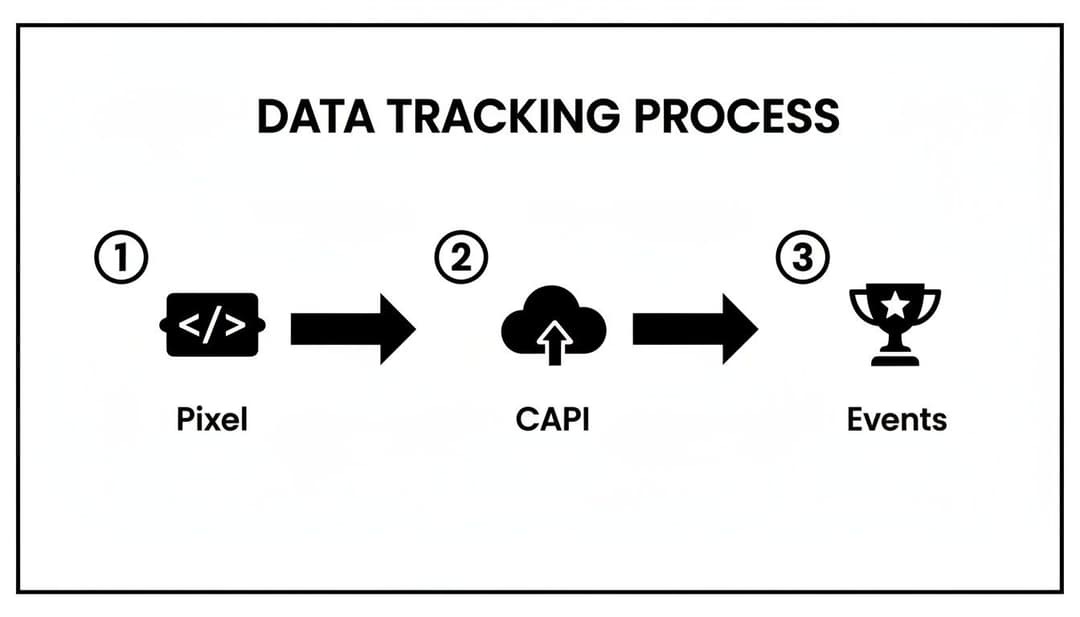
This shows how the Meta Pixel (browser-side) and Conversions API (server-side) have to work together to give you a complete picture, from the initial click all the way to the final sale.
From Landing Page to Conversion: Closing the Deal
This is the final hurdle, the moment of truth. Someone clicked your ad, your page loaded, and they’re interested. But something is holding them back from sealing the deal. Now, you need to look at your on-page conversion rate.
If your CTR is solid and your landing page is lightning-fast, but conversions are still in the gutter, the problem is your offer or the on-page experience.
- Is there a message mismatch? If your ad screams "50% Off Blue Widgets," your landing page headline had better be "Get Your 50% Off Blue Widgets Here!" Any disconnect, however small, creates confusion and erodes trust instantly.
- Is the offer confusing? Is it crystal clear what you want the user to do next? Is your Call-to-Action (CTA) button big, bold, and obvious? If they have to hunt for the "Buy Now" button or can't figure out the value proposition, they're out.
- Is there too much friction? How many fields are in your form? Is the checkout process a 10-step nightmare? Every single step you add is another opportunity for a potential customer to give up and leave.
It's worth remembering that the average conversion rate for Facebook ads is a whopping 9.21%, making it a serious powerhouse for driving sales. When everything is dialed in, it can turn casual scrollers into loyal customers far more effectively than many other platforms.
Common Conversion Blockers and Actionable Solutions
To make this even easier, here’s a quick diagnostic table. Use it to find where the leak is and plug it fast.
| Funnel Stage | Key Metric to Watch | Potential Problem | Actionable Solution |
|---|---|---|---|
| Awareness (In-Feed) | Click-Through Rate (CTR) | Ad Fatigue / Poor Targeting | Refresh creative with new formats (UGC, video). Test new ad copy hooks and headlines. Refine audience targeting. |
| Consideration (Post-Click) | Landing Page View Rate | Slow Page Speed / Broken Link | Optimize image sizes and use a CDN. Test the ad link in an incognito window to ensure it works. |
| Conversion (On-Page) | On-Page Conversion Rate | Message Mismatch / High Friction | Ensure ad and landing page messaging are identical. Simplify forms and checkout to the absolute minimum required steps. |
By breaking down the user journey with this framework, you can stop guessing and start making precise, data-backed decisions. That's how you systematically fix what's broken and boost your conversion rate on Facebook ads.
Developing Ad Creative and Copy That Truly Converts

While your tracking and targeting need to be solid, the single biggest lever you can pull to improve your conversion rate on Facebook ads is your creative. It’s the first impression, the thumb-stopper, the thing that actually gets someone to act. You can have the perfect audience, but if you show them a mediocre ad, it’s going to fall flat. Every time.
Great direct-response creative isn't about winning art awards. It's a science, built to spark a specific action from a specific person. It’s all about a repeatable process: create, test, and iterate.
The First Three Seconds Are Everything
On a fast-scrolling feed, you don’t have minutes—you have seconds. The "hook" in the first three seconds of your video or the headline of your image ad is everything. It determines whether someone keeps scrolling or pauses to see what you have to say. Your one job is to interrupt their pattern.
A powerful hook grabs them by the collar. It might be a surprising statistic, a relatable pain point, or an eye-catching result. It has to be clear, concise, and aimed directly at your audience’s core problems or desires.
Think about a brand selling comfortable shoes. They could open a video with a quick shot of someone wincing in pain while wearing heels, immediately followed by the solution. That visual story is instantly relatable and far more effective than just showing the product. Getting this right means understanding the playbook for great Facebook video ads.
Building Your Message with Proven Frameworks
Once you’ve got their attention, your ad copy needs to do the heavy lifting. Don't start from scratch. Instead, lean on battle-tested copywriting frameworks that tap into basic human psychology.
Two of the most reliable are:
- PAS (Problem-Agitate-Solution): This is my go-to for anything that solves a clear pain point. You start by identifying the problem, then you agitate it by describing the frustration it causes, and finally, you present your product as the obvious hero. It's direct and incredibly effective.
- AIDA (Attention-Interest-Desire-Action): A classic for a reason. It’s perfect for building more of a narrative. You grab Attention with your hook, build Interest with compelling facts, create Desire by showing them the ideal outcome, and push for Action with a clear CTA.
These aren't rigid rules, but they give your message a proven structure. If you're stuck, browsing through a few winning Facebook ad copy examples is a great way to get the ideas flowing.
Structuring Creative Tests for Clean Learnings
The goal isn't to guess what works. It's to build a system that tells you what works. This means moving away from random "let's try this" testing and into a structured, iterative process. The key is to isolate your variables.
When you launch a test, change only one significant thing at a time. This is the only way to know for sure what caused the change in performance.
So many advertisers make the mistake of testing a new image, a new headline, and new body copy all in the same ad. If performance changes, you have no idea which element was responsible. You’ve learned nothing that you can reliably apply to the next campaign.
Here’s a simple, practical testing structure to follow:
- Start with the Big Picture: Test fundamentally different creative concepts. For instance, put a raw, user-generated content (UGC) video up against a polished studio animation.
- Isolate the Winning Concept: Once you have a clear winner, that becomes your new "control" creative.
- Test a Single Variable: Now, start testing small variations of that winning concept. Try different headlines, different calls-to-action, or different opening hooks in the video.
This methodical approach takes the guesswork out of the equation. You're no longer throwing spaghetti at the wall; you're building on what you know works, one element at a time. This is how you systematically improve your creative and, in turn, your conversion rate on Facebook ads. You'll know you have a winner based on data, not just a gut feeling.
Fine-Tuning Your Audience and Landing Page
You can have the most mind-blowing ad creative on the planet, but if it’s shown to the wrong people or sends them to a clunky, confusing website, it’s dead on arrival. The real work starts after the click. If you’re serious about improving your conversion rate on Facebook ads, you have to master this post-click journey, which comes down to two things: who you're talking to and where you're sending them.
It's a classic rookie mistake to obsess over the ad creative and treat the audience and landing page as an afterthought. But that's precisely where conversions are won or lost. Let’s get both dialed in.
Stop Guessing: Refine Your Audience with First-Party Data
Broad targeting has its place, but the real magic happens when you use your own data. The information you've collected directly from customers and prospects—your first-party data—is your single most powerful asset. This is how you stop targeting vague "interests" and start reaching people who have already shown they're interested.
Two of the heaviest hitters here are retargeting funnels and Lookalike audiences. Retargeting isn't just about spamming everyone who ever visited your site. Smart retargeting is about segmenting users based on their actions.
- Website Visitors: These people showed initial interest. Bring them back.
- "Add to Cart" Abandoners: This is your low-hanging fruit. They were this close to buying. A gentle reminder or a small incentive can be all it takes to get them over the finish line.
- Past Purchasers: Your existing customers already know and trust you. Don't ignore them! Show them new products or exclusive offers.
Then you have Lookalike audiences, which let you find new people who are eerily similar to your best customers. You upload a list of your top buyers, and Meta’s algorithm goes to work finding clones—users with similar behaviors, demographics, and interests.
This is what separates the pros from the amateurs. You’re not just shouting into a crowded room anymore. You’re having a one-on-one conversation with the people most likely to actually listen and buy.
The results speak for themselves. On average, retargeting crushes cold audiences by 367%, and Lookalikes outperform interest targeting by 35%. It's just a more efficient way to find high-value customers. If you're curious about how your numbers stack up, you can discover more insights about Facebook ad conversion rates and see where you land.
Nail the Hand-Off with Perfect Landing Page Message Match
Once you’ve got the right people clicking, you absolutely must deliver on the promise your ad made. This is called message match, and it’s non-negotiable. If your ad screams "50% Off All Winter Coats," the headline on your landing page better say the exact same thing, front and center.
Any disconnect, no matter how small, creates friction. It makes the user pause and think, "Did I click the wrong link? Is this a bait-and-switch?" That hesitation is a conversion killer.
Beyond the headline, every single element on your landing page needs to be built for one purpose: conversion.
- Make the CTA Obvious: Your call-to-action button needs to pop. Use action-oriented text like "Get My 50% Off" instead of a boring "Submit."
- Show, Don't Just Tell: Sprinkle in social proof. Customer reviews, star ratings, and testimonials do the selling for you by building trust and easing anxiety.
- Reduce Friction: Keep your forms short. Only ask for what you absolutely need. For e-commerce, a single-page checkout can make a massive difference in cart abandonment.
- Think Mobile-First: This isn't a suggestion anymore; it's a requirement. The vast majority of people will see your ad on their phone. Your page needs to load lightning-fast and be dead simple to use on a small screen. Pull it up on your own phone—is it a smooth experience?
When you align a killer audience strategy with a perfectly optimized landing page, you create a seamless journey that guides people from ad to action. It’s how you stop wasting money and start maximizing the return on every single click.
Using AI and Automation to Scale Your Wins
So you've found a winning ad creative. That’s the hard part, right? Well, now the race is on to scale that winner before ad fatigue kills its momentum.
If you’ve ever tried to do this manually, you know the drill. Duplicating campaigns, tweaking tiny variables, and refreshing your dashboard every hour is slow, tedious, and honestly, a recipe for mistakes. This is where modern ad tech completely changes the game. It allows you to pour fuel on the fire at a speed and scale that’s just not humanly possible.
AI-powered platforms can now spin up hundreds of ad variations in minutes, mixing and matching different images, headlines, copy, and audiences. This isn't just about going faster; it’s about testing smarter. These tools dig into your historical performance data to pinpoint the exact elements that are driving results—maybe it’s a certain style of UGC, or a specific value prop in your copy that really clicks with people.
This approach shortens your testing cycles from weeks to days, helping you uncover new winning combinations before your competitors even know what's happening. For a deeper dive, our guide on using AI for Facebook Ads breaks down how these tools can totally reshape your workflow.
From Manual Tweaks to Automated Scaling
The real magic of automation kicks in after you hit launch. Forget manually checking your campaigns every few hours. AI-driven systems are on the job 24/7, monitoring performance in real-time.
They can intelligently shift budget toward the best-performing ads or ad sets, making sure every dollar you spend is working as hard as possible to drive conversions. This process takes the guesswork and emotional decision-making out of the equation. The system doesn't care that you think a certain creative should be working; it only follows the data, scaling what's proven to convert and shutting down what isn't.
By letting AI handle the heavy lifting of bulk creation and optimization, you free up your team to think bigger. You can focus on high-level strategy—like brainstorming new creative angles or exploring untapped markets—instead of getting lost in the day-to-day grind.
How AI Unlocks Higher Campaign Value
This efficiency isn't just about saving time; it's about unlocking serious financial potential. The top-performing campaigns on Facebook pull in some incredible numbers. The median website purchase conversion value can hit $5,823.40, and in competitive sectors like Apparel & Fashion, that number can skyrocket to $11,359.78 per conversion. You can discover more insights about these Facebook Ads benchmarks to see the potential for yourself.
The screenshot below gives you a glimpse of a platform built to streamline this whole process.
This kind of centralized system is what separates the pros from the amateurs. It pulls campaign creation, creative management, and performance analytics into one cohesive workflow. It’s all about moving from chaotic, manual work to a structured, data-backed system designed to consistently improve your conversion rate on Facebook ads. When you automate the repetitive stuff, you can finally focus on capitalizing on your wins and driving real growth.
Your Top Questions, Answered
When you're deep in the trenches with Facebook ads, questions are bound to pop up. Here are the straight-up answers to some of the most common ones we get from advertisers trying to crack the conversion code.
What Is a Good Conversion Rate for Facebook Ads?
This is the million-dollar question, and the honest answer is: it depends. A "good" conversion rate on Facebook ads is completely relative to your industry.
I've seen fitness brands pull in rates over 14%, while an e-commerce store might be thrilled to hit 3%. The numbers are all over the map.
While the often-quoted average across all industries is 9.21%, that figure gets heavily skewed by sectors like education that naturally have higher conversion intent. Don't chase a universal number. The real goal is to establish your own baseline and then consistently beat it, month over month.
Why Is My Facebook Ads Conversion Rate So Low?
A low conversion rate is almost never a single-point failure. Think of it as a symptom of a breakdown somewhere along the user's journey from ad to purchase.
More often than not, one of these is the culprit:
- Ad Fatigue: Your audience has seen the same ad one too many times. They're officially blind to it.
- Poor Audience Targeting: You’ve got a killer ad, but you're showing it to people who just don't care.
- Message Mismatch: The ad promises one thing, but the landing page talks about something else entirely. It’s a bait-and-switch, even if it's unintentional.
- High Friction: Your website is slow, the checkout process is a maze, or you're asking for too much information upfront. People are bouncing before they can convert.
Finding the real problem means you have to put on your detective hat and analyze the entire funnel, from your Click-Through Rate (CTR) right down to your on-page metrics.
How Can I Quickly Improve My Conversion Rate?
If you need to see a change now, put your energy into two places: your ad creative and your landing page. These are the levers you can pull for the fastest impact.
Start by testing a radically different creative concept. Pit a raw, user-generated content video against that polished static image you’ve been running. Sometimes, a fresh approach is all it takes to jolt your audience out of their ad blindness.
At the same time, audit your landing page. Does it perfectly match the message in your new ad? Is there any friction you can remove? Simplify the form, make the call-to-action impossible to miss, and for goodness' sake, make sure it loads instantly on a phone.
Ready to stop guessing and start scaling? AdStellar AI automates bulk ad creation and uses AI to identify your winning campaigns, helping you launch, test, and scale 10x faster. Discover how AdStellar can transform your Meta advertising today.