An e-commerce ad isn't just a pretty picture with a "buy now" button. At its core, it's a paid digital promotion laser-focused on one thing: driving sales for your online store.
We're talking about strategically placing ads on platforms like Meta (Facebook and Instagram) or Google to get in front of the right people at the right time. The end goal is always a profitable Return on Ad Spend (ROAS). This is less about fuzzy brand awareness and all about generating immediate, trackable revenue.
Building Your E-Commerce Advertisement Foundation

A killer ad campaign starts long before you ever hit "publish." The groundwork you lay right now will determine whether your budget fuels real growth or just disappears into the digital ether. This is where we move from wishful thinking to a rock-solid, data-backed strategy.
Too many brands make the classic mistake of jumping straight into creative, hoping for the best. That's a surefire way to burn through cash. Instead, let’s build a framework that guides every single decision, from the ad copy you write to the audiences you target.
Defining Your Core Objectives
First things first: you need tangible, measurable goals. "More sales" is not a goal; it's a wish. We need to lock in the specific key performance indicators (KPIs) that actually matter to your bottom line.
Your primary goals should be brutally clear:
- Target ROAS (Return on Ad Spend): For every dollar you put into ads, how many dollars in revenue do you need back to be profitable? A 4:1 ROAS is a common benchmark, but your magic number depends entirely on your product margins.
- Target CPA (Cost Per Acquisition): What’s the absolute most you can afford to pay for a new customer and still make money? This number has to be well below your Customer Lifetime Value (LTV).
Nailing down these numbers transforms your advertising from a guessing game into a predictable growth machine. They become your north star, telling you instantly what’s working and what’s getting cut.
Conducting a Competitor Deep-Dive
Next up, it’s time to see what everyone else is doing. And I don’t mean copying them. The goal here is to find the gaps in the market they’ve completely missed. Use ad library tools to spy on your competitors’ creatives, messaging, and offers.
Look for patterns. Are they all using the same tired UGC style? Are their headlines just listing features instead of selling benefits? These gaps are your openings. You're hunting for a unique angle that makes your e-commerce advertisement impossible to ignore.
Pro Tip: Don't just stalk your direct competitors. Look at what top-tier direct-to-consumer (DTC) brands in completely different industries are doing. Their fresh ad formats and bold messaging can spark some game-changing ideas for your own campaigns.
Crafting Your Ideal Customer Profile
Ultimately, your success lives and dies by how well you know your audience. You need to go way beyond basic demographics like age and location. We're building a detailed customer profile based on psychographics—their values, pain points, what keeps them up at night, and their actual shopping habits. A deep understanding of building a full funnel with ads is what connects you to this audience at every single touchpoint.
Use real data for this. Dive into your website analytics, customer surveys, and past purchase history. Once you have this crystal-clear profile, you can map your product’s benefits directly to their deepest needs.
And to make sure you’re collecting that data accurately from day one, you absolutely need to know how to set up your Facebook Pixel the right way. Getting this foundational step right ensures every ad you build is based on a real, solid understanding of your perfect customer.
Scaling Ad Creative for Today's Platforms

In the crowded world of e-commerce advertising, your creative isn't just a part of the campaign—it is the campaign. A scroll-stopping ad can build instant trust and make your product feel essential. The real challenge, though, isn't making one perfect ad. It's building a sustainable content engine that constantly feeds your campaigns fresh, high-performing creative.
This is a fundamental mindset shift. One-off designs just don't cut it anymore. They burn out fast thanks to creative fatigue, where your audience sees the same ad so often it becomes invisible. The winning brands today operate more like media companies, consistently pumping out a variety of ad formats that click with different customer segments.
Proven Ad Creative Frameworks for Ecommerce
So, how do you build this content engine without starting from a blank page every single time? You lean on battle-tested creative frameworks that are proven to grab attention on social platforms. These concepts tap into core consumer psychology and give you a repeatable structure for killer content.
Here's a breakdown of some battle-tested ad concepts, the psychology behind them, and where to deploy them in your funnel for the best results.
| Creative Framework | Description | Best For (Funnel Stage) |
|---|---|---|
| Problem-Solution Narrative | Start with a relatable pain point. Agitate it a bit. Then, swoop in with your product as the obvious, elegant solution. | Top-of-Funnel (TOFU) |
| Authentic UGC Mashup | Stitch together genuine clips from customer reviews, testimonials, and unboxing videos. Raw, real content builds massive social proof. | Middle-of-Funnel (MOFU) |
| Compelling Unboxing | A clean, satisfying unboxing video that highlights your packaging and the product itself. Taps into the excitement of getting something new. | Bottom-of-Funnel (BOFU) / Retargeting |
| "Us vs. Them" Comparison | Directly (or indirectly) compare your product to the old, clunky alternative. Positions your solution as the modern, superior choice. | TOFU / MOFU |
| Behind-the-Scenes | Show the craft, the people, or the process behind your product. This builds brand affinity and humanizes your company. | MOFU / Retargeting |
These frameworks give you a reliable starting point, but don't forget to keep an eye on what's working for others. Using the best ad spy tools can give you a massive leg up, showing you which frameworks your competitors are leaning on and revealing unique angles they might have missed.
Systematizing Creative Production and Testing
Having great ideas is one thing. Producing them at scale is another ballgame entirely.
The economics of e-commerce advertising have gotten intense. Ad costs on top platforms are projected to hit $3.5 billion in 2025, and Amazon alone spent a staggering $20.6 billion on advertising in 2022. With numbers like that, systematic experimentation isn't a "nice to have"—it's a requirement for survival. The brands that can rapidly generate and test hundreds of creative–copy–audience combinations are the ones that will stay profitable.
This is where modern tools completely change the game. Forget spending hours in video editors or manually duplicating ad sets in Ads Manager.
The goal is to move from slow, manual work to a high-volume testing model. This isn't about finding one mythical "winner" anymore. It's about building a portfolio of consistently performing ads you can rotate to keep your campaigns fresh and profitable.
Platforms like AdStellar AI were built specifically for this. You can upload raw video clips, product shots, headlines, and copy, and the platform automatically generates hundreds of unique ad variations. It mixes and matches every element, creating a massive pool of assets ready for testing.
This automated approach, which you can read more about in our guide on what is Dynamic Creative Optimization, is how you find your next breakthrough ad in days, not weeks. It turns creative production from a bottleneck into your biggest competitive advantage, letting you out-test and outmaneuver everyone else.
Writing Ad Copy That Sells Without Hype
Your ad creative might stop the scroll, but it's the copy that truly seals the deal. Great copy does more than just list what your product does; it taps into a customer's real-world problems and positions your product as the only logical solution. Think of it as the bridge between a casual glance and a confident click on "Add to Cart."
The mission here is to write direct-response copy that persuades without feeling like a late-night infomercial. Trust is your most valuable currency, and your words are how you earn it. This means blending proven copywriting frameworks with a voice that’s authentically yours.
The Power of Copywriting Formulas
Look, you don't need to reinvent the wheel every time you sit down to write an ad. Battle-tested copywriting formulas give you a reliable structure to hang your message on, making sure you hit all the right notes. They just work because they’re built on fundamental human psychology.
For e-commerce, two formulas are absolute gold:
- PAS (Problem, Agitate, Solution): This one is a killer for products that solve a clear pain point. You start by calling out a problem your customer is dealing with, poke the bruise a little to make them really feel that pain (agitate), and then swoop in with your product as the hero that saves the day.
- AIDA (Attention, Interest, Desire, Action): A versatile classic that guides the reader on a journey. You grab their attention with a killer hook, build interest with compelling details, create desire by painting a picture of a better future, and finally, drive them to action with a crystal-clear call-to-action.
These aren't rigid rules—think of them as flexible blueprints for your core message.
Crafting Headlines That Stop Thumbs
Your headline has exactly one job: earn you the next three seconds of someone's attention. In a jam-packed social feed, that’s a massive ask. Generic, sleepy headlines like "New Summer Collection" are completely invisible.
Your headline has to immediately answer the question on every user's mind: "What's in it for me?" Get straight to a powerful benefit, a surprising statistic, or a question that sparks undeniable curiosity.
Here’s how that plays out: A company selling noise-canceling headphones could run with, "Finally, Focus on Your Work, Not Your Coworkers." It instantly hits a specific pain point (annoying office chatter) and promises a clear benefit (focus). It’s lightyears better than just saying "High-Quality Headphones."
Focus on Benefits, Not Features
This is one of the oldest rules in the marketing playbook, and yet, it's ignored constantly. People don't buy a drill because they want a drill; they buy a drill because they want a hole in the wall. Your customers don’t really care that your new serum has "hyaluronic acid" (a feature); they care that it will give them "visibly plumper, hydrated skin" (a benefit).
A dead-simple way to check your copy is to read a line and ask yourself, "So what?"
- Feature: Our backpack is made of waterproof nylon.
- So what? Your laptop and books stay bone-dry, even in a downpour. (Benefit)
- Feature: This coffee is made from single-origin beans.
- So what? You get a richer, smoother taste without the bitterness of mass-market blends. (Benefit)
Always connect the dots from the feature to a tangible, desirable outcome for the customer. If you want to go deeper, our guide on crafting great ad copy breaks down more techniques for turning dry features into benefits people actually care about.
Writing CTAs That Create Urgency
Your Call-to-Action (CTA) is the final nudge. It has to be clear, direct, and compelling. "Shop Now" is the old standby, and it works, but you can often do much better by injecting a little urgency or reinforcing the value.
Just be careful to avoid fake scarcity ("Only 2 left!" when you've got a warehouse full). That's a quick way to kill trust. Instead, anchor your urgency in legitimate reasons to act now.
Try mixing it up with variations like these:
- Benefit-driven: "Get Your Silky Smooth Hair Today"
- Urgency-focused: "Shop the 24-Hour Flash Sale"
- Low-risk offer: "Try It Risk-Free for 30 Days"
The CTA is the last thing someone reads before they decide to click or scroll on. Make it count.
Building Audiences That Convert and Scale
You can have the most brilliant e-commerce advertisement in the world, but it’s completely worthless if it’s shown to the wrong people. Your creative might stop the scroll, but your audience targeting is what turns that scroll-stop into a sale.
Mastering audience building is how you transform ad spend from a simple expense into a high-yield investment. This isn’t about just picking a few interests and hoping for the best. It’s about building a strategic, full-funnel framework that has a clear plan for attracting brand-new customers, nurturing interested prospects, and bringing your loyal fans back for more.
Mapping Your Funnel to Audience Temperature
A simple way to think about your audience is in terms of temperature: cold, warm, and hot. Each temperature represents a different stage of the customer journey and needs a completely different targeting approach.
- Cold Audiences (Top of Funnel): These are people who have never heard of your brand. Your goal here is broad prospecting—finding new potential customers at the lowest possible cost.
- Warm Audiences (Middle of Funnel): These users have shown some interest. Maybe they’ve visited your site, engaged with your social media, or watched a video, but they haven't pulled the trigger and bought anything yet.
- Hot Audiences (Bottom of Funnel): This is your highest-intent group. They’ve added products to their cart, initiated checkout, or are existing customers who already know and trust you.
A robust audience strategy ensures you have active campaigns targeting all three temperatures at the same time. This creates a self-sustaining ecosystem where new customers are constantly discovered (cold), nurtured (warm), and converted (hot).
Building High-Value Prospecting Audiences
For your cold traffic campaigns, precision is everything. While broad targeting has its place, layering interests is a more surgical approach. For instance, instead of just targeting "Skincare," you could layer it with interests like "Veganism" and "Sustainable products" to find that perfect niche customer.
The real power player in prospecting, however, is the Lookalike Audience. Platforms like Meta can take a source list—like your customer email list—and find millions of new users who share similar characteristics.
Pro Tip: Don't just upload your entire customer list. Create a value-based Lookalike Audience using only your top 20% of customers—those with the highest average order value (AOV) or lifetime value (LTV). This tells the algorithm to find more big spenders, not just one-time buyers.
Retargeting Strategies That Actually Convert
This is where you make your money back. A visitor who abandons their cart isn’t a lost cause; they’re a prime candidate for a retargeting ad. But you have to be smart about it. Showing the same generic ad to every website visitor is lazy and, frankly, ineffective.
Segment your warm and hot audiences for maximum impact:
- All Website Visitors (Last 30 Days): A broad warm audience for general brand messaging and your best-selling products.
- Product Page Viewers (Last 14 Days): Show these users ads featuring the specific products they checked out, maybe with a testimonial for that exact item.
- Add to Cart (Last 7 Days): This is your hottest audience. Hit them with a dynamic product ad reminding them of what’s sitting in their cart. You might even consider adding a small incentive like "Free Shipping On Your Order" to get them over the line.
Strategic exclusions are just as important. Make sure to exclude recent purchasers from your prospecting and retargeting campaigns. There’s nothing more annoying than being served an ad for a product you just bought, and it’s a complete waste of your ad budget. A well-structured approach to targeted advertising on social media ensures you spend every dollar as efficiently as possible.
Layering Audiences for Scale and Efficiency
As you scale, you’ll find that your audiences start to overlap. The person who visited your website yesterday might also be on your high-value lookalike list. To stop yourself from bidding against yourself, you need to use strategic audience stacking and exclusions.
For example, your cold prospecting campaign should always exclude your warm and hot audiences (like website visitors and past purchasers). This ensures your prospecting budget is only spent on finding genuinely new people.
This one simple step cleans up your data, lowers your acquisition costs, and makes your e-commerce advertisement efforts far more profitable in the long run. When you build audiences with this level of intention, you create a powerful, scalable system that consistently drives conversions.
Building a Smart Ad Testing Framework That Actually Works
The best advertisers I know don't get lucky; they build a repeatable system for testing. A solid testing framework is what separates the campaigns that die out after a few weeks from the ones that deliver profitable, long-term growth. It’s all about creating a structured process to constantly generate insights and methodically improve your performance.
This isn’t about just throwing spaghetti at the wall to see what sticks. It's about designing clean experiments, setting realistic budgets, and knowing exactly when you have enough data to make a call with confidence. When you get this right, your ad account turns into a learning machine.
A/B Testing vs. Multivariate Testing
First things first, you need to know which tool to grab from the toolbox. For ad testing, your two main options are A/B testing and multivariate testing. They each have their place.
A/B Testing (or Split Testing): This is your go-to for simple, direct comparisons. You run two versions of an ad (Ad A and Ad B) where you change only one single thing—the headline, the image, the call-to-action button. It’s perfect when you need a clear, definitive answer about which specific element moves the needle.
Multivariate Testing: This is the more advanced approach where you test multiple variations of several elements all at once. For instance, you could test three headlines, two images, and two CTAs in the same campaign. The ad platform then mixes and matches all the pieces to find the single best combination. It's a fantastic way to understand how different elements play off each other.
If you want to go deeper, our guide on what is multivariate testing can help you figure out when it's the right move for your campaigns.
How to Design Clean Experiments
A test is only as good as its setup. If you want results you can trust, you have to isolate your variables and define the rules of the game before you spend a single dollar. A messy test just gives you noisy data that can easily send you in the wrong direction.
Before you hit "launch," make sure you've nailed down these key pieces:
- Your Hypothesis: What do you actually think will happen? Write it down. A good hypothesis sounds like this: "I believe a user-generated content (UGC) video will get a lower Cost Per Acquisition (CPA) than our polished studio video because it looks more authentic and trustworthy."
- The Key Metric: How will you decide the winner? Is it ROAS, CPA, or Click-Through Rate (CTR)? Pick one primary KPI to avoid getting mixed signals.
- Test Duration and Budget: How long are you going to let this run, and how much are you willing to spend to find out? You need enough budget and time to reach statistical significance, which is just a fancy way of saying the results aren't a random fluke.
A classic rookie mistake is calling a test too early. Just because one ad has a better ROAS after 48 hours doesn’t mean it's the real winner. You have to let the data mature before you declare victory.
This kind of rapid-fire testing is no longer a "nice-to-have." The scale of e-commerce demands it. With global online sales projected to hit the $6.4–$7.5 trillion mark by 2025, you're competing for the attention of nearly a third of the world's population. Platforms that can quickly test creative variations at scale are the ones that are going to win.
Here’s a simple way to think about segmenting your audiences for these tests.
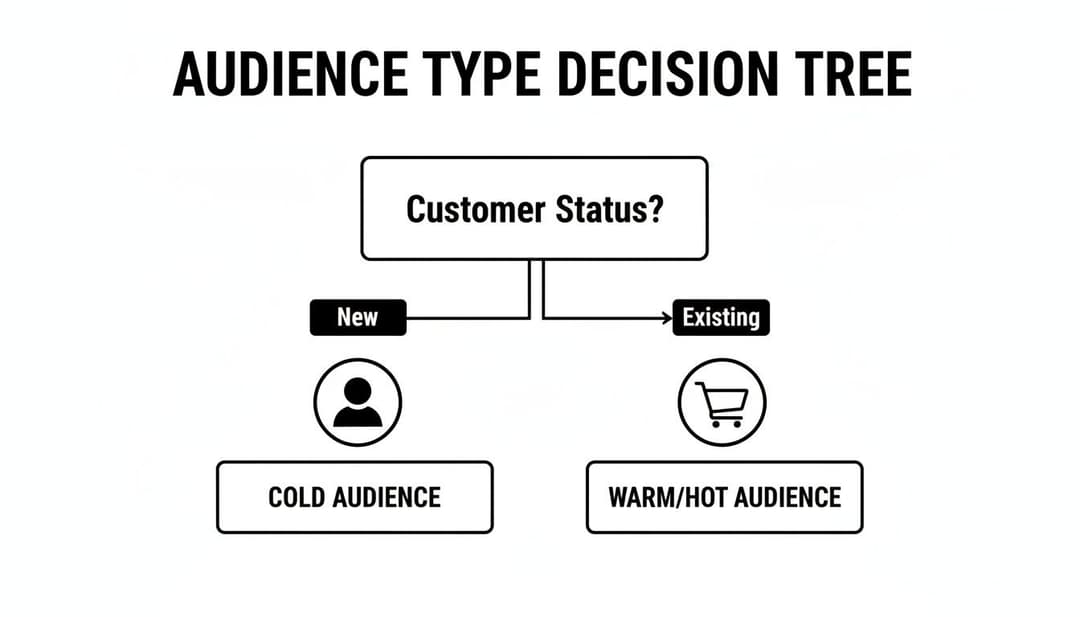
As the chart shows, your testing strategy for brand-new prospects (cold audiences) should be fundamentally different from how you approach people who already know you (warm/hot audiences).
Automating this entire process is where things get really interesting. Modern AI-driven tools can build new campaigns automatically based on what’s worked in the past, turning your historical data into a blueprint for future success. This is how you move from slow, manual tests to an automated system that constantly finds and scales your next winning e commerce advertisement.
Analyzing Performance and Scaling Profitably
Getting your ads live is just the first step. The real magic—and the real money—is in scaling your winners without torching your profit margins. This is where you shift from simply managing a campaign to acting like a portfolio manager, making cold, hard decisions based on data.
Think of your ad account as a story. To grow, you have to learn its language. That language is written in metrics, and fluency is non-negotiable if you want to scale profitably.
Decoding Your Core Performance Metrics
Every seasoned advertiser lives and dies by a few core metrics. These are the vital signs of your campaign’s health, showing you exactly where your money is going and what it’s bringing back.
ROAS (Return on Ad Spend): This is your ultimate profitability benchmark. It’s a simple ratio: for every dollar you put in, how many dollars in revenue came out? A 4:1 ROAS is often seen as a solid goal, but what truly matters is knowing your own break-even number.
CPA (Cost Per Acquisition): This tells you exactly what it costs to get a new customer. If your product's profit margin is $50 and your CPA creeps up to $55, you are literally paying to give your product away—even if the revenue numbers look impressive on the surface.
CPL (Cost Per Lead): If you capture emails or leads before the sale, CPL tracks how much each new subscriber costs you. It's a fantastic early indicator of a campaign's potential before a purchase is even made.
A quick word of caution: high revenue doesn't always equal high profit. A campaign boasting a 10:1 ROAS might look amazing, but if it only brought in two sales, it’s not nearly as valuable as a campaign humming along at a stable 3.5:1 ROAS that delivers 50 sales a day.
Smart Scaling Strategies That Protect Profit
So you've found a winner—an ad set that's consistently hitting your target KPIs. It's tempting to just crank up the budget and watch the sales roll in. But jamming the "increase budget" button too hard, too fast can shock the algorithm and send your performance into a nosedive.
You need a more methodical approach. There are really two main ways to scale your e-commerce ad campaigns:
Vertical Scaling: This is the most direct method. You take your existing, proven ad sets and gradually increase their budget. A good rule of thumb is to increase the daily budget by no more than 20-30% every 48-72 hours, but only if performance holds steady. This slow-and-steady tactic keeps you from resetting the platform's learning phase.
Horizontal Scaling: Instead of pouring more money into one ad set, you duplicate that winning ad set and aim it at new, untapped audiences. You could take a successful ad and test it with a completely different lookalike audience or a fresh set of interests. This approach broadens your reach and spreads your risk across multiple audience pools.
Scaling is a delicate dance. The goal is to pour fuel on the fire without putting it out. By systematically analyzing your data and using disciplined scaling tactics, you can turn small wins into a predictable, profitable growth engine that powers your business forward.
E Commerce Advertising FAQ
When you're in the trenches of e-commerce advertising, the same questions tend to pop up again and again. Let's cut through the noise and get straight to the answers every performance marketer needs.
How Much Should I Spend on Ads?
There’s no magic number here, but a solid rule of thumb is to set aside 10-20% of your total revenue for your ad budget. But honestly, that’s just a starting point.
The real key is knowing your target Cost Per Acquisition (CPA) inside and out. Figure out your customer lifetime value (LTV) and make sure your CPA leaves you with a healthy profit. You can always start small—say, $50-$100 a day—to get some initial data, see which ads are hitting the mark, and then pour gas on the fire once your Return on Ad Spend (ROAS) looks profitable.
What Is a Good ROAS for Ecommerce?
Everyone throws around 4:1 ROAS ($4 back for every $1 spent) as the gold standard, but the truth is, "good" is completely relative to your profit margins.
A brand selling high-margin luxury goods might be printing money at a 2:1 ROAS. On the other hand, a business with paper-thin margins might need to hit a 10:1 ROAS just to stay afloat. The only number that truly matters is your break-even ROAS—anything above that is pure profit in your pocket.
How Do I Avoid Ad Creative Fatigue?
Creative fatigue is the silent killer of otherwise great campaigns. It happens when your audience has seen your ad so many times they just start scrolling right past it. The only way to fight it is to build a system for churning out fresh creative—fast.
This is where modern tools come in, letting you generate dozens of variations at once. You should have a constant pipeline of new things to test:
- Hooks: That all-important first 3 seconds of your video.
- Formats: Is it a static image, a carousel, or a dynamic video?
- Angles: Are you hitting a pain point, showing off a new feature, or highlighting a different benefit?
As a general guideline, plan to swap in new creative for your top-performing ads every two to four weeks. This keeps things fresh, engagement high, and your performance where it needs to be.
Ready to stop the manual grind and scale your campaigns faster? With AdStellar AI, you can generate hundreds of ad variations in minutes, discover winning combinations with AI insights, and launch profitable campaigns with a single click. See how much faster you can grow at https://www.adstellar.ai.