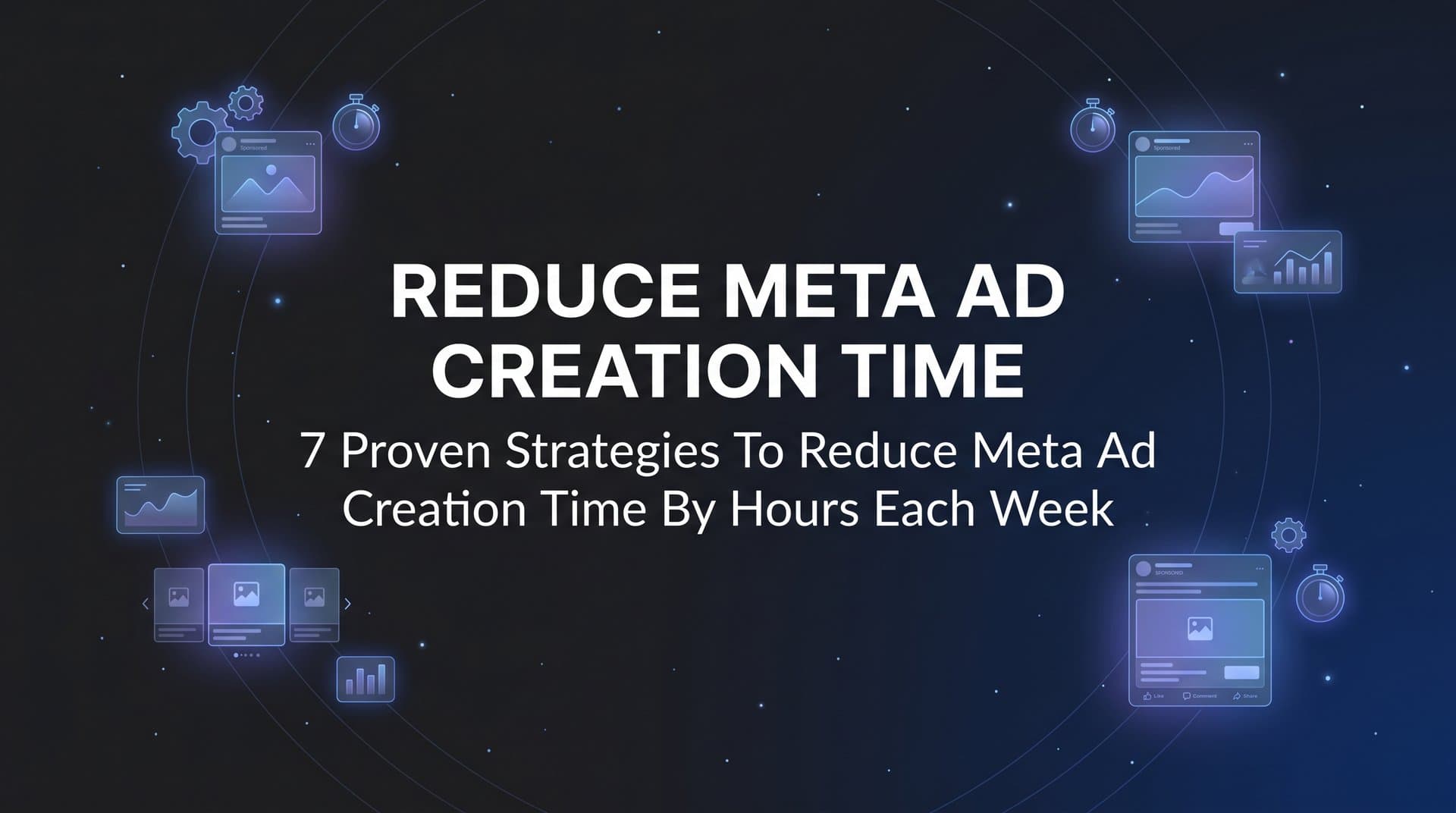
Creating Meta ads shouldn't feel like a full-time job, but for most digital marketers, it does. Between designing creatives, writing copy variations, setting up audiences, and launching campaigns, what should take minutes often stretches into hours or even days. For agencies managing multiple clients or in-house teams running continuous campaigns, this time adds up fast.
The bottleneck isn't your strategy or your targeting. It's the manual, repetitive tasks that eat up your week.
The good news is that modern tools and workflows can dramatically cut your ad creation time without sacrificing quality or performance. This guide covers seven actionable strategies that performance marketers are using right now to streamline their Meta ad production and get campaigns live faster. These aren't theoretical improvements. They're practical workflow changes that address the specific pain points slowing down your ad production today.
1. Use AI to Generate Ad Creatives From Product URLs
The Challenge It Solves
Creative production is often the biggest bottleneck in Meta advertising. Waiting on designers, coordinating with video editors, hiring actors for UGC content, and managing multiple rounds of revisions can stretch a simple ad creation task into a multi-day project. For teams running continuous campaigns or managing multiple products, this dependency creates a constant backlog that slows everything down.
The Strategy Explained
AI-powered creative generation eliminates the designer dependency entirely. Modern platforms can analyze a product URL, extract key information about features and benefits, and automatically generate scroll-stopping image ads, video ads, and UGC-style content. The AI understands visual composition, brand consistency, and platform-specific best practices to create ads that look professional and perform well.
This approach transforms creative production from a multi-person, multi-day process into a single-person, single-session task. Instead of briefing designers and waiting for deliverables, you input a product URL and receive multiple creative variations ready for testing. Teams struggling with manual ad creation find this particularly transformative.
Implementation Steps
1. Select an AI ad creative platform that generates multiple ad formats (image, video, UGC) from product information
2. Input your product URL or key product details into the platform
3. Review the AI-generated creative variations and refine any elements through chat-based editing
4. Export approved creatives directly to your Meta Ads Manager or launch them through an integrated platform
Pro Tips
Generate multiple creative variations at once to build a testing pool immediately. Use chat-based editing to refine specific elements without starting from scratch. Keep your product pages updated with clear, compelling information since the AI pulls from this source material to create your ads.
2. Clone and Adapt Competitor Ads From Meta Ad Library
The Challenge It Solves
Research is essential but time-consuming. Manually browsing the Meta Ad Library, taking screenshots, analyzing what makes competitor ads effective, and then trying to recreate those elements for your own brand can consume hours of your week. This research phase often delays campaign launches because teams want to understand what's working before committing budget to new creative approaches.
The Strategy Explained
AI-powered ad cloning lets you skip the manual research and recreation phases entirely. Instead of studying competitor ads and trying to rebuild them from scratch, you can use AI to analyze proven ad formats and automatically adapt them for your products and brand. The AI understands what makes the original ad effective and translates those elements to your context while maintaining your brand identity.
This approach gives you the benefit of competitor research without the time investment. You're not copying ads, you're learning from proven formats and applying those insights instantly to your own campaigns. Exploring AI ad creation tools for Meta can help you find the right platform for this workflow.
Implementation Steps
1. Identify high-performing competitor ads in the Meta Ad Library that align with your product category
2. Use an AI platform that can analyze and clone ad structures from the Ad Library
3. Input the competitor ad along with your product information
4. Review the AI-adapted version that maintains the effective structure while reflecting your brand and product
Pro Tips
Focus on ads that have been running for extended periods, as longevity often indicates strong performance. Clone multiple competitor approaches to test different angles rather than relying on a single format. Use this strategy to quickly enter new product categories by learning from established players.
3. Build Complete Campaigns With AI-Powered Campaign Builders
The Challenge It Solves
Campaign setup is deceptively complex. Choosing the right campaign objective, structuring ad sets, selecting audiences, writing headlines and primary text variations, and organizing everything into a logical testing framework requires both expertise and time. Even experienced marketers spend significant time on campaign architecture, and mistakes in structure can waste budget on poorly organized tests.
The Strategy Explained
AI campaign builders analyze your historical performance data to understand what works for your business, then automatically construct optimized campaign structures complete with recommended audiences, headlines, and creative combinations. The AI considers your past winners, current goals, and Meta's best practices to build campaigns that are strategically sound from the start.
What makes this powerful is the transparency. Advanced platforms explain every decision so you understand the strategy behind audience selection, headline recommendations, and campaign structure. You're not blindly accepting AI suggestions, you're learning why certain choices make sense for your specific situation. This is why automated Meta campaign creation has become essential for scaling teams.
Implementation Steps
1. Connect your Meta Ads account to an AI campaign builder platform
2. Set your campaign goals (awareness, conversions, traffic) and budget parameters
3. Let the AI analyze your historical campaign data to identify patterns and winning elements
4. Review the AI-generated campaign structure with full explanations for each strategic decision
5. Make any adjustments based on specific business knowledge the AI might not have
6. Launch the complete campaign directly to Meta
Pro Tips
The AI gets smarter with each campaign as it learns from your results. Start with a smaller campaign to establish baseline data if you're new to the platform. Pay attention to the AI's explanations to improve your own strategic thinking over time.
4. Launch Hundreds of Ad Variations Through Bulk Creation
The Challenge It Solves
Testing is essential for Meta ad success, but creating individual ad variations manually is painfully slow. If you want to test three creatives against four headlines with two audience segments, you're looking at 24 individual ads to set up. Multiply that across multiple campaigns or products, and testing becomes a massive time investment that most teams simply can't afford.
The Strategy Explained
Bulk ad creation generates every possible combination of your testing variables automatically. You select your creatives, headlines, audiences, and copy variations, and the platform creates every combination at once. What would take hours of manual setup happens in minutes, letting you launch comprehensive tests without the time investment. A dedicated bulk Meta ads creation tool makes this process seamless.
This capability transforms testing from a luxury into a standard practice. When creating variations is fast, you can test more aggressively, find winners faster, and optimize campaigns based on real performance data rather than assumptions.
Implementation Steps
1. Prepare your testing variables: multiple creatives, headline variations, audience segments, and copy options
2. Use a bulk creation tool that can mix elements at both the ad set and ad level
3. Set your combination rules (which elements to test against each other)
4. Review the generated ad variations to ensure they make sense
5. Launch all variations simultaneously to Meta for fair testing conditions
Pro Tips
Start with fewer variables if you're new to bulk testing to avoid overwhelming yourself with data. Use consistent naming conventions so you can easily identify which elements are in each ad. Set up your tracking properly before launching so you can accurately attribute performance to specific elements.
5. Create a Winners Library to Reuse Proven Elements
The Challenge It Solves
Most marketing teams are constantly reinventing the wheel. A creative that performed exceptionally well three months ago gets buried in old campaigns and forgotten. A headline that drove incredible CTR never gets reused because no one remembers it existed. This institutional knowledge loss means you're constantly starting from scratch instead of building on proven successes.
The Strategy Explained
A winners library is an organized collection of your top-performing creatives, headlines, audiences, and other campaign elements, each tagged with real performance data. Instead of digging through past campaigns to remember what worked, you have instant access to proven elements ready for reuse in new campaigns.
This approach turns your campaign history into a strategic asset. Every successful campaign contributes winning elements to your library, and over time you build a collection of proven performers that dramatically reduce creation time for new campaigns. Understanding how to reduce time spent on ad campaigns starts with leveraging what already works.
Implementation Steps
1. Set up a system to automatically identify top performers based on your key metrics (ROAS, CPA, CTR)
2. Create a centralized location where winning elements are stored with attached performance data
3. Tag each element with relevant categories (product type, campaign goal, audience segment) for easy filtering
4. When building new campaigns, start by browsing your winners library before creating new elements
5. Continuously add new winners as campaigns run to keep your library current
Pro Tips
Include performance context with each winner so you understand when and why it performed well. Update your library regularly to remove elements that no longer perform. Use your winners library as a training tool for new team members to understand what works for your brand.
6. Use Performance Leaderboards to Skip the Guesswork
The Challenge It Solves
Analyzing campaign performance to identify winners is tedious and time-consuming. You're exporting data, building spreadsheets, calculating metrics, and trying to identify patterns across dozens or hundreds of ads. This analysis paralysis delays optimization decisions and makes it difficult to quickly scale what's working or cut what's not.
The Strategy Explained
Performance leaderboards automatically rank every element of your campaigns by the metrics that matter to your business. Creatives, headlines, copy, audiences, and landing pages are scored against your target goals so you can instantly see what's winning and what's underperforming. No spreadsheets, no manual calculations, no guesswork.
The power is in the automation and clarity. Instead of spending hours analyzing data, you get instant visibility into your top performers. Implementing real-time Meta campaign monitoring ensures you catch performance shifts immediately. This speed lets you make optimization decisions faster and with more confidence.
Implementation Steps
1. Define your primary success metrics (ROAS, CPA, CTR, conversion rate)
2. Set target goals for each metric so the system knows what "winning" means for your business
3. Use a platform that automatically scores and ranks all campaign elements against your goals
4. Review leaderboards regularly to identify consistent top performers
5. Make optimization decisions based on clear performance rankings rather than gut feelings
Pro Tips
Focus on metrics that directly tie to business outcomes rather than vanity metrics. Look for consistent performers across multiple campaigns rather than one-time winners. Use leaderboards to identify underperforming elements quickly so you can cut them before they waste significant budget.
7. Eliminate Handoffs With End-to-End Ad Platforms
The Challenge It Solves
Tool fragmentation creates massive inefficiency. You generate creatives in one platform, organize them in another, build campaigns in Ads Manager, track performance in a separate analytics tool, and coordinate everything through spreadsheets or project management software. Every handoff between tools introduces friction, increases error risk, and wastes time on exports, imports, and data reconciliation.
The Strategy Explained
End-to-end ad platforms consolidate creative generation, campaign building, launching, and performance tracking into a single unified workflow. You move from product URL to live campaign without switching tools or manually transferring information between systems. This consolidation eliminates the friction that slows down traditional workflows and reduces the error risk that comes with manual data transfers. A comprehensive Meta ad creation platform handles everything in one place.
The efficiency gain comes from eliminating context switching and handoffs. When everything happens in one place, you maintain momentum and visibility throughout the entire process. No more wondering if the right creative got paired with the right headline, or if campaign settings got lost in translation between tools.
Implementation Steps
1. Evaluate your current workflow to identify all the tools you're using and where handoffs occur
2. Look for platforms that handle multiple stages of your workflow in a single interface
3. Prioritize platforms that integrate directly with Meta for seamless launching and data syncing
4. Test the unified workflow with a small campaign to understand the efficiency gains
5. Gradually migrate your entire ad production process to the consolidated platform
Pro Tips
Choose platforms that maintain transparency throughout the process so you understand what's happening at each stage. Ensure the platform supports your specific workflow needs rather than forcing you to adapt to rigid processes. Look for solutions that improve with use by learning from your campaign history.
Putting It All Together
Reducing Meta ad creation time comes down to three core principles: eliminate manual steps, reuse what works, and let AI handle the heavy lifting.
Start with the strategy that addresses your biggest bottleneck. If creative production slows you down, begin with AI-generated ads from product URLs or competitor ad cloning. If campaign setup is the issue, explore AI campaign builders that construct optimized structures automatically. If testing is your challenge, implement bulk launching to create hundreds of variations in minutes.
The most efficient teams combine multiple strategies into a streamlined workflow. They use AI to generate creatives, organize winners in a centralized library, build campaigns with AI assistance, launch comprehensive tests through bulk creation, and track everything through performance leaderboards. This systematic approach transforms ad production from a time-consuming manual process into a fast, data-driven workflow.
What matters most is momentum. Each strategy you implement compounds with the others. AI-generated creatives feed your winners library. Performance leaderboards inform your AI campaign builder. Bulk launching lets you test more aggressively, which identifies winners faster, which improves your library, which speeds up future campaigns.
With the right approach, you can cut hours from your weekly ad production while actually improving campaign performance through faster testing and iteration. The time you save goes back into strategy, analysis, and scaling what works rather than manual execution of repetitive tasks.
Ready to transform your advertising strategy? Start Free Trial With AdStellar and be among the first to launch and scale your ad campaigns 10× faster with our intelligent platform that automatically builds and tests winning ads based on real performance data.