Every Meta ad is fighting for a fraction of a second of attention. Users scroll through hundreds of posts, stories, and reels daily, and your ad has one job before anything else: stop the scroll. If your creative does not interrupt the pattern, nothing else matters. The headline, the offer, the targeting — all of it becomes irrelevant if the visual never earns a second glance.
The challenge is that most marketers know this but struggle to consistently produce creative that actually performs. They rely on gut instinct, recycle the same formats, and burn through budget testing ideas that were never grounded in strategy.
This guide breaks down eight proven strategies for building scroll-stopping ad creative on Meta, covering visual psychology, format selection, messaging hierarchy, and how to systematize your creative process so you stop guessing and start scaling. Whether you are a solo media buyer managing multiple accounts or a performance marketer trying to reduce creative fatigue, these strategies give you a repeatable framework for producing ads that earn attention and drive action.
1. Lead With the Moment of Pain, Not the Product
The Challenge It Solves
Most ads open with a product shot, a logo, or a generic benefit statement. The problem is that none of those things give the viewer a reason to stop. They are brand-centric, not audience-centric. When someone scrolling through their feed does not immediately see something that reflects their own experience, they keep moving.
The Strategy Explained
Open your ad with the specific frustration, fear, or problem your audience experiences before your product ever appears. This is the foundation of the PAS framework (Problem-Agitate-Solution), one of the most durable structures in direct response copywriting. When a viewer sees their exact situation reflected back at them in the first frame, they feel understood rather than sold to. That emotional recognition is what earns the next second of attention.
Think of it like this: if you sell a project management tool, do not open with a dashboard screenshot. Open with the chaos of missed deadlines, overflowing inboxes, and team members working from different versions of the same document. Make the pain real before you offer the relief.
Implementation Steps
1. List the top three frustrations your audience experiences before finding your product. Be specific, not generic.
2. Choose the frustration with the highest emotional charge and build your opening visual or headline around that single moment.
3. Delay the product reveal until after the problem has been clearly established, ideally in the second half of the creative.
Pro Tips
Use the exact language your audience uses to describe their problem. Pull phrases from customer reviews, support tickets, or community forums. The more precisely your creative mirrors how your audience already thinks about their pain, the stronger the pattern interrupt will be.
2. Use Visual Contrast to Break the Feed Pattern
The Challenge It Solves
Meta feeds develop a predictable visual rhythm over time. Warm lifestyle photography, clean white backgrounds, pastel palettes, and standard aspect ratios all start to blend together. When everything looks similar, nothing stands out. Your ad can be technically well-produced and still disappear into the visual noise.
The Strategy Explained
Visual contrast creates a pattern interrupt that earns attention before the viewer consciously decides to engage. This is grounded in Gestalt psychology: the human eye is wired to notice things that break from an established pattern. Unexpected color combinations, unconventional compositions, bold typography over a stark background, or sudden motion in a static feed all trigger that same attentional pull.
This does not mean your creative needs to be jarring or off-brand. It means being deliberate about how your ad differs visually from the content surrounding it. Study what is common in your niche, then identify where you can introduce contrast without sacrificing clarity.
Implementation Steps
1. Audit your current creative and identify the dominant visual patterns (colors, layouts, motion style) in your category.
2. Choose one visual element to deliberately contrast: try a bold color that does not appear in typical feed content for your niche, or use text-heavy composition when everyone else is using imagery.
3. Test the contrasting version against your standard creative to measure the impact on thumb-stop rate and click-through rate.
Pro Tips
The first frame of a video or the dominant visual element of a static ad carries the most weight. Spend disproportionate time on that single frame. A creative that wins in the first half-second has already done most of its job.
3. Build Creative Around a Single, Specific Claim
The Challenge It Solves
When a creative tries to communicate multiple benefits at once, it communicates none of them effectively. This is one of the most common creative mistakes in performance advertising. Marketers want to cover every angle, so they stack claims until the messaging becomes a blur that the viewer cannot process in the time available.
The Strategy Explained
Identify the one claim that matters most to your audience at their current stage of awareness, and build the entire creative around it. One clear, specific, believable claim is always more persuasive than five vague ones. The specificity is what makes it credible. "Lose 10 pounds in 30 days" is more compelling than "achieve your health goals" because it gives the brain something concrete to evaluate.
Your claim should reflect where your audience is in their buying journey. A cold audience needs a claim that addresses a recognized problem. A warm audience needs a claim that differentiates your solution from alternatives they are already considering.
Implementation Steps
1. Write down every benefit your product delivers and rank them by how much they matter to your target audience at the top of the funnel.
2. Select the single highest-ranked benefit and strip everything else from the creative concept.
3. Make the claim as specific as possible: replace vague language with concrete, measurable, or sensory descriptions.
Pro Tips
If you have multiple strong claims, do not try to fit them all into one ad. Build separate creatives for each claim and let performance data tell you which one resonates most with your audience. This turns a creative constraint into a testing advantage.
4. Leverage UGC-Style Formats to Build Instant Trust
The Challenge It Solves
Polished brand creative often triggers an immediate mental filter in social feed environments. Viewers recognize it as an ad and scroll past before they have processed a single word. The more produced and branded the creative looks, the faster that filter activates. This is a structural disadvantage that no amount of production quality can overcome.
The Strategy Explained
User-generated content style ads work because they blend into organic content and carry the psychological weight of social proof. When a creative looks like something a real person posted rather than something a brand produced, it bypasses the ad filter and gets evaluated on its content rather than its source. This is widely observed across the performance marketing community, and it is why many high-spending brands have shifted a significant portion of their creative mix toward UGC formats.
UGC-style creative does not require hiring real creators. It requires understanding the visual and tonal cues that make content feel native: casual framing, natural lighting, direct-to-camera delivery, minimal branding in the first few seconds, and language that sounds like a recommendation rather than a pitch.
Implementation Steps
1. Study organic posts in your category to identify the visual and tonal markers that distinguish native content from branded ads.
2. Replicate those markers in your creative: use handheld-style framing, conversational voiceover, and authentic-feeling environments rather than studio setups.
3. Delay or minimize brand elements in the first few seconds to let the content establish trust before the brand association is made.
Pro Tips
Tools like AdStellar can generate UGC-style avatar content and native-feeling creatives directly from a product URL, which removes the bottleneck of sourcing real creators while still producing content that carries the visual credibility of organic posts.
5. Structure Your Creative Testing as a System, Not a Guess
The Challenge It Solves
Random creative testing produces inconclusive data. When you change multiple variables at once, you cannot identify which change drove the performance difference. You end up with a winner you cannot explain and a process you cannot repeat. Budget gets consumed without generating the learning that would make the next campaign smarter.
The Strategy Explained
A structured testing matrix isolates one variable at a time across creatives, headlines, and audiences. This is standard methodology in conversion rate optimization and it applies directly to paid social creative. When you know exactly what changed between two ads, you know exactly what to carry forward, what to discard, and what to test next. The insights compound over time, making each testing cycle more efficient than the last.
Start by defining your testing hierarchy. Creative concept (the core idea or angle) should be tested before execution details (color, copy length, format). Once you identify a winning concept, you can optimize execution variables within it. This prevents you from over-investing in the polish of a concept that was never going to work.
Implementation Steps
1. Define your testing hierarchy: concept first, then hook style, then visual format, then copy variations.
2. Build a testing matrix that documents what is being tested, what is being held constant, and what metric determines the winner.
3. Set minimum spend thresholds before declaring a winner to ensure statistical confidence before cutting underperformers.
Pro Tips
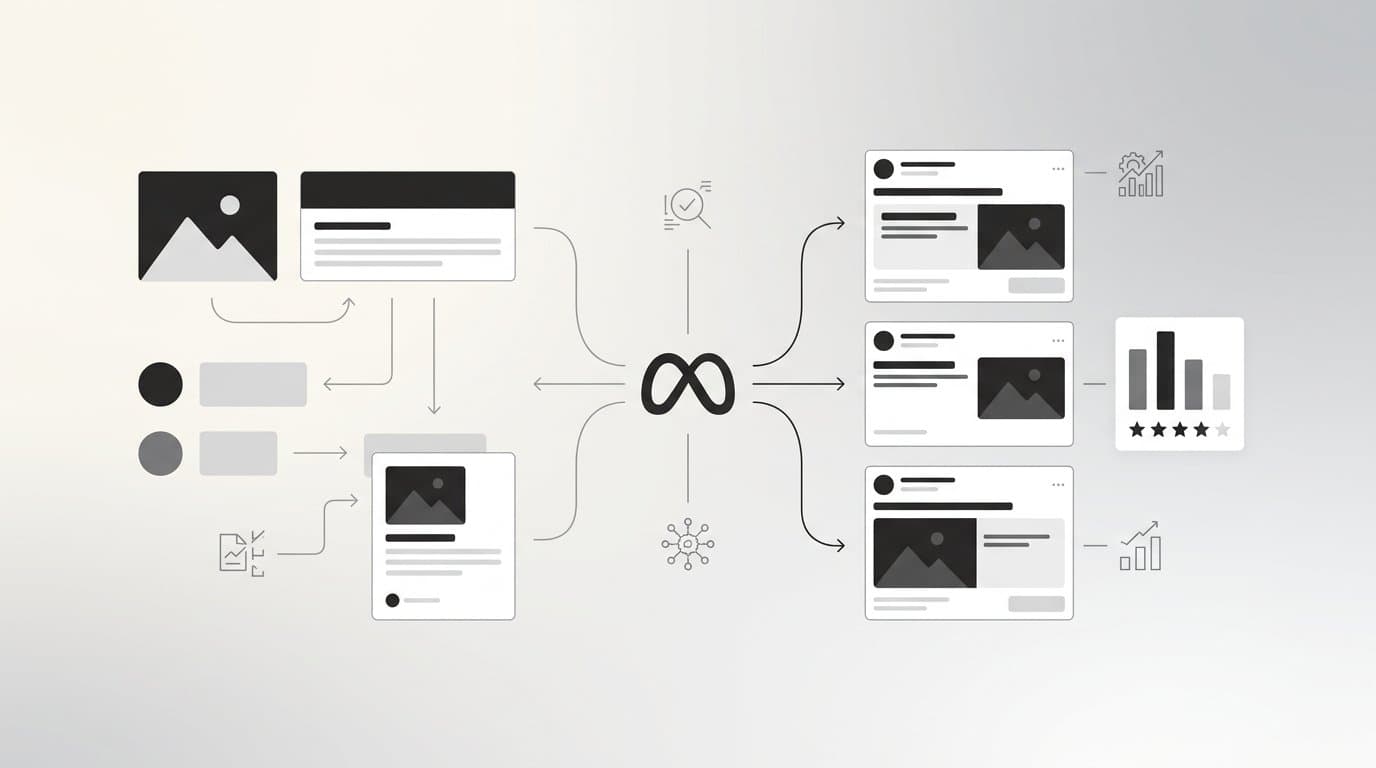
AdStellar's Bulk Ad Launch feature lets you generate hundreds of ad variations across creatives, headlines, and audiences and launch them all in minutes. Combined with the AI Insights leaderboard, you can see exactly which variables are driving performance without manually tracking combinations in a spreadsheet.
6. Match Creative Format to Placement and Intent
The Challenge It Solves
A single creative rarely performs equally across Reels, Stories, and Feed placements. Each placement has a different native behavior, aspect ratio, viewing context, and audience intent. Running the same creative everywhere is a common efficiency trap: it saves time in production but costs performance across the board.
The Strategy Explained
Adapting your core creative concept to fit the native format of each placement dramatically improves performance without requiring entirely new ideas. Meta's own placement guidance explicitly recommends this approach. A Reels placement rewards fast-paced, vertical video with strong audio and quick hooks. A Stories placement benefits from interactive elements and full-screen vertical composition. A Feed placement gives you more time with the viewer and can support longer copy and more static imagery.
The key is to think of your creative concept as the raw material and the placement as the production spec. The idea stays the same; the execution adapts to the context.
Implementation Steps
1. Identify your top-performing creative concept and document the core hook, claim, and visual approach.
2. Produce placement-specific versions: vertical 9:16 for Reels and Stories, square or horizontal for Feed, with pacing and audio adjusted to match native behavior.
3. Run placement-specific campaigns rather than automatic placements to measure performance by format accurately.
Pro Tips
When adapting for Reels, front-load the hook in the first two seconds. Reels viewers are moving faster than Feed viewers, and the drop-off rate in the first few seconds is steep. A hook that works in a five-second window for Feed may need to be compressed to two seconds for Reels to hold the same attention.
7. Study What Is Already Working Before You Create
The Challenge It Solves
Starting creative development from a blank page is inefficient and unnecessary. The Meta Ad Library is a publicly available tool that shows you every active ad from any advertiser on the platform. Ads that have been running for months without being paused are almost certainly profitable, which makes them the most valuable research resource available to any performance marketer.
The Strategy Explained
Analyzing competitor ads in the Meta Ad Library for format, hook structure, offer framing, and visual approach gives you a research-backed foundation for new creative. You are not copying; you are identifying what the market has already validated and using that intelligence to inform your own creative direction. This is how the most efficient media buyers operate: they let the market do the research, then they build on proven patterns.
Look for ads that have been running for more than 30 days in your category. Note the hook format (question, bold statement, problem scenario), the visual style (UGC, animation, product demo), the offer structure (discount, free trial, social proof), and the call to action. Patterns across multiple long-running ads reveal what is working at the category level.
Implementation Steps
1. Open the Meta Ad Library and search for your top three to five competitors by name.
2. Filter for active ads and sort by longest-running to identify likely performers.
3. Document the hook format, visual style, and offer structure of the top ads and look for patterns that appear across multiple advertisers.
Pro Tips
AdStellar includes a competitor ad cloning feature that pulls directly from the Meta Ad Library, letting you use competitor creative as a starting point and then generate your own variations with AI. This compresses the research-to-production cycle significantly and gives you a structured way to act on competitive intelligence.
8. Scale Winners Fast Before Creative Fatigue Sets In
The Challenge It Solves
Winning creatives have a shelf life. Creative fatigue is a well-documented phenomenon in Meta advertising where performance declines as the same audience sees the same creative repeatedly. Frequency rises, CTR drops, and CPA climbs. Marketers who wait for performance to collapse before responding lose days or weeks of profitable spend they could have protected with earlier action.
The Strategy Explained
Monitoring frequency and CTR trends allows you to identify fatigue early and launch fresh variations before performance drops materially. The goal is not to wait for a winner to die; it is to extract maximum value from it by scaling aggressively when it is performing and refreshing proactively before it burns out. This requires both a clear signal for when to act and a ready pipeline of new creative variations to deploy.
A practical approach is to set frequency and CTR thresholds as early warning indicators. When frequency crosses a defined point or CTR begins declining week over week, that is your signal to introduce new creative variations, not to pause the campaign. Refreshing creative within a performing campaign structure preserves the learning Meta's algorithm has accumulated while extending the campaign's profitable life.
Implementation Steps
1. Set up a weekly review of frequency and CTR trends for all active campaigns. Define your own thresholds based on your historical data.
2. Build a creative pipeline so that when a winner shows early fatigue signals, you have two to three fresh variations ready to test immediately.
3. When introducing new creative to a performing campaign, do not replace the winner immediately. Run the new variations alongside it and let performance data determine the transition.
Pro Tips
AdStellar's Winners Hub keeps your best-performing creatives, headlines, and audiences in one place with live performance data attached. When fatigue signals appear, you can pull from your proven asset library and build new variations around winning elements rather than starting from scratch. This makes the refresh cycle faster and more likely to produce another winner.
Putting It All Together
Scroll-stopping creative is not a talent. It is a system. The marketers who consistently produce high-performing ads are not more creative than everyone else. They are more deliberate. They lead with the problem, test with structure, study what works, and move fast when they find a winner.
Here is how to prioritize your implementation. Start by auditing your current creative against these eight principles and identifying the biggest gap. If your ads are opening with product shots instead of pain points, fix that first. If you are testing randomly without a matrix, build the structure before you spend another dollar. If you have never opened the Meta Ad Library to study competitors, do that before your next creative brief.
Once the fundamentals are in place, build the infrastructure that makes every future creative decision data-driven rather than instinct-driven. That means a testing matrix, a frequency monitoring routine, and a winner pipeline that keeps fresh creative ready before you need it.
If you want to shortcut the entire process, AdStellar handles creative generation, campaign building, bulk testing, and winner identification in one platform. You can go from product URL to live Meta campaign without a designer, a spreadsheet, or a separate analytics tool. Start Free Trial With AdStellar and be among the first to launch and scale your ad campaigns faster with an intelligent platform that automatically builds and tests winning ads based on real performance data.