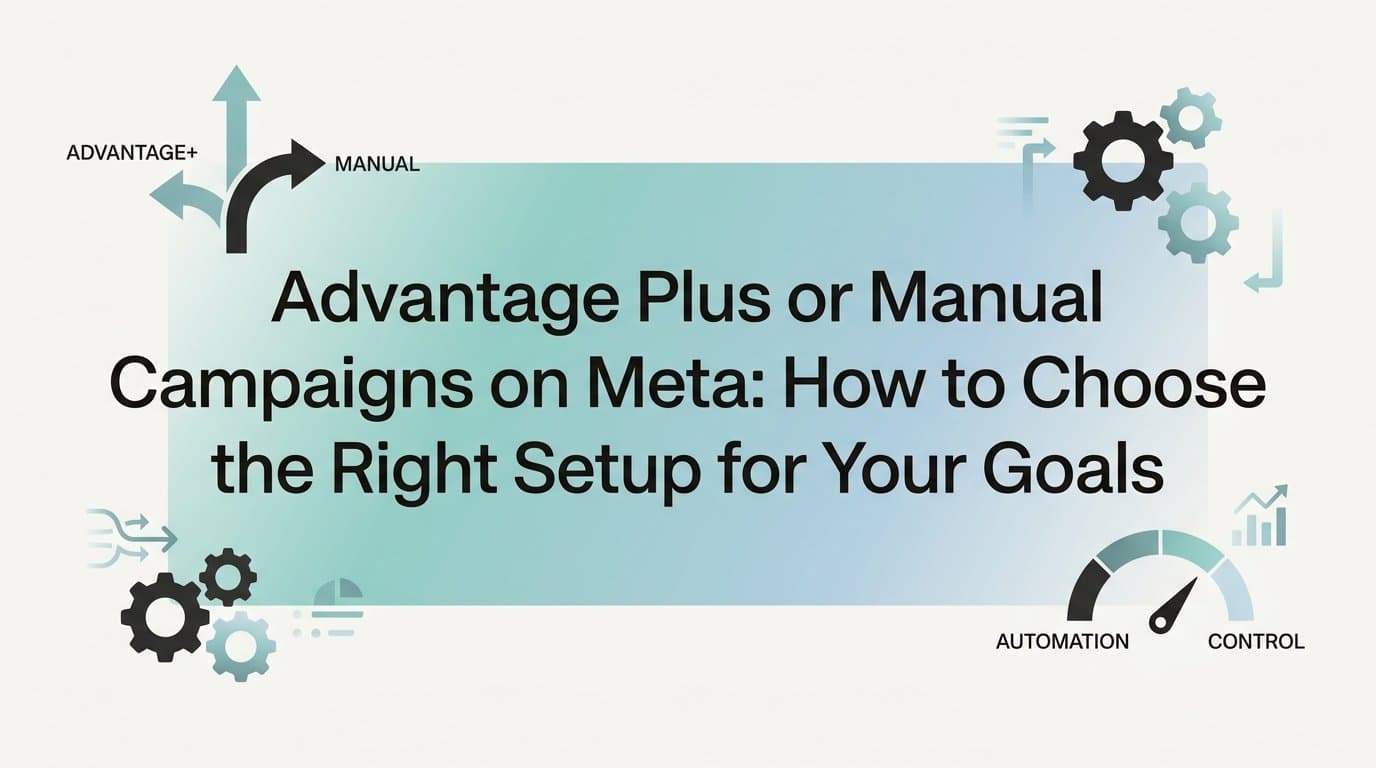
Every Meta advertiser eventually hits the same crossroads. You're setting up a new campaign and the choice is right there in front of you: let Meta's automation take the wheel with Advantage Plus, or build it out yourself with manual targeting, ad sets, and bidding strategies you control. Neither option comes with a guarantee, and the Meta help docs aren't exactly going to tell you which one is right for your specific account.
Here's the honest truth: both approaches can work. The question isn't which one is objectively better. The question is which one fits where your account actually is right now, what your creative library looks like, and how much bandwidth you have to manage things actively.
This article is a practical decision guide. We'll break down what each campaign type actually does under the hood, where each one genuinely outperforms the other, and how to read your own account signals to make a confident call. We'll also tackle the variable that matters more than either campaign structure: the quality of your creative. Because whether you go Advantage Plus or manual, bad ads will still lose money.
Two Campaign Philosophies, One Ad Account
Advantage Plus Shopping Campaigns represent Meta's automation-first approach to campaign management. Instead of building out separate ad sets for different audiences and placements, you feed Meta a pool of creatives and let the algorithm handle nearly everything else: who sees your ads, where they appear, how budget gets distributed, and how bids are adjusted in real time. The campaign structure is intentionally simplified because the complexity is meant to live inside Meta's machine learning system, not inside your Ads Manager.
Manual campaigns are the traditional setup most advertisers learned first. You define your audiences, whether that's custom audiences from your customer list, lookalikes built from past buyers, or interest-based targeting. You build separate ad sets for different segments. You choose your placements. You select your bidding strategy. Every variable is something you set deliberately, and changes you make are changes you can trace.
The philosophical difference between the two is actually pretty fundamental. Advantage Plus is a bet on Meta's algorithm: the idea that Meta's delivery system, fed with enough pixel data and conversion history, will find buyers more efficiently than any human targeting logic. Manual campaigns are a bet on the advertiser's own knowledge: the idea that structured segmentation, controlled creative testing, and deliberate audience management will produce better outcomes than handing the keys to a black box.
Neither philosophy is wrong. But each one requires a different set of conditions to deliver on its promise. Understanding what those conditions are is the whole game.
Where Advantage Plus Campaigns Actually Shine
Advantage Plus campaigns perform best when Meta's algorithm has rich data to work with. Think of it this way: the algorithm is trying to find people who will convert, and it learns by studying past conversions. If your pixel has recorded thousands of purchase events, the system has a detailed map of what your buyers look like. Give it that map and a strong pool of creatives, and it can go find more people who match the profile with impressive efficiency.
This is why e-commerce and direct-to-consumer brands with established products tend to see strong results from Advantage Plus. The purchase signal is clear, the optimization target is concrete, and the algorithm has something meaningful to chase. If you're selling a product that has moved volume, your pixel data is a genuine competitive asset inside an Advantage Plus campaign.
Advantage Plus also rewards accounts with deep creative libraries. Because the algorithm is rotating and testing creatives automatically, giving it more variations to work with means it has more combinations to explore. A brand that can supply ten strong creative assets will generally see better results than one feeding the campaign a single image and a couple of headlines.
The tradeoff is real, though, and worth naming clearly. When you run Advantage Plus, you give up a significant amount of visibility into who is actually seeing your ads. Audience segmentation becomes opaque. If performance dips, diagnosing the cause is harder because you can't isolate whether the problem is the audience, the placement, the creative, or some combination of all three. You're trusting the algorithm to make good decisions, and when it doesn't, the feedback loop is slower.
There's also the matter of audience overlap and brand control. Advantage Plus will show your ads to existing customers unless you explicitly exclude them, which requires an additional step. For brands with distinct messaging for prospects versus returning buyers, that blending can dilute the precision of your campaigns. The automation is powerful, but it doesn't know your business the way you do.
When Manual Campaigns Give You the Edge
Manual campaigns earn their keep in situations where the algorithm simply doesn't have enough to work with, or where the targeting logic is too specific for automation to handle gracefully.
New accounts are the clearest example. If your pixel has recorded fewer than a few dozen purchase events in the past month, Advantage Plus campaigns will often struggle to exit the learning phase and deliver consistent results. The algorithm is essentially guessing because it doesn't have enough signal to optimize meaningfully. In that situation, manual targeting gives you a way to be intentional about who sees your ads while you're building up the conversion data that automation eventually needs.
Niche B2B targeting is another scenario where manual control tends to win. If you're trying to reach procurement managers at mid-market manufacturing companies, Meta's interest-based and job title targeting, combined with a custom audience from your CRM, will get you closer to the right people than Advantage Plus will. The algorithm is trained on consumer purchase behavior at scale. The more specific your audience needs to be, the less the automation can help you find them.
Manual campaigns also matter when you need to protect specific audience segments. If you're running a loyalty promotion that should only reach past buyers, or a reactivation campaign for lapsed customers, you need the structural control that manual ad sets provide. You can define exactly who is in and who is out. Advantage Plus doesn't give you that precision natively.
For creative testing, manual campaigns give you cleaner data. When you run a specific creative against a defined audience, you learn something concrete: does this message work for this segment? Advantage Plus blends audiences and rotates creatives based on its own logic, which means the learning you extract is fuzzier. If understanding your audience is a strategic priority, not just hitting ROAS targets, manual campaigns give you the structured environment to do that.
The honest cost of manual, though, is time and attention. Managing multiple ad sets means monitoring frequency across each one, refreshing creatives before fatigue sets in, adjusting bids when performance shifts, and staying on top of audience overlap. It's real work. Advertisers who underestimate that operational load often end up with stale campaigns that quietly drain budget while they're focused elsewhere.
The Signals That Should Drive Your Decision
Rather than defaulting to one approach, treat this as a four-factor decision based on where your account actually stands.
Pixel maturity and conversion volume: This is the most important factor. If your account is generating a meaningful number of purchase events per month, Advantage Plus has the fuel it needs to optimize. If you're still in the early stages of building conversion history, manual campaigns give you a more controlled environment while that data accumulates. A commonly referenced benchmark in the Meta advertising community is that campaigns need a sufficient number of weekly optimization events to exit the learning phase, though the exact threshold varies by account and objective.
Creative library depth: Advantage Plus rewards volume and variety. If you can supply a range of image ads, video ads, and different copy angles, the algorithm has real material to test. If your creative library is thin, manual campaigns let you be more deliberate about which assets run and where, so you're not burning budget on weak variations.
Audience specificity needs: Ask yourself how precisely you need to control who sees your ads. Broad acquisition with a clear purchase signal? Advantage Plus can handle that well. Tight segmentation based on CRM data, job titles, or specific behavioral exclusions? Manual gives you the structural control to execute that.
Internal capacity: Manual campaigns require active management. If you have the bandwidth to monitor performance daily, refresh creatives regularly, and make deliberate adjustments, manual campaigns reward that attention. If you're a lean team or managing multiple accounts, Advantage Plus reduces the operational overhead significantly.
Many experienced media buyers land on a hybrid approach that draws on both. A common structure is running Advantage Plus for broad prospecting, where the algorithm's strength at audience discovery is most valuable, while using manual campaigns for retargeting, loyalty audiences, or specific product lines that need tighter messaging control. This isn't a compromise; it's a deliberate architecture that uses each campaign type where it actually has an advantage.
Creative Quality Is the Variable That Matters Most in Both
Here's the thing that often gets lost in the Advantage Plus versus manual debate: campaign structure is a secondary variable. Creative quality is the primary one.
As Meta's targeting automation has improved, the creative itself has become the most significant differentiable factor in campaign performance. When the algorithm is handling audience discovery, the ad creative is effectively doing the targeting. A scroll-stopping video ad that speaks directly to a real customer pain point will find its audience because the algorithm learns from the engagement signals it generates. A generic, forgettable image ad will underperform regardless of how well-structured your campaign is.
Advantage Plus amplifies your creative, in both directions. Strong creative assets get more distribution as the algorithm identifies what's working. Weak creative assets also get distribution, at least initially, before the data signals the algorithm to pull back. If you launch an Advantage Plus campaign with mediocre creatives, you're not protected by the automation. You're just spending money to find out they don't work.
Manual campaigns give you more control over which creatives run against which audiences, but that control only matters if you have strong creative variations to test in the first place. Running three versions of the same uninspired ad against a well-defined audience will still produce uninspired results.
This is where the creative bottleneck becomes a real operational problem for many advertisers. Producing a meaningful volume of high-quality image ads, video ads, and UGC-style content takes time, budget, and creative resources that many teams simply don't have in abundance.
AdStellar is built specifically to solve that problem. The platform generates scroll-stopping image ads, video ads, and UGC-style avatar content from a product URL, or lets you clone competitor ad styles from the Meta Ad Library as a starting point. You can refine any ad through chat-based editing without needing a designer or video editor. The AI Campaign Builder then analyzes your past performance data, ranks your creatives by actual metrics like ROAS and CPA, and builds complete campaigns in minutes.
The AI Insights feature surfaces leaderboards across your creatives, headlines, audiences, and landing pages, scored against your own performance benchmarks. Winners Hub collects your best performers in one place so you can pull them directly into your next campaign. Whether you're running Advantage Plus and need a deep creative pool for the algorithm to test, or running manual campaigns and need strong variations to isolate against specific audiences, AdStellar removes the production bottleneck that limits what either campaign type can do.
Putting It All Together: A Practical Starting Point
If you're trying to make this decision right now, here's a clear framework to work from.
Start with Advantage Plus if: your account has meaningful conversion history, your pixel is well-seasoned with purchase events, and you have a library of creative assets ready to feed the algorithm. Layer in manual campaigns for retargeting, loyalty audiences, or specific product lines where tight audience control is a business requirement.
Start with manual if: you're working with a newer account, you're targeting a niche or B2B audience that requires precise segmentation, or you need to protect specific customer segments from your prospecting campaigns. Build your conversion data and creative library over time, then introduce Advantage Plus as your account matures and the algorithm has more to work with.
One point worth emphasizing: neither approach is set-and-forget. Advantage Plus still requires creative refresh as assets fatigue and performance trends shift. Manual campaigns require ongoing attention to ad set performance, frequency caps, and audience overlap. Meta's algorithm also evolves, which means what works today may need adjustment as the platform changes its delivery logic.
The advertisers who consistently outperform aren't the ones who picked the right campaign type once. They're the ones who stay close to their performance data, refresh their creative consistently, and adapt their structure as their account and their goals evolve.
AdStellar works with both campaign types, handling creative generation, bulk ad launching across hundreds of variations, and AI-powered performance insights that surface your winners automatically. Instead of spending your time in production, you can spend it on strategy. Start Free Trial With AdStellar and build the creative foundation that makes either campaign type perform at its best.