Most marketing teams run Meta ads the same way: Ads Manager open in one tab, a design brief sitting in someone's inbox, a budget tracker living in a shared spreadsheet, and a Slack thread full of messages like "what did yesterday's campaign do?" and "can someone pull the CPA numbers?" It works, sort of, until it doesn't.
The fragmentation is the problem. Every tool does its job in isolation, which means every decision requires someone to manually connect the dots. And while that coordination is happening, budgets keep burning.
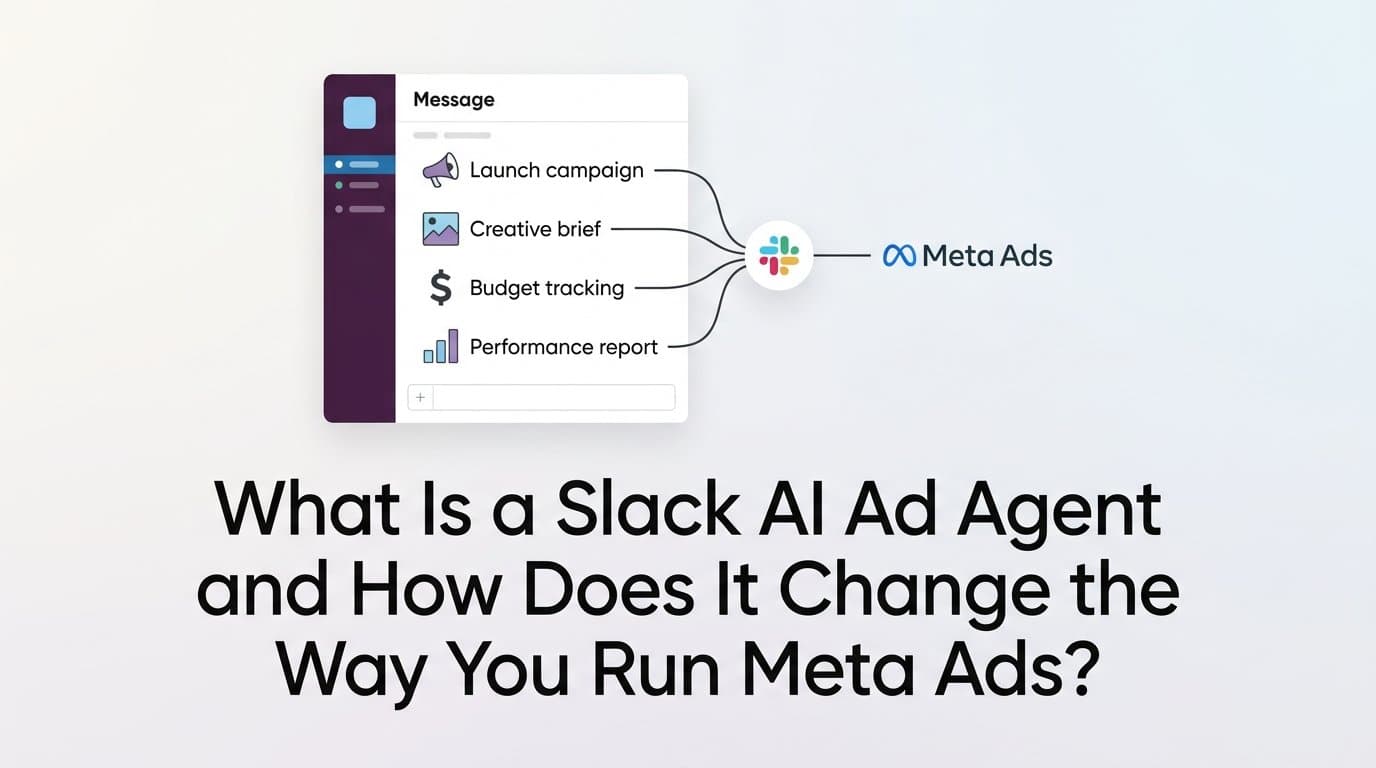
A Slack AI ad agent changes the architecture entirely. Instead of chasing data across five different tools, you ask a question in Slack and get an answer. You describe an ad and the agent builds it. You say "launch this campaign" and it goes live. The entire workflow, from creative to campaign to optimization, happens inside the thread where your team already communicates. That's the core promise, and it's a meaningful one.
The Fragmented Reality of Running Paid Ads Today
Picture a typical day for a performance marketer managing Meta campaigns. The morning starts with a check of Ads Manager to see how yesterday performed. Something looks off: a previously strong ad set is burning budget with a rising CPA. The natural next step is to pause it and reallocate the budget, but first you need to confirm the numbers with your media buyer, who's waiting on a creative revision from the designer, who's blocked because the brief is sitting in an email thread from three days ago.
By the time everyone is aligned and the change is made, hours have passed. The budget kept running. The opportunity to shift spend toward a winner was missed.
This is not a people problem. It's a structural one. The tools that run paid advertising were built to do specific jobs in specific places, and none of them talk to each other in real time. Ads Manager shows you the data. A design tool produces the creative. A spreadsheet tracks the budget. Slack handles the team conversation. Each one is a silo, and the coordination between them creates lag.
That lag is expensive. In performance marketing, speed is a competitive advantage. The team that can identify a failing ad and act on it in minutes rather than hours keeps more budget working efficiently. The team that can spin up a new creative and launch it the same day the brief is written tests more and learns faster.
The concept of a Slack AI ad agent addresses this directly. Rather than asking your team to jump between tools and coordinate through messages, the agent collapses the entire workflow into a single conversational thread. It lives inside Slack, where decisions already happen, and it connects to your ad account, your creative pipeline, and your performance data so that every action can be taken from the same place the conversation is happening.
The result is not just a faster workflow. It's a fundamentally different one, where the gap between spotting a problem and solving it shrinks from hours to minutes.
What a Slack AI Ad Agent Actually Does
The term "AI agent" gets used loosely, so it's worth being precise about what a Slack AI ad agent actually is and how it differs from tools you might already be using.
A basic notification bot tells you things. It might ping you when your ad spend crosses a threshold or when a campaign goes live. That's useful, but it's passive. A chatbot takes it one step further by answering questions, but it still requires you to take the action yourself.
An AI agent is different because it has agency. It can take actions on your behalf based on natural language instructions. When you ask it to pause an underperforming ad set, it pauses it. When you ask it to generate a video ad from a product URL, it builds one. When you tell it to launch a campaign targeting a specific audience, it constructs and deploys the campaign. The distinction between answering and acting is what separates an agent from everything else.
In practical terms, a Slack AI ad agent operates across three core capability categories.
Performance Intelligence: The agent connects directly to your ad account and pulls live data. You can ask it "which creatives had the best ROAS this week?" or "what's my current CPA by audience segment?" and get an answer in the thread, without opening Ads Manager or building a report. The agent interprets the data and surfaces what matters rather than making you dig for it.
Creative Generation: This is where a strong agent separates itself from the rest. Rather than simply suggesting copy or describing what an ad should look like, a capable Slack AI ad agent generates actual image ads, video ads, and UGC-style content on demand. You provide a product URL or a brief, and the agent produces the creative. You can refine it through conversation, the same way you'd give feedback to a designer, without ever leaving the thread.
Campaign Execution: The agent can build and launch complete Meta campaigns from within Slack. It selects audiences, writes headlines, structures the campaign, and pushes it live. It also handles ongoing execution: pausing waste, scaling winners, and shifting budgets based on real performance data. This is not a recommendation engine. It takes the action.
Together, these three capabilities mean the agent is not a reporting tool with a chat interface. It's a system that connects your creative pipeline, your ad account, and your performance data into a single operational layer that your team can direct through conversation.
From Brief to Live Campaign Inside One Thread
The most practical way to understand what a Slack AI ad agent does is to walk through what a real workflow looks like.
A marketer opens a Slack thread and types something like: "Create a video ad for our summer sale collection targeting women 25 to 44 who are interested in sustainable fashion." The agent processes the brief, pulls relevant product information, and generates a video ad creative. The marketer reviews it in the thread, asks for a revision to the headline, and the agent updates it. No designer briefing, no back-and-forth over email, no waiting until the next morning.
Once the creative is approved, the marketer types: "Launch this as a new campaign with a $200 daily budget." The agent builds the campaign structure, selects AI-optimized audiences based on past performance data, writes supporting copy variations, and pushes the campaign live to Meta. The entire sequence happens inside one conversation thread.
But the workflow doesn't stop at launch. This is where the ongoing optimization loop becomes valuable.
After the campaign goes live, the agent continues monitoring performance in the background. It tracks ROAS, CPA, CTR, and other key metrics against the goals you've set. When an ad set starts underperforming, the agent pauses it automatically rather than waiting for someone to notice in a morning review. When a creative is outperforming others, the agent scales the budget toward it. When a headline is driving stronger click-through, it gets prioritized in future variations.
This kind of bulk creative and copy testing is another area where the agent changes the math significantly. Instead of manually building five or ten ad variations, the agent can generate hundreds of combinations across creatives, headlines, audiences, and copy, then launch them all to Meta simultaneously. The testing happens at a scale that would be impractical to manage manually, and the agent surfaces the winners automatically based on real performance data.
AdStellar's AI Campaign Builder, for example, analyzes past campaign data, ranks every creative, headline, and audience by performance, and builds complete Meta campaigns in minutes. Every decision is explained in plain language so the team understands the strategy behind it, not just the output. The system gets smarter with each campaign it runs, drawing on an expanding dataset of what actually works for your specific account.
The net effect is a tighter feedback loop from idea to live ad to optimization, compressed into a workflow that a single person can manage from a Slack thread.
How Slack Changes the Way Your Team Makes Decisions
There's a less obvious benefit to running ad operations through Slack that goes beyond speed and automation. It changes how your team thinks and communicates about paid advertising.
When every campaign action happens inside a thread, context travels with the decision. The brief, the creative, the launch, the performance update, and the optimization call all exist in the same place. A team member who joins the conversation mid-campaign can scroll up and understand exactly what was built, why, and how it's performing. There's no need to reconstruct the history from three different tools.
This transparency also extends to the AI's reasoning. One of the most common concerns teams have when adopting AI tools is the black box problem: the system makes a recommendation or takes an action, but no one knows why. A well-built Slack AI ad agent addresses this by explaining its decisions in plain language inside the thread. When it pauses an ad set, it tells you why. When it shifts budget toward a winner, it shows you the data behind the call. That explainability builds trust over time and helps the team develop better intuition about what works.
The shift in team dynamics is also worth noting. When an agent handles the execution layer, media buyers and performance marketers can operate at a higher level. Instead of spending the majority of the day pulling reports, briefing designers, and manually adjusting bids, they spend that time on strategy: setting goals, evaluating creative direction, identifying new audiences, and making decisions that require human judgment. The agent handles the busywork. The human handles the thinking.
For teams managing multiple Meta campaigns simultaneously, this shift in capacity is significant. The same team can run more campaigns, test more creatives, and respond to performance signals faster without adding headcount or burning out the people they already have.
What Separates a Strong Slack AI Ad Agent from a Weak One
Not every tool that calls itself a Slack AI ad agent delivers the same capabilities. If you're evaluating options, there are a few specific things worth looking for.
Native Creative Generation: Some tools offer text suggestions or creative briefs but stop short of actually producing the ad. A strong agent generates real image ads, video ads, and UGC-style content from a product URL or description. The ability to produce and refine creatives through conversation, without involving a separate design tool or contractor, is a core differentiator. If the agent can't make the ad, it's not solving the biggest bottleneck in your workflow.
Direct Meta Integration: The agent should be able to launch campaigns to Meta directly from within the Slack thread, without requiring you to open Ads Manager to complete the process. Any tool that generates a campaign plan but requires manual execution is still leaving you with a context-switching problem.
Live Performance Data Access: There's a meaningful difference between an agent that connects to live ad account data and one that works from synced reports that may be hours old. Real-time data access means the agent can make optimization decisions based on what's actually happening right now, not what was happening this morning.
Transparent Decision-Making: As noted earlier, the ability to explain why a decision was made is not a nice-to-have. It's what separates a tool your team will trust from one they'll override or ignore. Look for an agent that communicates its reasoning clearly in plain language.
A Winners Hub or Equivalent: The best campaigns are built on proven assets. An agent that stores your top-performing creatives, headlines, audiences, and copy combinations in an accessible library can draw on real winners when building new campaigns rather than starting from scratch every time. AdStellar's Winners Hub does exactly this: it aggregates your best-performing assets with real performance data attached, so you can select a proven creative and instantly add it to the next campaign. Over time, this compounds into a significant advantage.
Is a Slack AI Ad Agent Right for Your Team?
The honest answer is that it depends on how you're currently running Meta ads and where the friction lives in your workflow.
If your team spends meaningful time every week pulling performance reports, briefing designers, manually adjusting budgets, and coordinating campaign changes through Slack threads, then a Slack AI ad agent addresses all of those pain points directly. The workflow it enables, from creative generation to campaign launch to ongoing optimization, all inside a single conversational thread, is a structural improvement over the fragmented approach most teams use today.
The teams that benefit most are performance marketers and media buyers managing multiple Meta campaigns who need to move fast, test more creative variations, and make optimization decisions without the lag that comes from tool-switching and manual coordination. If you're trying to scale output without scaling headcount, this is the kind of leverage that makes that possible.
AdStellar is built specifically for this workflow. It's an AI media buyer that connects to your ad account, generates image and video ad creatives, builds and launches Meta campaigns, and handles ongoing optimization, all from a conversational interface. It's not a reporting dashboard with a chat window. It's an agent that acts.
Start Free Trial With AdStellar and be among the first to launch and scale your ad campaigns faster with an intelligent platform that automatically builds and tests winning ads based on real performance data.
The Bottom Line
A Slack AI ad agent is not a productivity novelty. It's a structural change in how paid advertising teams operate. The traditional model, where data lives in one place, creatives in another, campaigns in a third, and team communication in a fourth, creates coordination overhead that slows everything down and keeps budgets burning on underperformers while the team catches up.
Collapsing that workflow into a single conversational thread changes the speed at which teams can move. It changes the scale at which they can test. It changes the role of every person involved, shifting them from reactive task executors to strategic decision-makers with a capable agent handling the execution layer.
The best Meta campaigns are won by teams that can generate strong creatives fast, launch and test at scale, and cut waste without waiting for a morning report. A Slack AI ad agent makes all of that possible without adding complexity to an already complex workflow. It removes complexity instead.
If that's the kind of operation you want to run, AdStellar is worth a close look. Visit adstellar.ai to see what it looks like in practice.