Most marketers waste 8-12 hours per week on Facebook ad creation tasks that could take minutes. They're rebuilding similar campaigns from memory, hunting through folders for that one image that worked three months ago, and manually copying audience settings between ad sets like it's still 2018.
The inefficiency compounds fast. Your competitor launches three campaign variations while you're still setting up your first. You miss market opportunities because campaign creation feels like such a heavy lift. Your best creative ideas sit unused because the execution process is exhausting.
Here's the reality: Creating Facebook ads shouldn't require heroic effort. The marketers consistently hitting their targets aren't necessarily more talented—they've built systems that eliminate friction at every step.
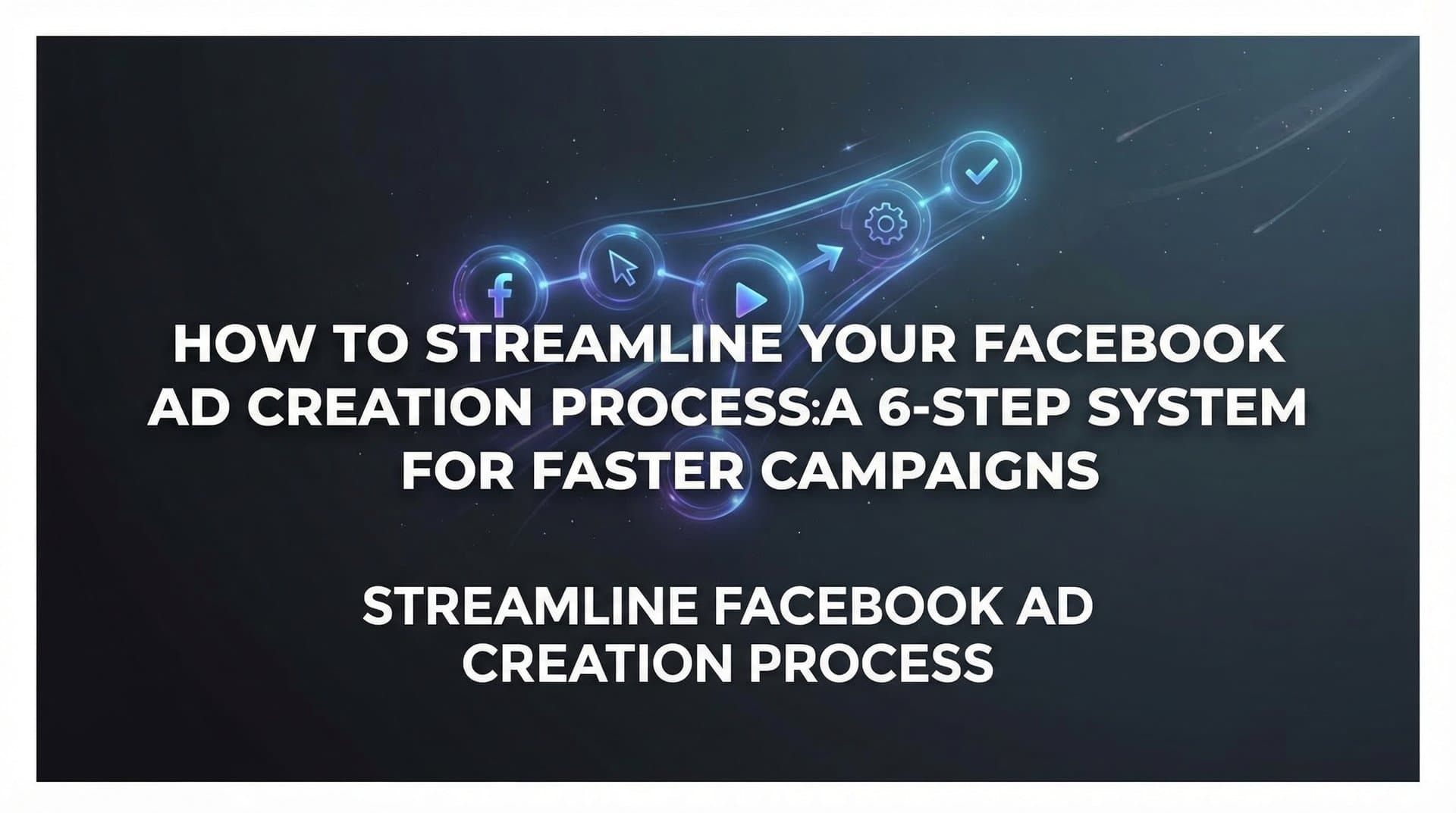
This guide breaks down a practical six-step framework to streamline your Facebook ad creation process from initial planning to launch. You'll learn how to identify your biggest time drains, organize assets for instant access, build reusable templates, batch similar tasks, automate routine decisions, and create a continuous improvement loop that makes each campaign faster than the last.
Whether you're managing ads for a single business or juggling multiple client accounts, these steps will help you launch better campaigns in a fraction of the time. Let's get into it.
Step 1: Audit Your Current Workflow and Identify Time Drains
You can't optimize what you don't measure. Start by mapping every single step in your current ad creation process, from receiving a campaign brief to hitting the publish button.
Grab a notebook or open a document. For your next campaign, track each task and how long it takes. Be specific: "Found product images in Dropbox - 12 minutes." "Created three headline variations - 18 minutes." "Set up audience targeting - 22 minutes."
Do this for at least one complete week. You'll likely discover that certain tasks consume disproportionate time relative to their value. The goal isn't to judge yourself—it's to identify patterns.
Common time drains that emerge from this exercise include searching for creative assets across multiple folders or platforms, recreating audience configurations you've used before, manually setting up A/B tests one variation at a time, switching between tools to gather performance data, and rebuilding campaign structures that are nearly identical to previous ones. These are classic manual Facebook ad creation challenges that plague marketers at every level.
Pay special attention to tasks you repeat frequently. If you're spending 20 minutes configuring audience settings for every campaign, and you launch three campaigns per week, that's an hour weekly on a task that could be templated.
Look for context-switching penalties too. Every time you jump from Meta Ads Manager to your design tool to your spreadsheet and back, you lose focus and momentum. These transitions might only take seconds individually, but they accumulate into significant productivity loss.
Once you've completed your audit, rank your time drains by frequency and duration. Circle the top three. These become your optimization targets for the remaining steps. If "finding and organizing creative assets" tops your list, Step 2 will deliver immediate relief. If "setting up similar campaigns repeatedly" is your pain point, Step 3 becomes your priority.
The insight here: Most marketers already know their process feels inefficient, but specific data transforms vague frustration into actionable targets. You now have a baseline to measure improvement against.
Step 2: Build a Centralized Creative Asset Library
Scattered assets kill momentum. When your product images live in one folder, your brand guidelines sit in another, your winning ad copy exists only in published campaigns, and your video files are somewhere in Slack messages from two months ago, every new campaign starts with a scavenger hunt.
Create a single source of truth for all creative assets. This could be a dedicated folder structure in Google Drive, Dropbox, or a digital asset management platform—the specific tool matters less than the organization system.
Structure your library with clear top-level categories: Images, Videos, Copy Templates, Brand Assets, and Performance Winners. Within each category, create subfolders organized by campaign type, product line, or audience segment—whatever taxonomy matches how you actually think about campaigns.
Naming conventions are non-negotiable. Establish a consistent format and stick to it religiously. A file named "IMG_2847.jpg" tells you nothing. A file named "ProductName_Lifestyle_Spring2026_Square.jpg" tells you everything.
Consider this format: AssetType_CampaignName_Variation_Dimensions_Date. For example: "Video_ProductLaunch_TestimonialA_1080x1920_2026-03.mp4" immediately communicates what it is, where it belongs, which variation it represents, what size it is, and when it was created.
Tag your assets with performance metadata. When an image drives a 3.2% conversion rate, note that in the file name or in a companion spreadsheet. Create a dedicated "Winners" folder for assets that have proven themselves in live campaigns. This becomes your go-to resource when you need reliable creative under deadline pressure.
Include your brand guidelines in this library: logo files in multiple formats, approved color codes, font files, tone of voice documentation, and any legal disclaimers or compliance requirements. When everything lives in one place, you eliminate the "where's that file?" tax on every campaign.
For copy, maintain a swipe file of headlines, primary text variations, and calls-to-action that have performed well. Organize these by campaign objective and emotional angle. When you need to write new ad copy, you're not starting from a blank page—you're remixing proven elements.
Set a calendar reminder to audit this library monthly. Remove outdated assets, add new winners, and update performance notes. A well-maintained asset library transforms from a filing system into a strategic advantage.
Step 3: Create Reusable Campaign Templates and Structures
Every time you rebuild a conversion campaign from scratch, you're reinventing the wheel. Most businesses run variations of the same campaign types repeatedly: product launches, seasonal promotions, lead generation, retargeting sequences.
Build template campaigns for each of your common objectives. In Meta Ads Manager, create a campaign with your standard structure—ad sets configured with your typical audience segments, placement selections, and budget allocation—then duplicate it as your starting point for future campaigns. Understanding the right Facebook campaign creation workflow makes this process significantly more efficient.
Document the logic behind each template. Why did you choose these placements? What's the reasoning behind this audience layering? When someone else on your team (or future you, six months from now) uses this template, they should understand the strategic thinking, not just follow steps blindly.
Pre-configure your most-used audience segments as saved audiences in Meta Ads Manager. If you consistently target "Women 25-45, interested in sustainable fashion, engaged in the last 30 days," save that configuration once. Next time, you'll select it from a dropdown instead of rebuilding it from scratch.
Create tiered templates based on budget levels. Your $500 test campaign structure likely differs from your $5,000 scale campaign. Build templates for each tier so you're not making structural decisions on the fly every time budget parameters change.
Include creative specifications in your templates. If your conversion campaigns always use 1:1 images and 9:16 videos, note those requirements. If your lead gen campaigns perform best with three headline variations and two primary text options, document that pattern.
For campaign naming, establish a consistent convention across all templates. Something like: "Objective_Product_Audience_StartDate" ensures you can scan your Ads Manager and immediately understand what each campaign does. "CONV_SpringCollection_Warm_2026-03-15" is infinitely more useful than "Campaign 47."
Don't just create these templates and forget them. Use them. Refine them. When you discover a new audience configuration that consistently outperforms, update the template. When placement mix changes based on new platform features, evolve your structure.
The goal isn't to eliminate creativity or strategic thinking—it's to eliminate the repetitive Facebook ad creation tasks that delay execution. Templates handle the scaffolding so you can focus on the messaging and targeting nuances that actually differentiate performance.
Step 4: Implement Batch Creation for Ad Variations
Task-switching destroys productivity. When you write one headline, then design one image, then write another headline, then find another image, your brain constantly shifts between creative modes. Each transition carries a cognitive cost.
Batch similar tasks into focused sessions. Set aside dedicated time to write all your ad copy variations in one sitting. Use a structured framework: Start with your core value proposition, then create variations that emphasize different benefits, address different objections, or appeal to different emotional triggers.
For a single campaign, write 5-7 headline variations, 3-5 primary text options, and 2-3 calls-to-action before moving to the next task. This approach leverages momentum—each variation flows more easily when you're already in writing mode.
Apply the same batching principle to creative selection. Pull all your potential images or videos for a campaign at once. Evaluate them against your campaign objective, arrange them in order of expected performance, and prepare them for upload together.
Meta Ads Manager's bulk upload features let you launch multiple ad variations simultaneously rather than creating them one by one. Prepare your creative combinations in a spreadsheet: which headlines pair with which images, which audience segments get which messaging angles. Then upload everything in a single operation. For a detailed walkthrough, check out this Facebook ads bulk creation tutorial.
AI-powered tools can accelerate this batching process significantly. Platforms like AdStellar AI can generate multiple ad variations based on your best-performing historical elements, creating dozens of testable combinations in under a minute. The AI analyzes which headlines historically perform best with which image types, which audience segments respond to which messaging angles, and which creative combinations are worth testing.
This isn't about removing human judgment—it's about augmenting your creative process. You still make strategic decisions about positioning and messaging, but the tool handles the mechanical work of generating variations and assembling combinations.
Schedule your batching sessions strategically. Many marketers find that creative writing flows better in the morning, while analytical tasks like reviewing performance data work better in the afternoon. Align your batching schedule with your natural energy patterns.
The efficiency gains compound when you combine batching with templates. Using your campaign template as a foundation, batch-creating your creative variations, and bulk-uploading everything can reduce Facebook ad creation time from hours into a 20-minute focused session.
Step 5: Automate Testing and Performance Analysis
Manual optimization is a full-time job. Checking campaigns multiple times daily, manually pausing underperformers, reallocating budget to winners—it's necessary work, but it doesn't require human intuition for every decision.
Set up automated rules in Meta Ads Manager to handle routine optimization decisions. Create a rule that automatically pauses any ad with a cost-per-conversion exceeding your target by 50% after spending a minimum threshold. Set another rule to increase budget by 20% for ad sets achieving your target cost-per-conversion with statistical significance.
These rules don't replace strategic oversight—they handle the obvious cases so you can focus on the nuanced decisions that actually require judgment. You're not constantly monitoring; you're reviewing the automated decisions and intervening only when something unexpected happens.
Move beyond basic metrics to AI-driven insights that identify which specific creative elements drive performance. Rather than just knowing "Ad A outperformed Ad B," understand that ads featuring customer testimonials in the first three seconds, using benefit-focused headlines, and targeting warm audiences consistently deliver 40% lower acquisition costs. Learning what Facebook ad campaign automation can accomplish helps you set realistic expectations.
Build a simple scoring system to quickly evaluate campaign performance without drowning in data. Define your key metrics—cost per conversion, conversion rate, return on ad spend—then create a weighted score that combines them into a single performance indicator. An ad scoring 85+ is a clear winner. An ad scoring below 60 needs immediate attention. Everything in between requires deeper analysis.
Create dashboards that surface actionable insights automatically. Use tools like Google Data Studio, Supermetrics, or built-in analytics platforms to pull performance data into a single view. Configure alerts that notify you when campaigns cross important thresholds—both positive (hitting scale targets) and negative (exceeding cost targets).
Integration with attribution tools like Cometly provides clearer insight into what's actually driving results beyond Meta's attribution window. You'll see which campaigns contribute to conversions days or weeks after the initial click, helping you avoid prematurely killing campaigns that are actually working.
The goal of automation isn't to remove yourself from the optimization process—it's to elevate your role from tactical monitor to strategic director. Let the systems handle routine decisions while you focus on identifying new opportunities, testing bold creative concepts, and refining your overall strategy. Explore media buyer Facebook automation tools to find solutions that match your workflow.
Step 6: Establish a Continuous Improvement Loop
Your systems should get smarter over time. Each campaign you run generates insights that should feed back into your templates, asset library, and processes.
Schedule a weekly review session—30 minutes minimum—to analyze what's working. Which headlines are consistently outperforming? Which audience segments are delivering the lowest acquisition costs? Which creative formats are driving the highest engagement?
Document these learnings systematically. Maintain a simple spreadsheet or document with columns for the insight, supporting data, and implementation action. "Benefit-focused headlines outperform feature-focused by 32% in conversion campaigns" becomes a documented insight that informs future copywriting.
Feed winning elements back into your asset library. When an ad creative drives exceptional results, immediately add it to your "Winners" folder with performance notes. Update your copy swipe file with successful headlines and primary text variations. Your asset library evolves from a static repository into a living collection of proven elements.
Refine your templates based on accumulated learnings. If you discover that your conversion campaigns consistently perform better with four ad sets instead of three, update the template. If a new placement mix delivers better results, evolve your standard structure. Understanding how to optimize Facebook ad workflow is an ongoing process, not a one-time fix.
Set benchmarks and track your time-to-launch improvements. How long did it take to build and launch a campaign this month compared to three months ago? Are you launching more variations in the same timeframe? Is your hit rate on successful campaigns improving?
Share learnings across your team or client accounts. A winning strategy for one product might apply to others. An audience insight from one campaign might unlock opportunities elsewhere. Create a simple system for cross-pollinating insights—a shared Slack channel, a monthly team review, or a centralized insights document.
The continuous improvement loop transforms your process from a static set of steps into an evolving system that compounds efficiency gains over time. Your tenth campaign using this system should be significantly faster and more effective than your first.
This isn't about perfection—it's about progression. Each cycle through the loop makes your systems slightly better, your asset library slightly more valuable, your templates slightly more refined. Those incremental improvements compound into substantial competitive advantages.
Putting It All Together
Streamlining your Facebook ad creation process isn't about cutting corners or sacrificing quality. It's about building systems that eliminate friction, reduce repetitive work, and let you focus on the strategic and creative decisions that actually differentiate performance.
The six-step framework gives you a clear path forward. Audit your workflow to identify where time actually goes. Build a centralized asset library so you're never hunting for files. Create reusable templates for your common campaign types. Batch similar tasks to maintain focus and momentum. Automate routine optimization decisions. Establish a continuous improvement loop that makes each campaign faster than the last.
Start with quick wins. This week, map your current process and identify your top three time drains. Create an organized asset library with clear naming conventions—even if you only tackle one category to start. Build one reusable campaign template for your most frequent campaign type. Batch your next round of ad copy creation instead of writing one variation at a time. Set up one automated rule to manage underperforming ads.
These aren't theoretical improvements—they're practical changes that deliver measurable results. Marketers implementing these systems report reducing campaign creation time by 60-70% while actually improving performance because they can test more variations and iterate faster. If you're ready to explore dedicated solutions, review the top Facebook ad creation platforms available today.
The competitive advantage goes to marketers who can move faster without sacrificing quality. While your competitors are still manually rebuilding campaigns and hunting for assets, you're launching sophisticated tests and scaling winners. That velocity compounds into market share.
Ready to transform your advertising strategy? Start Free Trial With AdStellar AI and be among the first to launch and scale your ad campaigns 10× faster with our intelligent platform that automatically builds and tests winning ads based on real performance data. Seven specialized AI agents handle everything from campaign structure to creative selection to budget allocation, while you maintain full control and transparency over every decision. Stop spending hours on repetitive tasks and start focusing on the strategic work that actually moves your business forward.