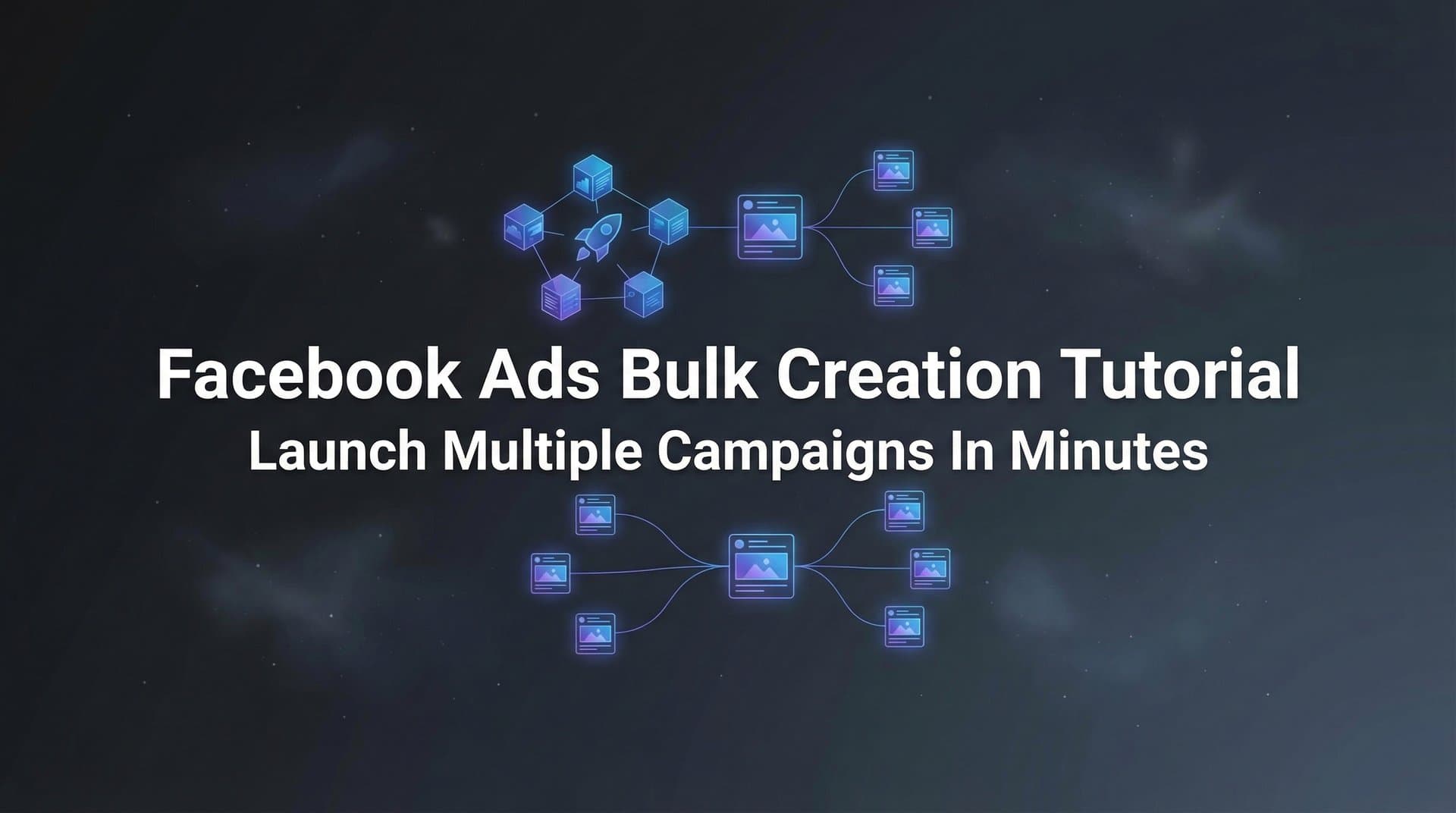
You're launching a new product line next week. You have 15 different ad creatives, 8 audience segments to test, and 3 headline variations for each. That's 360 individual ads to build. If you're creating them one by one in Ads Manager, you're looking at 20+ hours of mind-numbing work—and that's before your first campaign even launches.
The math is brutal. Manual ad creation doesn't scale. Period.
Facebook ads bulk creation isn't just a time-saver—it's the difference between testing at the pace your competitors move and actually staying ahead of them. When you can launch 50 ad variations in the time it used to take to build five, you're not just working faster. You're testing more angles, reaching more audiences, and finding winners while others are still stuck in the setup phase.
This tutorial walks you through the complete process of creating Facebook ads in bulk. You'll learn both Meta's native bulk tools and AI-powered approaches that compress hours of work into minutes. Whether you're managing multiple clients, testing creative angles at scale, or expanding winning campaigns across new audiences, you'll have a repeatable system that maintains quality while dramatically increasing your output.
Let's get into it.
Step 1: Organize Your Creative Assets and Copy Variations
Before you touch Ads Manager, you need a foundation that won't crumble when you're uploading dozens of ads simultaneously. Think of this as setting up your assembly line before production starts.
Create a dedicated folder structure on your computer or cloud storage. At the top level, separate by campaign. Within each campaign folder, create subfolders for images, videos, and copy documents. This isn't just about being neat—it's about preventing the nightmare scenario where you're hunting through 47 files named "final_v2_REAL_final.jpg" while your upload deadline looms.
Your naming convention matters more than you think. Use descriptive, consistent file names that tell you exactly what's inside. Instead of "image1.jpg," try "product_shoes_lifestyle_blue_background.jpg." When you're bulk uploading, these names become your navigation system. You'll thank yourself when you need to swap out a specific creative variation across 20 ads.
Now tackle your copy variations. Create a master spreadsheet with columns for headlines, primary text, and descriptions. Write multiple variations of each—at least 3-5 options per element. Keep them in the same document so you can see how they work together. This is where you test different angles: benefits-focused vs. feature-focused, urgent vs. educational, question-based vs. statement-based.
Here's the critical part: verify every asset meets Meta's specifications before you start building. Images should be 1080x1080 pixels minimum for feed placements. Videos need to be under 4GB and formatted as MP4 or MOV. Text overlays shouldn't dominate more than 20% of the image (though Meta has relaxed this, heavy text still gets penalized in delivery). Check your copy character counts—125 characters for headlines, 27 for link descriptions.
One often-overlooked detail: make sure your landing pages are ready and URLs are finalized. Nothing kills momentum like realizing mid-upload that your product page isn't live yet. Double-check UTM parameters if you're using them for tracking—bulk creation means bulk mistakes if your tracking setup is wrong.
The time you invest in organization here pays exponential dividends. A well-organized asset library means you can execute bulk uploads in minutes instead of hours. It also makes future campaigns faster since you're building a reusable system, not just throwing files together for a one-off launch.
Step 2: Structure Your Campaign Architecture for Scale
Campaign architecture is where most bulk creation attempts fall apart. You can't just dump 50 ads into Ads Manager and hope Meta figures it out. You need a blueprint. Using a dedicated Facebook ads campaign planner can help you map this structure before building.
Start by mapping your hierarchy on paper or in a spreadsheet. At the top: campaigns organized by objective (conversions, traffic, engagement). Below that: ad sets segmented by audience, placement, or testing variable. At the bottom: individual ads with their creative and copy combinations. This visual map prevents you from creating organizational chaos that's impossible to analyze later.
The CBO vs ABO decision matters for bulk campaigns. Campaign Budget Optimization (CBO) gives Meta control to distribute your budget across ad sets based on performance. This works well when you're testing audiences and want the algorithm to find winners automatically. Ad Set Budget Optimization (ABO) gives you manual control over spending per ad set—better when you have specific budget allocations for different audience tiers or when you're testing budget levels themselves.
For bulk creation, CBO often makes more sense. You're already creating volume at the ad level. Letting Meta optimize budget distribution means you're not manually adjusting 15 ad set budgets every morning. Set your total campaign budget and let the algorithm work.
Audience segmentation requires strategic thinking. Don't just create ad sets for every possible audience combination—you'll dilute your budget and kill statistical significance. Group audiences logically: one ad set for warm audiences (website visitors, email lists), another for lookalikes, another for interest-based cold audiences. Within each ad set, you'll test creative and copy variations.
Naming conventions save your sanity. Use a consistent format that includes key identifiers: "CAMP_ProductName_Objective_Date" for campaigns, "ADSET_AudienceType_Placement_Date" for ad sets, "AD_CreativeType_CopyAngle_Date" for individual ads. When you're looking at performance data for 100 ads, these names are how you quickly identify what's working.
Plan your testing variables before building. Are you testing audiences against each other? Then keep creative consistent across ad sets. Testing creative variations? Then keep audiences the same. Testing everything at once creates noise that makes it impossible to know what's actually driving results. Bulk creation amplifies this problem—if you're launching 50 ads with no clear testing hypothesis, you're just creating 50 data points of confusion.
Document your structure in a master spreadsheet. List every campaign, ad set, and ad you plan to create, along with their targeting, budgets, and creative assignments. This becomes your upload template and your reference guide for analysis later.
Step 3: Use Meta's Bulk Upload Features in Ads Manager
Meta's native bulk tools are hidden in plain sight. Most advertisers never discover them because they're buried in menus that aren't part of the normal campaign creation flow. Let's fix that.
In Ads Manager, click the hamburger menu (three horizontal lines) in the top left. Navigate to "Import & Export" under the Tools section. This is your gateway to bulk creation. You have two options: importing from a file or exporting existing campaigns to use as templates. Start with export if you've never done this before—it gives you a pre-formatted template with all the correct column headers.
Select a campaign that's similar to what you want to create in bulk. Export it as an Excel file. Open it and you'll see Meta's data structure: one row per ad, with columns for every possible setting. Campaign name, objective, budget, ad set name, targeting parameters, placement options, ad creative, copy—it's all there. This spreadsheet is your blueprint.
Now comes the detail work. Each column has specific formatting requirements. Budget columns need numbers only (no dollar signs). Date columns require YYYY-MM-DD format. Targeting columns use specific IDs that Meta recognizes—you can't just type "women 25-34," you need to use Meta's targeting codes. The export template shows you exactly how to format everything.
Start filling in your bulk upload sheet. Copy your campaign structure from your planning document. For each ad, specify the campaign and ad set it belongs to. Fill in targeting parameters—locations, age ranges, interests. Add your creative file names (these must match exactly what you'll upload). Paste in your ad copy variations for headlines, primary text, and descriptions.
Common upload errors to avoid: mismatched column headers (don't rename anything), empty required fields (every ad needs a campaign and ad set assignment), invalid targeting codes (double-check interest IDs), and file name mismatches (your spreadsheet says "image1.jpg" but you upload "image_1.jpg"). One wrong cell can cause the entire upload to fail.
Before uploading, use Meta's validation feature. In the Import & Export tool, there's an option to validate your file before actually creating campaigns. This catches errors before they waste your time. Fix any flagged issues, then run validation again until you get a clean result.
When you're ready, upload your spreadsheet and creative files. Meta processes the data and shows you a preview of what will be created. Review it carefully—this is your last chance to catch mistakes before campaigns go live. Once confirmed, Meta builds everything automatically. Campaigns, ad sets, and ads appear in your account within minutes.
The bulk upload method works, but it's tedious. You're essentially doing manual work in a spreadsheet instead of in Ads Manager. For true efficiency, especially when you're working with historical performance data, you need automation. If you're curious about the tradeoffs, our comparison of Facebook ads builder vs manual creation breaks down when each approach makes sense.
Step 4: Create Dynamic Variations with Multiple Text Options
Meta's Multiple Text Optimization feature is bulk creation's secret weapon. Instead of creating separate ads for each headline and copy combination, you create one ad with multiple variations—and Meta's algorithm tests them all automatically.
Here's how it works. When creating an ad (either manually or via bulk upload), you can add up to 5 variations each for headlines, primary text, and descriptions. Meta then generates every possible combination and tests them across your audience. If you add 5 headlines, 3 primary text options, and 3 descriptions, that's 45 unique ad combinations from a single ad unit.
Enable this feature in the ad creation interface under the text fields. You'll see "+ Add Another Option" links below each text element. Click to add variations. Each variation should test a different angle or approach—don't just rephrase the same message. Try benefit-focused vs. feature-focused headlines, urgent vs. educational primary text, different calls-to-action in descriptions.
The algorithm handles the testing automatically. Meta shows different combinations to different users and tracks which versions drive the best results for your optimization goal (conversions, clicks, impressions). Over time, winning combinations get more delivery while underperformers fade out. You get the benefits of extensive testing without creating dozens of separate ads.
Balance is critical. More variations aren't always better. If you add 5 options for every text element, you're creating 125 combinations. That requires significant traffic to reach statistical significance for each combination. For most campaigns, 3-4 variations per element hits the sweet spot—enough diversity to find winners, not so many that results get diluted.
Multiple Text Optimization works especially well for retargeting campaigns and warm audiences where you have enough volume to test variations quickly. For cold audience testing with limited budgets, you might get better insights from fewer, more distinct variations in separate ad sets where you can control budget allocation.
Track performance at the variation level in Ads Manager. Navigate to the ad level, then click "View Charts" and select "Delivery" to see which text combinations are winning. This data informs future campaigns—those winning headlines and copy angles become your starting point for the next round of bulk creation.
Step 5: Automate Bulk Creation with AI-Powered Tools
This is where bulk creation evolves from faster manual work to genuine automation. AI-powered Facebook ads platforms analyze your historical performance data and automatically generate winning campaign combinations at scale.
The fundamental difference: instead of you deciding which creatives, headlines, and audiences to combine, AI does it based on what's actually worked in your account. The system identifies your top-performing ad elements—the images that drive conversions, the headlines that generate clicks, the audiences that convert at the lowest cost. Then it builds new campaign variations using those proven winners.
Setting up automated bulk creation starts with connecting your Meta ad account to an AI platform. The system pulls your historical campaign data—typically 30-90 days of performance metrics. It analyzes which creative elements, copy angles, and targeting parameters have driven your best results. This becomes the foundation for automated campaign building.
When you're ready to launch a new campaign, you define your objective and budget. The AI then generates multiple campaign variations automatically. It selects high-performing creatives from your library, writes copy variations based on your best-performing messaging patterns, and assigns targeting based on your most successful audiences. Instead of you manually combining elements, the AI handles the combinatorial complexity.
AdStellar AI takes this further with specialized AI agents for Facebook ads that handle different aspects of campaign building. One agent analyzes your landing page and product to understand what you're promoting. Another structures the campaign architecture. A targeting agent selects audiences based on historical performance. A creative agent curates your best-performing visuals. A copywriting agent generates variations in your proven style. A budget agent allocates spending across ad sets. All of this happens in under 60 seconds.
The transparency matters. Unlike black-box automation, AI platforms should show you why they made each decision. Which historical campaigns influenced the creative selection? Why did it choose this audience over that one? What performance patterns led to the budget allocation? This rationale helps you learn from the AI's decisions and refine your strategy over time.
Bulk launching with AI means you can test at a scale that's impossible manually. Want to launch 20 campaign variations testing different audience segments with your top-performing creatives? That's a few clicks instead of hours of manual work. Need to quickly scale a winning campaign across new markets with localized copy? The AI generates variations automatically.
Connect your bulk launches to attribution tracking from the start. Integration with platforms like Cometly ensures you're measuring true conversion impact, not just Meta's last-click attribution. This closed-loop data feeds back into the AI, improving future campaign generation based on actual revenue results, not just platform metrics.
The learning loop is continuous. Each campaign you run generates new performance data. The AI analyzes what worked, updates its understanding of your best-performing elements, and applies those insights to the next bulk creation cycle. Your campaigns get smarter over time without you manually analyzing every data point.
Step 6: Review, QA, and Launch Your Bulk Campaigns
Bulk creation means bulk consequences if something's wrong. A single error multiplies across every ad variation. Your pre-launch checklist prevents expensive mistakes.
Start with targeting verification. Open each ad set and confirm the audience parameters match your plan. Check location targeting—are you accidentally showing ads globally when you meant to target the US? Verify age and gender settings. Review interest and behavior targeting to ensure you're reaching the right people. For lookalike audiences, confirm you're using the correct source audience and percentage.
Budget checks come next. If you're using CBO, verify the campaign budget is set correctly and that ad set spending limits (if any) make sense. For ABO campaigns, check that each ad set has the intended budget. Look for accidental zeros or misplaced decimal points—$100 vs. $1,000 is a costly typo when multiplied across 10 ad sets.
Placement review is critical for bulk campaigns. Click into ad set settings and verify placement selections. Are you running on Instagram when your creative isn't formatted for Stories? Did you accidentally enable Audience Network when you meant to stay on Facebook and Instagram only? Bulk creation often defaults to automatic placements—confirm this matches your strategy.
Creative and copy spot-checks catch formatting issues before they go live. Select a few ads from each campaign and use Meta's preview tool to see how they render across different placements. Does your square image get awkwardly cropped in Stories? Is your headline cut off in feed placements? Does your video have sound when it needs to work without it? Fix these issues in your master ads, and the corrections apply to all variations.
Run through your UTM parameters if you're using them for tracking. One wrong UTM in a bulk upload means broken attribution across dozens of ads. Open a few ads, copy the destination URL, and paste it into a browser to verify the parameters are correct and the landing page loads properly.
Schedule or launch based on your strategy. For major campaigns, consider scheduling launch for a specific date and time rather than going live immediately. This gives you a buffer to catch last-minute issues. Set up automated rules or alerts in Ads Manager to notify you if campaigns exceed daily budgets or if performance drops below thresholds.
Create a monitoring dashboard for your bulk campaigns. Use Ads Manager's custom columns to track the metrics that matter most for your objective. Group ads by testing variable so you can quickly see which audiences, creatives, or copy angles are winning. Check performance at least daily for the first week—bulk campaigns can burn through budgets quickly if something's wrong.
Document what you launched. Keep a record of which campaigns went live, what you're testing, and when you'll review results. This becomes your reference for analysis and your starting point for the next round of bulk creation. The best bulk creators maintain a knowledge base of what works—winning elements, successful structures, optimal budgets—that informs every future campaign.
Putting It All Together: Your Bulk Creation Workflow
You've just learned the complete system for Facebook ads bulk creation. Let's consolidate it into a repeatable workflow you can execute every time you launch campaigns at scale.
Your checklist: Organize assets with clear naming conventions and verify Meta specifications. Map your campaign architecture with clear testing hypotheses. Use Meta's bulk upload tools for manual scaling or AI automation for intelligent campaign generation. Enable Multiple Text Optimization for dynamic testing within ad units. Run thorough QA on targeting, budgets, placements, and creative rendering. Launch with monitoring systems in place.
The time savings are real. What used to take 20 hours now takes 2. But the bigger win isn't just speed—it's the ability to test at a scale that actually generates meaningful insights. You're not choosing between testing audiences OR creatives OR copy angles. You're testing all of them simultaneously, finding winners faster, and scaling Facebook ads profitably before your competition even finishes their first round of manual builds.
AI automation amplifies these advantages. When your bulk creation system learns from historical performance, selects winning elements automatically, and generates campaigns in seconds, you're operating at a different level entirely. You're spending your time on strategy and analysis, not on the mechanical work of building ads.
The marketers who master bulk creation don't just work faster. They test smarter, scale quicker, and consistently outperform competitors who are still building campaigns one ad at a time. This is your competitive advantage—use it.
Ready to transform your advertising strategy? Start Free Trial With AdStellar AI and be among the first to launch and scale your ad campaigns 10× faster with our intelligent platform that automatically builds and tests winning ads based on real performance data.