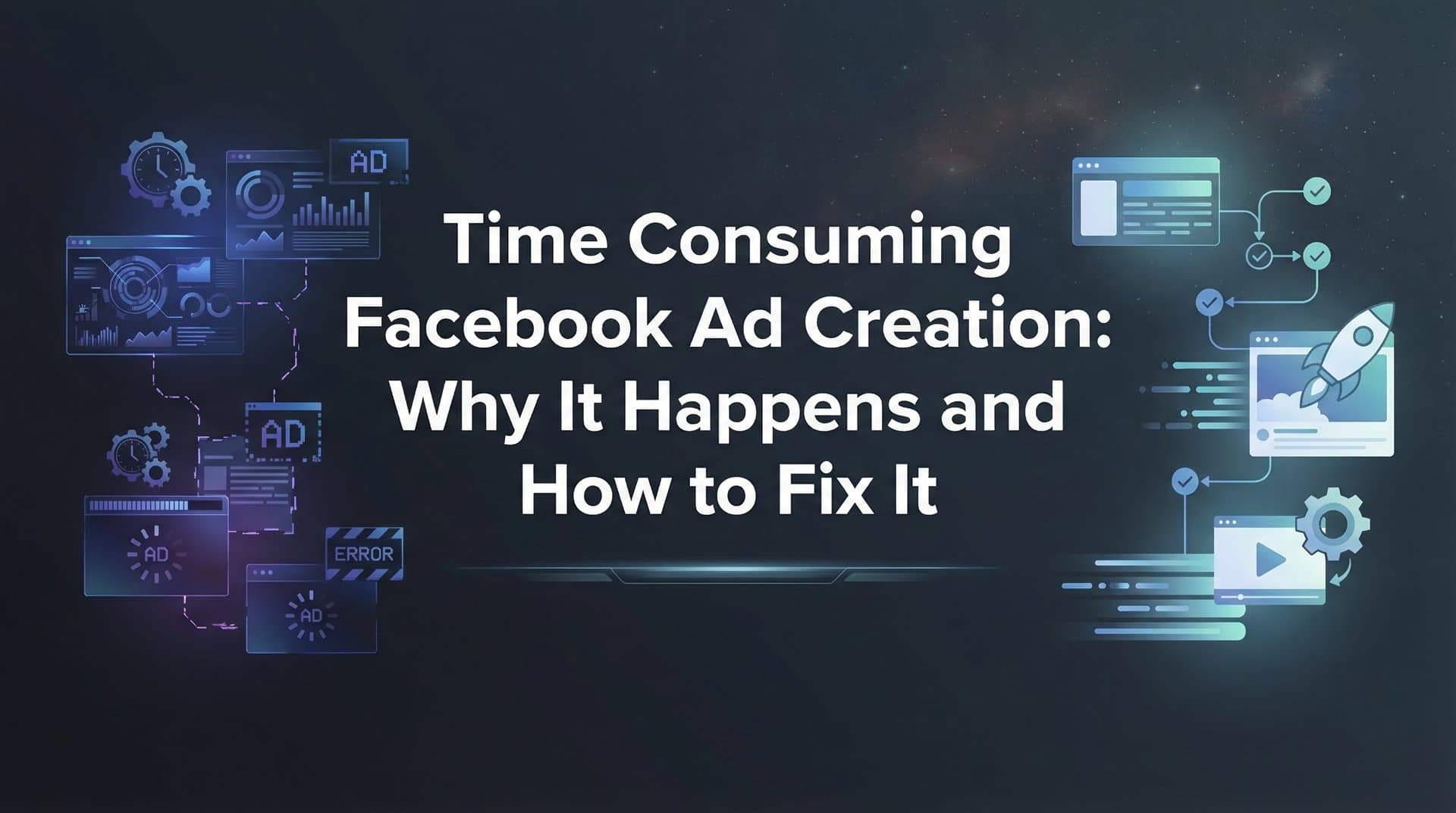
You've blocked off two hours to build a Facebook ad campaign. Two hours later, you're still tweaking audience parameters, second-guessing your creative choices, and wondering if you should test that third headline variation. Meanwhile, your to-do list has grown by five items, and you haven't even clicked "Publish" yet.
This isn't a productivity problem. It's a structural reality of time consuming Facebook ad creation that affects every digital marketer, whether you're managing campaigns for a Fortune 500 brand or a local business.
The frustration compounds when you realize that one campaign isn't enough. You need variations. You need tests. You need to actually find out what works before scaling your budget. But if one campaign takes two hours, how do you build the ten variations required for meaningful testing?
This guide breaks down exactly why Facebook ad creation devours your calendar and, more importantly, what you can do about it. We'll examine the hidden time drains, explore why manual processes don't scale, and reveal practical strategies that give you back control of your schedule without sacrificing campaign quality.
The Hidden Time Drains in Every Facebook Ad Campaign
Let's talk about where your time actually goes. If you've ever wondered why a "simple" ad campaign stretches from a 30-minute task into a three-hour ordeal, the answer lies in the accumulation of micro-tasks that Meta's platform requires.
Start with audience research. You're not just selecting "women aged 25-45 interested in fitness." You're cross-referencing interest categories, evaluating audience size against your budget, considering whether to layer behaviors, deciding between broad and narrow targeting, and wondering if you should create a lookalike audience first. Each decision point requires research, comparison, and judgment calls. What feels like five minutes of audience selection is actually 20-30 minutes of strategic thinking.
Then comes creative development. You need to source images or video, ensure they meet Meta's specifications, consider mobile versus desktop display, think about aspect ratios, and make sure nothing violates advertising policies. Even if you're working with existing assets, you're still evaluating which creative best matches your campaign objective, testing different crops, and debating whether the visual clearly communicates your value proposition.
Copy iterations create their own time sink. You write a primary text, then realize it needs a hook for scroll-stopping power. You craft a headline, then create two variations to test. You write a description, then edit it down because it's too long for mobile display. You're not writing one ad—you're writing components that need to work together while also standing alone in different placements. This is why Facebook ad copywriting is time consuming for even experienced marketers.
The technical setup phase introduces friction that most marketers underestimate. You're selecting campaign objectives, choosing between campaign budget optimization and ad set budgets, setting bid strategies, configuring conversion events, adding UTM parameters for tracking, selecting placements, and reviewing everything before launch. Meta's interface requires clicking through multiple screens, each with dozens of options that impact performance.
Here's what makes this particularly challenging: Meta updates its Ads Manager interface regularly. Features move. Options get renamed. New capabilities appear without announcement. What you learned three months ago might not apply today, forcing you to relearn processes or hunt for relocated settings. This constant adaptation adds cognitive overhead to every campaign build.
The review cycle extends timelines further when working with teams or clients. You build the campaign, send it for approval, receive feedback, make revisions, send again, and repeat until everyone's satisfied. Each round trip adds hours or days to what should be a straightforward process.
When you're managing multiple campaigns or clients simultaneously, these time drains compound exponentially. You're not just building one campaign—you're context-switching between different brands, objectives, audiences, and creative approaches. Each switch requires mental recalibration, which slows down every subsequent task. Understanding the full scope of time consuming Facebook ad setup helps you identify where to focus your optimization efforts.
Why Manual Ad Building Doesn't Scale
The math of manual ad creation reveals an uncomfortable truth: you can't test properly without time you don't have.
Effective Facebook advertising requires testing. You need to test different creatives to find what resonates. You need to test various audiences to discover who converts. You need to test multiple messages to identify which value proposition wins. Best practices suggest launching at least 5-10 variations per campaign to gather meaningful performance data.
But here's the bottleneck: if one campaign takes two hours to build, ten variations require 20 hours of focused work. That's half a work week dedicated to setup before you've learned anything about performance. Most marketers can't afford this time investment, so they compromise—launching fewer variations, testing less thoroughly, and potentially missing their best-performing combinations. This is precisely why Facebook ad testing becomes too time consuming for most teams.
The repetitive nature of manual building creates inefficiency at scale. You're selecting the same interest categories across campaigns. You're entering identical budget parameters. You're uploading similar creative assets. You're writing variations of the same core message. Each campaign requires you to repeat 80% of the same setup work, even when the only meaningful difference is testing one variable.
Audience selection becomes particularly time-intensive when building multiple variations. You need to create custom audiences, build lookalikes, research interest targeting, consider geographic parameters, and layer behavioral data. When you're testing five different audience approaches, you're essentially doing this research five times—even though much of the foundational work overlaps.
Budget allocation across multiple ad sets demands careful attention that doesn't automate well manually. You're calculating daily budgets, considering lifetime budgets, deciding on bid caps, and thinking through how budget distribution affects learning phases. Multiply this across ten ad sets, and you're spending significant time on mathematical calculations rather than strategic thinking.
The cognitive load of context-switching between creative thinking and technical implementation disrupts flow states. You're brainstorming compelling copy one minute, then navigating dropdown menus the next. You're thinking strategically about audience psychology, then immediately shifting to technical details about pixel implementation. This constant oscillation between creative and technical modes prevents you from achieving the deep focus that produces your best work. These are the core manual Facebook ad creation challenges that limit scaling potential.
When managing multiple clients or brands, the scaling problem intensifies. You can't simply copy-paste campaigns between accounts because each business has unique audiences, objectives, and brand voices. You're rebuilding similar structures repeatedly while customizing for specific contexts—a time-consuming middle ground between full automation and complete customization.
Strategic Shortcuts That Actually Work
Smart marketers don't work harder—they build systems that eliminate redundant effort while maintaining campaign quality.
Template-based approaches transform how quickly you can launch new campaigns. Create a master campaign structure that includes your standard naming conventions, preferred placements, tracking parameters, and common settings. When you need to launch something new, you're modifying a proven template rather than building from scratch. This approach works particularly well when you run similar campaign types regularly—lead generation, product launches, retargeting flows—where the structure remains consistent even as creative and audiences change.
Naming conventions deserve special attention because they save time during both setup and analysis. Develop a standardized system that immediately communicates campaign type, audience, creative variation, and test parameters. When you can glance at a campaign name and instantly understand what it's testing, you eliminate the need to click into settings repeatedly. A clear naming structure also makes performance analysis faster because you can quickly identify patterns across similar campaign types.
Batch processing techniques dramatically reduce the time required for campaign creation. Instead of building campaigns end-to-end one at a time, group similar tasks together. Spend one focused session researching and creating all your audiences. Dedicate another block to writing all your copy variations. Use a third session for creative selection and technical setup. This approach minimizes context-switching and allows you to stay in one mental mode longer, improving both speed and quality. Developing a consistent Facebook campaign creation workflow makes batch processing even more effective.
Leveraging historical performance data eliminates the need to start from scratch with every campaign. Before building anything new, review what's worked previously. Which audiences converted best? Which creative styles drove engagement? Which messaging angles generated clicks? Use this intelligence to inform your starting point rather than guessing. You're building on proven foundations instead of testing randomly.
Creating a swipe file of winning elements accelerates creative development. Maintain a library of your best-performing headlines, primary text hooks, calls-to-action, and creative concepts. When you need to build a new campaign, you're remixing proven components rather than inventing everything from zero. This doesn't mean copying old ads—it means starting with elements that have demonstrated effectiveness and adapting them for new contexts.
Establishing clear decision frameworks reduces the time spent deliberating over options. Create guidelines for when to use broad versus specific targeting, how to allocate budgets across ad sets, which placements to prioritize for different objectives. When you have predetermined criteria for common decisions, you move faster through setup without sacrificing strategic thinking.
The key to making shortcuts work is recognizing which elements of your campaigns should be standardized and which require customization. Your tracking structure, naming conventions, and technical settings can often be templated. Your creative messaging and audience selection typically need customization. Focus your time on the high-value decisions while systematizing the repetitive mechanics. For a deeper dive into practical techniques, explore how to reduce Facebook ad setup time with proven methods.
Automation Tools That Eliminate Repetitive Work
The next evolution beyond manual shortcuts is leveraging technology that handles the heavy lifting of campaign construction entirely.
Bulk creation capabilities represent the most straightforward automation win. Instead of building ad variations one at a time through Meta's interface, platforms with bulk launching functionality allow you to create multiple variations simultaneously. You define your variables—different headlines, audiences, creatives—and the system generates all possible combinations in seconds. What would take hours of manual clicking and copying becomes a few minutes of configuration. A dedicated bulk Facebook ad creation tool can transform your production capacity overnight.
This approach proves particularly valuable when testing systematically. You want to test five creatives against three audiences with two different headlines? That's 30 ad variations that would require substantial manual effort. Bulk creation tools generate all combinations instantly, ensuring you're testing comprehensively without proportional time investment.
AI-powered platforms take automation further by analyzing your historical performance data to inform new campaigns. Rather than you manually reviewing past results and deciding which elements to reuse, AI systems identify patterns across your account history. They recognize which audience characteristics correlate with conversions, which creative styles drive engagement, which messaging angles generate clicks—then automatically select these winning elements when building new campaigns.
The intelligence here extends beyond simple copying. Advanced systems understand context—they know that a winning audience for a product launch campaign might not be ideal for a retargeting flow. They recognize that creative styles that work for awareness objectives differ from those that drive conversions. They're making informed selections based on campaign objectives, not just blindly reusing past winners. Understanding what Facebook ad campaign automation actually involves helps you evaluate which solutions fit your needs.
Continuous learning systems improve recommendations over time as they accumulate more performance data. Early campaigns provide baseline intelligence about what works for your brand. As you launch more campaigns and gather more results, the AI refines its understanding of your specific audience dynamics, creative preferences, and messaging effectiveness. The recommendations become increasingly precise and personalized to your account's unique performance patterns.
Integration capabilities matter significantly for workflow efficiency. Platforms that connect directly with Meta's API can pull your existing audiences, creative assets, and campaign structures without manual data entry. They can access real-time performance metrics to inform optimization decisions. This seamless integration eliminates the friction of moving data between systems or manually updating information across platforms. Learning how to use Facebook Ads API opens up powerful automation possibilities.
Transparency in AI decision-making separates sophisticated tools from black boxes. The most valuable automation platforms don't just make decisions—they explain their rationale. When AI selects a particular audience or creative, it should articulate why based on your historical data. This transparency allows you to understand the logic, learn from the patterns, and maintain strategic control even while delegating tactical execution.
The practical impact of these automation capabilities is substantial. Tasks that consumed hours of manual work—audience research, creative selection, campaign structure building—happen in minutes. You're not eliminating strategic thinking; you're eliminating repetitive mechanical work that doesn't require human judgment. This shifts your role from campaign builder to campaign strategist, focusing your time on high-value decisions rather than interface navigation.
Building a Faster Ad Creation Workflow
Implementing workflow improvements requires understanding your current process before optimizing it. Start with a time audit.
Track how you actually spend time during campaign creation for one week. Don't estimate—measure. Record when you start audience research, when you finish. Time your creative selection process. Note how long technical setup takes. Capture interruptions and context switches. This data reveals where your biggest time sinks actually occur, which often differs from where you think you're spending time.
Once you have real data, identify the 20% of tasks consuming 80% of your time. These high-impact bottlenecks are your optimization priorities. For many marketers, audience research and creative development dominate. For others, it's the technical setup and review cycles. Your specific bottlenecks determine which improvements deliver the greatest time savings.
Creating a library of proven winners eliminates the need to constantly reinvent campaign elements. Build a structured repository of your best-performing creatives, headlines, audience definitions, and campaign structures. Organize it by campaign type, objective, or product category—whatever taxonomy makes elements easy to find when you need them. When launching new campaigns, start by browsing your winners library rather than starting with a blank slate.
This library becomes increasingly valuable over time as you accumulate more proven assets. You're building institutional knowledge that persists even as team members change. New marketers can access what's worked historically instead of guessing or repeating failed experiments.
Establishing clear handoff points between strategy, creative, and execution phases prevents the inefficient mixing of different work modes. Separate your strategic planning from your tactical implementation. Spend focused time developing campaign strategy—objectives, targeting approach, messaging angles—without simultaneously trying to navigate Ads Manager. Once strategy is clear, shift into execution mode where you're building campaigns based on predetermined decisions rather than making strategy calls mid-setup.
This separation proves particularly valuable in team environments. Strategists can focus on campaign planning without needing deep technical knowledge of Ads Manager. Media buyers can focus on efficient execution without constantly stopping to debate strategic direction. Clear handoffs with documented decisions prevent the back-and-forth that extends timelines. For media buyers specifically, exploring media buyer Facebook automation tools can dramatically improve team efficiency.
Standardizing your pre-launch checklist ensures you're not forgetting critical steps or wasting time double-checking work. Create a documented list of everything that needs verification before a campaign goes live—tracking pixels, conversion events, budget settings, audience exclusions, placement selections. Work through this checklist systematically for every campaign. You'll catch errors earlier and spend less time troubleshooting after launch.
Consider which improvements to implement first. Don't attempt to overhaul your entire workflow simultaneously. Choose one high-impact change—perhaps implementing a naming convention system or creating your first campaign template—and master it before adding complexity. Incremental improvements compound over time without the overwhelm of wholesale process changes.
The goal isn't perfection. The goal is continuous improvement that reclaims hours each week, allowing you to either increase campaign volume or invest time in higher-value activities like performance analysis and strategic optimization.
Putting Your Time Back to Work
Here's what matters most: the time you save from streamlined ad creation isn't just about working less—it's about working on what actually moves the needle.
When you're not spending hours on repetitive campaign building, you can focus on strategic analysis. You can dig into performance data to understand why certain audiences convert better. You can identify patterns across campaigns that inform broader marketing strategy. You can develop testing hypotheses based on insights rather than hunches. This analytical work typically drives more performance improvement than building yet another ad variation.
Reclaimed time also enables proper optimization. Instead of launching campaigns and hoping they work, you can actively monitor performance, identify underperforming elements early, and make data-driven adjustments. You can scale winning campaigns faster because you're watching results in real-time rather than checking in days later when budget has already been spent inefficiently.
The creative quality of your campaigns often improves when you're not rushed. When campaign building takes hours, you're incentivized to launch "good enough" rather than holding out for "excellent." When you can build campaigns quickly, you have time to iterate on messaging, test additional creative variations, and refine targeting approaches. Speed creates space for quality.
Start with one improvement rather than attempting to transform everything simultaneously. If bulk creation capabilities would save you the most time, explore platforms that offer this functionality. If audience research is your bottleneck, focus on building reusable audience segments. If creative development slows you down, establish your winners library. Pick the highest-impact change for your specific workflow and implement it thoroughly.
The advertising landscape continues evolving toward automation and AI-powered assistance. Platforms that analyze historical performance to inform new campaigns, that generate multiple variations simultaneously, that handle the mechanical aspects of campaign building—these tools exist now and continue improving. The question isn't whether to adopt automation, but which solutions align with your specific needs and workflow.
Ready to transform your advertising strategy? Start Free Trial With AdStellar AI and be among the first to launch and scale your ad campaigns 10× faster with our intelligent platform that automatically builds and tests winning ads based on real performance data.
The time you spend building Facebook ads is time you're not spending on strategy, analysis, or optimization. Every hour reclaimed from repetitive setup work is an hour you can invest in activities that actually improve performance. The marketers winning in today's advertising environment aren't necessarily working more hours—they're working smarter by eliminating the time-consuming manual processes that don't scale.