Video is the dominant ad format on Meta. Most marketers know this. Most marketers are also watching their video ads get skipped before the first cut, burning budget on creative that looks great but converts terribly, and wondering where the strategy went wrong.
Here is the uncomfortable truth: the problem is rarely the production quality. Plenty of beautifully shot, professionally edited video ads fail every day on Meta. And plenty of lo-fi, phone-recorded clips drive serious revenue. The difference is not the camera. It is the strategy behind the creative.
A strong video ad creative strategy is not a single clever idea or a lucky hook that goes viral. It is a repeatable system built on structure, audience understanding, deliberate testing, and disciplined optimization. When that system is in place, you stop hoping your next video performs and start building the conditions for it to perform.
This article breaks down that system into five core pillars. You will learn why most video ads fail before the first cut, how to structure a high-converting video, which creative angles consistently drive performance on Meta, how to test your way to a winner without wasting budget, and how to scale what works while cutting what does not. The final section covers how AI is reshaping the entire workflow for performance marketers who need to move faster without adding headcount.
If you manage Meta ad spend and want your video creative to do more than look good in a deck, this is the framework you need.
Why Most Video Ads Fail Before the First Cut
The Meta feed is one of the most competitive environments in digital advertising. Users are scrolling fast, their attention is fragmented, and the algorithm is constantly competing for that same attention with organic content, Stories, Reels, and ads from every other advertiser in your space. In this environment, the opening frame of your video is not just important. It is the entire game.
Performance marketers widely observe that mobile users make their scroll-or-stop decision within the first two to three seconds of a video. This is not a single study finding. It is a behavioral reality that practitioners across the industry have measured, debated, and confirmed through account data. If your video does not immediately signal relevance, curiosity, or value to the viewer, they are gone. No amount of great storytelling in seconds four through thirty will save you.
This is the scroll-stop problem, and it exposes one of the most common strategic mistakes in video advertising: treating the opening frame as a creative afterthought rather than the primary decision point.
The second major failure mode is the strategy-versus-production quality gap. Many advertisers pour significant resources into production: professional videography, motion graphics, polished color grading. These investments are not inherently wrong, but they become costly mistakes when the strategic foundation is missing. If you have not defined your audience clearly, mapped your message to where they are in the funnel, or identified the specific angle your video needs to take, no production budget will fix that.
The strategic brief matters more than the equipment. Questions like "what does this viewer believe before they see this ad?" and "what single action do I want them to take?" should be answered before a single frame is shot or generated.
The third failure mode is the cost of running without a strategy at all. When you launch video ads without a defined framework, you cannot iterate meaningfully. You do not know if the hook failed, if the offer was wrong, if the audience was mismatched, or if the format was off. You just know it did not work. Without a baseline, there is nothing to improve from. Budget gets burned, conclusions are drawn too broadly, and the next video starts from zero instead of from a stronger position. Strategy is what transforms each campaign into a learning asset rather than a sunk cost.
The Four Pillars of a High-Converting Video Ad
Once you understand why video ads fail, the next step is building them with intention. High-converting video ads on Meta share a common structural logic regardless of length, format, or industry. That structure has four pillars.
Hook, Body, CTA Structure: Think of every short-form video ad as a three-act framework compressed into a matter of seconds. The hook exists purely to stop the scroll and earn the next few seconds of attention. It does not need to explain the product. It needs to create enough curiosity, recognition, or emotional pull to prevent the thumb from moving. The body delivers the core message: the problem you solve, the proof that you solve it, or the desire your product satisfies. The CTA converts that attention and desire into a specific action. Each segment has one job. When any of the three is missing or muddy, performance suffers.
Message-to-Audience Fit: The same product needs fundamentally different video angles depending on where the viewer sits in the funnel. A cold audience has never heard of you. They need context, credibility, and a reason to care before they will consider clicking. A warm retargeting audience already knows what you offer. They need a reason to act now, which might mean a sharper offer, a testimonial that removes doubt, or a direct price-and-CTA approach. Running the same video to both audiences is one of the most common and costly mistakes in Meta advertising. Message-to-audience fit is not optional. It is the difference between a video that converts and one that just gets views.
Format and Placement Alignment: Vertical 9:16 video is built for Reels and Stories, where it fills the entire screen and competes with native content. Square format works for feed placements where the context is different and the viewing behavior shifts. These are not interchangeable. A horizontal video cropped awkwardly into a Reels placement immediately signals "ad" to a viewer trained on native content, and that signal kills engagement before the hook even lands. Beyond aspect ratio, format alignment affects pacing, text overlay placement, and sound-off behavior. A significant portion of Meta video is watched without sound, which means your video needs to communicate its core message visually, through captions or on-screen text, not just through audio.
Visual Clarity Over Visual Complexity: Busy visuals, cluttered text, and rapid scene changes can overwhelm a viewer who made the decision to stop scrolling but has not yet committed to watching. The best-performing video ads on Meta tend to have a clear visual hierarchy: one focal point in the opening frame, one message communicated at a time, and enough visual breathing room for the viewer to process what they are seeing. Complexity is not a signal of quality. Clarity is.
Creative Angles That Drive Performance on Meta
Structure tells you how to build a video ad. Creative angles tell you what to say inside that structure. The angle is the strategic lens through which you frame your product or offer, and choosing the right angle for the right audience and objective is one of the highest-leverage decisions in your video ad creative strategy.
There are five angles that consistently drive performance on Meta across categories and campaign types.
Problem-Agitate-Solve: Open by naming a specific pain point your audience recognizes, amplify the frustration or consequence of that problem, then position your product as the clear solution. This angle works well for cold audiences because it leads with empathy rather than promotion. The viewer feels understood before they feel sold to.
Social Proof and UGC-Style Testimonials: Real people describing real results carry enormous trust weight on Meta, where polished brand messaging often reads as noise. A customer talking directly to camera about a specific outcome, a before-and-after experience, or a product discovery moment can outperform a professionally scripted brand video because it feels earned rather than manufactured. This is where UGC-style creative has become a major performance lever.
Before-and-After Demonstrations: Show the contrast. This angle is particularly effective for products with a visible or measurable transformation: physical products, software tools, services with clear outcomes. The visual comparison creates immediate desire and makes the value proposition concrete rather than abstract.
Curiosity-Gap Hooks: Open with a statement or question that creates an information gap the viewer feels compelled to close. "The reason your ads keep getting ignored has nothing to do with your budget" is more compelling than "We help businesses run better ads." This angle is especially effective for top-of-funnel video where the goal is engagement and click-through before conversion.
Direct Offer Ads: For warm audiences and retargeting, sometimes the most effective angle is the most direct one. Here is the product. Here is the price. Here is the reason to act today. No storytelling required. Warm audiences already understand the value. They need permission and urgency to convert.
On the question of UGC-style versus polished brand video: Meta's own creative guidance, along with widespread practitioner experience, points to authentic lo-fi creative styles frequently outperforming high-production ads in direct response contexts. The native feel reduces the perceived "ad-ness" of the content, which lowers resistance and increases engagement. You do not need to hire creators to replicate this aesthetic. AI tools can now generate UGC-style video content, including avatar-based testimonial formats, at scale without actors or video editors.
For competitive intelligence, Meta's Ad Library is a free, publicly available tool that shows active ads run by any Facebook Page. If a competitor is running the same video creative at scale over an extended period, that is a strong signal the creative is working. Use the Ad Library to identify which angles your competitors are betting on, then use that intelligence to inform and differentiate your own creative strategy.
Testing Your Way to a Winning Video Creative
Creative testing is where strategy meets execution, and it is also where most advertisers make the same mistake: they test randomly. They change the hook, the music, the offer, and the visual style all at once, then try to interpret which change made the difference. The answer is always unclear because too many variables moved simultaneously.
Structured creative testing means isolating one variable at a time. If you want to know whether a curiosity-gap hook outperforms a problem-agitate-solve hook, keep everything else identical: same body, same CTA, same audience, same format. When the data comes back, you know exactly what drove the difference. That knowledge compounds. Every test adds a data point to your understanding of what your specific audience responds to, and over time that understanding becomes a significant competitive advantage.
The variables worth isolating in video creative testing include: the opening hook (visual and verbal), the background music or sound design, the CTA text and placement, the visual style (lo-fi versus polished, talking head versus product demo), and the offer framing (discount versus free trial versus urgency-based). Each of these can meaningfully shift performance, and each deserves its own test rather than being bundled into a single creative overhaul.
Volume is also a strategy. Running multiple video variations simultaneously gives the Meta algorithm more signal to work with and surfaces winners faster than running one video at a time and waiting for statistical significance before moving on. The performance marketing community broadly operates on the understanding that more creative volume, when structured intelligently, accelerates learning and reduces the time between launch and optimization.
Reading the data correctly matters as much as running the tests. At the top of the funnel, the metrics that tell you whether your creative is working are hook rate (the percentage of viewers who watch at least three seconds of your video) and three-second video views. These metrics are available directly in Meta Ads Manager and tell you whether your opening frame is doing its job. A low hook rate means the scroll-stop problem is not solved, and no amount of downstream optimization will fix it.
As you move down the funnel toward scaling decisions, the metrics shift to ROAS and CPA. A video with a strong hook rate but a weak CPA tells you the creative is engaging but the offer or landing page is breaking down. These are different problems that require different solutions, and separating them is only possible when you are reading the right metric at the right stage.
Scaling Winners and Killing Losers Without Wasting Budget
Knowing when to scale and when to cut is one of the most valuable skills in performance marketing, and it is almost entirely a function of having defined your benchmarks before the campaign launched.
A winner is not a video that "feels like it's working." A winner is a video that has cleared a minimum spend threshold and hit your predefined performance benchmarks for ROAS, CPA, or CTR, depending on your campaign objective. Setting those benchmarks before launch removes the emotional decision-making that leads to scaling losers too early or cutting winners too soon. The spend threshold matters because drawing conclusions from insufficient data is one of the fastest ways to make bad scaling decisions. Give each creative enough budget to generate meaningful signal before you judge it.
Once a winner is confirmed, scaling is not just about increasing budget on the winning ad set. It is about understanding why the creative won and using that understanding to build the next generation of creative from a stronger foundation.
Creative fatigue is real. Performance marketers consistently observe that even top-performing video ads experience diminishing returns as audiences become repeatedly exposed to the same creative. The engagement drops, the cost per result rises, and performance cliffs. The marketers who handle this well are the ones who build a refresh cadence into their strategy before fatigue hits, not after. Monitoring frequency alongside performance metrics gives you early warning. When frequency climbs and ROAS starts to soften, it is time to introduce new creative, not to wait and confirm the decline.
The most efficient way to refresh creative is not to start from scratch. It is to extract the winning elements from your top performers and systematically reuse them in new iterations. If a specific hook drove exceptional hook rates, test that hook with a new body. If a particular visual style consistently outperforms others, carry it into your next batch of creatives. If a CTA phrase drove strong conversion rates, keep it while testing new openings. This is how creative performance compounds over time rather than resetting with every new campaign. The winning elements become intellectual assets that you reinvest rather than abandon.
How AI Is Changing the Video Ad Creative Workflow
The traditional video ad workflow has a lot of handoff points. The strategist writes the brief. The designer or video editor produces the creative. The media buyer sets up the campaign. The analyst reviews performance and feeds insights back to the strategist. Each handoff takes time, introduces interpretation errors, and slows down the iteration cycle that separates fast-learning teams from slow ones.
AI is collapsing those handoffs into a single workflow, and for performance marketers running Meta campaigns, the practical implications are significant.
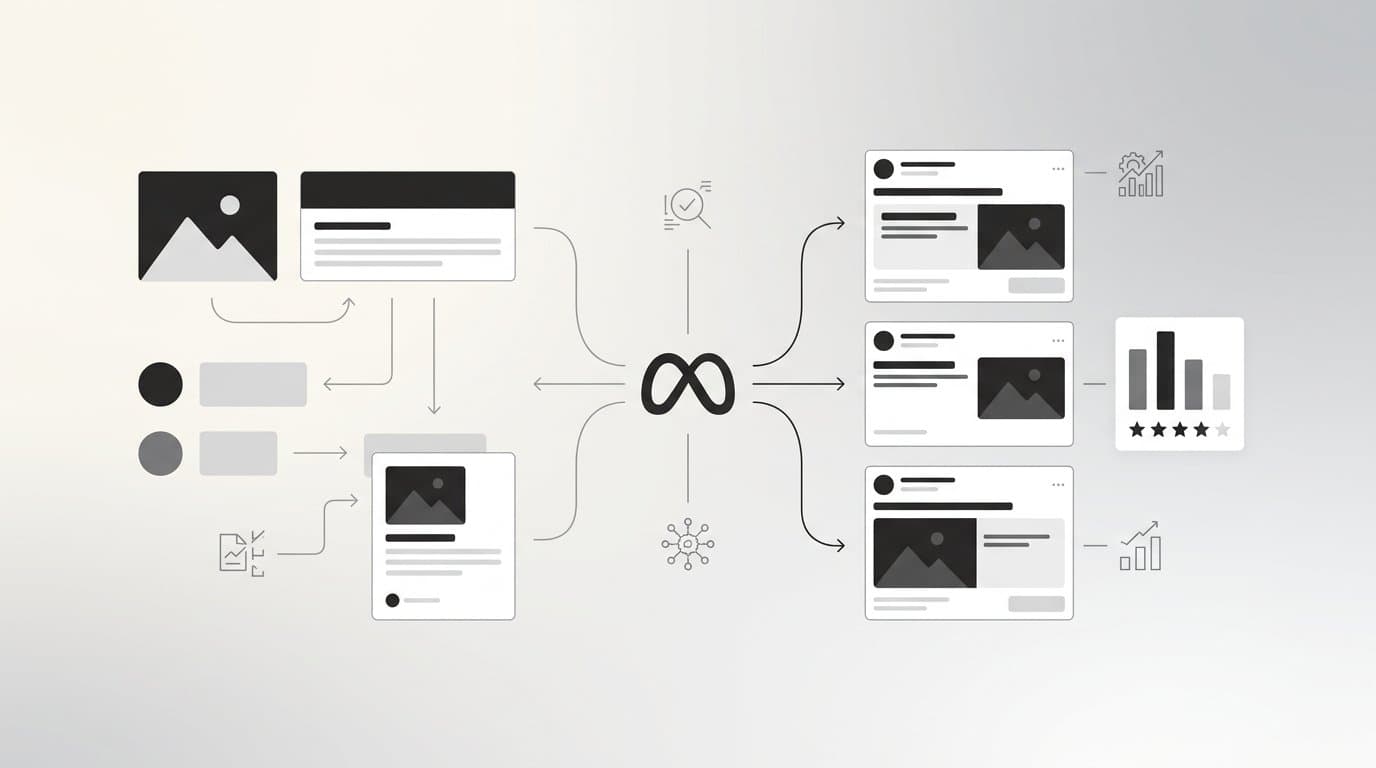
Platforms like AdStellar now handle creative generation, campaign building, and performance analysis in one place. You can generate video ads, UGC-style avatar content, and image ads directly from a product URL. You can clone competitor ads from the Meta Ad Library for creative intelligence. You can refine any creative through chat-based editing without going back to a designer. The AI Campaign Builder analyzes your past campaigns, ranks every creative, headline, and audience by performance, and builds complete Meta campaigns with full transparency into the reasoning behind each decision.
The quality bar for AI-generated video creative on Meta placements is now genuinely viable for direct response campaigns. UGC-style formats, in particular, translate well to AI generation because the aesthetic is intentionally authentic rather than polished. The result is creative volume that would previously have required a full production team, generated in a fraction of the time.
On the optimization side, AI Insights leaderboards rank your creatives, headlines, copy, audiences, and landing pages by real metrics including ROAS, CPA, and CTR, scored against your own performance benchmarks. The Winners Hub consolidates your top performers so you can instantly pull winning elements into your next campaign rather than hunting through old ad sets. The manual spreadsheet review cycle that used to eat hours of a media buyer's week is replaced by a real-time performance layer that surfaces what matters and flags what does not.
This is not about replacing strategic thinking. It is about removing the operational drag that slows down the strategic decisions you need to make quickly.
Putting It All Together
Video ad creative strategy is a system, not a single insight. It starts with understanding why most video ads fail: the scroll-stop problem, the strategy-versus-production gap, and the cost of running without a repeatable framework. It builds through clear structure, where hook, body, and CTA each carry a defined job, and through message-to-audience fit that ensures the right video reaches the right viewer at the right funnel stage.
Creative angles give you the strategic vocabulary to frame your product in ways that resonate: problem-solve, social proof, demonstration, curiosity, direct offer. Testing gives you the methodology to find what actually works for your specific audience rather than guessing based on industry averages. Scaling winners and killing losers with discipline, built on predefined benchmarks and a refresh cadence that anticipates fatigue, keeps performance compounding rather than declining.
And AI-powered tools are making this entire system faster, more accessible, and more scalable than it has ever been, removing the production and operational bottlenecks that used to slow down even the most capable teams.
The performance marketers who win on Meta video are not the ones with the biggest production budgets. They are the ones with the clearest strategy, the fastest iteration cycles, and the discipline to let data drive their decisions.
If you want to build that kind of operation without hiring a 10-person creative team, Start Free Trial With AdStellar and be among the first to launch and scale your ad campaigns faster with a platform that generates winning video creatives, builds and tests campaigns automatically, and surfaces your top performers in real time. One platform, from creative to conversion.