Most video ad production workflows are broken before they begin. Marketers spend days coordinating with designers, waiting on revisions, briefing video editors, and then launching a single ad that may not even perform. By the time results come in, the budget is gone and the cycle starts over.
This is not a production problem. It is a systems problem.
This guide walks you through a modern video ad production workflow built specifically for performance marketers running Meta campaigns. You will learn how to move from concept to live campaign without the traditional bottlenecks, covering everything from defining your creative strategy and scripting your video concept to building multiple variations, launching to Meta, and identifying your winners fast.
Whether you are a solo media buyer, a small marketing team, or a growing brand scaling its ad spend, this workflow is designed to help you produce more video ads in less time while generating better data on what actually converts.
The traditional approach of briefing, production, review, and export is being replaced by AI-driven systems that compress timelines from weeks to minutes. This guide reflects that shift, showing you how to use tools like AdStellar to generate video ads, launch complete campaigns, and surface top performers without needing a production team behind you.
By the end of these seven steps, you will have a repeatable, scalable process that feeds your Meta campaigns with fresh creatives consistently, keeps your testing pipeline full, and gives you real performance data to make smarter creative decisions over time.
Step 1: Define Your Creative Brief Before Touching Any Tool
The single biggest time-waster in any video ad production workflow is starting without a clear brief. You end up producing something that looks polished but misses the message entirely, and then you spend hours in revision cycles trying to fix what a ten-minute planning session would have prevented.
Start with your campaign goal. Awareness, traffic, conversions, and retargeting each require a different approach to video length, format, and messaging. A retargeting video can assume the viewer already knows your brand and focus on overcoming objections. A cold audience video needs to earn attention from scratch and establish context quickly. These are fundamentally different creative briefs, and treating them the same is a common mistake.
Next, get specific about your audience segment. Not your general customer profile, but the specific person this ad is for. What do they already believe? What objection are they most likely to have? What outcome are they hoping for? The more precisely you can answer these questions, the more targeted your video will feel to the people watching it.
Write a single sentence that captures what the video must communicate. This becomes your anchor. Every creative decision that follows, from the hook to the CTA, should serve this one sentence. If a creative choice does not support it, cut it.
Then decide on your primary format. The three main options for Meta video ads are:
Standard video: Produced or animated content that presents your product or brand in a polished, brand-consistent way. Works well for awareness and consideration campaigns.
UGC-style: Conversational, camera-forward content that mimics organic creator posts. Performs strongly for direct response because it blends into the feed and feels less like an ad.
Product-focused: Demos, before-and-after sequences, or feature walkthroughs. Effective for conversion campaigns where the viewer needs to understand what they are buying.
Each format serves a different purpose and performs differently depending on your audience temperature and campaign objective. Choose based on your goal, not based on what looks most impressive.
Success indicator: You can describe the video in one sentence, name exactly who it is for, and state the single action you want them to take. If you cannot do all three, the brief is not finished.
Step 2: Research Competitor Ads and Winning Creative Patterns
Before you write a single line of script, spend time in the Meta Ad Library. This is a publicly available tool from Meta that lets you search any brand or keyword and see their active ads, including video ads. It is one of the most underused research resources available to performance marketers.
Search for your direct competitors first, then expand to adjacent brands targeting similar audiences. Filter by active ads and pay particular attention to video ads that have been running for more than two weeks. Longevity in a paid environment is a signal. If a brand is still spending behind a creative weeks after launch, it is likely performing well enough to justify the continued budget.
As you review these ads, look for patterns across four dimensions:
Hook style: How does the video open? Is it a bold statement, a relatable question, a surprising visual, or a person speaking directly to camera? Note which approach appears most frequently across your category.
Text overlay placement: Where does the key message appear on screen? How much text is used? Is the value proposition front-loaded or revealed gradually?
CTA phrasing: What action are they asking for and how are they framing it? "Shop now" feels different from "Get yours today" or "See how it works." Small phrasing differences can reflect significant testing learnings.
Emotional tone: Is the dominant emotional driver urgency, curiosity, social proof, or transformation? The tone that dominates your category is often the tone your audience is most responsive to.
AdStellar allows you to clone competitor ad structures directly from the Meta Ad Library, giving you a starting point rather than a blank canvas. This is particularly useful when you want to test a proven format before investing time in developing something entirely original.
Document two to three creative angles you want to test based on your research. These become the basis for your video variations in Step 4. The goal is not to copy competitors but to understand the creative language that already resonates with your shared audience, then find ways to differentiate within that language.
Success indicator: You have a reference folder of three to five competitor video ads and a documented list of creative patterns you want to test or deliberately differentiate from.
Step 3: Script and Structure Your Video Concept
With your brief locked and your research done, it is time to structure your video. For direct response video ads on Meta, the hook-problem-solution-proof-CTA framework is the most reliable structure available. Each section has a specific job and a specific time budget.
Hook (0 to 3 seconds): Your only job here is to stop the scroll. Use a bold visual, a surprising statement, or a pain point your audience immediately recognizes. This is the most important three seconds of the entire video. Everything else depends on whether the viewer keeps watching. Write at least three different hook options for each video concept, because the hook is also the highest-leverage variable to test.
Problem and solution (3 to 15 seconds): State the problem your audience recognizes, then introduce your product or service as the answer. Keep this specific. Generic problem statements ("tired of wasting time?") are easy to scroll past. Specific ones ("spending three hours a day manually checking ad performance?") create a moment of recognition that holds attention.
Proof and CTA (15 to 30 seconds): Add a credibility element. This could be a result reference, a product demonstration, a before-and-after sequence, or a testimonial framing. Then close with a direct, specific call to action. Tell the viewer exactly what to do next and why doing it now matters.
For UGC-style video ads, the script should sound conversational rather than polished. Write it the way someone would actually speak, with natural pauses, informal language, and a first-person perspective. Brand voice documents are useful for many things, but they will make your UGC script sound like an ad, which defeats the purpose.
Plan for sound-off viewing from the start. A significant share of Meta video views happen without audio, which means every key message needs to be communicable through text overlays alone. Do not treat text overlays as an afterthought. Script them alongside your spoken content as a parallel communication layer.
Keep your total script within your target video length. For most direct response Meta video ads, thirty seconds is a reasonable upper limit for cold audiences. Retargeting videos can run longer because the viewer already has context.
Success indicator: Your script fits within your target length, communicates the value proposition from Step 1, and works with or without sound as a standalone viewing experience.
Step 4: Generate Multiple Video Ad Variations with AI
Here is where the modern video ad production workflow fundamentally separates from the traditional one. Instead of producing one video and hoping it performs, you build multiple variations from the start. This is not optional if you want meaningful test data. It is the foundation of the entire approach.
The reason is straightforward. A single video ad gives you a single data point. You learn whether that specific combination of hook, message, format, and CTA worked for that specific audience at that specific time. Multiple variations give you comparative data, which is the only kind of data that actually tells you why something worked.
Using a platform like AdStellar, you can generate video ads and UGC-style avatar content directly from a product URL or a creative brief, without needing video editors or on-camera talent. The AI builds the creative based on your inputs, and you refine it through chat-based editing rather than briefing a designer and waiting for a revision cycle.
Build your variations across three dimensions to maximize the data value of your test:
Hook style: Use the different hook options you wrote in Step 3. A bold statement hook and a question-based hook for the same product will often perform very differently with the same audience. This is your highest-leverage test variable.
Format: Run a standard video variation alongside a UGC-style variation. Format affects how native the ad feels in the feed, and different audience segments respond differently to each.
Messaging angle: Test benefit-led messaging ("here is what you get") against problem-led messaging ("here is what you are dealing with") against social proof-led messaging ("here is what others experienced"). These represent genuinely different creative strategies, not cosmetic differences.
AdStellar's chat-based editing lets you refine any video without starting over. Change the headline, swap the CTA, or adjust the tone in seconds. This makes iteration fast enough to actually happen, rather than becoming the kind of task that gets deprioritized because of how long it takes.
Aim for a minimum of three to five distinct video variations per campaign. The common pitfall here is producing variations that are too similar, changing only the color or font rather than the hook and the message. Cosmetic differences do not generate meaningful test data. Structural differences do.
Success indicator: You have at least three video ads that represent genuinely different creative angles, all aligned to the brief from Step 1, ready to upload and launch.
Step 5: Build and Launch Your Meta Campaign with AI
With your video variations ready, the next step is building the campaign structure that will test them efficiently on Meta. This is where setup decisions directly affect the quality of data you collect, so it is worth getting right before you spend a dollar.
AdStellar's AI Campaign Builder analyzes your past campaign data, ranks your creatives and audiences by historical performance, and builds a complete Meta campaign structure in minutes. Every decision is explained so you understand the strategy behind the setup, not just the output. This transparency matters because it helps you learn what is working and why, rather than treating the AI as a black box.
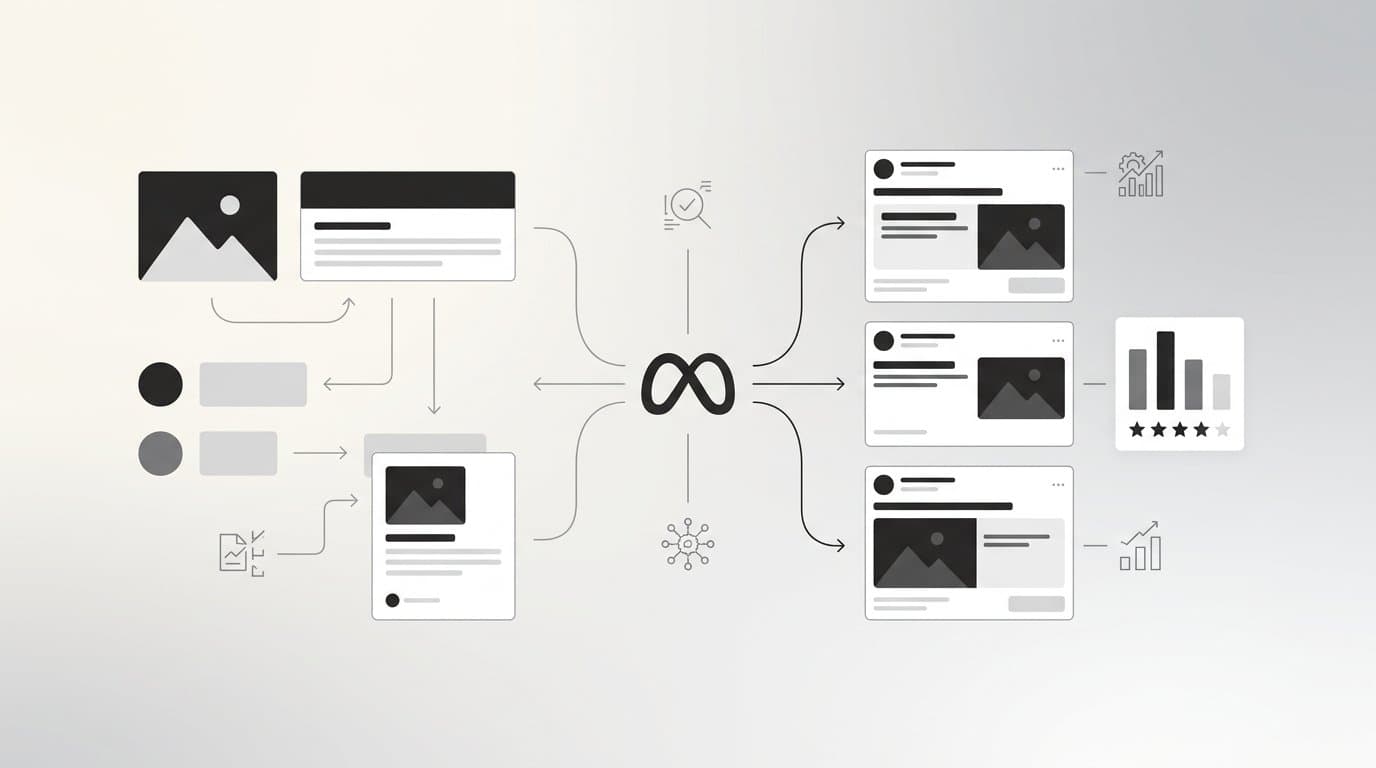
Use AdStellar's Bulk Ad Launch to create hundreds of ad combinations by mixing your video creatives with multiple headlines, ad copy variations, and audience sets at both the ad set and ad level. What would take hours to set up manually takes minutes with bulk launch. AdStellar generates every combination and pushes them to Meta directly.
Before you hit launch, verify a few critical setup elements:
Conversion tracking: Your Meta pixel needs to be firing correctly and recording the conversion event that matches your campaign objective. If you are running a conversion campaign and your pixel is not confirmed active, you are flying blind from day one.
Campaign objective alignment: Your campaign objective in Ads Manager must match the goal you defined in Step 1. A traffic objective optimizes for clicks. A conversion objective optimizes for purchases or leads. These are different optimization signals and will deliver your ads to different people.
Budget allocation: Give each creative variation enough budget to generate statistically meaningful data before making optimization decisions. The common pitfall is launching too many variations with too little budget spread across them, which means no single variation gets enough impressions to tell you anything useful. If budget is limited, consolidate to your strongest three to five variations rather than spreading thin across ten.
Success indicator: Your campaign is live on Meta with multiple video ad variations running, conversion tracking is confirmed active, and your campaign structure matches the testing goals you set in your brief.
Step 6: Monitor Performance and Surface Your Winners
Launching is not the finish line. The workflow continues in the monitoring phase, and this is where most performance marketers either win or waste their budget.
The first rule is patience at the start. Give your campaign enough time to exit Meta's learning phase before drawing conclusions. Meta's published guidance references a minimum of fifty optimization events per ad set per week as the threshold for exiting the learning phase. Making major changes before that point resets the learning phase and costs you time and data.
Once you have meaningful data, use AdStellar's AI Insights leaderboards to rank your video creatives by the metrics that matter most to your specific goal. ROAS, CPA, and CTR are the primary signals, but the right priority depends on your campaign objective. Set your target benchmarks in AdStellar and the AI scores every creative against them automatically, so you are not manually sorting through data to find your winners.
Pay particular attention to hook rate, which is the percentage of viewers who continue watching past the first three seconds. Hook rate is a leading indicator of video ad quality that is separate from conversion performance. A high hook rate with weak conversion typically points to a messaging or landing page issue rather than a creative one. A low hook rate with decent conversion suggests the ad is reaching a highly qualified audience but losing too many people at the top of the funnel.
AdStellar's Winners Hub consolidates your top-performing creatives, headlines, audiences, and more in one place with real performance data attached. When you are ready to launch your next campaign, you can select any winner and add it directly without rebuilding from scratch. This is what makes the workflow compounding rather than repetitive.
Pause underperformers early and reallocate budget to your proven winners. This is the core optimization loop. It sounds simple because it is, but it requires the discipline to act on data rather than on attachment to a creative you worked hard to produce.
Success indicator: You can clearly identify which video variation is your top performer and why, based on real metrics rather than gut feeling, and you have reallocated budget accordingly.
Step 7: Systematize and Repeat with Compounding Data
A one-time workflow is useful. A repeatable system is where the real advantage builds over time.
After each campaign cycle, document what worked. Which hook style drove the strongest hook rate? Which messaging angle produced the best CPA? Which format outperformed for which audience segment? This documentation becomes your creative playbook, and it is more valuable than any single campaign result because it informs everything you produce going forward.
Feed your winners back into AdStellar's AI Campaign Builder. The system gets smarter with every campaign you run, using your historical performance data to make better recommendations over time. Each cycle gives the AI more signal to work with, which means your starting point for the next campaign is already better than it was for the last one.
Plan your next creative cycle before your current campaign begins to fatigue. Video ads on Meta typically see performance decline after several weeks of consistent exposure to the same audience. This is a well-documented pattern in paid social advertising. Fresh creatives prevent this decline from eroding your results before you have a chance to respond. The goal is to have your next batch of variations ready before you need them, not after performance has already dropped.
Use your Winners Hub data to brief your next round of video variations. Start from what is proven, then test new angles against your control creative. This approach gives you a reliable baseline while still generating new learning with every cycle.
The compounding effect is real. Each campaign cycle gives you more data, better benchmarks, and a stronger creative playbook. Teams that run this workflow consistently, treating each campaign as a learning event rather than a standalone project, build a meaningful and durable advantage over those who start from scratch every time.
Success indicator: You have a documented creative playbook, a scheduled timeline for your next creative cycle, and a clear understanding of your top-performing creative patterns going into the next round.
Putting It All Together
A strong video ad production workflow is not about having the biggest production budget or the largest creative team. It is about having a repeatable system that moves from brief to live campaign quickly, tests multiple variations simultaneously, and learns from every result.
The seven steps in this guide give you that system. Start with a clear brief. Research what is already working in your category. Script for the feed, including sound-off viewing. Generate multiple variations with AI. Launch with a structure built for testing. Identify your winners fast. Feed those learnings back into your next cycle.
Platforms like AdStellar compress the most time-intensive parts of this workflow into minutes, from generating video ads and UGC-style creatives to building complete Meta campaigns and surfacing top performers automatically. The result is a production workflow that scales with your ambition rather than with your headcount.
If you are ready to build your first AI-generated video ad campaign and run this workflow end to end, Start Free Trial With AdStellar and be among the first to launch and scale your ad campaigns faster with an intelligent platform that automatically builds and tests winning ads based on real performance data.