Video ads dominate Meta placements right now, and for good reason. They stop thumbs, communicate quickly, and can drive action in a way that static images often cannot. But here is the problem most marketers run into: they spend hours building video creatives from scratch, launch them with optimism, and watch performance fall flat within days.
The fix is not a bigger production budget or more hours in the editing suite. It is a smarter approach to how you structure, test, and scale your video ad templates.
A well-built template is not just a time-saver. It is a repeatable system for producing creatives that follow proven conversion frameworks, stay on-brand, and can be iterated quickly when performance data comes in. Think of it like a recipe rather than a one-off meal. The ingredients change based on the audience and offer, but the underlying structure does the heavy lifting every time.
This article breaks down seven practical strategies for getting more out of your video ad templates, whether you are running campaigns for a DTC brand, a SaaS product, or a local business. Each strategy covers not just what to do, but why it works and how to implement it inside your existing workflow.
If you are tired of the cycle of building, guessing, and hoping, these strategies will help you move toward a more systematic, data-informed approach to video ad production.
1. Lead With a Hook Template, Not a Brand Template
The Challenge It Solves
Most marketers instinctively open their video ads with a logo animation or a branded title card. It feels professional. It feels right. But on Meta feeds, where content from friends, creators, and brands all compete for the same eyeballs, a branded intro is often the fastest way to lose a viewer. Most people decide within the first few seconds whether to keep watching or scroll past. A logo does not give them a reason to stay.
The Strategy Explained
Structure your video ad templates so the hook is a modular, swappable element rather than a fixed branded intro. This means the very first frame of your ad should be designed to create curiosity, provoke a reaction, or immediately signal relevance to the viewer.
There are four hook types worth building into your template library. A question hook speaks directly to a pain point or desire: "Still paying too much for ads that don't convert?" A bold claim hook leads with a surprising or counterintuitive statement that demands attention. A visual disruption hook uses an unexpected image, movement, or color contrast to interrupt the scroll pattern. A social proof hook opens with a result or testimonial that immediately establishes credibility.
By making the hook a swappable module, you can test multiple openers against the same underlying creative without rebuilding everything from scratch.
Implementation Steps
1. Audit your existing video ads and identify where the hook currently begins. If it starts after a logo or intro sequence, that is your first fix.
2. Build four hook variants using the types listed above and attach them to the same base creative.
3. Launch all four as separate ad variations and let performance data tell you which hook style resonates most with your audience.
4. Promote the winning hook type to your default template structure for future campaigns.
Pro Tips
Keep your hook under three seconds. If you are using text overlays, make sure they appear immediately, not after a visual transition. The goal is to give the algorithm and the viewer a reason to keep watching before they even realize they are watching an ad. Tools like AdStellar's AI Ad Creative let you generate multiple hook variations from a single product URL, so you are not manually building each variant from scratch.
2. Use the Problem-Agitate-Solve Structure as Your Core Framework
The Challenge It Solves
Without a clear narrative structure, video ads tend to meander. They show the product, say it is great, and end with a generic call to action. This approach rarely moves cold audiences because it skips the most important step: making the viewer feel understood before presenting a solution. When someone does not feel the problem being described, they have no emotional reason to care about the solution.
The Strategy Explained
The Problem-Agitate-Solve (PAS) framework is a foundational direct response copywriting structure with roots in traditional direct mail advertising. Applied to video ad templates, it maps each phase to a specific time segment within the creative.
The Problem phase occupies roughly the first third of the ad. This is where you name the pain point clearly and directly. The viewer should immediately recognize themselves in the scenario being described. The Agitate phase deepens the emotional weight of that problem. You are not twisting the knife cruelly; you are helping the viewer feel why this problem matters and what it costs them in time, money, or frustration. The Solve phase introduces your product or service as the logical resolution. By this point, the viewer is primed to receive it.
For cold audiences, keep the problem and agitate phases relatable and broad. For retargeting audiences who already know your brand, you can compress the problem phase and spend more time on the solution and proof.
Implementation Steps
1. Write a one-sentence version of each PAS phase before scripting any visuals.
2. Map your script to three time blocks: problem (seconds 0-5), agitate (seconds 5-12), solve (seconds 12-30 for short-form).
3. Align your visuals to each phase. Problem visuals should feel relatable and slightly uncomfortable. Agitate visuals can intensify that feeling. Solve visuals should feel clean, aspirational, and confident.
4. Build a retargeting variant that starts at the agitate or solve phase to avoid repetition for warm audiences.
Pro Tips
The PAS framework works because it mirrors how people naturally make decisions. They feel a problem, they feel it more acutely when they understand its cost, and then they look for relief. Your template should guide them through that emotional arc, not just describe your product's features.
3. Build Audience-Specific Template Variants, Not One-Size-Fits-All Creatives
The Challenge It Solves
Running the same video ad to cold audiences, warm audiences, and past purchasers is one of the most common efficiency leaks in Meta campaigns. Cold audiences need context and credibility. Warm audiences need a reason to convert now. Retargeting audiences need a different angle entirely, often one that addresses objections or reinforces urgency. A single creative cannot do all three jobs well.
The Strategy Explained
The key is understanding the difference between a template and a variant. A template is the master structure: the aspect ratio, the general flow, the brand elements, the duration. A variant is a version of that template adapted for a specific audience stage by changing specific modular elements.
For a cold audience variant, prioritize the hook and problem phases. Lead with something that creates immediate recognition of a pain point, and invest more time in building credibility before presenting the offer. For a warm audience variant, compress the problem setup and move faster to the solution and proof. Social proof elements like testimonials or results work particularly well here. For a retargeting variant, consider addressing the most common objections directly. Why didn't they convert the first time? Price? Trust? Timing? Build that conversation into the creative.
The elements that typically stay consistent across variants include brand colors, logo placement, overall visual style, and CTA format. The elements that change include the hook, the opening voiceover or text, the emphasis within the narrative, and sometimes the offer itself.
Implementation Steps
1. Define your three audience tiers: cold, warm, and retargeting.
2. List the five to seven core elements in your base template.
3. For each audience tier, identify which elements need to change and which stay fixed.
4. Build each variant by swapping only those elements, keeping everything else identical to maintain brand consistency.
Pro Tips
Audiences exposed to the same creative repeatedly tend to disengage over time. Building audience-specific variants also helps manage creative fatigue by ensuring each segment sees messaging calibrated to where they are in the buying journey, rather than the same ad on repeat.
4. Design Templates Around Meta Placement Specs First
The Challenge It Solves
Building a video ad in the wrong format and then trying to adapt it for different placements is one of the most avoidable production headaches in paid social. Text gets cropped. Faces get cut off. Key visual elements disappear behind interface elements. Starting from placement specs means your template is built to perform in the actual environment where it will be seen, not just in a preview window.
The Strategy Explained
Meta publishes official placement specifications for all major ad surfaces. According to Meta's platform guidance, Reels use a 9:16 aspect ratio and support up to 90 seconds. Stories also use 9:16 and support up to 60 seconds. Feed placements recommend a 4:5 aspect ratio for most video formats, also up to 60 seconds for standard placements.
The practical implication is that your primary template should be built at 9:16 first. This vertical format covers Reels and Stories, which are among the highest-engagement placements on the platform. From a 9:16 master, you can crop and adapt for 4:5 Feed and 1:1 formats without losing critical visual information, as long as you have designed with safe zones in mind from the start.
Safe zones are the areas of the frame that remain visible across all placements without being obscured by interface elements like profile icons, captions, or action buttons. On Reels and Stories, the bottom portion of the frame is often covered by these elements. Any text, logos, or critical visuals placed in those zones will be hidden in real-world delivery.
Implementation Steps
1. Set your master template canvas to 1080x1920 pixels (9:16) before any creative work begins.
2. Map out safe zones: keep critical text and visuals within the central 80% of the frame vertically, avoiding the top 10% and bottom 20%.
3. Build your 4:5 Feed variant by cropping the 9:16 master, ensuring no key elements are lost.
4. Test your template in Meta's ad preview tool before launch to confirm safe zone compliance across placements.
Pro Tips
Text overlays are powerful in vertical video because many viewers watch without sound. Keep text concise, high-contrast, and positioned within safe zones. If your template relies heavily on on-screen text, test a version with captions auto-generated for accessibility and engagement in sound-off environments.
5. Treat Your CTA as a Testable Template Element, Not an Afterthought
The Challenge It Solves
Most video ad templates treat the call to action as a fixed final frame: "Shop Now" appears at the end, and that's that. But the CTA is one of the highest-leverage elements in any direct response creative. The phrasing, timing, visual treatment, and placement of your CTA can meaningfully affect whether a viewer takes action or exits. Locking it in as a static element means you are leaving a major optimization lever untouched.
The Strategy Explained
Build CTA variations directly into your template system so they can be swapped and tested independently of the rest of the creative. This means designing your template with a clearly defined CTA zone, a visual container or end card that can accept different text, button styles, and messaging without requiring a full rebuild.
Different campaign objectives call for different CTA formats. Awareness campaigns benefit from softer CTAs: "Learn More," "See How It Works," or "Watch the Full Story." Consideration campaigns can use directional CTAs: "Get Your Free Trial," "Book a Demo," or "See Pricing." Conversion campaigns need urgency-driven CTAs: "Shop Now," "Claim Your Offer," or "Start Today."
Beyond phrasing, test CTA placement within the video itself. An early CTA at the ten-second mark can capture intent from viewers who are already sold. A mid-video CTA can reinforce the message at the peak of the agitate phase. An end-card CTA captures viewers who watched through. Some high-performing video ad structures include all three, layered into the creative at different points.
Implementation Steps
1. Build a reusable CTA library with at least three variants per campaign objective: soft, directional, and urgent.
2. Design your template end card as a modular zone that accepts different CTA text without layout changes.
3. Test one CTA variable at a time against a control to isolate the impact of phrasing versus placement.
4. Log winning CTAs in a reference document organized by objective and audience type for future campaigns.
Pro Tips
Align your on-screen CTA text with the button text in your Meta ad setup. Inconsistency between the two creates a subtle friction that can reduce click-through. Consistency signals clarity, and clarity drives action.
6. Clone and Iterate From Winning Competitors Using the Meta Ad Library
The Challenge It Solves
Starting a new template from a blank canvas is inefficient when there is a publicly available database of what is actually running in your market right now. Many marketers either do not know the Meta Ad Library exists or do not know how to extract useful structural insights from it. The result is that they build templates based on gut instinct rather than observable market evidence.
The Strategy Explained
The Meta Ad Library is a real, publicly available tool from Meta that allows anyone to search active and inactive ads across the platform. It is a legitimate competitive research source, and it is free. The goal is not to copy competitor ads. The goal is to reverse-engineer the structural decisions that appear in ads that have been running for a long time, because longevity in a paid ad often signals performance.
When analyzing competitor video ads in the library, look for patterns across these dimensions. Pacing: how quickly does the video cut between scenes? Fast cuts often signal performance-focused direct response. Slower pacing may indicate brand-building objectives. Hook style: does the ad open with a person speaking to camera, a text overlay, a product demonstration, or a lifestyle scene? CTA placement: does the CTA appear early, mid-video, or only at the end? Visual treatment: is the aesthetic polished and produced, or raw and UGC-style? Each of these observations becomes a testable hypothesis for your own template.
Tools like AdStellar can directly clone competitor ads from the Meta Ad Library and use them as a starting point for generating your own AI-powered video creatives, which dramatically compresses the time between observation and execution.
Implementation Steps
1. Search the Meta Ad Library for your top three to five competitors and filter for video ads.
2. Identify ads that appear to have been running for several weeks or longer, as these are more likely to be performing.
3. Document the structural patterns you observe: hook type, pacing, CTA placement, visual style, and duration.
4. Translate each observation into a testable template hypothesis: "What if we open with a person-to-camera hook instead of a product shot?"
5. Build and test those hypotheses against your current control creative.
Pro Tips
Do not just look at direct competitors. Look at adjacent categories that share your target audience. A brand selling productivity software and a brand selling fitness supplements may share the same audience of ambitious professionals. Their creative strategies can cross-pollinate in surprisingly effective ways.
7. Build a Testing Matrix Into Every Template From Day One
The Challenge It Solves
Most marketers test reactively. An ad underperforms, so they change something and relaunch. But without a structured testing plan, it is impossible to know which change actually moved the needle. You end up with a collection of creative decisions that feel right but have no systematic evidence behind them. Over time, this leads to a creative process driven by opinion rather than data.
The Strategy Explained
Embedding a testing matrix into your template from the start means deciding in advance which variables you will test, in what order, and against what baseline. This transforms your template from a static asset into a learning system.
The general best practice in structured testing is to isolate one variable at a time for clean data. If you change the hook and the CTA simultaneously, you cannot determine which change drove the result. Start with the highest-leverage variable, which is almost always the hook, since it determines whether anyone watches the rest of the ad at all.
A basic testing sequence for a new video ad template might look like this: first, test hook variants against a fixed body and CTA. Once a winning hook is established, lock it in and test CTA variants. Once a winning CTA is identified, test audience variants using the same creative. This sequential approach builds a compounding body of evidence rather than a pile of inconclusive experiments.
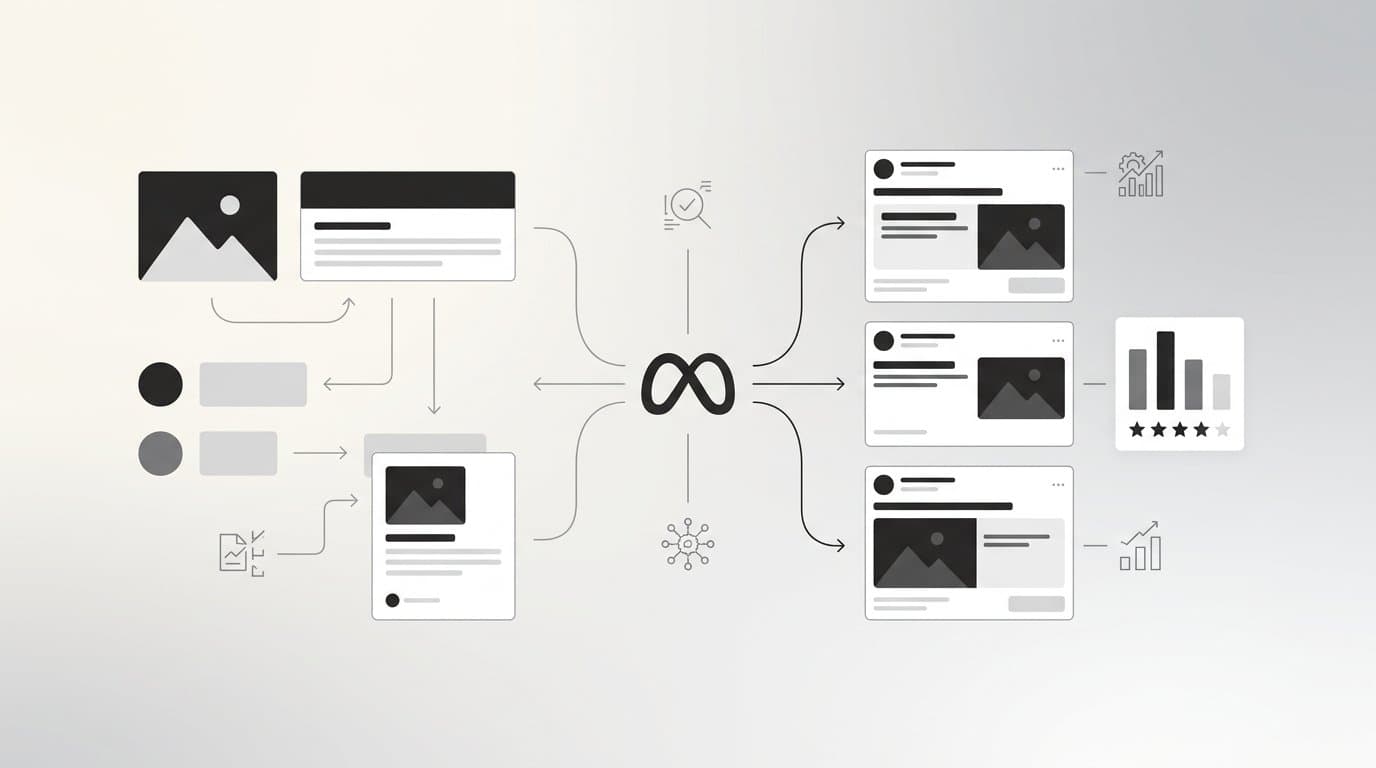
For teams running higher ad volume, multivariate testing allows you to test multiple variables simultaneously across a larger audience pool. AdStellar's Bulk Ad Launch feature can generate hundreds of ad variations by mixing creatives, headlines, audiences, and copy, then launch them all to Meta in minutes rather than hours. The AI Insights feature then ranks every combination by real metrics like ROAS, CPA, and CTR so you can identify winners without manually sifting through data. If you want to go deeper on multivariate testing methodology, check out AdStellar's guide on multivariate testing for a structured framework you can apply directly to your campaigns.
Implementation Steps
1. Before launching any new template, list the five elements you want to test: hook, CTA, duration, pacing, and offer framing are a good starting set.
2. Rank them by expected impact and start with the highest-leverage variable.
3. Define your success metric before the test begins: ROAS, CPA, CTR, or video completion rate depending on your objective.
4. Set a minimum spend threshold before calling a winner to ensure statistical reliability.
5. Document results in a shared winners log and use them to inform the next iteration of your template.
Pro Tips
Your Winners Hub is only as useful as the documentation behind it. When you record a winning creative, note which variable was tested, what the control was, and what metric improved. This context turns individual results into a reusable knowledge base that makes every future campaign smarter than the last.
Putting It All Together
Strong video ad templates are not static assets. They are living frameworks that get sharper with every test cycle. The marketers who consistently outperform on Meta are not the ones with the biggest production budgets. They are the ones with the tightest systems.
If you are starting from scratch, here is a prioritized implementation path. Start by auditing your current creative process and identifying where the most time and budget is being lost. Then apply these strategies in order of impact: nail your hook structure first, build your PAS framework second, and layer in audience variants and testing matrices as your volume scales.
The sequence matters because each strategy builds on the one before it. A well-structured hook makes your PAS framework more effective. A strong PAS framework makes audience variants easier to adapt. And a systematic testing matrix makes all of it continuously better over time.
If you want to accelerate this entire process, AdStellar is built specifically for this workflow. It generates video ad creatives from a product URL, clones competitor ads from the Meta Ad Library, tests combinations automatically through Bulk Ad Launch, and surfaces your top performers through AI Insights and Winners Hub so you can double down on what is working without the manual guesswork.
The creative process does not have to be a cycle of building, guessing, and hoping. With the right template strategies and the right tools, it becomes a system. And systems scale in ways that gut instinct never can. Start Free Trial With AdStellar and be among the first to launch and scale your ad campaigns faster with an intelligent platform that automatically builds and tests winning ads based on real performance data.